Recognition: no theorem link
A Major Geomagnetic Storm in 2024 October Linked to Sympathetic CME--Prominence Eruptions
Pith reviewed 2026-05-10 18:30 UTC · model grok-4.3
The pith
Enhanced southward magnetic fields from CME compression drove the major 2024 October geomagnetic storm.
A machine-rendered reading of the paper's core claim, the machinery that carries it, and where it could break.
Core claim
A sympathetic eruption produced two overlapping CMEs whose interaction compressed southward magnetic fields, making those enhanced fields the primary cause of the major geomagnetic storm rather than the original solar magnetic structures alone.
What carries the argument
Sympathetic eruption of a filament and active-region CME that created two distinct but interacting structures, with compression during their overlap enhancing the southward component of the magnetic field.
If this is right
- The trailing CME retained flux-rope signatures that match the photospheric source region fields.
- The leading CME showed distorted and inconsistent magnetic configurations between Wind and STEREO-A observations.
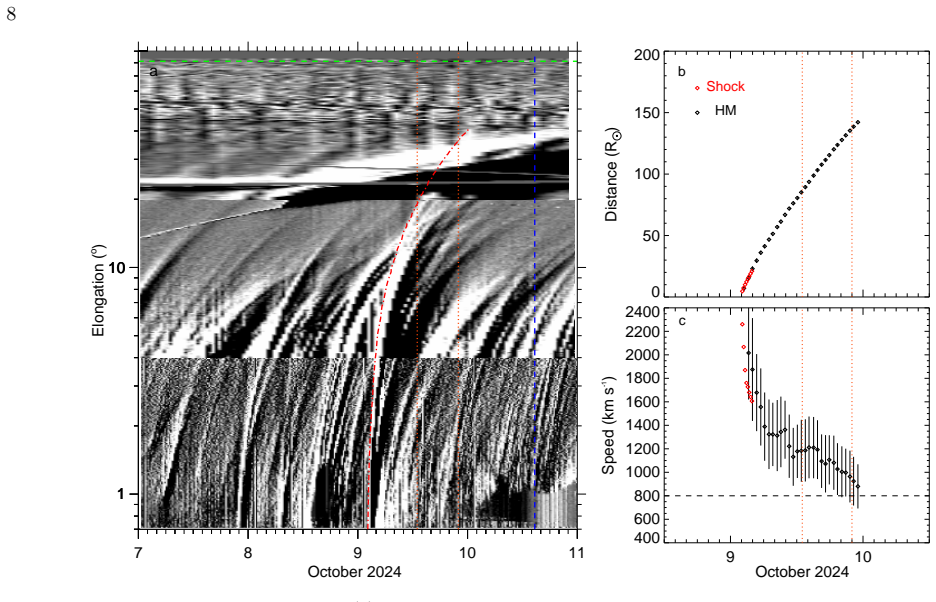
- Both CMEs completed impulsive acceleration before the coronagraph field of view and decelerated slowly beyond 100 solar radii.
- Direct mapping from solar magnetic configurations to in-situ measurements remains tentative and needs additional study.
Where Pith is reading between the lines
- Multipoint in-situ data may help separate compression effects from original solar structures in future events.
- Space weather models could gain accuracy by explicitly including interaction-driven compression of the magnetic field.
- Similar sympathetic eruptions may explain many other major storms when single-CME models fall short.
Load-bearing premise
The two CMEs originated from one connected sympathetic eruption event and their in-situ magnetic signatures can be traced back to the solar source regions without major mixing or evolution en route.
What would settle it
Detection of separate, unconnected source regions for the two CMEs or the absence of measurable compression-induced increase in southward field strength at Earth would undermine the claimed driver.
Figures




read the original abstract
Improving predictions of the geomagnetic impact of coronal mass ejections (CMEs) requires understanding how solar source properties relate to in-situ measurements at Earth. However, major geomagnetic storms frequently arise from interacting CMEs, complicating the link back to their solar origins. We analyze a CME interaction event that caused a major geomagnetic storm in 2024 October 10-11 (D$_{st}$ $\sim$-333 nT). Multiviewpoint observations reveal that the storm was related to a sympathetic eruption involving a quiescent filament and an active-region CME. The coronagraph on board the Advanced Space-based Solar Observatory clearly shows that this sympathetic eruption resulted in two distinct CMEs. Due to the overlap of the CMEs in the coronagraph field of view (FOV), a spheroid shock model was used to fit the observed shock. Kinematic analysis indicates that the interacting CMEs had completed their impulsive acceleration phase before entering the coronagraph FOV, with a slow deceleration continuing beyond 100 R$_\odot$. In-situ measurements indicate that the enhanced southward magnetic fields, arising from compression during CME interactions, were the primary driver of the storm. Compared to photospheric fields, the in-situ magnetic fields suggest that the trailing CME maintained flux-rope-like signatures consistent with the source region. In contrast, the compressed leading CME displayed varying magnetic configurations between Wind and STEREO-A, featuring distorted flux-rope signatures and inconsistent inferred axis orientations. Our study bridges solar source dynamics to in-situ multipoint measurements, providing key insights for space weather prediction. Nevertheless, the direct linkage between source-region magnetic field configurations and these measurements remains tentative and requires further investigation.
Editorial analysis
A structured set of objections, weighed in public.
Referee Report
Summary. The paper analyzes a 2024 October sympathetic eruption involving a quiescent filament and active-region CME that produced two distinct CMEs and drove a major geomagnetic storm (Dst ~ -333 nT). Multiviewpoint coronagraph data (including ASO-S) and a spheroid shock model are used to track the kinematics, showing that the CMEs had completed impulsive acceleration before the coronagraph FOV with continued slow deceleration beyond 100 R⊙. In-situ Wind and STEREO-A measurements are interpreted as showing that compression from the trailing CME enhanced southward Bz in the leading structure, making this the primary storm driver; the trailing CME retains flux-rope signatures consistent with the source while the leading one appears distorted with inconsistent axis orientations.
Significance. If the compression-driven Bz enhancement is confirmed, the study supplies a well-observed case linking solar sympathetic eruptions to multipoint in-situ signatures, with direct relevance to space-weather forecasting of interacting CMEs. The multiviewpoint coronagraph coverage and dual-spacecraft in-situ data constitute a clear observational strength that improves upon single-viewpoint studies.
major comments (2)
- [Abstract; in-situ measurements section] Abstract and the in-situ measurements discussion: the central claim that 'enhanced southward magnetic fields, arising from compression during CME interactions, were the primary driver' is not supported by any explicit compression ratio derived from the spheroid shock model parameters or from the reported slow deceleration beyond 100 R⊙. No comparison of |B| or Bz in the leading structure against the trailing CME or against typical values for similar photospheric sources is provided, leaving the causal attribution interpretive rather than quantitative.
- [Kinematic analysis; source linkage discussion] Kinematic analysis and source-to-in-situ linkage paragraphs: the assumption that the two observed CMEs originated from a single sympathetic event and that their distinct in-situ magnetic signatures (flux-rope-like trailing vs. distorted leading) map directly back to the solar sources without significant evolution or mixing is load-bearing for the storm-driver interpretation, yet the overlapping coronagraph FOV and the spheroid shock fit do not include a test or bound on post-launch distortion.
minor comments (2)
- [Abstract] The abstract states Dst ~ -333 nT but does not specify the exact minimum value or the time of occurrence; this should be stated explicitly with reference to the OMNI or ground-based index used.
- [Kinematic analysis section] Notation for the spheroid shock model parameters is introduced without a dedicated table or equation list, making it difficult to assess which quantities are fitted versus assumed.
Simulated Author's Rebuttal
We thank the referee for the careful and constructive review of our manuscript. The comments highlight areas where our claims can be made more quantitative and where limitations in the source-to-in-situ linkage should be discussed more explicitly. We address each major comment below and will incorporate the suggested clarifications and comparisons in the revised version.
read point-by-point responses
-
Referee: [Abstract; in-situ measurements section] Abstract and the in-situ measurements discussion: the central claim that 'enhanced southward magnetic fields, arising from compression during CME interactions, were the primary driver' is not supported by any explicit compression ratio derived from the spheroid shock model parameters or from the reported slow deceleration beyond 100 R⊙. No comparison of |B| or Bz in the leading structure against the trailing CME or against typical values for similar photospheric sources is provided, leaving the causal attribution interpretive rather than quantitative.
Authors: We agree that the manuscript would benefit from more explicit quantitative support for the compression interpretation. The spheroid shock model was applied to track the overall shock kinematics and propagation speed rather than to compute local compression ratios. The primary evidence for compression-enhanced Bz remains the in-situ observations at Wind and STEREO-A, where the leading structure exhibits |B| and |Bz| values higher than those typically reported for isolated CMEs from comparable photospheric sources, together with the observed slow deceleration beyond 100 R⊙ that is consistent with momentum exchange during interaction. We will add a direct comparison of the measured magnetic-field magnitudes against both the trailing CME and literature values for non-interacting events, and we will qualify the causal statement to reflect the interpretive nature of the attribution while retaining the observational basis. revision: yes
-
Referee: [Kinematic analysis; source linkage discussion] Kinematic analysis and source-to-in-situ linkage paragraphs: the assumption that the two observed CMEs originated from a single sympathetic event and that their distinct in-situ magnetic signatures (flux-rope-like trailing vs. distorted leading) map directly back to the solar sources without significant evolution or mixing is load-bearing for the storm-driver interpretation, yet the overlapping coronagraph FOV and the spheroid shock fit do not include a test or bound on post-launch distortion.
Authors: The two-CME interpretation rests on the clear morphological separation visible in the ASO-S coronagraph data, the near-simultaneous timing of the filament and active-region eruptions, and the contrasting in-situ magnetic signatures (coherent flux-rope in the trailing structure versus distorted and orientation-inconsistent fields in the leading structure). While the overlapping fields of view limit direct tracking, the spheroid model was used precisely to separate the shock fronts. We acknowledge that no explicit quantitative bound on post-launch distortion or mixing was derived. In the revision we will expand the discussion of possible evolutionary effects, note the tentative character of the direct source-to-in-situ mapping (already stated in the abstract), and indicate that future MHD modeling would be required to place tighter constraints on distortion. revision: partial
Circularity Check
No circularity: analysis rests on direct multi-point observations and standard kinematic fitting
full rationale
The paper's central claims derive from multiviewpoint coronagraph imaging, in-situ Wind/STEREO-A magnetic field measurements, and application of an established spheroid shock model to fit observed fronts. Kinematic parameters (slow deceleration beyond 100 R⊙) and magnetic configuration comparisons are extracted directly from data rather than from any self-referential equation or fitted parameter renamed as a prediction. No load-bearing self-citations, ansatzes smuggled via prior work, or uniqueness theorems are invoked to close the derivation; the linkage between sympathetic eruption, CME interaction, and enhanced Bz is presented as an interpretation of the observations themselves.
Axiom & Free-Parameter Ledger
free parameters (1)
- spheroid shock model parameters
axioms (1)
- domain assumption The two CMEs are distinct structures originating from a sympathetic eruption of a quiescent filament and an active-region CME
Reference graph
Works this paper leans on
-
[1]
2025, Space Science Reviews, 221, doi: 10.1007/s11214-025-01138-w Alfv´ en, H
Al-Haddad, N., & Lugaz, N. 2025, SSRv, 221, 12, doi: 10.1007/s11214-025-01138-w
-
[2]
Berger, M. A., & Field, G. B. 1984, Journal of Fluid Mechanics, 147, 133, doi: 10.1017/S0022112084002019
-
[3]
Bobra, M. G., Sun, X., Hoeksema, J. T., et al. 2014, SoPh, 289, 3549, doi: 10.1007/s11207-014-0529-3
-
[4]
Bothmer, V., & Schwenn, R. 1998, Annales Geophysicae, 16, 1, doi: 10.1007/s00585-997-0001-x
-
[5]
Burlaga, L. F., Behannon, K. W., & Klein, L. W. 1987, J. Geophys. Res., 92, 5725, doi: 10.1029/JA092iA06p05725
-
[6]
Burlaga, L. F., Plunkett, S. P., & St. Cyr, O. C. 2002, Journal of Geophysical Research (Space Physics), 107, 1266, doi: 10.1029/2001JA000255
-
[7]
Burton, R. K., McPherron, R. L., & Russell, C. T. 1975, J. Geophys. Res., 80, 4204, doi: 10.1029/JA080i031p04204
-
[8]
Chen, C., Liu, Y. D., Wang, R., et al. 2019, ApJ, 884, 90, doi: 10.3847/1538-4357/ab3f36
-
[9]
2024, The Astrophysical Journal Letters, 975, L25
Chi, Y., Shen, C., Zhang, Z., et al. 2024, The Astrophysical Journal Letters, 975, L25
2024
-
[10]
2004, A&A, 422, 307, doi: 10.1051/0004-6361:20035776
Cremades, H., & Bothmer, V. 2004, A&A, 422, 307, doi: 10.1051/0004-6361:20035776
-
[11]
2019, Research in Astronomy and Astrophysics, 19, 162, doi: 10.1088/1674-4527/19/11/162
Feng, L., Li, H., Chen, B., et al. 2019, Research in Astronomy and Astrophysics, 19, 162, doi: 10.1088/1674-4527/19/11/162
-
[12]
Gan, W. Q., Feng, L., & Su, Y. 2022, Nature Astronomy, 6, 165, doi: 10.1038/s41550-021-01593-9
-
[13]
2009, Journal of Geophysical Research (Space Physics), 114, A00A22, doi: 10.1029/2008JA013686
Yashiro, S. 2009, Journal of Geophysical Research (Space Physics), 114, A00A22, doi: 10.1029/2008JA013686
-
[14]
2001, The Astrophysical Journal, 548, L91
Bougeret, J.-L. 2001, The Astrophysical Journal, 548, L91
2001
-
[15]
T., Liu, Y., Hayashi, K., et al
Hoeksema, J. T., Liu, Y., Hayashi, K., et al. 2014, SoPh, 289, 3483, doi: 10.1007/s11207-014-0516-8
-
[16]
2006, Physical Review Letters, 96, 255002, doi: 10.1103/PhysRevLett.96.255002
Kliem, B., & T¨ or¨ ok, T. 2006, Physical Review Letters, 96, 255002, doi: 10.1103/PhysRevLett.96.255002
-
[17]
Lemen, J. R., Title, A. M., Akin, D. J., et al. 2012, SoPh, 275, 17, doi: 10.1007/s11207-011-9776-8
-
[18]
2022, Science China Physics, Mechanics, and Astronomy, 65, 289602, doi: 10.1007/s11433-022-1893-3
Li, C., Fang, C., Li, Z., et al. 2022, Science China Physics, Mechanics, and Astronomy, 65, 289602, doi: 10.1007/s11433-022-1893-3
-
[19]
2012, Space Science Reviews, 171, 141
Li, G., Moore, R., Mewaldt, R., Zhao, L., & Labrador, A. 2012, Space Science Reviews, 171, 141
2012
-
[20]
2019, Research in Astronomy and Astrophysics, 19, 158, doi: 10.1088/1674-4527/19/11/158
Li, H., Chen, B., Feng, L., et al. 2019, Research in Astronomy and Astrophysics, 19, 158, doi: 10.1088/1674-4527/19/11/158
-
[21]
Liewer, P. C., Hall, J. R., Howard, R. A., et al. 2011, Journal of Atmospheric and Solar-Terrestrial Physics, 73, 1173, doi: 10.1016/j.jastp.2010.09.004
-
[22]
A., Torok, T., Downs, C., et al
Linker, J. A., Torok, T., Downs, C., et al. 2024, in Journal of Physics Conference Series, Vol. 2742, Journal of Physics Conference Series (IOP), 012012, doi: 10.1088/1742-6596/2742/1/012012
-
[23]
A., Liu, Y
Liu, Y. A., Liu, Y. D., Hu, H., Wang, R., & Zhao, X. 2018, The Astrophysical Journal, 854, 126
2018
-
[24]
D., Chen, C., & Zhao, X
Liu, Y. D., Chen, C., & Zhao, X. 2020, The Astrophysical Journal Letters, 897, L11
2020
-
[25]
D., Hu, H., Wang, R., et al
Liu, Y. D., Hu, H., Wang, R., et al. 2015, The Astrophysical Journal Letters, 809, L34
2015
-
[26]
D., Hu, H., Zhao, X., Chen, C., & Wang, R
Liu, Y. D., Hu, H., Zhao, X., Chen, C., & Wang, R. 2024, The Astrophysical Journal Letters, 974, L8
2024
-
[27]
Liu, Y. D., Luhmann, J. G., Lugaz, N., et al. 2013, ApJ, 769, 45, doi: 10.1088/0004-637X/769/1/45
-
[28]
Liu, Y. D., Yang, Z., Wang, R., et al. 2014a, ApJL, 793, L41, doi: 10.1088/2041-8205/793/2/L41
-
[29]
D., Zhao, X., Hu, H., Vourlidas, A., & Zhu, B
Liu, Y. D., Zhao, X., Hu, H., Vourlidas, A., & Zhu, B. 2019, ApJS, 241, 15, doi: 10.3847/1538-4365/ab0649
-
[30]
Liu, Y. D., Zhao, X., & Zhu, B. 2017, ApJ, 849, 112, doi: 10.3847/1538-4357/aa9075
-
[31]
Liu, Y. D., Luhmann, J. G., Kajdiˇ c, P., et al. 2014b, Nature Communications, 5, 3481, doi: 10.1038/ncomms4481
-
[32]
Lugaz, N., Farrugia, C. J., Davies, J. A., et al. 2012, ApJ, 759, 68, doi: 10.1088/0004-637X/759/1/68
-
[33]
Lugaz, N., Temmer, M., Wang, Y., & Farrugia, C. J. 2017, Solar Physics, 292, 64 13
2017
-
[34]
Lugaz, N., Vourlidas, A., & Roussev, I. I. 2009, Annales Geophysicae, 27, 3479, doi: 10.5194/angeo-27-3479-2009
-
[35]
Martin, S. F. 1998, SoPh, 182, 107, doi: 10.1023/A:1005026814076 M¨ uller, D., St. Cyr, O. C., Zouganelis, I., et al. 2020, A&A, 642, A1, doi: 10.1051/0004-6361/202038467
-
[36]
1998, Geophysical Research Letters, 25, 2959 O’Brien, T
Mulligan, T., Russell, C., & Luhmann, J. 1998, Geophysical Research Letters, 25, 2959 O’Brien, T. P., & McPherron, R. L. 2000, J. Geophys. Res., 105, 7707, doi: 10.1029/1998JA000437
-
[37]
Pesnell, W. D., Thompson, B. J., & Chamberlin, P. C. 2012, SoPh, 275, 3, doi: 10.1007/s11207-011-9841-3
-
[38]
2020, A&A, 642, A8, doi: 10.1051/0004-6361/201936663
Rochus, P., Auch` ere, F., Berghmans, D., et al. 2020, A&A, 642, A8, doi: 10.1051/0004-6361/201936663
-
[39]
2015, The Astrophysical Journal, 809, 158
Sachdeva, N., Subramanian, P., Colaninno, R., & Vourlidas, A. 2015, The Astrophysical Journal, 809, 158
2015
-
[40]
2017, Solar Physics, 292, 118
Sachdeva, N., Subramanian, P., Vourlidas, A., & Bothmer, V. 2017, Solar Physics, 292, 118
2017
-
[41]
Scherrer, P. H., Schou, J., Bush, R. I., et al. 2012, SoPh, 275, 207, doi: 10.1007/s11207-011-9834-2
-
[42]
Schou, J., Scherrer, P. H., Bush, R. I., et al. 2012, SoPh, 275, 229, doi: 10.1007/s11207-011-9842-2
-
[43]
2017, Solar Physics, 292, 104
Shen, F., Wang, Y., Shen, C., & Feng, X. 2017, Solar Physics, 292, 104
2017
-
[44]
2022, The Astrophysical Journal, 933, 68
Song, H., Li, L., & Chen, Y. 2022, The Astrophysical Journal, 933, 68
2022
-
[45]
2016, Astronomy & Astrophysics, 588, A16
Syntelis, P., Gontikakis, C., Patsourakos, S., & Tsinganos, K. 2016, Astronomy & Astrophysics, 588, A16
2016
-
[46]
Thernisien, A. F. R., Howard, R. A., & Vourlidas, A. 2006, ApJ, 652, 763, doi: 10.1086/508254 T¨ or¨ ok, T., Panasenco, O., Titov, V., et al. 2011, The Astrophysical Journal Letters, 739, L63 T¨ or¨ ok, T., Downs, C., Linker, J. A., et al. 2018, The Astrophysical Journal, 856, 75
-
[47]
2004, A&A, 422, 337, doi: 10.1051/0004-6361:20035815
Tripathi, D., Bothmer, V., & Cremades, H. 2004, A&A, 422, 337, doi: 10.1051/0004-6361:20035815
-
[48]
K., & Raouafi, N.-E
Tziotziou, K., Georgoulis, M. K., & Raouafi, N.-E. 2012, The Astrophysical Journal Letters, 759, L4
2012
-
[49]
Vandas, M., Fischer, S., Dryer, M., et al. 1997, J. Geophys. Res., 102, 22295, doi: 10.1029/97JA01675
-
[50]
2023, Research in Astronomy and Astrophysics, 23, 095025
Wang, Q., Zhang, M., Yang, S., Yang, X., & Zhu, X. 2023, Research in Astronomy and Astrophysics, 23, 095025
2023
-
[51]
Wang, R., Liu, Y. D., Yang, S., & Hu, H. 2022, ApJ, 925, 202, doi: 10.3847/1538-4357/ac3f35
-
[52]
Wang, R., Liu, Y. D., Zimovets, I., et al. 2016, ApJL, 827, L12, doi: 10.3847/2041-8205/827/1/L12
-
[53]
Wiegelmann, T. 2004, SoPh, 219, 87, doi: 10.1023/B:SOLA.0000021799.39465.36
-
[54]
Woodgate, B. E., Martres, M. J., Smith, J. B., J., et al. 1984, Advances in Space Research, 4, 11, doi: 10.1016/0273-1177(84)90151-0
-
[55]
Yang, S., B¨ uchner, J., Santos, J. C., & Zhang, H. 2013, SoPh, 283, 369, doi: 10.1007/s11207-013-0236-5
-
[56]
2018, A&A, 613, A27, doi: 10.1051/0004-6361/201628108
Yang, S., B¨ uchner, J., Sk´ ala, J., & Zhang, H. 2018, A&A, 613, A27, doi: 10.1051/0004-6361/201628108
-
[57]
2002, ApJL, 566, L117, doi: 10.1086/339660
Zhang, J., & Wang, J. 2002, ApJL, 566, L117, doi: 10.1086/339660
-
[58]
Zhao, X., Liu, Y. D., Hu, H., & Wang, R. 2019, ApJ, 882, 122, doi: 10.3847/1538-4357/ab379b
discussion (0)
Sign in with ORCID, Apple, or X to comment. Anyone can read and Pith papers without signing in.