Recognition: 2 theorem links
· Lean TheoremGravitational Lensing as an Optical Framework for Modified Gravity Theories
Pith reviewed 2026-05-10 18:09 UTC · model grok-4.3
The pith
Gravitational lensing in modified gravity can be recast as light propagation through a medium whose refractive index derives from the metric, giving closed-form deflection angles for MOND, Yukawa and f(R) models.
A machine-rendered reading of the paper's core claim, the machinery that carries it, and where it could break.
Core claim
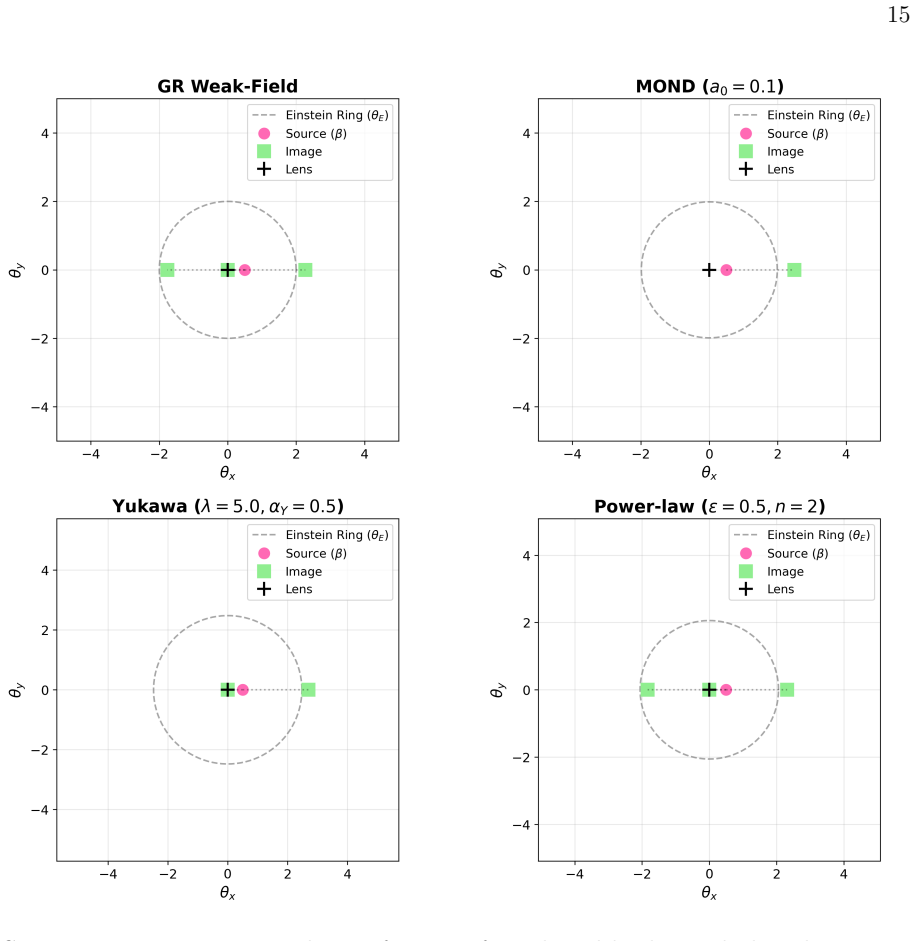
Identifying an effective refractive index from the metric components converts the null-geodesic deflection problem into an optical one; assuming the same index relation continues to hold when the metric is replaced by the effective potential of a modified gravity theory yields closed-form expressions for the deflection angle and Einstein radius in deep-MOND, Yukawa-type, and power-law f(R) models, all validated by ray-tracing simulations.
What carries the argument
The effective refractive index n(r) constructed from the metric (or effective potential), which converts gravitational light deflection into standard optical ray tracing governed by the variational principle for a graded-index medium.
If this is right
- Closed-form deflection angles and Einstein radii become available for deep-MOND, Yukawa and f(R) lensing without solving the geodesic equation.
- The optical mapping supplies a direct route to compare predicted ring sizes against existing or future lensing observations for each model.
- Any other modified gravity theory whose weak-field limit can be written as an effective potential can be inserted into the same refractive-index formula.
- Students can reproduce and extend the calculations with only calculus, Snell's law and simple numerical integration.
Where Pith is reading between the lines
- If the optical analogy extends to non-spherical or strong-field regimes, it could simplify numerical lensing studies in a wider class of gravity theories.
- The same refractive-index construction might be tested against precision solar-system or galactic lensing data to constrain the allowed forms of the effective potential.
- Rewriting lensing observables in terms of an equivalent refractive profile could make the differences between modified-gravity predictions more transparent for observers.
Load-bearing premise
The assumption that the relation between the metric and an effective refractive index that works in general relativity remains valid when the metric is replaced by an effective potential taken from a modified gravity theory.
What would settle it
Numerical integration of the null geodesics for any one of the three modified metrics produces a deflection angle that differs from the angle obtained by applying the optical formula to the same effective potential.
Figures


read the original abstract
We present a framework that reformulates gravitational lensing as an optical phenomenon governed by an effective refractive index, enabling exploration of modified gravity theories using undergraduate-level mathematics and optics. After deriving the general deflection angle for arbitrary spherically symmetric fields, we establish the observational baseline using standard general relativity, including the lens equation and Einstein ring properties. Assuming the optical relation holds for modified effective potentials, we apply the formalism to deep-MOND, Yukawa-type, and power-law ($f(R)$) models, providing closed-form analytical expressions for the deflection angle and Einstein radius. Numerical ray-tracing simulations validate these analytical results. This framework serves as a conceptual bridge to contemporary research, offering students computational experience and critical awareness of gravitational lensing foundations.
Editorial analysis
A structured set of objections, weighed in public.
Referee Report
Summary. The manuscript proposes reformulating gravitational lensing as an optical problem using an effective refractive index derived from the weak-field metric. It derives a general deflection angle for spherically symmetric fields, establishes the GR baseline including the lens equation and Einstein ring, and then applies the same optical relation to modified effective potentials in deep-MOND, Yukawa-type, and power-law f(R) models to obtain closed-form expressions for deflection angles and Einstein radii. Numerical ray-tracing simulations are used to validate the analytical results. The work is framed as a pedagogical bridge to modified gravity using undergraduate-level tools.
Significance. If the central extension is valid, the framework provides an accessible entry point for exploring lensing in modified gravity via familiar optics, with the closed-form expressions and ray-tracing validation offering concrete computational value for teaching and quick estimates. The explicit statement of the assumption in the abstract is a positive transparency feature. However, the significance is constrained because the results remain formal without independent justification from the modified theories' metrics or actions.
major comments (2)
- [Application to modified gravity models] In the section applying the formalism to modified gravity models (following the GR baseline): the closed-form deflection angles and Einstein radii for deep-MOND, Yukawa, and f(R) rest on the direct substitution of modified effective potentials into the GR-derived refractive index n(r) obtained from g_{00}≈1+2Φ and g_{ij}≈1-2Φ. No re-derivation of null geodesics or the optical relation from each theory's action or metric is provided, despite the fact that extra degrees of freedom (e.g., scalar in f(R)) or the non-relativistic nature of deep-MOND can alter light propagation beyond a simple potential replacement. This assumption is load-bearing for the central claim of physically applicable expressions.
- [Numerical ray-tracing simulations] In the numerical validation section: the ray-tracing simulations employ the identical n(r) constructed under the same assumption, confirming internal consistency of the analytics but not providing an external test against the light deflection predicted by the full modified-gravity field equations or against existing literature benchmarks for these models.
minor comments (2)
- [Conclusions] The abstract and introduction clearly flag the assumption, but the conclusions should expand on the conditions under which the optical mapping remains valid or the regimes where it may break down for each model.
- [Modified gravity applications] Explicit equations defining the effective potentials for deep-MOND, Yukawa, and f(R) cases would improve traceability when substituting into the deflection formula.
Simulated Author's Rebuttal
We thank the referee for the constructive and detailed report. The comments help clarify the scope of our pedagogical framework, and we address each major point below with proposed revisions to improve transparency without altering the core approach.
read point-by-point responses
-
Referee: [Application to modified gravity models] In the section applying the formalism to modified gravity models (following the GR baseline): the closed-form deflection angles and Einstein radii for deep-MOND, Yukawa, and f(R) rest on the direct substitution of modified effective potentials into the GR-derived refractive index n(r) obtained from g_{00}≈1+2Φ and g_{ij}≈1-2Φ. No re-derivation of null geodesics or the optical relation from each theory's action or metric is provided, despite the fact that extra degrees of freedom (e.g., scalar in f(R)) or the non-relativistic nature of deep-MOND can alter light propagation beyond a simple potential replacement. This assumption is load-bearing for the central claim of physically applicable expressions.
Authors: We agree that the closed-form results for the modified models rely on the assumption that the GR-derived optical relation n(r) can be applied via direct substitution of the modified effective potential Φ. This assumption is stated explicitly in the abstract and main text. The manuscript is framed as a pedagogical tool that recasts lensing in familiar optical terms for undergraduate-level exploration, rather than a first-principles derivation from the full actions or metrics of each theory. For the Yukawa model the weak-field metric is directly analogous to GR with a screened potential, making the substitution more direct. For deep-MOND (non-relativistic) and f(R) (with scalar degree of freedom) we acknowledge that additional effects on null geodesics could arise. We will revise the manuscript to expand the discussion of this assumption, its domain of applicability, and its limitations, and we will add brief references to existing literature on light deflection in these models for context. revision: partial
-
Referee: [Numerical ray-tracing simulations] In the numerical validation section: the ray-tracing simulations employ the identical n(r) constructed under the same assumption, confirming internal consistency of the analytics but not providing an external test against the light deflection predicted by the full modified-gravity field equations or against existing literature benchmarks for these models.
Authors: The ray-tracing simulations are intended solely to confirm internal consistency: that the analytical deflection angles and Einstein radii match numerical integration of the ray equation under the same effective n(r). This validates the derivations within the adopted optical framework. We accept that the simulations do not constitute an external validation against the complete field equations of the modified theories or against literature benchmarks. Performing such full numerical tests lies outside the pedagogical scope of the paper. We will revise the relevant section to state this purpose explicitly and to note that direct comparisons with full modified-gravity light-deflection calculations remain an avenue for future work. revision: partial
Circularity Check
No significant circularity detected
full rationale
The paper explicitly derives the general deflection angle for arbitrary spherically symmetric fields and the GR baseline (lens equation, Einstein ring) using standard methods before stating the assumption that the optical refractive-index relation holds for modified effective potentials. It then applies the same formalism to deep-MOND, Yukawa, and f(R) models to obtain closed-form expressions. This extension is presented as an assumption rather than a first-principles derivation from the modified theories' metrics or actions, with no reduction of outputs to inputs by construction, no self-citations, and no self-definitional loops. The numerical ray-tracing validation employs the assumed relation but does not create circularity because the paper does not claim the expressions are independently derived from the target modified-gravity frameworks.
Axiom & Free-Parameter Ledger
axioms (1)
- domain assumption The optical relation between the metric and an effective refractive index continues to hold when the gravitational potential is replaced by a modified-gravity effective potential.
Lean theorems connected to this paper
-
IndisputableMonolith/Foundation/AbsoluteFloorClosure.leanreality_from_one_distinction unclear?
unclearRelation between the paper passage and the cited Recognition theorem.
Assuming the optical relation holds for modified effective potentials, we apply the formalism to deep-MOND, Yukawa-type, and power-law (f(R)) models, providing closed-form analytical expressions for the deflection angle and Einstein radius.
-
IndisputableMonolith/Foundation/AlexanderDuality.leanalexander_duality_circle_linking unclear?
unclearRelation between the paper passage and the cited Recognition theorem.
n(r) = 1 - 2Φ(r)/c² ... α = 2/c² ∫ Φ(r) b/r² ds
What do these tags mean?
- matches
- The paper's claim is directly supported by a theorem in the formal canon.
- supports
- The theorem supports part of the paper's argument, but the paper may add assumptions or extra steps.
- extends
- The paper goes beyond the formal theorem; the theorem is a base layer rather than the whole result.
- uses
- The paper appears to rely on the theorem as machinery.
- contradicts
- The paper's claim conflicts with a theorem or certificate in the canon.
- unclear
- Pith found a possible connection, but the passage is too broad, indirect, or ambiguous to say the theorem truly supports the claim.
Reference graph
Works this paper leans on
-
[1]
and the MOG/STVG theory [30]. Our phenomenological treatment, which yields αMOND = 2π √GM a0/c2, should be understood as an illustrative calculation demonstrat- ing the characteristic constant-deflection behavior, noting that detailed predictions require the full relativistic framework. In the deep-MOND regime (accelerationa≪a 0, wherea 0 ≈1.2×10 −10 m/s2...
-
[2]
poses a more severe challenge in that the separation between the X-ray gas and the gravitational lensing signal requires a significant mass component that does not interact collisionally, which in MOND frameworks necessitates additional fields (e.g., neutrinos) and remains a subject of active debate. For the Yukawa-type potential, solar system VLBI measur...
-
[3]
Annalen der Physik , year = 1916, volume = 354, pages =
A. Einstein, “Die Grundlage der allgemeinen Relativit¨ atstheorie,” Ann. Phys.49, 769 (1916). DOI: 10.1002/andp.19163540702
-
[4]
C. W. Misner, K. S. Thorne, and J. A. Wheeler,Gravitation(W. H. Freeman, San Francisco, 1973)
1973
-
[5]
Observational Evidence from Supernovae for an Accelerating Universe and a Cosmological Constant
A. G. Riess et al., “Observational Evidence from Supernovae for an Accelerating Universe and a Cosmological Constant,” Astron. J.116, 1009 (1998). DOI: 10.1086/300499
-
[6]
Measurements of Omega and Lambda from 42 High-Redshift Supernovae
S. Perlmutter et al., “Measurements of Ω and Λ from 42 High-Redshift Supernovae,” Astro- phys. J.517, 565 (1999). DOI: 10.1086/307221
work page internal anchor Pith review doi:10.1086/307221 1999
-
[7]
V. C. Rubin, W. K. Ford, Jr., and N. Thonnard, “Rotational properties of 21 SC galaxies with a large range of luminosities and radii, from NGC 4605 (R = 4 kpc) to UGC 2885 (R = 122 kpc),” Astrophys. J.238, 471 (1980). DOI: 10.1086/158003
-
[8]
S. Capozziello and M. De Laurentis, “Extended Theories of Gravity,” Phys. Rep.509, 167 (2011). DOI: 10.1016/j.physrep.2011.09.003
-
[9]
T. Clifton, P. G. Ferreira, A. Padilla, and C. Skordis, “Modified Gravity and Cosmology,” Phys. Rep.513, 1 (2012). DOI: 10.1016/j.physrep.2012.01.001
-
[10]
The total eclipse of 1919 May 29 and the influence of gravitation on light,
A. S. Eddington, “The total eclipse of 1919 May 29 and the influence of gravitation on light,” The Observatory42, 119 (1919). https://adsabs.harvard.edu/full/1919Obs....42..119E
1919
-
[11]
F. W. Dyson, A. S. Eddington, and C. Davidson, “A Determination of the Deflection of Light by the Sun’s Gravitational Field, from Observations Made at the Total Eclipse of May 29, 1919,” Phil. Trans. R. Soc. A220, 291 (1920). DOI: 10.1098/rsta.1920.0009
-
[12]
D. Clowe, M. Bradaˇ c, A. H. Gonzalez, M. Markevitch, S. W. Randall, C. Jones, and D. Zaritsky, “A Direct Empirical Proof of the Existence of Dark Matter,” Astrophys. J.648, L109 (2006). DOI: 10.1086/508162
-
[13]
H0LiCOW–I.H 0 Lenses in COSMOGRAIL’s Wellspring: program overview,
S. H. Suyu et al., “H0LiCOW–I.H 0 Lenses in COSMOGRAIL’s Wellspring: program overview,” Mon. Not. R. Astron. Soc.468, 2590 (2017). DOI: 10.1093/mnras/stx483
-
[14]
S. Mao and B. Paczy´ nski, “Gravitational Microlensing by Double Stars and Planetary Sys- tems,” Astrophys. J.374, L37 (1991). DOI: 10.1086/186066
-
[15]
Binney and S
J. Binney and S. Tremaine,Galactic Dynamics, 2nd ed. (Princeton University Press, Prince- ton, 2008)
2008
-
[16]
P. Schneider, J. Ehlers, and E. E. Falco,Gravitational Lenses(Springer, Berlin, 1992). DOI: 10.1007/978-3-662-03758-4
-
[17]
On the optical-mechanical analogy in general relativity,
K. K. Nandi and A. Islam, “On the optical-mechanical analogy in general relativity,” Am. J. Phys.63, 258 (1995). DOI: 10.1119/1.17934
-
[18]
Lectures on Gravitational Lensing
R. Narayan and M. Bartelmann, “Lectures on Gravitational Lensing,”, arXiv:astro- ph/9606001, DOI: 10.48550/arXiv.astro-ph/9606001
-
[19]
Weak Lensing Probes of Modified Gravity,
F. Schmidt, “Weak Lensing Probes of Modified Gravity,” Phys. Rev. D78, 043002 (2008). DOI: 10.1103/PhysRevD.78.043002
-
[20]
Testing chameleon gravity with the Coma cluster,
A. Terukina, L. Lombriser, K. Yamamoto, D. Bacon, K. Koyama, and R. C. Nichol, “Testing chameleon gravity with the Coma cluster,” J. Cosmol. Astropart. Phys.04, 030 (2011). DOI: 19 10.1088/1475-7516/2014/04/013
-
[21]
Introducing Alternative Theories of Gravity through Analysis of Perihelion Precession,
R. H. S. Budhi, A. Hermanto, A. B. S. Utomo, and E. T. Sulistyani, “Introducing Alternative Theories of Gravity through Analysis of Perihelion Precession,”Eur. J. Phys.(2025). DOI: 10.1088/1361-6404/ae55df
-
[22]
J. Soldner, “ ¨Uber die Ablenkung eines Lichtstrahls von seiner geradlinigen Bewegung durch die Attraktion eines Weltk¨ orpers, an welchem er nahe vorbeigeht,” Ann. Phys.370, 593 (1921). DOI: 10.1002/andp.19213701503
-
[23]
¨Uber den Einfluß der Schwerkraft auf die Ausbreitung des Lichtes,
A. Einstein, “ ¨Uber den Einfluß der Schwerkraft auf die Ausbreitung des Lichtes,” Ann. Phys. 340, 898 (1911). DOI: 10.1002/andp.19113401005
-
[24]
Born and E
M. Born and E. Wolf,Principles of Optics: Electromagnetic Theory of Propagation, Interfer- ence and Diffraction of Light, 7th (expanded) ed. (Cambridge University Press, Cambridge, 1999)
1999
-
[25]
Gravitational lensing from a spacetime perspective,
V. Perlick, “Gravitational lensing from a spacetime perspective,” Living Rev. Relativ.7, 9 (2004). DOI: 10.12942/lrr-2004-9
-
[26]
Weinberg,Gravitation and Cosmology: Principles and Applications of the General Theory of Relativity(John Wiley & Sons, New York, 1972)
S. Weinberg,Gravitation and Cosmology: Principles and Applications of the General Theory of Relativity(John Wiley & Sons, New York, 1972)
1972
-
[27]
The Confrontation between General Relativity and Experiment
C. M. Will, “The Confrontation between General Relativity and Experiment,” Living Rev. Relativ.17, 4 (2014). DOI: 10.12942/lrr-2014-4
-
[28]
M. Milgrom, “A modification of the Newtonian dynamics as a possible alternative to the hidden mass hypothesis,” Astrophys. J.270, 365 (1983). DOI: 10.1086/161130
-
[29]
Relativistic gravitation theory for the modified Newtonian dynamics paradigm,
J. D. Bekenstein, “Relativistic gravitation theory for the modified Newtonian dynamics paradigm,” Phys. Rev. D70, 083509 (2004). DOI: 10.1103/PhysRevD.70.083509
-
[30]
The vector field for the gravitational lensing in TeVeS,
H. S. Zhao, “The vector field for the gravitational lensing in TeVeS,” arXiv:astro-ph/0611774 (2006). DOI: 10.48550/arXiv.astro-ph.0611777
-
[31]
M. Milgrom, “Bimetric MOND gravity,” Phys. Rev. D80, 123536 (2009). DOI: 10.1103/Phys- RevD.80.123536
-
[32]
J. W. Moffat, “Scalar-tensor-vector gravity theory,” J. Cosmol. Astropart. Phys.03, 004 (2006). DOI: 10.1088/1475-7516/2006/03/004
-
[33]
Theoretical Aspects of Massive Gravity,
K. Hinterbichler, “Theoretical Aspects of Massive Gravity,” Rev. Mod. Phys.84, 671 (2012). DOI: 10.1103/RevModPhys.84.671
-
[34]
Tests of the Gravitational Inverse-Square Law,
E. G. Adelberger, B. R. Heckel, and A. E. Nelson, “Tests of the Gravitational Inverse-Square Law,” Ann. Rev. Nucl. Part. Sci.53, 77 (2003). DOI: 10.1146/annurev.nucl.53.041002.110503
-
[35]
Solar System Constraints on the Yukawa Potential inf(R) Gravity,
R. H. S. Budhi, “Solar System Constraints on the Yukawa Potential inf(R) Gravity,” Indones. J. Appl. Phys.15, 280 (2025). DOI: 10.13057/ijap.v15i2.99471
-
[36]
T. P. Sotiriou and V. Faraoni, “f(R) theories of gravity,” Rev. Mod. Phys.82, 451 (2010). DOI: 10.1103/RevModPhys.82.451
-
[37]
Living Reviews in Relativity , keywords =
A. De Felice and S. Tsujikawa, “f(R) theories,” Living Rev. Relativ.13, 3 (2010). DOI: 10.12942/lrr-2010-3
-
[38]
Inflation in anR 2-correctedf(R) gravity model,
R. H. S. Budhi and D. N. I. Syamputra, “Inflation in anR 2-correctedf(R) gravity model,” Rev. Mex. Fis.71, 009 (2025). DOI: 10.31349/RevMexFis.71.020702
-
[39]
J. Khoury and A. Weltman, “Chameleon cosmology,” Phys. Rev. D69, 044026 (2004). DOI: 10.1103/PhysRevD.69.044026
-
[40]
Constraints on dark matter mass in anF(R) grav- ity model with an additionalR 2 correction term,
R. H. S. Budhi and D. A. Allaudza’i, “Constraints on dark matter mass in anF(R) grav- ity model with an additionalR 2 correction term,” Phys. Scripta100, 015304 (2025). DOI: 10.1088/1402-4896/ad95c6
-
[41]
Preventing curvature singulari- 20 ties inf(R) dark energy models,
R. H. S. Budhi, N. Shobcha, and N. S. Risdianto, “Preventing curvature singulari- 20 ties inf(R) dark energy models,” Int. J. Mod. Phys. A40, 2550154 (2025). DOI: 10.1142/S0217751X25501544
-
[42]
Gravitational Lensing Simulations for Modified Gravity Theories,
R. H. S. Budhi, “Gravitational Lensing Simulations for Modified Gravity Theories,” Zenodo (2026). DOI: 10.5281/zenodo.19434875
-
[43]
A. S. Bolton, S. Burles, L. V. E. Koopmans, T. Treu, and L. A. Moustakas, “The Sloan Lens ACS Survey. I. A Large Spectroscopically Selected Sample of Massive Early-Type Lens Galaxies,” Astrophys. J.638, 703 (2006). DOI: 10.1086/498884
discussion (0)
Sign in with ORCID, Apple, or X to comment. Anyone can read and Pith papers without signing in.