Recognition: no theorem link
Explaining Neural Networks in Preference Learning: a Post-hoc Inductive Logic Programming Approach
Pith reviewed 2026-05-10 17:50 UTC · model grok-4.3
The pith
ILASP approximates neural networks for user preferences using weak constraints and PCA to yield transparent explanations.
A machine-rendered reading of the paper's core claim, the machinery that carries it, and where it could break.
Core claim
We propose using Learning from Answer Sets to approximate black-box models such as neural networks in the specific case of learning user preferences. We specifically explore the use of ILASP to approximate preference learning systems through weak constraints on a recipe preference dataset. Experiments investigate ILASP both as a global and a local approximator, with a PCA preprocessing step to reduce dimensionality while keeping explanations transparent.
What carries the argument
ILASP using weak constraints to approximate the target neural network, with PCA dimensionality reduction as the preprocessing step to maintain transparency.
If this is right
- Black-box neural preference models can be replaced or augmented with interpretable symbolic programs without major loss of accuracy.
- The same approximation technique works for both global model understanding and local prediction explanations.
- High-dimensional preference data becomes manageable for symbolic approximation through PCA without sacrificing explanatory clarity.
- Computational time remains controlled even as feature spaces grow, due to the preprocessing step.
- Neural and logic-based methods can be combined for preference learning tasks that require both accuracy and transparency.
Where Pith is reading between the lines
- The PCA-ILASP pipeline could be tested on preference datasets from domains other than recipes to check generality.
- Hybrid systems might use the learned logic programs to audit or correct neural predictions in deployment.
- The method hints at using answer set programming more broadly as a post-hoc tool for explaining neural models in ranking or recommendation tasks.
Load-bearing premise
The assumption that ILASP approximations via weak constraints can achieve appropriate fidelity to the neural network while remaining computationally tractable and transparent after PCA reduction on high-dimensional preference data.
What would settle it
An experiment in which the ILASP approximation shows substantially lower fidelity to the neural network predictions on the recipe preference dataset or produces logic programs that are no longer transparently interpretable by humans.
Figures



read the original abstract
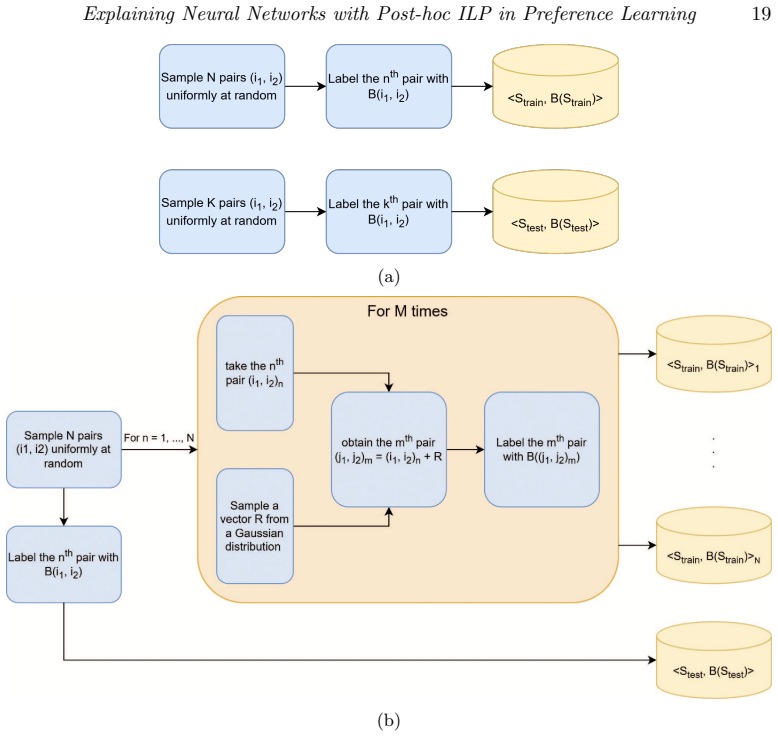
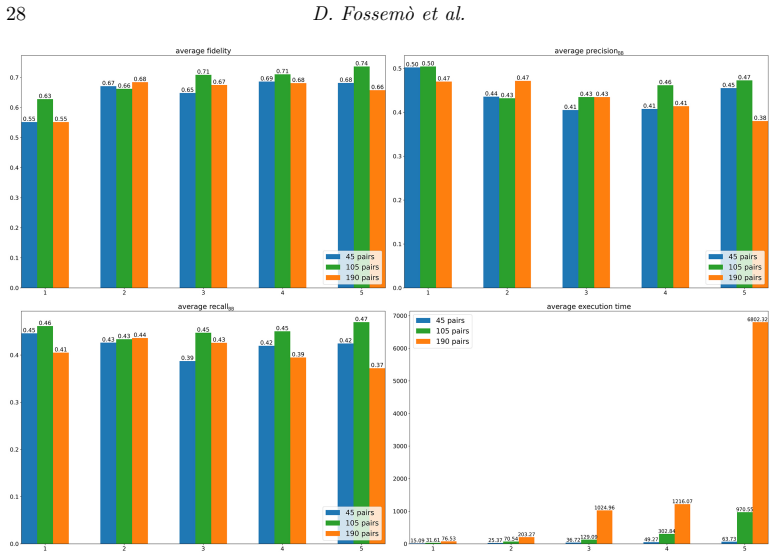
In this paper, we propose using Learning from Answer Sets to approximate black-box models, such as Neural Networks (NN), in the specific case of learning user preferences. We specifically explore the use of ILASP (Inductive Learning of Answer Set Programs) to approximate preference learning systems through weak constraints. We have created a dataset on user preferences over a set of recipes, which is used to train the NNs that we aim to approximate with ILASP. Our experiments investigate ILASP both as a global and a local approximator of the NNs. These experiments address the challenge of approximating NNs working on increasingly high-dimensional feature spaces while achieving appropriate fidelity on the target model and limiting the increase in computational time. To handle this challenge, we propose a preprocessing step that exploits Principal Component Analysis to reduce the dataset's dimensionality while keeping our explanations transparent. Under consideration for publication in Theory and Practice of Logic Programming (TPLP).
Editorial analysis
A structured set of objections, weighed in public.
Referee Report
Summary. The paper proposes a post-hoc method to explain neural networks trained on user recipe preferences by approximating them with ILASP (Inductive Learning of Answer Set Programs) using weak constraints. It examines ILASP both as a global approximator and a local one, creates a preference dataset for training the target NNs, and introduces PCA-based dimensionality reduction to address high-dimensional feature spaces while claiming to preserve explanation transparency. Experiments aim to balance fidelity to the NN, computational tractability, and interpretability.
Significance. If the fidelity and transparency claims hold with supporting quantitative evidence, this would offer a concrete bridge between neural preference models and symbolic logic programs, advancing explainable AI in recommendation domains. The use of a real user-preference dataset and explicit handling of dimensionality challenges via PCA is a practical strength; successful global/local comparisons could inform hybrid neuro-symbolic systems.
major comments (2)
- [Preprocessing with PCA] The preprocessing step with PCA (described in the abstract and method): the assertion that explanations remain transparent after dimensionality reduction is load-bearing for the post-hoc motivation, yet PCA produces uncorrelated linear combinations of original features (e.g., recipe attributes) that lack direct human-interpretable semantics. No mapping from learned weak constraints back to original features is provided, nor is there an interpretability evaluation or user study comparing post-PCA programs to the original NN.
- [Experiments] Experiments section: the central claim that ILASP achieves 'appropriate fidelity' while remaining tractable requires concrete metrics (e.g., approximation accuracy or error rates relative to the NN, runtime figures, and baseline comparisons). The abstract provides none, and without these the evaluation of global vs. local approximation and the PCA benefit cannot be verified.
minor comments (1)
- [Abstract] Abstract: the phrase 'keeping our explanations transparent' is repeated without a precise definition of transparency in this context (e.g., syntactic simplicity of the ASP program or semantic alignment with original features).
Simulated Author's Rebuttal
We thank the referee for the constructive and detailed feedback, which helps clarify the strengths and areas for improvement in our post-hoc ILASP approximation approach for neural preference models. We address each major comment point by point below, with honest indications of where revisions will strengthen the manuscript without altering its core claims.
read point-by-point responses
-
Referee: [Preprocessing with PCA] The preprocessing step with PCA (described in the abstract and method): the assertion that explanations remain transparent after dimensionality reduction is load-bearing for the post-hoc motivation, yet PCA produces uncorrelated linear combinations of original features (e.g., recipe attributes) that lack direct human-interpretable semantics. No mapping from learned weak constraints back to original features is provided, nor is there an interpretability evaluation or user study comparing post-PCA programs to the original NN.
Authors: We acknowledge that PCA produces linear combinations of the original recipe features, which can reduce direct semantic interpretability of the input space. Our transparency claim centers on the output of ILASP: the learned weak constraints remain symbolic and human-readable logic programs, providing a post-hoc explanation distinct from the NN's opaque parameters. To address the concern directly, we will revise the manuscript to (i) include the PCA loadings matrix with examples mapping principal components back to dominant original attributes (e.g., ingredient or nutritional features), (ii) show how a sample weak constraint on a PC can be re-expressed in terms of those attributes, and (iii) add a qualitative interpretability analysis comparing program complexity and readability before and after PCA. A full user study lies outside the current scope and resources, but the added mapping and analysis will allow readers to assess transparency. These changes will be incorporated in the revised version. revision: yes
-
Referee: [Experiments] Experiments section: the central claim that ILASP achieves 'appropriate fidelity' while remaining tractable requires concrete metrics (e.g., approximation accuracy or error rates relative to the NN, runtime figures, and baseline comparisons). The abstract provides none, and without these the evaluation of global vs. local approximation and the PCA benefit cannot be verified.
Authors: The experiments section reports fidelity via agreement rates between ILASP predictions and the target NN on held-out preference data, plus runtime measurements across global/local modes and varying PCA dimensions. We agree these results benefit from more explicit presentation. In revision we will add a dedicated table with concrete values: approximation accuracy (percentage of matching predictions), error rates (e.g., disagreement percentage or MSE on preference scores), runtimes in seconds, and direct comparisons to baselines such as linear models and decision-tree approximators. We will also revise the abstract to summarize the key quantitative outcomes (e.g., fidelity levels retained with PCA). This will make the global vs. local and PCA-benefit claims verifiable. revision: yes
Circularity Check
No circularity: empirical approximation method with no self-referential derivations
full rationale
The paper proposes an empirical post-hoc method: train neural networks on a custom recipe preference dataset, then apply ILASP (via weak constraints) as global or local approximators, with optional PCA preprocessing for high-dimensional inputs. No equations, uniqueness theorems, or derivations are presented that reduce to fitted parameters or prior results by construction. Claims of fidelity and transparency rest on experimental evaluation rather than self-definition or load-bearing self-citations. The approach is self-contained as a methodological proposal tested on held-out data, with no patterns matching self-definitional, fitted-prediction, or ansatz-smuggling circularity.
Axiom & Free-Parameter Ledger
axioms (2)
- domain assumption Neural networks trained on preference data can be approximated by inductive logic programs learned via ILASP.
- domain assumption Principal Component Analysis reduces dimensionality without destroying the preference structure needed for faithful approximation.
Reference graph
Works this paper leans on
-
[1]
Guidotti, A
R. Guidotti, A. Monreale, S. Ruggieri, F. Turini, F. Giannotti, D. Pedreschi, 2018,A survey of methods for explaining black-box models, ACM computing surveys (CSUR), 51, 1 -
2018
-
[2]
Calimeri, W
F. Calimeri, W. Faber, M. Gebser, G. Ianni, R. Kaminski, T. Krennwallner, N. Leone, M. Maratea, F. Ricca, T. Schaub, 2020,ASP-Core-2 input language format, Theory and Practice of Logic Programming 20 294-309. M. Law, A. Russo, K. Broda, 2014,Inductive learning of answer set programs, European Work- shop on Logics in Artificial Intelligence, Springer, pp. ...
2020
-
[3]
M. Law, A. Russo, K. Broda, 2018,Inductive learning of answer set programs from noisy exam- ples, arXiv preprint arXiv:1808.08441. 38D. Fossem` o et al. F. A. D’Asaro, M. Spezialetti, L. Raggioli, S. Rossi, 2020,Towards an inductive logic pro- gramming approach for explaining black-box preference learning systems, Proceedings of the International Conferen...
-
[4]
doi:https://doi.org/10.24963/kr.2020/88. D. Fossem` o, F. Mignosi, L. Raggioli, M. Spezialetti, F. D’Asaro, 2022,Using inductive logic programming to globally approximate neural networks for preference learning: challenges and preliminar results, BEWARE 2022: BIAS, Ethical AI, Explainability and the Role of Logic and Logic Programming 67-83. URL:https://c...
-
[5]
URL:https://www.frontiersin.org/ article/10.3389/frai.2020.00036. doi:10.3389/frai.2020.00036 T. Kamishima, 2003,Nantonac collaborative filtering: recommendation based on order responses, Proceedings of the ninth ACM SIGKDD international conference on Knowledge discovery and data mining, pp. 583-588. J. Rabold, M. Siebers, U. Schmid, 2018,Explaining black...
-
[6]
Rabold, H
J. Rabold, H. Deininger, M. Siebers, U. Schmid, 2020,Enriching visual with verbal explanations for relational concepts - combining lime with aleph, P. Cellier, K. Driessens (Eds.), Machine Learning and Knowledge Discovery in Databases, Springer, pp. 180 -
2020
-
[7]
Shakerin, G
F. Shakerin, G. Gupta, 2019,Induction of non-monotonic logic programs to explain boosted tree models using lime, Proceedings of the AAAI Conference on Artificial Intelligence, volume 33, pp. 3052 -
2019
-
[8]
Srinivasan, 2019,The Aleph manual, URL:http://www.cs.ox.ac.uk/activities/ machinelearning/Aleph/
A. Srinivasan, 2019,The Aleph manual, URL:http://www.cs.ox.ac.uk/activities/ machinelearning/Aleph/. B. De Ville, 2013Decision trees, Wiley Interdisciplinary Reviews: Computational Statistics 5(6), 448-445. doi:https://doi.org/10.1002/wics.1278 C. Rebelo de S´ a, W. Duivesteijn, C. Soares, A. Knobbe, 2016,Exceptional preferences mining, T. Calders, M. Cec...
-
[9]
M. T. Ribeiro, S. Singh, C. Guestrin, 2016,“Why should I trust you?”: explaining the pre- dictions of any classifier, Proceedings of the 22nd ACM SIGKDD International Conference on Knowledge Discovery and Data Mining, KDD ’16, Association for Computing Machin- ery, New York, NY, USA, p. 1135-1144. URL:https://doi.org/10.1145/2939672.2939778. doi:10.1145/2...
-
[10]
F¨ urnkranz, 2010,Preference learning, Springer-Verlag Berlin Heidelberg
J. F¨ urnkranz, 2010,Preference learning, Springer-Verlag Berlin Heidelberg. M. Gurrieri, X. Siebert, P. Fortemps, S. Greco, R. S lowi´ nski, 2012,Advances on Computational Intelligence, pp. 613 -
2010
-
[11]
Y. Zhou, Y. Liu, J. Yang, X. He, L. Liu, 2014,A taxonomy of label ranking algorithms, Journal of Computers 9, 557 -
2014
-
[12]
Abdi, L.J
H. Abdi, L.J. Williams, 2010,Principal Component Analysis, Wiley interdisciplinary reviews: computational statistics 2, 433 -
2010
-
[13]
Gretton, K.M
A. Gretton, K.M. Borgwardt, M.J. Rasch, B. Sch¨ olkopf, A. Smola, 2012,A kernel two-sample, Journal of Machine Learning Research 13, 723 -
2012
-
[14]
Explaining Neural Networks with Post-hoc ILP in Preference Learning39 M. Soori, B. Arezoo, R. Dastres, 2023,Artificial intelligence, machine learning and deep learning in advanced robotics, a review, Cognitive Robotics 3, 54-70. doi:https://doi.org/10.1016/ j.cogr.2023.04.001 P. Rajpurkar, M.P. Lungren, 2023,The Current and Future State of AI Interpretati...
work page doi:10.1016/j 2023
-
[15]
A. Severyn, A. Moschitti, 2015,Learning to rank short text pairs with convolutional deep neu- ral networks, Proceedings of the 38th international ACM SIGIR conference on research and development in information retrieval, 373-382. B. Li, Y. Fan, M.E. Papka, Z. Lan, 2022,Encoding for reinforcement learning driven schedul- ing, Workshop on Job Scheduling Str...
discussion (0)
Sign in with ORCID, Apple, or X to comment. Anyone can read and Pith papers without signing in.