Recognition: 2 theorem links
· Lean TheoremModelling Distributed Applications with Mixed-Choice Stateful Typestates
Pith reviewed 2026-05-10 18:20 UTC · model grok-4.3
The pith
Typestates are extended with mutable internal state, mixed sessions, and expected action ratios to model quantitative constraints and concurrent behaviors in distributed protocols.
A machine-rendered reading of the paper's core claim, the machinery that carries it, and where it could break.
Core claim
We present a probabilistic runtime solution extending typestates with an internal mutable state for the expression of quantitative constraints, mixed sessions to represent concurrent input and output actions, and expected ratios for the number of actions in a state, with monitoring semantics to detect deviations from an expected behaviour at runtime.
What carries the argument
Mixed-choice stateful typestates that incorporate internal mutable state for quantitative constraints, mixed sessions for concurrent actions, and expected ratios with monitoring.
If this is right
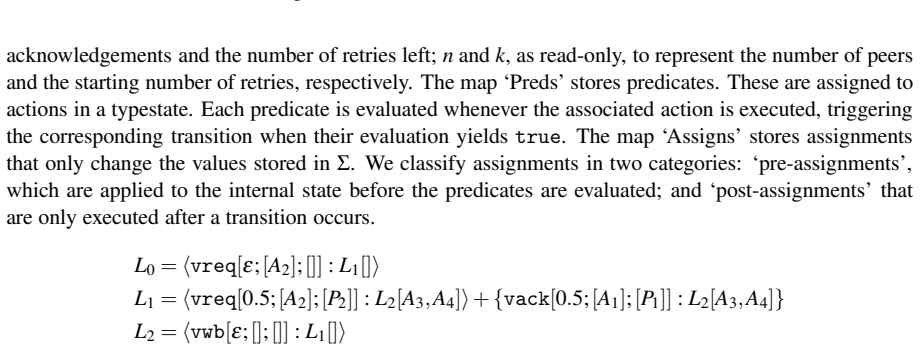
- An acknowledgement protocol can be modelled with a participant sending multiple messages while waiting for responses using mixed sessions.
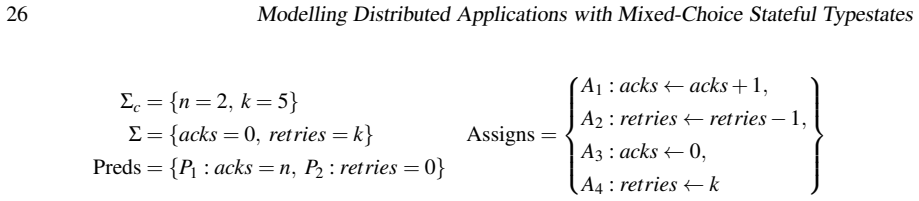
- A voting protocol can use mutable state to track quorums while enforcing expected message volume distributions via ratios.
- Runtime monitoring detects deviations from expected behaviour in distributed protocols where static verification is insufficient.
- The approach supports modelling input and output operations concurrently in the same state.
Where Pith is reading between the lines
- This could enable better design of other distributed consensus mechanisms by allowing probabilistic checks at runtime.
- Integration with existing session type tools might help developers catch errors in asynchronous handlers earlier.
- Testing in real networks could reveal if the monitoring overhead remains acceptable for large scale applications.
Load-bearing premise
That the proposed extensions integrate cleanly into typestate frameworks and that runtime monitoring of expected ratios can reliably detect meaningful deviations in real distributed environments without high overhead or false positives.
What would settle it
Deploying the monitoring in a live distributed system and measuring if it accurately flags deviations with minimal false positives and acceptable performance cost.
Figures



read the original abstract
Distributed systems have become increasingly prevalent in the software industry. Due to their intrinsic complexity, much research has focused on the verification of their behaviour. An active research line is around behaviour models that capture these protocols - e.g., session types, or typestates - allowing their static verification. Correctly designing distributed protocols is not trivial. Their communication behaviour is typically implicitly defined via asynchronous message handlers, making errors harder to detect until execution. While typestates can ease the design process by explicitly defining correct sequences of operations, they struggle in two ways: they lack the expressiveness to define quantitative constraints that govern distributed protocols (i.e., number of acknowledgements for a quorum); and they assume strict sequencing of operations, failing to capture concurrent input/output actions in a state, typical of the distributed setting. Furthermore, runtime network failures cannot be statically verified. We present a probabilistic runtime solution extending typestates with: (i) an internal mutable state for the expression of quantitative constraints; (ii) mixed sessions to represent concurrent input and output actions; (iii) expected ratios for the number of actions in a state, with monitoring semantics to detect deviations from an expected behaviour at runtime. We demonstrate the suitability of our solution with two examples that motivated our approach: an acknowledgement protocol with a participant that sends several messages while waiting for a response, effectively modelling input and output operations in a state; and a voting protocol whose participants try to achieve consensus on a single bit using a quorum, thus, requiring an internal mutable state, while respecting a pre-defined distribution for the volume of exchanged messages.
Editorial analysis
A structured set of objections, weighed in public.
Referee Report
Summary. The manuscript proposes extending typestates for distributed applications by adding (i) internal mutable state to express quantitative constraints, (ii) mixed sessions to represent concurrent input and output actions within a state, and (iii) expected ratios of actions together with monitoring semantics that detect runtime deviations from expected behavior. These extensions are motivated by limitations of standard typestates in handling quantitative aspects (e.g., quorums) and concurrent I/O, and are illustrated via two concrete protocols: an acknowledgement protocol in which a participant issues multiple messages while awaiting a response, and a voting protocol that achieves consensus via quorum while respecting a pre-defined message distribution.
Significance. If the extensions can be equipped with a sound formal semantics and the monitoring mechanism can be shown to operate with acceptable overhead, the work would meaningfully increase the expressiveness of typestate-based modeling for distributed systems by bridging static sequencing with runtime quantitative checks. The two motivating examples are well-chosen and clearly demonstrate the targeted shortcomings of existing typestates.
major comments (2)
- [Abstract] Abstract: the central claim that the three extensions constitute a 'probabilistic runtime solution' with 'monitoring semantics' rests entirely on high-level description of the two protocols; no formal type rules, operational semantics, or monitoring transition rules are supplied, which is load-bearing for any assertion that the extensions integrate cleanly or that deviations can be reliably detected.
- [Voting protocol example] Voting protocol example: the need for mutable state to track quorum progress and for expected ratios is stated, yet the manuscript supplies neither the update rules for the internal state nor the definition of the monitoring predicate that would detect deviations, leaving the practical feasibility of the runtime component unverified.
minor comments (1)
- [Abstract] The abstract lists the three extensions as (i), (ii), (iii) but does not explicitly map each feature to the corresponding limitation mentioned in the preceding paragraph, which would improve readability.
Simulated Author's Rebuttal
We thank the referee for the constructive feedback and for recognizing the potential significance of our proposed extensions. We address each major comment below and commit to revisions that strengthen the formal foundations of the work.
read point-by-point responses
-
Referee: [Abstract] Abstract: the central claim that the three extensions constitute a 'probabilistic runtime solution' with 'monitoring semantics' rests entirely on high-level description of the two protocols; no formal type rules, operational semantics, or monitoring transition rules are supplied, which is load-bearing for any assertion that the extensions integrate cleanly or that deviations can be reliably detected.
Authors: We agree that the manuscript currently presents the extensions primarily through high-level descriptions and illustrative protocols rather than supplying complete formal type rules, operational semantics, or monitoring transition rules. This was a deliberate choice to first establish the motivation and applicability via the acknowledgement and voting examples. To substantiate the central claims, we will revise the manuscript by adding a dedicated formal semantics section. This will include: (i) extended type rules incorporating mutable state and mixed sessions, (ii) operational semantics defining transitions for concurrent I/O and state updates, and (iii) monitoring transition rules that specify how deviations from expected action ratios are detected at runtime. These additions will demonstrate clean integration and reliable detection. revision: yes
-
Referee: [Voting protocol example] Voting protocol example: the need for mutable state to track quorum progress and for expected ratios is stated, yet the manuscript supplies neither the update rules for the internal state nor the definition of the monitoring predicate that would detect deviations, leaving the practical feasibility of the runtime component unverified.
Authors: The referee is correct that the voting protocol example motivates mutable state for quorum tracking and expected ratios for message distribution but does not supply the concrete update rules or monitoring predicate. In the revised manuscript we will add these definitions explicitly. We will specify the state-update rules (e.g., how vote counts are incremented on message receipt and how quorum thresholds are checked) and the monitoring predicate (a runtime check that compares observed action ratios against the declared expected distribution and raises a deviation alert when the difference exceeds a configurable tolerance). This will verify the practical feasibility of the runtime monitoring component. revision: yes
Circularity Check
No significant circularity detected
full rationale
The paper is a proposal for extending typestates with internal mutable state, mixed sessions for concurrent I/O, and ratio-based runtime monitoring, illustrated via two protocol examples (acknowledgement and voting/quorum). No derivation chain, equations, fitted parameters, or predictions are presented that could reduce to self-definition or self-citation. The central claims concern expressiveness and runtime detection suitability, which remain independent of any internal reduction. This is a standard non-circular modeling contribution.
Axiom & Free-Parameter Ledger
axioms (2)
- domain assumption Typestates can be extended with mutable internal state and mixed input/output without breaking static verification properties
- domain assumption Expected action ratios can be predefined and monitored at runtime to detect deviations from correct protocol behavior
invented entities (3)
-
mixed sessions
no independent evidence
-
internal mutable state
no independent evidence
-
expected ratios
no independent evidence
Lean theorems connected to this paper
-
IndisputableMonolith/Foundation/RealityFromDistinction.leanreality_from_one_distinction unclear?
unclearRelation between the paper passage and the cited Recognition theorem.
We present a probabilistic runtime solution extending typestates with: (i) an internal mutable state for the expression of quantitative constraints; (ii) mixed sessions to represent concurrent input and output actions; (iii) expected ratios for the number of actions in a state, with monitoring semantics...
-
IndisputableMonolith/Cost/FunctionalEquation.leanwashburn_uniqueness_aczel unclear?
unclearRelation between the paper passage and the cited Recognition theorem.
By assigning ratios to each action in a state, the generated monitors can use a frequentist approach to infer the runtime correctness...
What do these tags mean?
- matches
- The paper's claim is directly supported by a theorem in the formal canon.
- supports
- The theorem supports part of the paper's argument, but the paper may add assumptions or extra steps.
- extends
- The paper goes beyond the formal theorem; the theorem is a base layer rather than the whole result.
- uses
- The paper appears to rely on the theorem as machinery.
- contradicts
- The paper's claim conflicts with a theorem or certificate in the canon.
- unclear
- Pith found a possible connection, but the passage is too broad, indirect, or ambiguous to say the theorem truly supports the claim.
Reference graph
Works this paper leans on
-
[1]
Lorenzo Bacchiani, Mario Bravetti, Marco Giunti, Jo˜ ao Mota & Ant´ onio Ravara (2022): A Java typestate checker supporting inheritance . Sci. Comput. Program. 221, p. 102844, doi: 10.1016/J.SCICO.2022. 102844
-
[2]
Lorenzo Bacchiani, Mario Bravetti, Marco Giunti, Jo˜ ao Mota & Ant´ onio Ravara (2024): Behavioural Up/down Casting F or Statically Typed Languages. In Jonathan Aldrich & Guido Salvaneschi, editors: 38th European Conference on Object-Oriented Programming, ECOO P 2024, Vienna, Austria, September 16-20, 2024, LIPIcs 313, Schloss Dagstuhl - Leibniz-Zentrum f...
-
[3]
Christian Bartolo Burl` o, Adrian Francalanza & Alceste Scalas (2020): T owards a Hybrid V erification Meth- odology for Communication Protocols (Short Paper) . In Alexey Gotsman & Ana Sokolova, editors: Formal Techniques for Distributed Objects, Components, and Systems - 40th IFIP WG 6.1 International Conference, FORTE 2020, Held as Part of the 15th Inter...
-
[4]
Christian Bartolo Burl` o, Adrian Francalanza, Alceste Scalas, Catia Trubiani & Emilio Tuosto (2021): T o- wards Probabilistic Session-Type Monitoring. In Ferruccio Damiani & Ornela Dardha, editors: Coordination Models and Languages - 23rd IFIP WG 6.1 International Confer ence, COORDINA TION 2021, Held as Part of the 16th International Federated Conferenc...
-
[5]
V asconcelos (20 22): Mixed sessions
Filipe Casal, Andreia Mordido & V asco T. V asconcelos (20 22): Mixed sessions . Theor. Comput. Sci. 897, pp. 23–48, doi: 10.1016/J.TCS.2021.08.005
-
[6]
Ankush Das, Di Wang & Jan Hoffmann (2023): Probabilistic Resource-Aware Session Types. Proc. ACM Program. Lang. 7(POPL), pp. 1925–1956, doi: 10.1145/3571259
-
[7]
Raymond Hu, Nobuko Y oshida & Kohei Honda (2008): Session-Based Distributed Programming in Java . In Jan Vitek, editor: ECOOP 2008 - Object-Oriented Programming, 22nd European Co nference, Paphos, Cyprus, July 7-11, 2008, Proceedings , Lecture Notes in Computer Science 5142, Springer, pp. 516–541, doi:10.1007/978-3-540-70592-5_22
-
[8]
Hans H¨ uttel, Ivan Lanese, V asco T. V asconcelos, Lu´ ıs Caires, Marco Carbone, Pierre-Malo Deni´ elou, Di- mitris Mostrous, Luca Padovani, Ant´ onio Ravara, Emilio Tuosto, Hugo Torres Vieira & Gianluigi Zavattaro (2016): F oundations of Session Types and Behavioural Contracts. ACM Comput. Surv. 49(1), pp. 3:1–3:36, doi:10.1145/2873052
-
[9]
Jo˜ ao Mota, Marco Giunti & Ant´ onio Ravara (2021): Java Typestate Checker . In Ferruccio Damiani & Ornela Dardha, editors: Coordination Models and Languages - 23rd IFIP WG 6.1 Interna tional Conference, COORDINA TION 2021, Held as Part of the 16th International Federated Conference on Distributed Comput- ing Techniques, DisCoTec 2021, V alletta, Malta, ...
-
[10]
Typestate: A Programming Language Concept for Enhancing Software Reliability,
Robert E. Strom & Shaula Y emini (1986): Typestate: A Programming Language Concept for Enhancing Software Reliability. IEEE Trans. Software Eng. 12(1), pp. 157–171, doi: 10.1109/TSE.1986.6312929
-
[11]
Dagstuhl Artifacts Ser
Dawit Legesse Tirore, Jesper Bengtson & Marco Carbone ( 2025): Multiparty Asynchronous Session Types: A Mechanised Proof of Subject Reduction (Artifact) . Dagstuhl Artifacts Ser. 11(2), pp. 3:1–3:5, doi: 10.4230/ DARTS.11.2.3
2025
-
[12]
V asconcelos (2012): Fundamentals of session types
V asco T. V asconcelos (2012): Fundamentals of session types . Inf. Comput. 217, pp. 52–70, doi: 10.1016/ J.IC.2012.05.002
2012
-
[13]
Fangyi Zhou, Francisco Ferreira, Raymond Hu, Rumyana N eykova & Nobuko Y oshida (2020): Statically verified refinements for multiparty protocols . Proc. ACM Program. Lang. 4(OOPSLA), pp. 148:1–148:30, doi:10.1145/3428216
discussion (0)
Sign in with ORCID, Apple, or X to comment. Anyone can read and Pith papers without signing in.