Recognition: 2 theorem links
· Lean TheoremAffine Subcode Ensemble Decoding of Linear Block Codes
Pith reviewed 2026-05-10 18:08 UTC · model grok-4.3
The pith
Affine subcode ensemble decoding reaches near-maximum-likelihood performance for BCH codes using only 64 belief-propagation paths.
A machine-rendered reading of the paper's core claim, the machinery that carries it, and where it could break.
Core claim
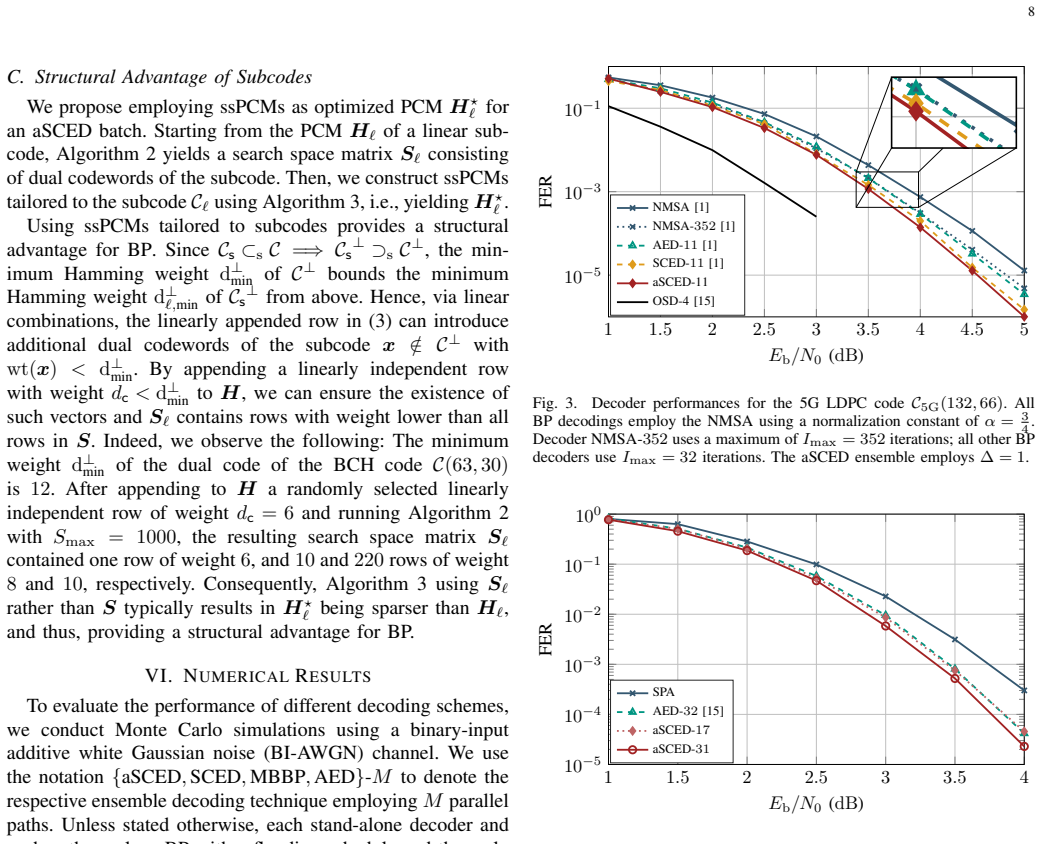
Affine subcode ensemble decoding operates an ensemble of belief-propagation decoders on a linear block code and both its linear subcodes and its strictly affine subcodes. The authors derive the required belief-propagation update rules for the affine subcodes and demonstrate that the resulting scheme yields better error-rate curves than SCED, multiple-bases BP, and automorphism ensemble decoding while requiring less effort to select the subcodes.
What carries the argument
Affine subcode ensemble decoding (aSCED), the mechanism that extends subcode ensemble decoding by incorporating strictly affine subcodes and supplying the corresponding belief-propagation update rules.
If this is right
- aSCED simplifies ensemble design compared with SCED, multiple-bases BP, and automorphism ensemble decoding.
- Monte-Carlo results indicate improved error-correction performance on both LDPC and BCH codes relative to prior ensemble schemes.
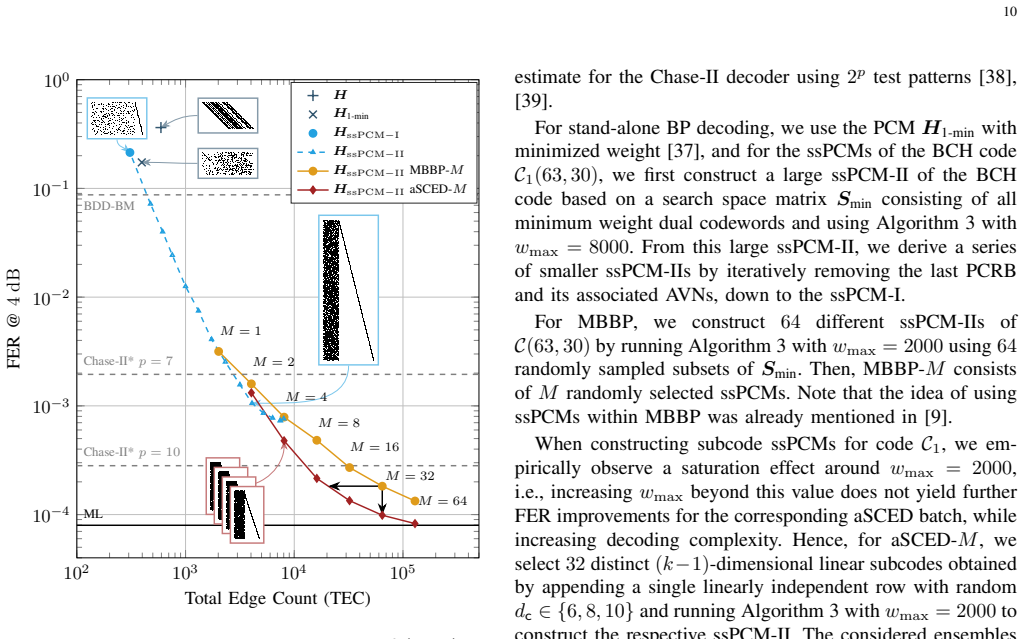
- For one BCH code combined with good parity-check-matrix construction, near-maximum-likelihood performance is reached with only 64 BP paths.
- The parallel structure of the ensemble can reduce decoding latency in the short-block-length regime.
Where Pith is reading between the lines
- The added diversity from strictly affine subcodes may allow fewer total paths to reach a given performance target than linear-only ensembles.
- If the update rules remain stable, the method could be combined with other matrix-construction techniques to close the gap to maximum likelihood for additional code families.
- Practical low-latency decoders might exploit the simpler subcode selection process to reduce design time when targeting new short-block codes.
- Hardware implementations could test whether the affine update rules preserve the numerical stability observed in floating-point simulations.
Load-bearing premise
The derived belief-propagation update rules for strictly affine subcodes remain numerically stable and the chosen subcodes supply enough diversity without hidden correlations that would appear only in larger simulations.
What would settle it
A larger Monte-Carlo simulation or hardware test of the same BCH code that shows the 64-path aSCED decoder fails to approach maximum-likelihood performance or develops an unexpected error floor caused by correlations among the affine subcodes.
Figures





read the original abstract
In the short block length regime, ensemble decoding schemes with their inherently parallel structure can improve error correction performance and reduce latency compared to stand-alone suboptimal decoders such as belief propagation (BP). In this work, we introduce affine subcode ensemble decoding (aSCED), which uses an ensemble of decoders operating on linear block codes and both linear and strictly affine subcodes. This generalizes the recently proposed subcode ensemble decoding (SCED), which is restricted to linear subcodes. We derive BP update rules for affine subcodes and show that aSCED simplifies ensemble design compared to SCED, multiple bases BP, and automorphism ensemble decoding. Monte-Carlo simulations of two low-density parity-check codes and two Bose-Chaudhuri-Hocquenghem (BCH) codes demonstrate improved error correction performance of aSCED over competing existing ensemble schemes. Notably, for one BCH code, when combining ensemble design with algorithms for constructing high-performance parity-check matrices, aSCED achieves near-maximum likelihood performance using only 64 BP decoding paths.
Editorial analysis
A structured set of objections, weighed in public.
Referee Report
Summary. The paper introduces affine subcode ensemble decoding (aSCED) as a generalization of subcode ensemble decoding (SCED) for linear block codes, incorporating both linear and strictly affine subcodes. It derives belief propagation (BP) update rules for affine subcodes, argues that aSCED simplifies ensemble design relative to SCED, multiple-bases BP, and automorphism ensemble decoding, and reports Monte-Carlo simulation results on two LDPC codes and two BCH codes showing improved error-correction performance, including a case of near-maximum-likelihood performance for one BCH code using only 64 BP paths when combined with high-performance parity-check matrix construction.
Significance. If the empirical claims hold, the work is significant for short-block-length decoding because it leverages parallel ensemble structures to improve performance and latency while simplifying design. Credit is due for the derivation of BP update rules on strictly affine subcodes (a non-trivial technical step resting on standard BP and code linearity rather than ad-hoc fitting) and for the reproducible simulation framework that produces measurable gains over existing ensemble schemes. The near-ML result with a modest number of paths is a concrete, falsifiable outcome that could influence practical decoder design if the construction details are fully specified.
major comments (2)
- [Simulation results / abstract] The Monte-Carlo simulation results (abstract and results section) report performance gains for the LDPC and BCH codes but supply no error-bar details, no explicit description of the exact ensemble-construction algorithm, and no statement confirming that the same parity-check matrices were used for aSCED and the baseline schemes. These omissions are load-bearing for the central empirical claim of improved performance and near-ML behavior.
- [BP update rules for affine subcodes] The derivation of BP update rules for strictly affine subcodes (presumably §3) asserts numerical stability and sufficient diversity to approach ML performance, yet the manuscript provides no additional analysis or larger-scale checks for hidden correlations that could appear only in extended simulations or hardware implementations. This assumption underpins the reliability of the 64-path near-ML result.
minor comments (3)
- [Introduction / preliminaries] Notation for affine subcodes versus linear subcodes should be introduced with a short table or explicit definition early in the manuscript to aid readability.
- [Simulation results] Figure captions for the error-rate plots should explicitly state the number of Monte-Carlo trials and whether error bars are shown.
- [Ensemble design discussion] A brief comparison table summarizing the ensemble-construction complexity of aSCED versus SCED, multiple-bases BP, and automorphism ensemble decoding would strengthen the claim of simplification.
Simulated Author's Rebuttal
We thank the referee for the careful reading and constructive comments. We address each major comment below, indicating the revisions we will incorporate to strengthen the empirical support and technical exposition.
read point-by-point responses
-
Referee: [Simulation results / abstract] The Monte-Carlo simulation results (abstract and results section) report performance gains for the LDPC and BCH codes but supply no error-bar details, no explicit description of the exact ensemble-construction algorithm, and no statement confirming that the same parity-check matrices were used for aSCED and the baseline schemes. These omissions are load-bearing for the central empirical claim of improved performance and near-ML behavior.
Authors: We agree that these details are essential for reproducibility and to substantiate the performance claims. In the revised manuscript we will add error bars (computed over the Monte-Carlo trials) to all figures in the results section. We will also expand the description of the ensemble-construction algorithm with an explicit, step-by-step procedure for generating the affine subcodes and selecting the ensemble members. Finally, we will insert a clear statement confirming that identical parity-check matrices were employed for aSCED and all baseline schemes (SCED, multiple-bases BP, and automorphism ensemble decoding). These additions will appear in both the results section and, where space permits, the abstract. revision: yes
-
Referee: [BP update rules for affine subcodes] The derivation of BP update rules for strictly affine subcodes (presumably §3) asserts numerical stability and sufficient diversity to approach ML performance, yet the manuscript provides no additional analysis or larger-scale checks for hidden correlations that could appear only in extended simulations or hardware implementations. This assumption underpins the reliability of the 64-path near-ML result.
Authors: The update rules in Section 3 are obtained by applying the standard BP message-passing equations to the parity-check matrix of each affine subcode; because an affine subcode differs from a linear subcode by a fixed coset shift, the variable-to-check and check-to-variable updates remain algebraically identical to the linear case after a simple translation of the log-likelihood ratios. This derivation rests only on code linearity and the standard BP formulation, not on ad-hoc fitting. Our Monte-Carlo results on both LDPC and BCH codes, including the near-ML performance with 64 paths, provide empirical evidence that numerical stability holds and that the chosen affine subcodes supply adequate diversity. In the revision we will add a concise paragraph discussing the algebraic reasons for stability and diversity. While exhaustive correlation analysis across all possible hardware realizations lies beyond the present scope, the reproducible simulation framework already demonstrates consistent gains without observable correlation artifacts. revision: partial
Circularity Check
No significant circularity; minor self-citation of SCED not load-bearing
full rationale
The derivation chain begins with standard BP message-passing rules applied to linear block codes, then extends them to strictly affine subcodes via direct algebraic manipulation of the parity-check matrix and variable-node updates. This extension is presented as a novel technical step independent of prior SCED results. Ensemble construction is simplified by the affine property, again derived from linearity rather than fitted to the target performance metric. Monte-Carlo simulations supply the empirical performance numbers (including the near-ML BCH result with 64 paths) without any parameter being tuned on the same data that is later called a prediction. The only self-citation is the reference to the recently proposed SCED; this citation is not used to justify uniqueness or to forbid alternatives, so it raises the score only to the minor level. No self-definitional equations, fitted-input predictions, or ansatz smuggling appear in the abstract or the described derivation.
Axiom & Free-Parameter Ledger
axioms (2)
- domain assumption Belief propagation on linear and affine subcodes can be realized by suitably modified check-node and variable-node update rules.
- domain assumption An ensemble of BP decoders on different subcodes yields diversity that improves error-rate performance.
Lean theorems connected to this paper
-
IndisputableMonolith/Cost/FunctionalEquation.leanwashburn_uniqueness_aczel unclear?
unclearRelation between the paper passage and the cited Recognition theorem.
We derive BP update rules for affine subcodes... Design Principle 1... Theorem 1... ssPCMs via Algorithm 2/3
-
IndisputableMonolith/Foundation/DimensionForcing.leanalexander_duality_circle_linking unclear?
unclearRelation between the paper passage and the cited Recognition theorem.
M=2 proper subcodes... 2^Δ cosets... uniform protection
What do these tags mean?
- matches
- The paper's claim is directly supported by a theorem in the formal canon.
- supports
- The theorem supports part of the paper's argument, but the paper may add assumptions or extra steps.
- extends
- The paper goes beyond the formal theorem; the theorem is a base layer rather than the whole result.
- uses
- The paper appears to rely on the theorem as machinery.
- contradicts
- The paper's claim conflicts with a theorem or certificate in the canon.
- unclear
- Pith found a possible connection, but the passage is too broad, indirect, or ambiguous to say the theorem truly supports the claim.
Forward citations
Cited by 2 Pith papers
-
Affine Subcode Ensemble Decoding for Degeneracy-Aware Quantum Error Correction
Extending affine subcode ensemble decoding to quantum codes with overcomplete matrices improves convergence and reduces logical error rates for toric and generalized bicycle codes.
-
Affine Subcode Ensemble Decoding for Degeneracy-Aware Quantum Error Correction
Extending affine subcode ensemble decoding to quantum codes with overcomplete matrices improves BP convergence and reduces logical error rates on toric and generalized bicycle codes.
Reference graph
Works this paper leans on
-
[1]
Subcode ensemble decod- ing of linear block codes,
J. Mandelbaum, H. J ¨akel, and L. Schmalen, “Subcode ensemble decod- ing of linear block codes,” inProc. IEEE Int. Symp. Inf. Theory (ISIT), Ann Arbor, MI, USA, 2025
2025
-
[2]
Subcode ensemble decoding of polar codes,
H. Lulei, J. Mandelbaum, M. R ¨ubenacke, H. J ¨akel, S. ten Brink, and L. Schmalen, “Subcode ensemble decoding of polar codes,” inProc. Int. Symp. on Topics in Coding (ISTC), Los Angeles, USA, 2025
2025
-
[3]
Richardson and R
T. Richardson and R. Urbanke,Modern Coding Theory. Cambridge University Press, 2008
2008
-
[4]
Trends in channel coding for 6G,
S. Miaoet al., “Trends in channel coding for 6G,”Proc. IEEE, vol. 112, no. 7, pp. 653–675, Jul. 2024
2024
-
[5]
Short block-length codes for ultra- reliable low latency communications,
M. Shirvanimoghaddamet al., “Short block-length codes for ultra- reliable low latency communications,”IEEE Commun. Mag., vol. 57, no. 2, pp. 130–137, Feb. 2019
2019
-
[6]
Channel polarization: A method for constructing capacity- achieving codes for symmetric binary-input memoryless channels,
E. Arıkan, “Channel polarization: A method for constructing capacity- achieving codes for symmetric binary-input memoryless channels,”IEEE Trans. Inf. Theory, vol. 55, no. 7, pp. 3051–3073, Jul. 2009
2009
-
[7]
List decoding of polar codes,
I. Tal and A. Vardy, “List decoding of polar codes,” inProc. IEEE Int. Symp. Inf. Theory (ISIT), St. Petersburg, Russia, Jul. 2011
2011
-
[8]
Iterative decoding of linear block codes: a parity-check orthogonalization approach,
S. Sankaranarayanan and B. Vasic, “Iterative decoding of linear block codes: a parity-check orthogonalization approach,”IEEE Trans. Inf. Theory, vol. 51, no. 9, pp. 3347–3353, Sep. 2005
2005
-
[9]
Belief propagation decoding for short codes on structured sparse parity-check matrices,
Y . Shenet al., “Belief propagation decoding for short codes on structured sparse parity-check matrices,” inProc. IEEE Int. Symp. Inf. Theory (ISIT), Ann Arbor, MI, USA, 2025
2025
-
[10]
Generating code rep- resentations suitable for belief propagation decoding,
J. S. Yedidia, J. Chen, and M. P. C. Fossorier, “Generating code rep- resentations suitable for belief propagation decoding,” inProc. Allerton Conf. Commun., Control, and Comput. (Allerton), Monticello, IL, 2002
2002
-
[11]
On graphical representations of algebraic codes suitable for iterative decoding,
V . Kumar and O. Milenkovic, “On graphical representations of algebraic codes suitable for iterative decoding,”IEEE Commun. Lett., vol. 9, no. 8, pp. 729–731, Aug. 2005
2005
-
[12]
Toward universal belief propagation decoding for short binary block codes,
Y . Shenet al., “Toward universal belief propagation decoding for short binary block codes,”IEEE J. Sel. Areas Commun., vol. 43, no. 4, pp. 1135–1152, Feb. 2025
2025
-
[13]
Ensemble belief propagation decoding for short linear block codes,
K. Kraft, M. Hermann, O. Griebel, and N. Wehn, “Ensemble belief propagation decoding for short linear block codes,” inProc. Int. ITG Workshop on Smart Antennas (WSA) and Conf. on Syst., Commun., and Coding (SCC), Braunschweig, Germany, Feb. 2023
2023
-
[14]
Multiple-bases belief-propagation decoding of high-density cyclic codes,
T. Hehn, J. B. Huber, O. Milenkovic, and S. Laendner, “Multiple-bases belief-propagation decoding of high-density cyclic codes,”IEEE Trans. Commun., vol. 58, no. 1, pp. 1–8, Jan. 2010
2010
-
[15]
Automorphism ensemble decoding of quasi-cyclic LDPC codes by breaking graph symmetries,
M. Geiselhart, M. Ebada, A. Elkelesh, J. Clausius, and S. ten Brink, “Automorphism ensemble decoding of quasi-cyclic LDPC codes by breaking graph symmetries,”IEEE Commun. Lett., vol. 26, no. 8, pp. 1705–1709, Aug. 2022
2022
-
[16]
A comparative study of ensemble decoding methods for short length ldpc codes,
F. Krieg, J. Clausius, M. Geiselhart, and S. ten Brink, “A comparative study of ensemble decoding methods for short length ldpc codes,” in Proc. Intl. ITG Conf. on Syst., Commun., and Coding (SCC), Mar. 2025
2025
-
[17]
Automorphism ensemble decoding of Reed-Muller codes,
M. Geiselhart, A. Elkelesh, M. Ebada, S. Cammerer, and S. ten Brink, “Automorphism ensemble decoding of Reed-Muller codes,”IEEE Trans. Commun., vol. 69, no. 10, pp. 6424–6438, Oct. 2021
2021
-
[18]
Multiple-bases belief-propagation for decoding of short block codes,
T. Hehn, J. B. Huber, S. Laendner, and O. Milenkovic, “Multiple-bases belief-propagation for decoding of short block codes,” inProc. IEEE Int. Symp. Inf. Theory (ISIT), Nice, France, Jun. 2007
2007
-
[19]
Rate-compatible polar codes for automorphism ensemble decoding,
M. Geiselhart, J. Clausius, and S. ten Brink, “Rate-compatible polar codes for automorphism ensemble decoding,” inProc. Int. Symp. on Topics in Coding (ISTC), Brest, France, Sept. 2023
2023
-
[20]
Noise-aided belief propagation list decoding of polar codes,
A. C ¸ a˘grı Arlı and O. Gazi, “Noise-aided belief propagation list decoding of polar codes,”IEEE Commun. Lett., vol. 23, no. 8, pp. 1285–1288, Aug. 2019
2019
-
[21]
A new LDPC decoder hardware implementation with improved error rates,
P. Schl ¨afer, S. Scholl, E. Leonardi, and N. Wehn, “A new LDPC decoder hardware implementation with improved error rates,” inProc. IEEE Jordan Conf. on Appl. Elect. Eng. and Comput. Technol. (AEECT), Amman, Jordan, Nov. 2015
2015
-
[22]
Multiple-bases belief- propagation with leaking for decoding of moderate-length block codes,
T. Hehn, J. B. Huber, P. He, and S. Laendner, “Multiple-bases belief- propagation with leaking for decoding of moderate-length block codes,” inProc. Int. ITG Conf. on Source and Channel Coding (SCC), Ulm, Germany, Jan. 2008
2008
-
[23]
Endomorphisms of linear block codes,
J. Mandelbaum, S. Miao, H. J ¨akel, and L. Schmalen, “Endomorphisms of linear block codes,” inProc. IEEE Int. Symp. Inf. Theory (ISIT), Athens, Greece, Jul. 2024
2024
-
[24]
Generalized automor- phisms of channel codes: Properties, code design, and a decoder,
J. Mandelbaum, H. J ¨akel, and L. Schmalen, “Generalized automor- phisms of channel codes: Properties, code design, and a decoder,” in Proc. Int. Symp. on Topics in Coding (ISTC), Brest, France, Sept. 2023
2023
-
[25]
The intractability of computing the minimum distance of a code,
A. Vardy, “The intractability of computing the minimum distance of a code,”IEEE Trans. on Inf. Theory, vol. 43, no. 6, pp. 1757–1766, Nov. 1997
1997
-
[26]
Covering numbers in linear algebra,
P. L. Clark, “Covering numbers in linear algebra,”The American Mathematical Monthly, vol. 119, pp. 65–67, Jan. 2012
2012
-
[27]
Density evolution for BP-based decoding algorithms of LDPC codes and their quantized versions,
J. Chen and P. Fossorier, “Density evolution for BP-based decoding algorithms of LDPC codes and their quantized versions,” inGlobal Conf. Commun. (GLOBECOM), Taipei, Taiwan, Nov. 2002
2002
-
[28]
A probabilistic algorithm for computing minimum weights of large error-correcting codes,
J. Leon, “A probabilistic algorithm for computing minimum weights of large error-correcting codes,”IEEE Trans. Inf. Theory, vol. 34, no. 5, pp. 1354–1359, 1988
1988
-
[29]
Automorphism ensemble polar code decoders for 6G URLLC,
C. Kestel, M. Geiselhart, L. Johannsen, S. ten Brink, and N. Wehn, “Automorphism ensemble polar code decoders for 6G URLLC,” in Proc. Intl. Workshop on Smart Antennas (WSA) and ITG Conf. on Syst., Commun., and Coding (SCC), Braunschweig, Germany, Feb. 2023
2023
-
[30]
Polar codes for automorphism ensem- ble decoding,
C. Pillet, V . Bioglio, and I. Land, “Polar codes for automorphism ensem- ble decoding,” inProc. IEEE Inf. Theory Workshop (ITW), Kanazawa, Japan, Oct. 2021
2021
-
[31]
F. J. MacWilliams and N. J. A. Sloane,The Theory of Error Correcting Codes, ser. North-Holland Mathematical Library. Elsevier, 1977
1977
-
[32]
Enhancing iterative decoding of cyclic LDPC codes using their automorphism groups,
C. Chen, B. Bai, X. Yang, L. Li, and Y . Yang, “Enhancing iterative decoding of cyclic LDPC codes using their automorphism groups,”IEEE Trans. Commun., vol. 61, no. 6, pp. 2128–2137, Jun. 2013
2013
-
[33]
When does one redundant parity-check equation matter?
S. Laendner, T. Hehn, O. Milenkovic, and J. B. Huber, “When does one redundant parity-check equation matter?” inGlobal Conf. Commun. (GLOBECOM), San Francisco, CA, USA, Nov.-Dec. 2006
2006
-
[34]
Polar subcodes,
P. Trifonov and V . Miloslavskaya, “Polar subcodes,”IEEE J. Sel. Areas Commun., vol. 34, no. 2, pp. 254–266, Nov. 2016
2016
-
[35]
D. J. C. MacKay,Information Theory, Inference, and Learning Algo- rithms. Cambridge, U.K.: Cambridge University Press, 2003
2003
-
[36]
Selective avoidance of cycles in irregular LDPC code construction,
T. Tian, C. Jones, J. Villasenor, and R. Wesel, “Selective avoidance of cycles in irregular LDPC code construction,”IEEE Trans. Commun., vol. 52, no. 8, pp. 1242–1247, Aug. 2004
2004
-
[37]
Database of Channel Codes and ML Simulation Results,
M. Helmlinget al., “Database of Channel Codes and ML Simulation Results,” www.uni-kl.de/channel-codes, 2019, accessed 2023-01-04
2019
-
[38]
Error performance analysis for reliability- based decoding algorithms,
M. Fossorier and S. Lin, “Error performance analysis for reliability- based decoding algorithms,”IEEE Trans. Inf. Theory, vol. 48, no. 1, pp. 287–293, Jan. 2002
2002
-
[39]
Shift-register synthesis and BCH decoding,
J. L. Massey, “Shift-register synthesis and BCH decoding,”IEEE Trans. Inf. Theory, vol. 15, pp. 122–127, Jan. 1969
1969
discussion (0)
Sign in with ORCID, Apple, or X to comment. Anyone can read and Pith papers without signing in.