Recognition: no theorem link
Galactic Rotation Curves from Full-Disk Newtonian Modeling: The Lost and Found Framework
Pith reviewed 2026-05-10 18:20 UTC · model grok-4.3
The pith
Full-disk Newtonian modeling yields galactic masses about two-thirds those from Keplerian estimates
A machine-rendered reading of the paper's core claim, the machinery that carries it, and where it could break.
Core claim
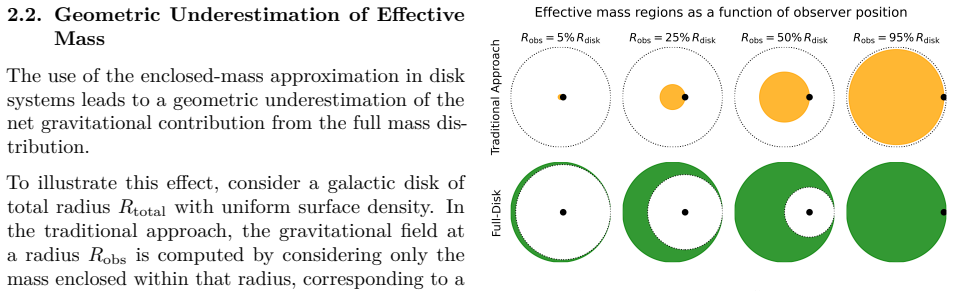
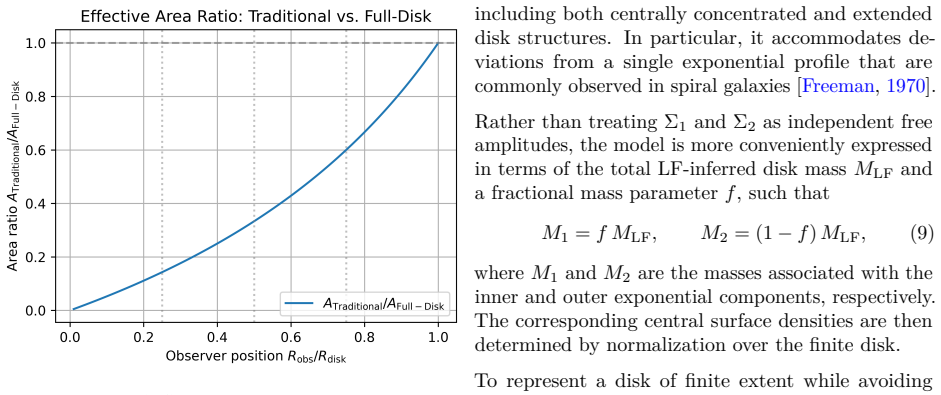
The Lost and Found framework computes the gravitational field in disk galaxies through direct integration over the full mass distribution represented by a parametrized surface density. Applied to a heterogeneous sample, it reproduces the primary features of measured rotation curves while producing inferred masses that scale nearly linearly with conventional dynamical masses at a factor of approximately 0.67. This indicates that geometric assumptions in standard estimates contribute to the apparent baryonic mass shortfall.
What carries the argument
The Lost and Found (LF) framework of full-disk Newtonian gravitational integration using a parametrized disk surface density
If this is right
- The observed flat outer rotation curves can be reproduced with lower total masses when exterior disk contributions are included.
- Standard enclosed-mass formulas overestimate the dynamical mass for flattened systems.
- Part of the mass discrepancy in disk galaxies may be resolved by consistent geometric modeling.
- A linear scaling relation between full-disk and Keplerian masses suggests a systematic correction applicable across galaxy samples.
Where Pith is reading between the lines
- If confirmed, this approach could lower estimates of dark matter required in galactic halos for some systems.
- Re-analysis of existing rotation curve datasets with disk integrators might reveal systematic biases in prior mass determinations.
- Similar full-geometry treatments could be tested on other disk-like structures such as protoplanetary disks or galactic rings.
Load-bearing premise
A parametrized representation of the disk surface density accurately represents the true baryonic mass distribution without additional unseen mass.
What would settle it
A counterexample would be a galaxy whose rotation curve cannot be fit by the full-disk model using only its observed baryonic surface density, requiring extra mass even after full integration.
Figures



read the original abstract
The approximately flat outer parts of spiral galaxy rotation curves are commonly interpreted as evidence for a discrepancy between the observed baryonic mass and the dynamical mass inferred from the measured orbital velocities. In many analyses, simplified mass estimates are often expressed through the Keplerian relation $v^2(R)=GM(<R)/R$, which is exact only under spherical symmetry. Spiral galaxies, however, are flattened disk systems, for which mass exterior to the galactocentric radius under consideration can contribute non-negligibly to the gravitational field. Previous thin-disk studies have shown that the gravitational field in disk galaxies can be computed from the full mass distribution rather than from enclosed-mass approximations alone. Building on this approach, we introduce the \textit{Lost and Found} (LF) framework, a geometrically consistent Newtonian model based on direct full-disk gravitational integration and a parametrized representation of the disk surface density. We apply the LF model to a heterogeneous sample of disk galaxies spanning a broad range of masses and radial extents. The model reproduces the main observed features of the rotation curves, including the inner rise and the approximately flat outer behavior, while yielding systematically lower inferred masses compared to standard Keplerian estimates. Across the sample, the LF-inferred mass scales nearly linearly with the conventional dynamical mass, with a characteristic scaling factor $\eta_{\rm LF}\sim0.67$. These results suggest that part of the inferred mass discrepancy in disk galaxies may be associated with geometric assumptions in standard mass estimates, and highlight the importance of full-disk treatments when interpreting galactic rotation curves.
Editorial analysis
A structured set of objections, weighed in public.
Referee Report
Summary. The paper introduces the Lost and Found (LF) framework, a Newtonian model that performs full-disk gravitational integration using a parametrized representation of the disk surface density. Applied to a heterogeneous sample of disk galaxies, the model reproduces the inner rise and approximately flat outer parts of observed rotation curves while returning total masses that scale linearly with conventional Keplerian dynamical masses at a characteristic factor η_LF∼0.67. The authors conclude that geometric assumptions in standard mass estimates contribute to the apparent baryon-dynamical mass discrepancy in spiral galaxies.
Significance. If the central quantitative result holds under independent constraints, the work would be significant for galactic dynamics: it quantifies how full-disk Newtonian gravity (as opposed to enclosed-mass spherical approximations) can reduce the inferred total mass needed to match rotation curves by roughly one-third. The reported near-linear scaling across galaxies of varying mass and size provides a concrete, testable relation that could inform revised mass modeling pipelines. However, the significance is limited by the absence of any demonstration that the fitted surface-density profiles correspond to actual baryonic distributions measured via photometry or HI maps.
major comments (3)
- [Framework description] Framework section: the parametrized surface density is adjusted to reproduce the observed rotation curves rather than being fixed by independent stellar surface-brightness profiles or gas maps. Consequently, the reported η_LF∼0.67 compares two quantities both derived from the same velocity data, rendering the geometric-interpretation claim circular rather than a genuine prediction from baryonic mass.
- [Methods and implementation] Methods and results: no explicit functional form for the surface-density parametrization, no description of the numerical quadrature used for the full-disk potential, no fitting algorithm or convergence criteria, and no error propagation or validation against mock data are provided. These omissions make the quantitative claim η_LF∼0.67 impossible to reproduce or assess for robustness.
- [Results] Sample and results: the heterogeneous sample is described only qualitatively; without tabulated galaxy properties, selection cuts, or a comparison of LF-inferred masses against independently measured baryonic masses (e.g., from 3.6 μm photometry), it is unclear whether the lower masses reflect physical geometry or merely the extra degrees of freedom in the parametrization.
minor comments (1)
- [Abstract] The abstract states that the model yields 'systematically lower inferred masses' but does not define the radial extent at which total mass is evaluated or whether the same radial cutoff is used for both LF and Keplerian estimates.
Simulated Author's Rebuttal
We thank the referee for their careful reading and constructive comments on our manuscript. We address each major comment below and indicate where revisions will be incorporated.
read point-by-point responses
-
Referee: [Framework description] Framework section: the parametrized surface density is adjusted to reproduce the observed rotation curves rather than being fixed by independent stellar surface-brightness profiles or gas maps. Consequently, the reported η_LF∼0.67 compares two quantities both derived from the same velocity data, rendering the geometric-interpretation claim circular rather than a genuine prediction from baryonic mass.
Authors: The LF framework is intended to quantify the effect of full-disk Newtonian integration versus the spherical Keplerian approximation on the total mass needed to reproduce the same observed rotation curves. The parametrized density represents a flattened disk geometry, and the resulting η_LF factor directly measures how much lower the required mass is when exterior mass contributions are properly included. This is a comparison of two dynamical models fitted to identical velocity data but under different geometric assumptions, not a claim that the density profile is predicted from independent baryonic observations. We will revise the text to clarify this distinction and explicitly note the value of future photometric comparisons. revision: partial
-
Referee: [Methods and implementation] Methods and results: no explicit functional form for the surface-density parametrization, no description of the numerical quadrature used for the full-disk potential, no fitting algorithm or convergence criteria, and no error propagation or validation against mock data are provided. These omissions make the quantitative claim η_LF∼0.67 impossible to reproduce or assess for robustness.
Authors: We agree that these details are required for reproducibility. The revised manuscript will specify the explicit functional form of the surface-density parametrization, describe the numerical quadrature method for the full-disk potential, outline the fitting algorithm together with convergence criteria, and add sections on error propagation and validation against mock rotation curves. revision: yes
-
Referee: [Results] Sample and results: the heterogeneous sample is described only qualitatively; without tabulated galaxy properties, selection cuts, or a comparison of LF-inferred masses against independently measured baryonic masses (e.g., from 3.6 μm photometry), it is unclear whether the lower masses reflect physical geometry or merely the extra degrees of freedom in the parametrization.
Authors: We will expand the results section to include a table of galaxy properties, explicit selection criteria, and, where data permit, direct comparisons of LF-inferred masses with independent baryonic mass estimates from 3.6 μm photometry or similar tracers. This will help separate geometric effects from parametrization freedom. revision: yes
Circularity Check
LF-inferred mass scaling arises from fitting parametrized surface density directly to the same rotation curve data used for conventional dynamical masses
specific steps
-
fitted input called prediction
[Abstract]
"We apply the LF model to a heterogeneous sample of disk galaxies spanning a broad range of masses and radial extents. The model reproduces the main observed features of the rotation curves, including the inner rise and the approximately flat outer behavior, while yielding systematically lower inferred masses compared to standard Keplerian estimates. Across the sample, the LF-inferred mass scales nearly linearly with the conventional dynamical mass, with a characteristic scaling factor η_LF∼0.67."
The LF-inferred mass is obtained by fitting the parametrized surface density to reproduce the observed rotation curves via full-disk integration. The conventional dynamical mass is computed from the same observed velocities via the Keplerian relation. The reported scaling therefore compares two quantities both derived from the identical velocity measurements rather than constituting an independent prediction or first-principles result.
full rationale
The paper applies a parametrized disk surface density in full-disk Newtonian integration to reproduce observed rotation curves, then reports that the resulting total masses scale with conventional Keplerian masses by a factor ~0.67. Because the surface density parameters are adjusted to match the velocity data and the conventional mass is also computed from those velocities, the scaling factor is a direct numerical consequence of the fitting procedure and the choice of gravitational kernel rather than an independent result. The abstract provides the relevant description but does not anchor the parametrization to photometric or HI data.
Axiom & Free-Parameter Ledger
free parameters (1)
- parameters of the disk surface density parametrization
axioms (2)
- domain assumption Newtonian gravity governs galactic dynamics at the relevant scales
- domain assumption Spiral galaxies can be treated as infinitesimally thin disks for gravitational field calculations
Reference graph
Works this paper leans on
-
[1]
doi: 10.1086/113062. Andreas Burkert. The structure of dark matter halos in dwarf galaxies.The Astrophysical Journal, 447 (1):L25,
-
[2]
doi: 10.1046/j.1365-8711. 2003.06531.x. E. Corbelli, D. Thilker, S. Zibetti, C. Giovanardi, and P. Salucci. Dynamical signatures of aλcdm- halo and the distribution of the baryons in m33. Astronomy & Astrophysics, 572:A23,
-
[3]
doi: 10.1051/0004-6361/201424033. W. J. G. de Blok, F. Walter, E. Brinks, C. Tra- chternach, S.-H. Oh, and R. C. Kennicutt. High- resolution rotation curves and galaxy mass models fromthings.The Astronomical Journal, 136(6):2648– 2719,
-
[4]
doi: 10.1088/0004-6256/136/6/2648. James Q. Feng and C. F. Gallo. Mass distribution in rotating thin-disk galaxies according to newtonian dynamics.Galaxies, 1(2):79–101,
-
[5]
3390/galaxies1020079. arXiv:1212.5317. K.C. Freeman. On the disks of spiral and s0 galaxies. The Astrophysical Journal, 160:811,
-
[6]
doi: 10.1051/0004-6361/ 201629300. J. C. Lagarias, J. A. Reeds, M. H. Wright, and P. E. Wright. Convergence properties of the nelder–mead simplex method in low dimensions.SIAM Journal on Optimization, 9(1):112–147,
-
[7]
doi: 10.3847/0004-6256/152/6/157. Stacy S. McGaugh, Federico Lelli, and James M. Schombert. Radial acceleration relation in rotation- ally supported galaxies.Physical Review Letters, 117(20):201101,
-
[8]
Available: https://doi.org/10.1093/comjnl/7.4.308
doi: 10.1093/comjnl/7.4.308. Isaac Newton.Philosophiae Naturalis Principia Math- ematica. Royal Society,
-
[9]
14 Vera C Rubin, W Kent Ford Jr, and Norbert Thon- nard
Traducción de la edición original latina. 14 Vera C Rubin, W Kent Ford Jr, and Norbert Thon- nard. Rotational properties of 21 sc galaxies with a large range of luminosities and radii, from ngc 4605/r= 4kpc/to ugc 2885/r= 122 kpc.Astrophys- ical Journal, Part 1, vol. 238, June 1, 1980, p. 471-487., 238:471–487,
1980
-
[10]
doi: 10.1088/1751-8113/46/22/ 225501. arXiv:1301.5233. Yoshiaki Sofue and Vera Rubin. Rotation curves of spiral galaxies.Annual Review of Astronomy and Astrophysics, 39:137–174,
discussion (0)
Sign in with ORCID, Apple, or X to comment. Anyone can read and Pith papers without signing in.