Recognition: no theorem link
A Practical Introduction to Tensor Network Renormalization with TNRKit.jl
Pith reviewed 2026-05-10 17:57 UTC · model grok-4.3
The pith
TNRKit extracts universal conformal data directly from fixed-point tensors in tensor network renormalization.
A machine-rendered reading of the paper's core claim, the machinery that carries it, and where it could break.
Core claim
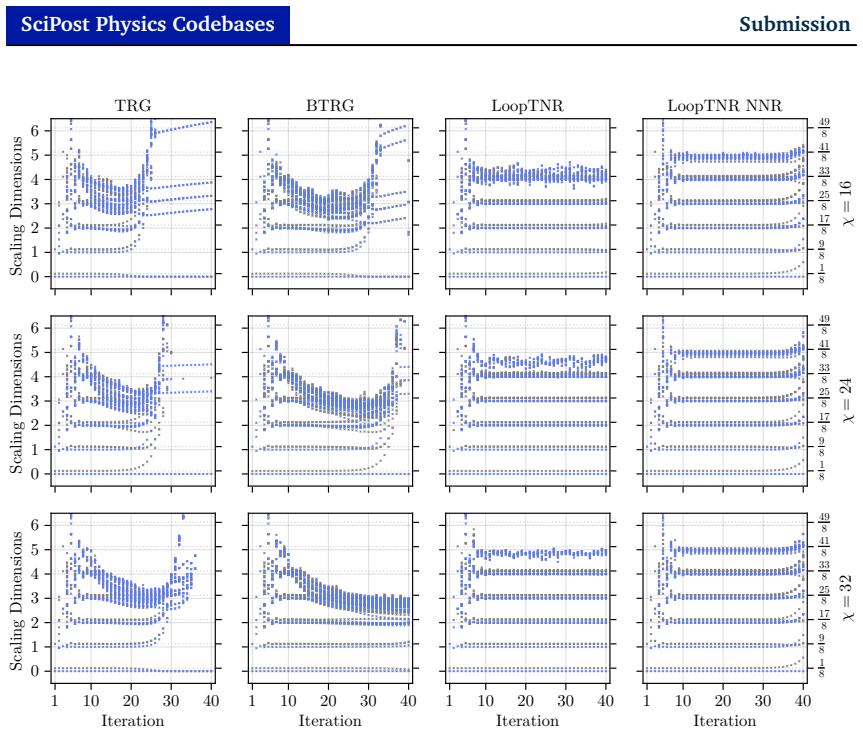
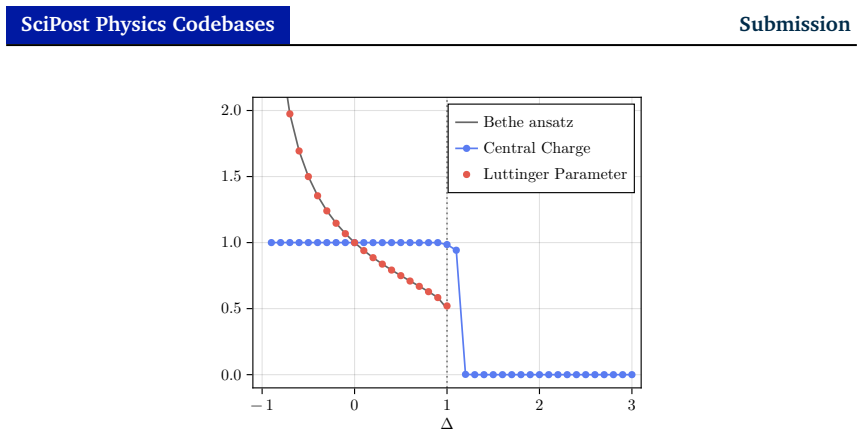
TNRKit is a symmetry-aware framework for constructing tensor-network representations of partition functions and coarse-graining them, enabling the extraction of universal conformal data including scaling dimensions and the central charge directly from fixed-point tensors.
What carries the argument
Fixed-point tensors obtained after coarse-graining, whose spectrum encodes the scaling dimensions and central charge of the model.
If this is right
- Thermodynamic quantities can be calculated from the same tensor networks used for conformal data.
- The framework supports benchmarking of different renormalization algorithms like TRG and HOTRG.
- New tensor renormalization methods can be developed and tested within the extensible package structure.
Where Pith is reading between the lines
- Extending the package to quantum models could bridge classical and quantum critical phenomena studies.
- Fixed-point extraction might help in identifying relevant operators in renormalization group flows for lattice field theories.
Load-bearing premise
The coarse-graining steps must produce tensors that accurately capture the universal properties in their eigenvalues without being dominated by numerical artifacts.
What would settle it
Running the package on the two-dimensional Ising model and finding that the extracted lowest scaling dimension is not close to 0.125 would indicate that the fixed-point data does not reliably encode the conformal spectrum.
Figures





read the original abstract
We present TNRKit, an open-source Julia package for Tensor Network Renormalization (TNR) of two- and three-dimensional classical statistical models and Euclidean lattice field theories. Built on top of TensorKit, it provides a symmetry-aware framework for constructing tensor-network representations of partition functions and coarse-graining them using methods such as TRG, HOTRG, and LoopTNR. Beyond thermodynamic quantities, the package enables the extraction of universal conformal data -- including scaling dimensions and the central charge -- directly from fixed-point tensors. TNRKit is designed with both usability and extensibility in mind, offering a practical platform for applying, benchmarking, and developing modern tensor renormalization algorithms. This paper also serves as a self-contained introduction to the TNR framework.
Editorial analysis
A structured set of objections, weighed in public.
Referee Report
Summary. The manuscript presents TNRKit.jl, an open-source Julia package built on TensorKit for tensor network renormalization of 2D and 3D classical statistical models and Euclidean lattice field theories. It implements coarse-graining routines including TRG, HOTRG, and LoopTNR to compute thermodynamic quantities from tensor-network representations of partition functions, and claims to enable direct extraction of universal conformal data (scaling dimensions and central charge) from the resulting fixed-point tensors. The paper also functions as a self-contained practical introduction to the TNR framework, with emphasis on usability, extensibility, and symmetry awareness.
Significance. If the numerical claims hold, the package would provide a reproducible, symmetry-aware platform that lowers the barrier for applying modern TNR methods to critical phenomena and conformal data extraction. The open-source release and tutorial-style presentation are strengths that could aid benchmarking of new algorithms and promote reproducible research in condensed-matter and statistical physics.
major comments (1)
- [Abstract] Abstract: the central claim that universal conformal data (scaling dimensions and central charge) can be extracted directly from fixed-point tensors produced by the implemented TRG/HOTRG/LoopTNR routines is load-bearing. The manuscript must demonstrate that bond-dimension truncation and any symmetry-breaking errors do not distort the retained eigenvalues/vectors; without explicit benchmarks against exact results (e.g., Ising model) or error analysis of the conformal-data extraction step, the universality of the extracted quantities remains unverified.
minor comments (2)
- The manuscript would benefit from including at least one fully worked numerical example (with code) that reproduces a known central charge or scaling dimension, to substantiate the extraction claim.
- Ensure consistent notation for tensor indices and singular-value spectra across the description of the coarse-graining routines and the conformal-data extraction procedure.
Simulated Author's Rebuttal
We thank the referee for their careful reading of the manuscript and for highlighting the importance of verifying the conformal data extraction procedure. We address the major comment point by point below.
read point-by-point responses
-
Referee: [Abstract] Abstract: the central claim that universal conformal data (scaling dimensions and central charge) can be extracted directly from fixed-point tensors produced by the implemented TRG/HOTRG/LoopTNR routines is load-bearing. The manuscript must demonstrate that bond-dimension truncation and any symmetry-breaking errors do not distort the retained eigenvalues/vectors; without explicit benchmarks against exact results (e.g., Ising model) or error analysis of the conformal-data extraction step, the universality of the extracted quantities remains unverified.
Authors: We agree that the claim in the abstract requires explicit support. The manuscript already contains numerical demonstrations for the 2D Ising model in which scaling dimensions (including the leading magnetic exponent 1/8) and the central charge are extracted from the fixed-point tensors obtained via TRG and LoopTNR and compared against known exact values. To strengthen this further and directly address the referee's concern, we will add a dedicated subsection on error analysis. This will include (i) systematic variation of bond dimension, (ii) quantification of how truncation affects the retained eigenvalues and eigenvectors, and (iii) explicit checks that symmetry sectors remain correctly preserved under the TensorKit implementation. These additions will be placed in the section describing conformal-data extraction and will be accompanied by additional tables and figures. revision: yes
Circularity Check
No circularity: software package implements established TNR methods
full rationale
The paper introduces TNRKit.jl as an open-source implementation of standard tensor network renormalization algorithms (TRG, HOTRG, LoopTNR) on top of TensorKit. It enables extraction of conformal data such as scaling dimensions and central charge from fixed-point tensors using well-known procedures in the TNR literature. No new theoretical derivations, predictions, or uniqueness theorems are claimed that reduce by construction to fitted parameters, self-definitions, or load-bearing self-citations. The package is presented as a computational tool and self-contained introduction, with its functionality depending on external libraries and established methods rather than any self-referential chain within the paper.
Axiom & Free-Parameter Ledger
Reference graph
Works this paper leans on
-
[1]
[1]L. Devos and J. Haegeman,Tensorkit.jl: A julia package for large-scale tensor computa- tions, with a hint of category theory(2025), 2508.10076. [2]S. R. White,Density matrix formulation for quantum renormalization groups, Phys. Rev. Lett.69, 2863 (1992), doi:10.1103/PhysRevLett.69.2863. [3]U. Schollwöck,The density-matrix renormalization group, Rev. Mo...
-
[2]
02414. [44]S. Iino, S. Morita and N. Kawashima,Boundary tensor renormalization group, Phys. Rev. B100, 035449 (2019), doi:10.1103/PhysRevB.100.035449. [45]S. Akiyama, Y. Meurice and R. Sakai,Tensor renormalization group for fermions(2024), 2401.08542. [46]T . Nishino,Density matrix renormalization group method for 2d classical models, Journal of the Physi...
discussion (0)
Sign in with ORCID, Apple, or X to comment. Anyone can read and Pith papers without signing in.