Recognition: no theorem link
Direct-detection constraints on inelastic dark matter with a scalar mediator
Pith reviewed 2026-05-10 17:31 UTC · model grok-4.3
The pith
Xenon experiments can constrain scalar-mediated inelastic dark matter for sub-MeV mass splittings via DM-electron scattering.
A machine-rendered reading of the paper's core claim, the machinery that carries it, and where it could break.
Core claim
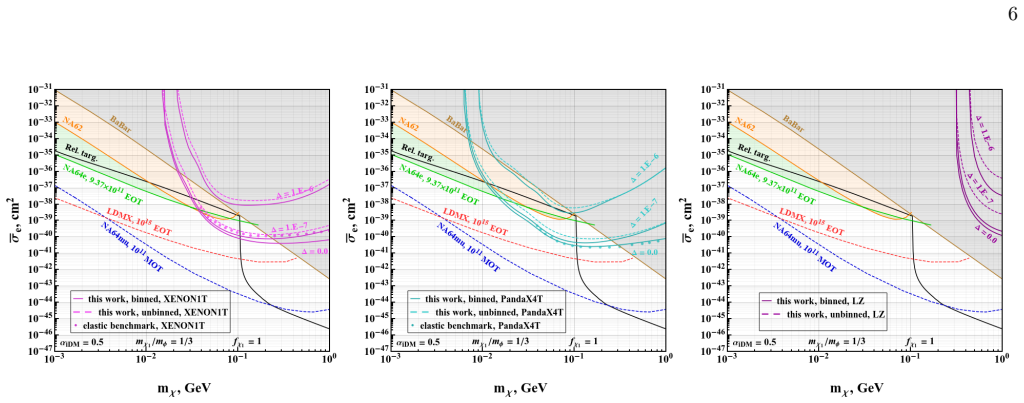
We calculate direct detection constraints on inelastic dark matter (DM) for a scalar portal scenario with leptophilic couplings. The p-wave velocity suppression of the annihilation cross section of scalar-mediated inelastic Dirac DM implies the opening of viable regions of DM parameter space in the MeV-GeV mass range. Xenon-based experiments can provide constraints on scalar-mediated inelastic fermion dark matter for sub-MeV mass splitting, via endothermic and exothermic spin-independent DM-electron scattering. To estimate the relevant constraints, we use public data from the XENON1T, PandaX-4T, and LZ liquid-xenon experiments that measure ionization electron signals.
What carries the argument
endothermic and exothermic spin-independent DM-electron scattering rates for inelastic Dirac fermions coupled through a leptophilic scalar mediator, evaluated in liquid-xenon targets
If this is right
- P-wave suppression opens viable MeV-GeV parameter space that would otherwise be ruled out by relic density.
- Xenon detectors already bound sub-MeV mass splittings through both energy-gain and energy-loss electron scattering.
- Public ionization data from XENON1T, PandaX-4T, and LZ directly translate into limits on the mediator-DM coupling.
- The same scattering kinematics apply to any leptophilic scalar portal model with small inelastic splitting.
Where Pith is reading between the lines
- The same ionization-channel analysis could be repeated on data from other low-threshold noble-liquid or semiconductor detectors.
- If the mediator acquires even small quark couplings, nuclear-recoil channels would become relevant and could strengthen or weaken the bounds.
- Future runs of LZ or DARWIN with improved ionization thresholds would probe still smaller mass splittings or weaker couplings.
- The p-wave relic-density argument may also relax constraints in related models with vector or pseudoscalar mediators.
Load-bearing premise
The scalar mediator couples exclusively to leptons and the dark matter consists of Dirac fermions whose annihilation proceeds only through p-wave channels.
What would settle it
A reanalysis of the XENON1T or LZ ionization-electron dataset that finds zero events in the kinematic window predicted for 10–100 MeV dark matter with a 0.1–1 MeV splitting would exclude the corresponding slice of coupling and mass parameter space.
Figures



read the original abstract
We calculate direct detection constraints on inelastic dark matter (DM) for a scalar portal scenario with leptophilic couplings. The p-wave velocity suppression of the annihilation cross section of scalar-mediated inelastic Dirac DM implies the opening of viable regions of DM parameter space in the MeV-GeV mass range. Xenon-based experiments can provide a constraints on scalar-mediated inelastic fermion dark matter for sub-MeV mass splitting, via endothermic and exothermic spin-independent DM-electron scattering. To estimate the relevant constraints, we use public data from the XENON1T, PandaX-4T, and LZ liquid-xenon experiments that measure ionization electron signals.
Editorial analysis
A structured set of objections, weighed in public.
Referee Report
Summary. The manuscript calculates direct-detection constraints on inelastic Dirac fermion dark matter in a scalar portal model with leptophilic couplings. It argues that p-wave suppression of the annihilation cross section opens viable MeV-GeV parameter space, and that XENON1T, PandaX-4T, and LZ ionization data can constrain sub-MeV mass splittings via endothermic and exothermic spin-independent DM-electron scattering, using public data releases to estimate the limits.
Significance. If the limits hold after proper accounting for inelastic kinematics, the work would usefully map viable regions for scalar-mediated inelastic DM and highlight the role of electron scattering channels. The explicit use of public experimental data is a strength for reproducibility and verifiability.
major comments (1)
- [Abstract] Abstract: the statement that public data from XENON1T, PandaX-4T, and LZ 'measure ionization electron signals' are used 'to estimate the relevant constraints' does not address the required re-derivation of the differential rate. The inelastic minimum velocity is v_min = sqrt(2δ/μ) + (E_e + δ)/sqrt(2 m_DM E_e) (endothermic) or its exothermic counterpart, and dσ/dE_e acquires an extra kinematic factor from δ; published efficiencies and background models are derived under elastic assumptions. Without re-weighting the galactic velocity integral and spectrum, the overlap with signal regions and thresholds changes, undermining the applicability of the quoted limits.
Simulated Author's Rebuttal
We thank the referee for their careful reading of the manuscript and for highlighting an important technical point regarding the application of public data to inelastic scattering. We address the major comment below and will revise the manuscript to improve clarity on this issue.
read point-by-point responses
-
Referee: [Abstract] Abstract: the statement that public data from XENON1T, PandaX-4T, and LZ 'measure ionization electron signals' are used 'to estimate the relevant constraints' does not address the required re-derivation of the differential rate. The inelastic minimum velocity is v_min = sqrt(2δ/μ) + (E_e + δ)/sqrt(2 m_DM E_e) (endothermic) or its exothermic counterpart, and dσ/dE_e acquires an extra kinematic factor from δ; published efficiencies and background models are derived under elastic assumptions. Without re-weighting the galactic velocity integral and spectrum, the overlap with signal regions and thresholds changes, undermining the applicability of the quoted limits.
Authors: We agree that the inelastic kinematics must be handled carefully and that the abstract statement is too brief to convey this. In the full calculation we use the inelastic v_min (with the exact form given by the referee for both endothermic and exothermic cases) when evaluating the velocity integral, and we include the additional kinematic factor proportional to δ in dσ/dE_e. The expected ionization-electron spectrum is computed with these modifications before folding with the experimental efficiency curves taken from the public data releases. We acknowledge that the abstract does not explicitly note this re-derivation, which could give the impression that elastic efficiencies were applied directly. In the revised manuscript we will update the abstract to state that the constraints are derived from public data after properly incorporating the inelastic kinematics into the differential rate and velocity integral. We will also add a short paragraph in the methods section that writes out the inelastic v_min and the modified dσ/dE_e to make the procedure fully transparent. revision: partial
Circularity Check
No circularity: constraints computed from external public data using model kinematics
full rationale
The paper derives direct-detection limits by folding the inelastic DM-electron scattering rate (with endothermic/exothermic kinematics and p-wave annihilation suppression) into public XENON1T/PandaX-4T/LZ ionization data. No parameter is fitted to the target dataset and then re-used as a 'prediction'; the central result is an application of the model's differential cross section and velocity integral to independent experimental efficiencies and backgrounds. No self-citation chain, ansatz smuggling, or renaming of known results is required for the load-bearing step. The derivation remains self-contained against the cited external data releases.
Axiom & Free-Parameter Ledger
free parameters (3)
- DM mass
- mass splitting delta
- mediator-DM coupling
axioms (2)
- standard math Standard model of particle physics governs electron interactions
- domain assumption Inelastic DM is Dirac fermion with scalar mediator
invented entities (1)
-
scalar mediator
no independent evidence
Forward citations
Cited by 1 Pith paper
-
Prospects of boosted magnetic dipole inelastic fermion dark matter at ILC-BDX
ILC-BDX can probe inelastic magnetic-dipole dark matter in a relevant parameter space for relative mass splittings of 0.05 and 0.001 over 1-10 years of running with 4e21 electrons on target per year.
Reference graph
Works this paper leans on
-
[1]
The momentum transfer depends on the dark-matter velocity𝑣 𝜒 and deposited energy𝐸d as [57]: 𝑞±(𝑣) = ⃒⃒⃒𝑚𝜒𝑣𝜒 ± √︁ 𝑚2𝜒𝑣2𝜒 −2𝑚 𝜒(𝐸d +𝛿) ⃒⃒⃒ ,(7) which implies the following condition on the dark matter velocity for exothermic processes with|𝛿|< 𝐸 d and endothermic processes as: 𝑣2 𝜒 >2(𝐸 d +𝛿)/𝑚 𝜒.(8) In particular, for the up-scattering process one finds t...
-
[2]
Planck 2018 results. VI. Cosmological parameters
N. Aghanimet al.(Planck), “Planck 2018 results. VI. Cosmological parameters,” Astron. Astrophys.641, A6 (2020), [Erratum: Astron.Astrophys. 652, C4 (2021)], arXiv:1807.06209 [astro-ph.CO]
work page internal anchor Pith review Pith/arXiv arXiv 2018
-
[3]
Gianfranco Bertone and Dan Hooper, “History of dark matter,” Rev. Mod. Phys.90, 045002 (2018), arXiv:1605.04909 [astro-ph.CO]. 9
work page Pith review arXiv 2018
-
[4]
Dark Matter Search Results from a One Ton-Year Exposure of XENON1T,
E. Aprileet al.(XENON), “Dark Matter Search Results from a One Ton-Year Exposure of XENON1T,” Phys. Rev. Lett.121, 111302 (2018), arXiv:1805.12562 [astro- ph.CO]
-
[5]
Dark Matter Search Re- sults from the PandaX-4T Commissioning Run,
Yue Menget al.(PandaX-4T), “Dark Matter Search Re- sults from the PandaX-4T Commissioning Run,” Phys. Rev. Lett.127, 261802 (2021), arXiv:2107.13438 [hep- ex]
-
[6]
J. Aalberset al.(LZ), “First Dark Matter Search Results from the LUX-ZEPLIN (LZ) Experiment,” Phys. Rev. Lett.131, 041002 (2023), arXiv:2207.03764 [hep-ex]
-
[7]
Cosmological Lower Bound on Heavy Neutrino Masses,
Benjamin W. Lee and Steven Weinberg, “Cosmological Lower Bound on Heavy Neutrino Masses,” Phys. Rev. Lett.39, 165–168 (1977)
1977
-
[8]
The Lee-Weinberg Bound Revisited,
Edward W. Kolb and Keith A. Olive, “The Lee-Weinberg Bound Revisited,” Phys. Rev. D33, 1202 (1986), [Erra- tum: Phys.Rev.D 34, 2531 (1986)]
1986
-
[9]
Gordan Krnjaic, “Probing Light Thermal Dark-Matter With a Higgs Portal Mediator,” Phys. Rev. D94, 073009 (2016), arXiv:1512.04119 [hep-ph]
-
[10]
Gauge singlet scalars as cold dark mat- ter,
John McDonald, “Gauge singlet scalars as cold dark mat- ter,” Phys. Rev. D50, 3637–3649 (1994), arXiv:hep- ph/0702143
-
[11]
The Minimal model of nonbaryonic dark matter: A Singlet scalar,
C. P. Burgess, Maxim Pospelov, and Tonnis ter Veld- huis, “The Minimal model of nonbaryonic dark matter: A Singlet scalar,” Nucl. Phys. B619, 709–728 (2001), arXiv:hep-ph/0011335
-
[12]
How to Find a Hidden World at the Large Hadron Collider,
James D. Wells, “How to Find a Hidden World at the Large Hadron Collider,” , 283–298 (2008), arXiv:0803.1243 [hep-ph]
-
[13]
H. Sieber, D. V. Kirpichnikov, I. V. Voronchikhin, P. Crivelli, S. N. Gninenko, M. M. Kirsanov, N. V. Kras- nikov, L. Molina-Bueno, and S. K. Sekatskii, “Probing hidden sectors with a muon beam: Implication of spin-0 dark matter mediators for the muon (g-2) anomaly and the validity of the Weisz¨ acker-Williams approach,” Phys. Rev. D108, 056018 (2023), ar...
-
[14]
Probingpurelyinelasticscalardarkmatteracross colliders and gravitational wave observatories,
Jinhui Guo, Jia Liu, Chenhao Peng, and Xiao-Ping Wang,“Probingpurelyinelasticscalardarkmatteracross colliders and gravitational wave observatories,” Phys. Rev. D112, 115014 (2025), arXiv:2508.13276 [hep-ph]
-
[15]
I. V. Voronchikhin and D. V. Kirpichnikov, “Probing scalar, Dirac, Majorana, and vector dark matter through a spin-0 electron-specific mediator at electron fixed- target experiments,” Phys. Rev. D109, 075012 (2024), arXiv:2312.15697 [hep-ph]
-
[16]
Mathias Becker, Emanuele Copello, Julia Harz, and Martin Napetschnig, “Manual for SE+BSF4DM – A mi- crOMEGAs package for Sommerfeld Effect and Bound State Formation in colored Dark Sectors,” (2025), arXiv:2512.02155 [hep-ph]
-
[17]
Mathias Becker, Emanuele Copello, Julia Harz, and Martin Napetschnig, “Sommerfeld Effect and Bound State Formation for Dark Matter Models with Colored Mediators with SE+BSF4DM,” (2026), arXiv:2601.03026 [hep-ph]
-
[18]
Scalar-Mediated Inelastic Dark Matter as a Solution to Small-Scale Structure Anomalies
Zihan Wang, “Scalar-Mediated Inelastic Dark Matter as a Solution to Small-Scale Structure Anomalies,” (2025), arXiv:2512.18959 [hep-ph]
work page internal anchor Pith review Pith/arXiv arXiv 2025
-
[19]
Two U(1)’s and Epsilon Charge Shifts,
Bob Holdom, “Two U(1)’s and Epsilon Charge Shifts,” Phys. Lett. B166, 196–198 (1986)
1986
-
[20]
Analyzing the Discovery Potential for Light Dark Matter,
Eder Izaguirre, Gordan Krnjaic, Philip Schuster, and Natalia Toro, “Analyzing the Discovery Potential for LightDarkMatter,” Phys.Rev.Lett.115,251301(2015), arXiv:1505.00011 [hep-ph]
- [21]
-
[22]
Lepton phenomenology of Stueckelberg por- tal to dark sector,
Aliaksei Kachanovich, Sergey Kovalenko, Serguei Kuleshov, Valery E. Lyubovitskij, and Alexey S. Zhevlakov, “Lepton phenomenology of Stueckelberg por- tal to dark sector,” Phys. Rev. D105, 075004 (2022), arXiv:2111.12522 [hep-ph]
-
[23]
Dark𝑆𝑈(2) Stueckelberg portal,
Valery E. Lyubovitskij, Alexey S. Zhevlakov, Aliak- sei Kachanovich, and Serguei Kuleshov, “Dark𝑆𝑈(2) Stueckelberg portal,” Phys. Rev. D107, 055006 (2023), arXiv:2210.05555 [hep-ph]
-
[24]
Probing light exotics from a hidden sector at c-𝜏factories with polarized electron beams,
Dmitry Gorbunov and Dmitry Kalashnikov, “Probing light exotics from a hidden sector at c-𝜏factories with polarized electron beams,” Phys. Rev. D107, 015014 (2023), arXiv:2211.06270 [hep-ph]
-
[25]
Probing feebly interacting dark matter with monojet searches,
J´ erˆ ome Claude, Ma´ ıra Dutra, and Stephen God- frey, “Probing feebly interacting dark matter with monojet searches,” Phys. Rev. D107, 075006 (2023), arXiv:2208.09422 [hep-ph]
-
[26]
Direct detection of cosmic ray-boosted puffy dark mat- ter,
Wenyu Wang, Wu-Long Xu, Jin Min Yang, and Rui Zhu, “Direct detection of cosmic ray-boosted puffy dark mat- ter,” Nucl. Phys. B995, 116348 (2023), arXiv:2305.12668 [hep-ph]
-
[27]
Implication of the Weizsacker-Williams approximation for the dark matter mediator production,
I. V. Voronchikhin and D. V. Kirpichnikov, “Implication of the Weizsacker-Williams approximation for the dark matter mediator production,” Phys. Rev. D111, 035034 (2025), arXiv:2409.12748 [hep-ph]
-
[28]
Cosmic-ray boosted inelastic dark matter from neutrino-emitting active galactic nuclei,
R. Andrew Gustafson, Gonzalo Herrera, Mainak Mukhopadhyay, Kohta Murase, and Ian M. Shoe- maker, “Cosmic-ray boosted inelastic dark matter from neutrino-emitting active galactic nuclei,” (2025), arXiv:2508.20984 [hep-ph]
-
[29]
Gonzalo Herrera, Alejandro Ibarra, and Satoshi Shirai, “Enhanced prospects for direct detection of inelastic dark matter from a non-galactic diffuse component,” JCAP 04, 026 (2023), arXiv:2301.00870 [hep-ph]
-
[30]
Cosmic-ray cooling in active galactic nuclei as a new probe of inelastic dark matter,
R. Andrew Gustafson, Gonzalo Herrera, Mainak Mukhopadhyay, Kohta Murase, and Ian M. Shoemaker, “Cosmic-ray cooling in active galactic nuclei as a new probe of inelastic dark matter,” Phys. Rev. D111, L121303 (2025), arXiv:2408.08947 [hep-ph]
-
[31]
Gravity-mediated (or Composite) Dark Matter,
Hyun Min Lee, Myeonghun Park, and Veronica Sanz, “Gravity-mediated (or Composite) Dark Matter,” Eur. Phys. J. C74, 2715 (2014), arXiv:1306.4107 [hep-ph]
-
[32]
Yoo-Jin Kang and Hyun Min Lee, “Lightening Gravity- Mediated Dark Matter,” Eur. Phys. J. C80, 602 (2020), arXiv:2001.04868 [hep-ph]
-
[33]
Graviton-photon production with a massive spin-2 particle,
Joshua A. Gill, Dipan Sengupta, and Anthony G. Williams, “Graviton-photon production with a massive spin-2 particle,” Phys. Rev. D108, L051702 (2023), arXiv:2303.04329 [hep-ph]
-
[34]
Cosmic ray boosted sub-GeV gravita- tionally interacting dark matter in direct detection,
Wenyu Wang, Lei Wu, Jin Min Yang, Hang Zhou, and Bin Zhu, “Cosmic ray boosted sub-GeV gravita- tionally interacting dark matter in direct detection,” JHEP12, 072 (2020), [Erratum: JHEP 02, 052 (2021)], arXiv:1912.09904 [hep-ph]
-
[35]
Warm dark matter from a gravitational freeze-in in extra dimensions,
Arturo de Giorgi and Stefan Vogl, “Warm dark matter from a gravitational freeze-in in extra dimensions,” JHEP 04, 032 (2023), arXiv:2208.03153 [hep-ph]
-
[36]
The bremsstrahlung-like production of the massive spin-2 dark matter mediator,
I. V. Voronchikhin and D. V. Kirpichnikov, “The bremsstrahlung-like production of the massive spin-2 10 dark matter mediator,” Eur. Phys. J. C85, 1110 (2025), arXiv:2412.10150 [hep-ph]
-
[37]
Junzhe Liu and Alfredo Gurrola, “Probing Freeze-In Dark Matter via a Spin-2 Portal at the LHC with Vector Boson Fusion and Machine Learning,” (2026), arXiv:2604.02604 [hep-ph]
work page internal anchor Pith review Pith/arXiv arXiv 2026
-
[38]
David Tucker-Smith and Neal Weiner, “Inelastic dark matter,” Phys. Rev. D64, 043502 (2001), arXiv:hep- ph/0101138
-
[39]
Final model independent result of DAMA/LIBRA-phase1,
R. Bernabeiet al., “Final model independent result of DAMA/LIBRA-phase1,” Eur. Phys. J. C73, 2648 (2013), arXiv:1308.5109 [astro-ph.GA]
-
[40]
Andrea De Simone, Veronica Sanz, and Hiromitsu Phil Sato, “Pseudo-Dirac Dark Matter Leaves a Trace,” Phys. Rev. Lett.105, 121802 (2010), arXiv:1004.1567 [hep-ph]
-
[41]
Masha Baryakhtar, Asher Berlin, Hongwan Liu, and Neal Weiner, “Electromagnetic signals of inelas- tic dark matter scattering,” JHEP06, 047 (2022), arXiv:2006.13918 [hep-ph]
-
[42]
Cosmology and signals of light pseudo-Dirac dark matter,
MarianaCarrilloGonz´ alezandNataliaToro,“Cosmology and signals of light pseudo-Dirac dark matter,” JHEP04, 060 (2022), arXiv:2108.13422 [hep-ph]
-
[43]
Testing Light Dark Matter Coan- nihilation With Fixed-Target Experiments,
Eder Izaguirre, Yonatan Kahn, Gordan Krnjaic, and Matthew Moschella, “Testing Light Dark Matter Coan- nihilation With Fixed-Target Experiments,” Phys. Rev. D96, 055007 (2017), arXiv:1703.06881 [hep-ph]
-
[44]
Unlocking the inelastic Dark Matter window with vector mediators,
Ana Luisa Foguel, Peter Reimitz, and Re- nata Zukanovich Funchal, “Unlocking the inelastic Dark Matter window with vector mediators,” JHEP05, 001 (2025), arXiv:2410.00881 [hep-ph]
-
[45]
Examin- ing scalar portal inelastic dark matter with lepton fixed- target experiments,
I. V. Voronchikhin and D. V. Kirpichnikov, “Examin- ing scalar portal inelastic dark matter with lepton fixed- target experiments,” Phys. Rev. D113, 015031 (2026), arXiv:2505.04290 [hep-ph]
-
[46]
Missing energy signatures of inelastic magnetic dipole DM at NA64e,
Sergei N. Gninenko, N. V. Krasnikov, I. V. Voronchikhin, and D. V. Kirpichnikov, “Missing energy signatures of inelastic magnetic dipole DM at NA64e,” (2026), arXiv:2603.28278 [hep-ph]
-
[47]
Inelastic Dark Matter at the LHC Lifetime Frontier: ATLAS, CMS, LHCb, CODEX-b, FASER, and MATHUSLA,
Asher Berlin and Felix Kling, “Inelastic Dark Matter at the LHC Lifetime Frontier: ATLAS, CMS, LHCb, CODEX-b, FASER, and MATHUSLA,” Phys. Rev. D 99, 015021 (2019), arXiv:1810.01879 [hep-ph]
-
[48]
Krzysztof Jod lowski, “Looking forward to inelastic DM with electromagnetic form factors at FASER and beam dump experiments,” Phys. Rev. D108, 115025 (2023), arXiv:2305.16781 [hep-ph]
-
[49]
Extend- ing the discovery potential for inelastic-dipole dark mat- ter with FASER,
Keith R. Dienes, Jonathan L. Feng, Max Fieg, Fei Huang, Seung J. Lee, and Brooks Thomas, “Extend- ing the discovery potential for inelastic-dipole dark mat- ter with FASER,” Phys. Rev. D107, 115006 (2023), arXiv:2301.05252 [hep-ph]
-
[50]
Detectability of Certain Dark Matter Candidates,
Mark W. Goodman and Edward Witten, “Detectability of Certain Dark Matter Candidates,” Phys. Rev. D31, 3059 (1985)
1985
-
[51]
Direct Detection of WIMP Dark Mat- ter: Concepts and Status,
Marc Schumann, “Direct Detection of WIMP Dark Mat- ter: Concepts and Status,” J. Phys. G46, 103003 (2019), arXiv:1903.03026 [astro-ph.CO]
-
[52]
Direct Detection of Sub-GeV Dark Matter
Rouven Essig, Jeremy Mardon, and Tomer Volansky, “Direct Detection of Sub-GeV Dark Matter,” Phys. Rev. D85, 076007 (2012), arXiv:1108.5383 [hep-ph]
work page Pith review arXiv 2012
- [53]
-
[54]
New Constraints and Prospects for sub-GeV Dark Matter Scattering off Electrons in Xenon
Rouven Essig, Tomer Volansky, and Tien-Tien Yu, “New Constraints and Prospects for sub-GeV Dark Matter Scattering off Electrons in Xenon,” Phys. Rev. D96, 043017 (2017), arXiv:1703.00910 [hep-ph]
work page Pith review arXiv 2017
-
[55]
Timon Emken, Rouven Essig, Chris Kouvaris, and Mukul Sholapurkar, “Direct Detection of Strongly In- teracting Sub-GeV Dark Matter via Electron Recoils,” JCAP09, 070 (2019), arXiv:1905.06348 [hep-ph]
-
[56]
Direct Detection of sub-GeV Dark Matter with Semiconductor Targets
Rouven Essig, Marivi Fernandez-Serra, Jeremy Mardon, AdrianSoto, TomerVolansky, andTien-TienYu,“Direct Detection of sub-GeV Dark Matter with Semiconductor Targets,” JHEP05, 046 (2016), arXiv:1509.01598 [hep- ph]
work page Pith review arXiv 2016
-
[57]
A. R. Caddell, V. V. Flambaum, and B. M. Roberts, “Accurate electron-recoil ionization factors for dark mat- ter direct detection in xenon, krypton, and argon,” Phys. Rev. D108, 083030 (2023), arXiv:2305.05125 [hep-ph]
-
[58]
Keisuke Harigaya, Yuichiro Nakai, and Motoo Suzuki, “Inelastic Dark Matter Electron Scattering and the XENON1T Excess,” Phys. Lett. B809, 135729 (2020), arXiv:2006.11938 [hep-ph]
-
[59]
Lee,Exothermic dark matter for XENON1T excess,JHEP01(2021) 019 [2006.13183]
Hyun Min Lee, “Exothermic dark matter for XENON1T excess,” JHEP01, 019 (2021), arXiv:2006.13183 [hep- ph]
-
[60]
Dark matter-electron interactions in materials beyond the dark photon model,
Riccardo Catena, Daniel Cole, Timon Emken, Marek Matas, Nicola Spaldin, Walter Tarantino, and Einar Urdshals, “Dark matter-electron interactions in materials beyond the dark photon model,” JCAP03, 052 (2023), arXiv:2210.07305 [hep-ph]
-
[61]
Search for Light Inelastic Dark Matter with Low- Energy Ionization Signatures in PandaX-4T,
Yu-Chen Wang, Youhui Yun, Hong-Jian He, and Yue Meng, “Search for Light Inelastic Dark Matter with Low- Energy Ionization Signatures in PandaX-4T,” (2025), arXiv:2508.13062 [hep-ph]
- [62]
-
[63]
A systematic investigation on dark matter- electron scattering in effective field theories,
Jin-Han Liang, Yi Liao, Xiao-Dong Ma, and Hao- Lin Wang, “A systematic investigation on dark matter- electron scattering in effective field theories,” JHEP07, 279 (2024), arXiv:2406.10912 [hep-ph]
- [64]
-
[65]
Exploring leptophilic dark matter with NA64- 𝜇,
Chien-Yi Chen, Jonathan Kozaczuk, and Yi-Ming Zhong, “Exploring leptophilic dark matter with NA64- 𝜇,” JHEP10, 154 (2018), arXiv:1807.03790 [hep-ph]
- [66]
-
[67]
Two-component spinor techniques and Feyn- man rules for quantum field theory and supersymmetry,
Herbi K. Dreiner, Howard E. Haber, and Stephen P. Martin, “Two-component spinor techniques and Feyn- man rules for quantum field theory and supersymmetry,” Phys.Rept.494,1–196(2010),arXiv:0812.1594[hep-ph]
-
[68]
X-rays from inelastic dark matter freeze-in,
Gordan Krnjaic, David McKeen, Riku Mizuta, Gopolang Mohlabeng, David E. Morrissey, and Douglas Tuckler, “X-rays from inelastic dark matter freeze-in,” Phys. Rev. D112, 115039 (2025), arXiv:2509.19428 [hep-ph]
-
[69]
A minimalistic model for inelastic dark matter,
Giovani Dalla Valle Garcia, “A minimalistic model for inelastic dark matter,” Phys. Lett. B862, 139320 (2025), 11 arXiv:2411.02147 [hep-ph]
-
[70]
Three exceptions in the calculation of relic abundances,
Kim Griest and David Seckel, “Three exceptions in the calculation of relic abundances,” Phys. Rev. D43, 3191– 3203 (1991)
1991
-
[71]
Joakim Edsjo and Paolo Gondolo, “Neutralino relic den- sity including coannihilations,” Phys. Rev. D56, 1879– 1894 (1997), arXiv:hep-ph/9704361
-
[72]
Testing Thermal-Relic Dark Matter with a Dark Photon Mediator,
Gordan Krnjaic, “Testing Thermal-Relic Dark Matter withaDarkPhotonMediator,” (2025),arXiv:2505.04626 [hep-ph]
-
[73]
On Effective Degrees of Freedom in the Early Universe
Lars Husdal, “On Effective Degrees of Freedom in the Early Universe,” Galaxies4, 78 (2016), arXiv:1609.04979 [astro-ph.CO]
work page Pith review arXiv 2016
-
[74]
Calculations of Relic Densities in the Early Universe,
Mark Srednicki, Richard Watkins, and Keith A. Olive, “Calculations of Relic Densities in the Early Universe,” Nucl. Phys. B310, 693 (1988)
1988
-
[75]
Kolb and Michael S
Edward W. Kolb and Michael S. Turner,The Early Uni- verse, Vol. 69 (Taylor and Francis, 2019)
2019
-
[76]
CMB Constraints on WIMP Annihilation: Energy Absorption During the Recombination Epoch
Tracy R. Slatyer, Nikhil Padmanabhan, and Douglas P. Finkbeiner, “CMB Constraints on WIMP Annihilation: Energy Absorption During the Recombination Epoch,” Phys. Rev. D80, 043526 (2009), arXiv:0906.1197 [astro- ph.CO]
work page Pith review arXiv 2009
- [77]
-
[78]
Resonant pseudo-Dirac dark matter as a sub-GeV thermal target,
Nirmalya Brahma, Saniya Heeba, and Katelin Schutz, “Resonant pseudo-Dirac dark matter as a sub-GeV thermal target,” Phys. Rev. D109, 035006 (2024), arXiv:2308.01960 [hep-ph]
-
[79]
E. Aprileet al.(XENON), “Light Dark Matter Search with Ionization Signals in XENON1T,” Phys. Rev. Lett. 123, 251801 (2019), arXiv:1907.11485 [hep-ex]
-
[80]
Search for Light Dark Matter with Ionization Signals in the PandaX-4T Experiment,
Shuaijie Liet al.(PandaX), “Search for Light Dark Matter with Ionization Signals in the PandaX-4T Experiment,” Phys. Rev. Lett.130, 261001 (2023), arXiv:2212.10067 [hep-ex]
discussion (0)
Sign in with ORCID, Apple, or X to comment. Anyone can read and Pith papers without signing in.