Recognition: unknown
Prospects of boosted magnetic dipole inelastic fermion dark matter at ILC-BDX
Pith reviewed 2026-05-10 00:35 UTC · model grok-4.3
The pith
The ILC-BDX beam-dump experiment can probe inelastic fermionic dark matter with an off-diagonal magnetic dipole coupling over relevant parameter space.
A machine-rendered reading of the paper's core claim, the machinery that carries it, and where it could break.
Core claim
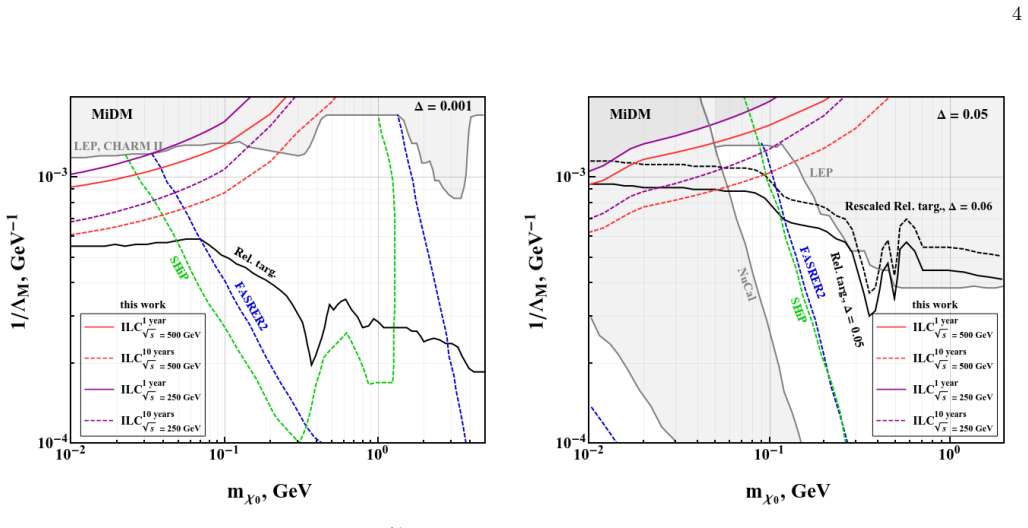
We compute the production rate of dark matter states in the bremsstrahlung-like process e^{-} N → e^{-} N γ* (→ χ_{1} χ̄_{0}) induced by high-energy electrons scattering on target nuclei. The resulting boosted dark matter fluxes are propagated to the detector where signal events arise from scattering off detector electrons. The projected exclusion limits for one and ten years of data taking with 4.0 × 10^{21} electrons on target per year show that ILC-BDX can probe inelastic magnetic-dipole dark matter over a phenomenologically relevant region of parameter space for benchmark relative mass splittings Δ = 0.05 and Δ = 0.001.
What carries the argument
The off-diagonal magnetic dipole operator that couples the two dark matter states to the photon, enabling both production via electron-nucleus bremsstrahlung and detection via electron scattering.
Load-bearing premise
Backgrounds can be suppressed sufficiently and the boosted dark matter signal remains observable at the stated electron-on-target rate of 4.0 × 10^{21} per year.
What would settle it
No observed excess events in the ILC-BDX detector after ten years of running at 4.0 × 10^{21} electrons on target per year would exclude the predicted signal rates for the considered dipole strengths and mass splittings.
Figures


read the original abstract
In this work, we investigate the projected sensitivity of the Beam-Dump eXperiment at the International Linear Collider (ILC-BDX) to inelastic fermionic dark matter coupled to the Standard Model photon through an off-diagonal magnetic dipole operator. We compute the production rate of dark matter states in the bremsstrahlung like process $e^- N \to e^- N \gamma^* (\to \chi_{1} \bar{\chi}_0)$, induced by the scattering of high-energy electrons on target nuclei. The resulting boosted dark matter fluxes are then propagated to the detector, where the signal events arise from scattering off detector electrons. The projected exclusion limits are derived using the expected numbers of electrons on target (this implies a typical rate of $4.0~\times~10^{21}/\mbox{year}$) corresponding to 1 year and 10 years of data taking. To characterize the impact of inelasticity, we consider two benchmark relative mass splittings, $\Delta=0.05$ and $\Delta=0.001$, motivated by thermal dark matter scenarios. Our results show that ILC-BDX can probe inelastic magnetic-dipole dark matter over a phenomenologically relevant region of parameter space.
Editorial analysis
A structured set of objections, weighed in public.
Referee Report
Summary. The paper computes the production of boosted inelastic fermionic dark matter states χ₁ and χ₀ via off-diagonal magnetic dipole transitions in electron-nucleus bremsstrahlung-like scattering at the ILC beam dump, propagates the resulting flux to a downstream detector, and derives projected exclusion limits on the dipole coupling strength for two benchmark mass splittings (Δ = 0.05 and Δ = 0.001) using nominal exposures of 4.0 × 10²¹ electrons on target per year for 1 and 10 years of running. The central claim is that ILC-BDX can probe a phenomenologically relevant region of parameter space for this DM model.
Significance. If the background-suppression assumptions hold, the work would furnish concrete sensitivity projections for a new inelastic DM search channel at a future linear-collider beam-dump facility, complementing existing direct-detection and collider bounds on magnetic-dipole operators. The calculation of the production cross section and boosted flux propagation is a standard but useful exercise; the paper does not, however, supply machine-checked proofs, fully reproducible code, or parameter-free derivations that would strengthen its technical contribution.
major comments (2)
- [Abstract and projected-limits section] The projected limits rest on the unverified premise that residual backgrounds (beam-related, cosmic, and detector) can be suppressed sufficiently for the inelastic DM-electron scattering signal to be observable at the quoted 4.0 × 10²¹ eot/yr exposure. No quantitative background model, rejection efficiencies after cuts, or Monte Carlo validation is presented; the inelastic kinematics impose an energy threshold that further reduces both signal and the effective background rejection, yet this is not folded into any background estimate. This assumption is load-bearing for the central claim that ILC-BDX can probe the stated parameter space.
- [Benchmark selection and results] The two benchmark values Δ = 0.05 and Δ = 0.001 are motivated by thermal DM scenarios, but the paper does not demonstrate how the derived limits translate to the full (m_χ, Δ, g) parameter space or whether the sensitivity degrades continuously between these points; the exclusion contours therefore remain tied to these discrete choices rather than providing a general mapping.
minor comments (2)
- [Introduction] Notation for the dark-matter states (χ₁, χ₀) and the relative mass splitting Δ should be defined explicitly at first use rather than introduced only in the abstract.
- [Experimental setup] The electron-on-target rate is given as 4.0 × 10²¹ per year; the corresponding integrated luminosity or running time assumptions for the 1-year and 10-year projections should be stated explicitly in a dedicated table or paragraph.
Simulated Author's Rebuttal
We thank the referee for the careful review and constructive comments on our manuscript. We address each major comment below and have revised the manuscript to improve clarity and transparency where feasible.
read point-by-point responses
-
Referee: [Abstract and projected-limits section] The projected limits rest on the unverified premise that residual backgrounds (beam-related, cosmic, and detector) can be suppressed sufficiently for the inelastic DM-electron scattering signal to be observable at the quoted 4.0 × 10²¹ eot/yr exposure. No quantitative background model, rejection efficiencies after cuts, or Monte Carlo validation is presented; the inelastic kinematics impose an energy threshold that further reduces both signal and the effective background rejection, yet this is not folded into any background estimate. This assumption is load-bearing for the central claim that ILC-BDX can probe the stated parameter space.
Authors: We agree that the projections rely on the assumption of sufficient background suppression and that no quantitative background model or Monte Carlo validation is included. The manuscript is a sensitivity study focused on signal production and detection rates rather than a full experimental proposal. In the revised version, we will add explicit discussion in the projected-limits section stating the background-suppression assumptions, noting the impact of the inelastic energy threshold on both signal and potential backgrounds, and clarifying that these are indicative projections pending dedicated background studies. This makes the load-bearing assumption more transparent without altering the central results. revision: partial
-
Referee: [Benchmark selection and results] The two benchmark values Δ = 0.05 and Δ = 0.001 are motivated by thermal DM scenarios, but the paper does not demonstrate how the derived limits translate to the full (m_χ, Δ, g) parameter space or whether the sensitivity degrades continuously between these points; the exclusion contours therefore remain tied to these discrete choices rather than providing a general mapping.
Authors: The benchmarks were chosen to illustrate sensitivity in two distinct inelastic regimes motivated by thermal relic calculations. The underlying production cross section, flux, and detection rate depend smoothly on Δ, so the sensitivity interpolates continuously between the points. In the revised manuscript we will add explanatory text on this dependence and include a supplementary figure or statement showing how the exclusion limits vary with Δ at fixed masses, thereby providing a clearer mapping to the broader parameter space. revision: yes
- A complete quantitative background model with Monte Carlo validation and rejection efficiencies for the ILC-BDX setup cannot be provided within the scope of this theoretical sensitivity paper.
Circularity Check
No circularity; projections use external exposure and standard rates
full rationale
The paper computes DM production via bremsstrahlung-like eN scattering and subsequent DM-electron scattering using standard QED matrix elements and kinematics for given mass splittings. Projected limits are obtained by scaling the computed signal rate to the nominal ILC electron-on-target exposure of 4e21/yr (1 and 10 years). No parameters are fitted inside the paper and then re-used as predictions; no self-citations are invoked as load-bearing uniqueness theorems; the derivation chain remains independent of its own outputs.
Axiom & Free-Parameter Ledger
free parameters (2)
- relative mass splitting Delta =
0.05 and 0.001
- electrons on target per year =
4.0e21
axioms (2)
- domain assumption Dark matter couples to the SM photon via an off-diagonal magnetic dipole operator
- domain assumption Signal arises from boosted dark matter scattering off detector electrons
invented entities (1)
-
inelastic fermionic dark matter states chi1 and chi0
no independent evidence
Reference graph
Works this paper leans on
-
[1]
Planck 2018 results. VI. Cosmological parameters
N. Aghanimet al.(Planck), “Planck 2018 results. VI. Cosmological parameters,” Astron. Astrophys.641, A6 (2020), [Erratum: Astron.Astrophys. 652, C4 (2021)], arXiv:1807.06209 [astro-ph.CO]
work page internal anchor Pith review arXiv 2018
-
[2]
Summary Re- port of the Physics Beyond Colliders Study at CERN,
R. Alemany Fern´ andezet al.(PBC), “Summary Re- port of the Physics Beyond Colliders Study at CERN,” (2025), arXiv:2505.00947 [hep-ex]
-
[3]
Cosmic abun- dances of stable particles: Improved analysis,
Paolo Gondolo and Graciela Gelmini, “Cosmic abun- dances of stable particles: Improved analysis,” Nucl. Phys. B360, 145–179 (1991)
1991
-
[4]
Direct-detection constraints on inelastic dark matter with a scalar mediator
I. V. Voronchikhin and D. V. Kirpichnikov, “Direct- detection constraints on inelastic dark matter with a scalar mediator,” (2026), arXiv:2604.06929 [hep-ph]
work page internal anchor Pith review Pith/arXiv arXiv 2026
-
[5]
Scalar-Mediated Inelastic Dark Matter as a Solution to Small-Scale Structure Anomalies
Zihan Wang, “Scalar-Mediated Inelastic Dark Matter as a Solution to Small-Scale Structure Anomalies,” (2025), arXiv:2512.18959 [hep-ph]
work page internal anchor Pith review Pith/arXiv arXiv 2025
-
[6]
Analyzing the Discovery Potential for Light Dark Matter,
Eder Izaguirre, Gordan Krnjaic, Philip Schuster, and Natalia Toro, “Analyzing the Discovery Potential for Light Dark Matter,” Phys. Rev. Lett.115, 251301 (2015), arXiv:1505.00011 [hep-ph]
-
[7]
Probing inelastic sub-GeV dark matter at the DUNE near detector
Amalia Betancur, Gustavo Castrill´ on, and ´Oscar Za- pata, “Probing inelastic sub-GeV dark matter at the DUNE near detector,” (2026), arXiv:2604.15541 [hep- ph]
work page internal anchor Pith review Pith/arXiv arXiv 2026
-
[8]
Yoo-Jin Kang and Hyun Min Lee, “Lightening Gravity- Mediated Dark Matter,” Eur. Phys. J. C80, 602 (2020), arXiv:2001.04868 [hep-ph]
-
[9]
The bremsstrahlung-like production of the massive spin-2 dark matter mediator,
I. V. Voronchikhin and D. V. Kirpichnikov, “The bremsstrahlung-like production of the massive spin-2 dark matter mediator,” Eur. Phys. J. C85, 1110 (2025), arXiv:2412.10150 [hep-ph]
-
[10]
Extend- ing the discovery potential for inelastic-dipole dark mat- ter with FASER,
Keith R. Dienes, Jonathan L. Feng, Max Fieg, Fei Huang, Seung J. Lee, and Brooks Thomas, “Extend- ing the discovery potential for inelastic-dipole dark mat- ter with FASER,” Phys. Rev. D107, 115006 (2023), arXiv:2301.05252 [hep-ph]
-
[11]
Krzysztof Jod lowski, “Looking forward to inelastic DM with electromagnetic form factors at FASER and beam dump experiments,” Phys. Rev. D108, 115025 (2023), arXiv:2305.16781 [hep-ph]
-
[12]
Felix Kling, Jui-Lin Kuo, Sebastian Trojanowski, and Yu-Dai Tsai, “FLArE up dark sectors with EM form fac- tors at the LHC forward physics facility,” Nucl. Phys. B 987, 116103 (2023), arXiv:2205.09137 [hep-ph]
-
[13]
Light dark states with electromagnetic form factors,
Xiaoyong Chu, Josef Pradler, and Lukas Semmelrock, “Light dark states with electromagnetic form factors,” Phys. Rev. D99, 015040 (2019), arXiv:1811.04095 [hep- ph]
-
[14]
Inelastic dark matter at the Fermilab Short Baseline Neutrino Program,
Brian Batell, Joshua Berger, Luc Darm´ e, and Claudia Frugiuele, “Inelastic dark matter at the Fermilab Short Baseline Neutrino Program,” Phys. Rev. D104, 075026 (2021), arXiv:2106.04584 [hep-ph]
-
[15]
Two-component spinor techniques and Feyn- man rules for quantum field theory and supersymmetry,
Herbi K. Dreiner, Howard E. Haber, and Stephen P. Martin, “Two-component spinor techniques and Feyn- man rules for quantum field theory and supersymmetry,” Phys. Rept.494, 1–196 (2010), arXiv:0812.1594 [hep-ph]
-
[16]
Magnetic Inelastic Dark Matter,
Spencer Chang, Neal Weiner, and Itay Yavin, “Magnetic Inelastic Dark Matter,” Phys. Rev. D82, 125011 (2010), arXiv:1007.4200 [hep-ph]
-
[17]
Testing Light Dark Matter Coan- nihilation With Fixed-Target Experiments,
Eder Izaguirre, Yonatan Kahn, Gordan Krnjaic, and Matthew Moschella, “Testing Light Dark Matter Coan- nihilation With Fixed-Target Experiments,” Phys. Rev. 6 D96, 055007 (2017), arXiv:1703.06881 [hep-ph]
-
[18]
Con- straining light thermal inelastic dark matter with NA64,
Martina Mongillo, Asli Abdullahi, Benjamin Banto Oberhauser, Paolo Crivelli, Matheus Hostert, Daniele Massaro, Laura Molina Bueno, and Silvia Pascoli, “Con- straining light thermal inelastic dark matter with NA64,” Eur. Phys. J. C83, 391 (2023), arXiv:2302.05414 [hep- ph]
-
[19]
Feng et al.,The Forward Physics Facility at the High-Luminosity LHC,J
Jonathan L. Fenget al., “The Forward Physics Facility at the High-Luminosity LHC,” J. Phys. G50, 030501 (2023), arXiv:2203.05090 [hep-ex]
-
[20]
Missing energy signatures of inelastic magnetic dipole DM at NA64e,
Sergei N. Gninenko, N. V. Krasnikov, I. V. Voronchikhin, and D. V. Kirpichnikov, “Missing energy signatures of inelastic magnetic dipole DM at NA64e,” (2026), arXiv:2603.28278 [hep-ph]
-
[21]
C. Cazzanigaet al.(NA64), “Probing the explanation of the muon (g-2) anomaly and thermal light dark matter with the semi-visible dark photon channel,” Eur. Phys. J. C81, 959 (2021), arXiv:2107.02021 [hep-ex]
-
[22]
Examin- ing scalar portal inelastic dark matter with lepton fixed- target experiments,
I. V. Voronchikhin and D. V. Kirpichnikov, “Examin- ing scalar portal inelastic dark matter with lepton fixed- target experiments,” Phys. Rev. D113, 015031 (2026), arXiv:2505.04290 [hep-ph]
-
[23]
On the physics potential of ILC and CLIC,
Aleksander Filip Zarnecki (CLICdp, ILD concept group), “On the physics potential of ILC and CLIC,” PoS CORFU2019, 037 (2020), arXiv:2004.14628 [hep-ph]
-
[24]
New physics searches at the ILC positron and electron beam dumps,
Kento Asai, Sho Iwamoto, Yasuhito Sakaki, and Daiki Ueda, “New physics searches at the ILC positron and electron beam dumps,” JHEP09, 183 (2021), arXiv:2105.13768 [hep-ph]
-
[25]
First evaluation of meson andτlepton spectra and search for heavy neutral leptons at ILC beam dump,
Mihoko M. Nojiri, Yasuihito Sakaki, Kohsaku Tobioka, and Daiki Ueda, “First evaluation of meson andτlepton spectra and search for heavy neutral leptons at ILC beam dump,” JHEP12, 145 (2022), arXiv:2206.13523 [hep-ph]
-
[26]
Sub-GeV dark mat- ter search at ILC beam dumps,
Kento Asai, Sho Iwamoto, Maxim Perelstein, Ya- suhito Sakaki, and Daiki Ueda, “Sub-GeV dark mat- ter search at ILC beam dumps,” JHEP02, 129 (2024), arXiv:2301.03816 [hep-ph]
- [27]
-
[28]
Fujiiet al., (2017), arXiv:1710.07621 [hep-ex]
Keisuke Fujiiet al., “Physics Case for the 250 GeV Stage of the International Linear Collider,” (2017), arXiv:1710.07621 [hep-ex]
- [29]
- [30]
-
[31]
CalcHEP 3.4 for collider physics within and beyond the Standard Model
Alexander Belyaev, Neil D. Christensen, and Alexander Pukhov, “CalcHEP 3.4 for collider physics within and beyond the Standard Model,” Comput. Phys. Commun. 184, 1729–1769 (2013), arXiv:1207.6082 [hep-ph]
work page Pith review arXiv 2013
-
[32]
Con- straints on dark axion portal: missing energy and fermion EDMs,
Sergei N. Gninenko, N. V. Krasnikov, Valery E. Lyubovitskij, Sergey Kuleshov, Alexey S. Zhevlakov, I. V. Voronchikhin, and D. V. Kirpichnikov, “Con- straints on dark axion portal: missing energy and fermion EDMs,” (2026), arXiv:2602.11405 [hep-ph]
-
[33]
Probing millicharged particles with NA64µand LDMX,
Sergei N. Gninenko, N. V. Krasnikov, Sergey Kuleshov, Valery E. Lyubovitskij, P. Crivelli, D. V. Kirpichnikov, L. Molina Bueno, Alexey S. Zhevlakov, H. Sieber, and I. V. Voronchikhin, “Probing millicharged particles with NA64µand LDMX,” Eur. Phys. J. C86, 140 (2026), arXiv:2505.04295 [hep-ph]
-
[34]
Nataliya Arefyeva, Sergei Gninenko, Dmitry Gorbunov, and Dmitry Kirpichnikov, “Passage of millicharged par- ticles in the electron beam-dump: Refining constraints from SLACmQ and estimating sensitivity of NA64e,” Phys. Rev. D106, 035029 (2022), arXiv:2204.03984 [hep- ph]
-
[35]
Single photon and multiphoton events with missing energy ine +e− collisions at LEP,
P. Achardet al.(L3), “Single photon and multiphoton events with missing energy ine +e− collisions at LEP,” Phys. Lett. B587, 16–32 (2004), arXiv:hep-ex/0402002
-
[36]
Collider Con- straints on Dipole-Interacting Dark Matter,
Jean-Francois Fortin and Tim M. P. Tait, “Collider Con- straints on Dipole-Interacting Dark Matter,” Phys. Rev. D85, 063506 (2012), arXiv:1103.3289 [hep-ph]
-
[37]
Search for Axion Like Par- ticle Production in 400-GeV Proton - Copper Interac- tions,
F. Bergsmaet al.(CHARM), “Search for Axion Like Par- ticle Production in 400-GeV Proton - Copper Interac- tions,” Phys. Lett. B157, 458–462 (1985)
1985
-
[38]
A Search for Decays of Heavy Neutrinos,
F. Bergsmaet al.(CHARM), “A Search for Decays of Heavy Neutrinos,” Phys. Lett. B128, 361 (1983)
1983
-
[39]
Light and Darkness: consistently coupling dark matter to photons via effective operators,
Chiara Arina, Andrew Cheek, Ken Mimasu, and Luca Pagani, “Light and Darkness: consistently coupling dark matter to photons via effective operators,” Eur. Phys. J. C81, 223 (2021), arXiv:2005.12789 [hep-ph]
-
[40]
Dis- covering Inelastic Thermal-Relic Dark Matter at Collid- ers,
Eder Izaguirre, Gordan Krnjaic, and Brian Shuve, “Dis- covering Inelastic Thermal-Relic Dark Matter at Collid- ers,” Phys. Rev. D93, 063523 (2016), arXiv:1508.03050 [hep-ph]
-
[41]
Philip Schuster, Natalia Toro, and Kevin Zhou, “Prob- ing invisible vector meson decays with the NA64 and LDMX experiments,” Phys. Rev. D105, 035036 (2022), arXiv:2112.02104 [hep-ph]
- [42]
discussion (0)
Sign in with ORCID, Apple, or X to comment. Anyone can read and Pith papers without signing in.