Recognition: unknown
Probing the accretion geometry of the transient accreting millisecond pulsar SAX J1808.4-3658: transitions to the propeller regime
Pith reviewed 2026-05-10 17:05 UTC · model grok-4.3
The pith
Observations of SAX J1808.4-3658 show its accretion disk truncated at roughly 23 gravitational radii during the 2025 outburst, placing the magnetosphere beyond the co-rotation radius and indicating the onset of the propeller regime.
A machine-rendered reading of the paper's core claim, the machinery that carries it, and where it could break.
Core claim
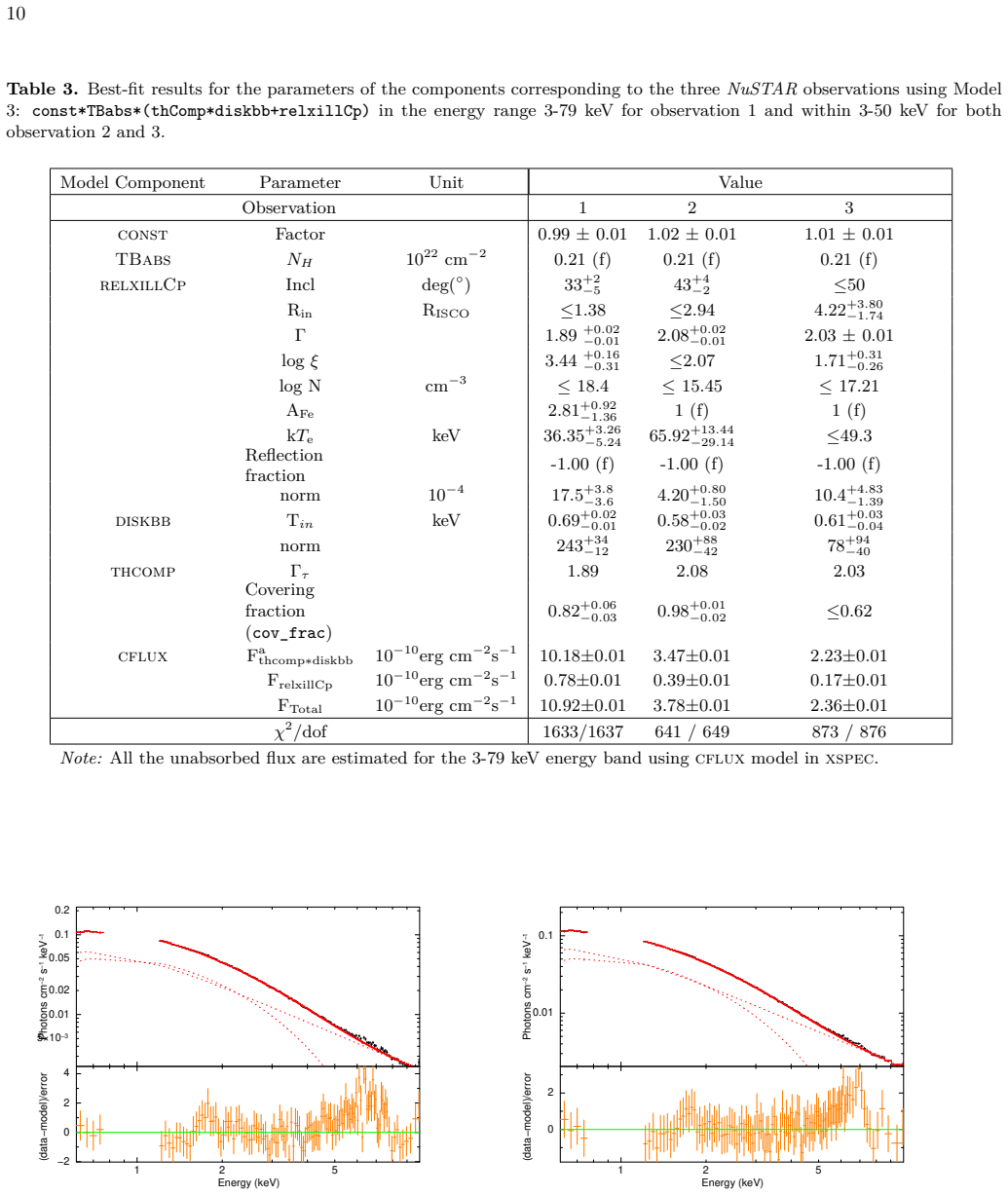
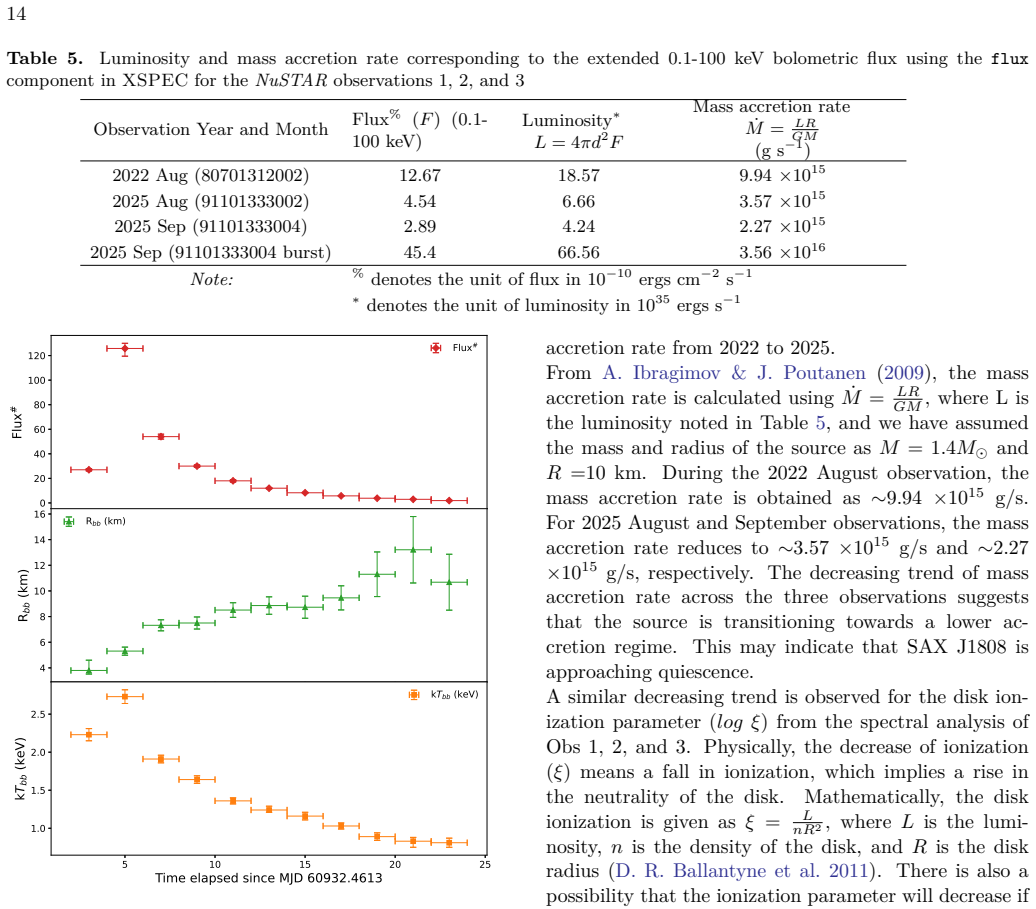
In the 2025 September NuSTAR observation the relativistic reflection modeling yields an inner-disk radius of approximately 23 R_g. At this location the inferred magnetospheric radius exceeds the co-rotation radius, providing a direct hint that the neutron star’s magnetic field is beginning to expel incoming gas rather than permitting steady accretion. The continued detection of a Type-I X-ray burst nevertheless demonstrates that residual accretion onto the stellar surface persists at a low rate.
What carries the argument
relxillCP relativistic reflection model that fits the iron line and Compton hump to constrain the inner accretion-disk radius, then compared against the co-rotation radius to diagnose the propeller transition.
If this is right
- The inner disk radius grows outward and the disk ionization drops as the accretion rate declines from 2022 to 2025.
- When the magnetospheric radius exceeds co-rotation the magnetic field can begin to eject material instead of allowing it to accrete.
- Residual accretion continues even after truncation begins, as shown by the detection of a Type-I burst.
- The source inclination is constrained to the moderate range of 30–50 degrees.
Where Pith is reading between the lines
- If the measured truncation is physical, later observations at still lower accretion rates should exhibit stronger propeller signatures such as reduced persistent flux or enhanced pulsed emission.
- The simultaneous presence of truncation and bursts implies that the propeller regime is not a sharp on/off switch and may require models that allow partial leakage of material.
- Repeating the same reflection analysis on other accreting millisecond pulsars could locate the critical accretion rate at which the propeller transition occurs.
Load-bearing premise
The relxillCP model returns an unbiased physical value for the inner disk radius even when the continuum shape and ionization profile are allowed to vary.
What would settle it
A higher-signal observation at the same flux level that recovers an inner radius well inside the co-rotation radius would falsify the claimed truncation and propeller onset.
Figures






read the original abstract
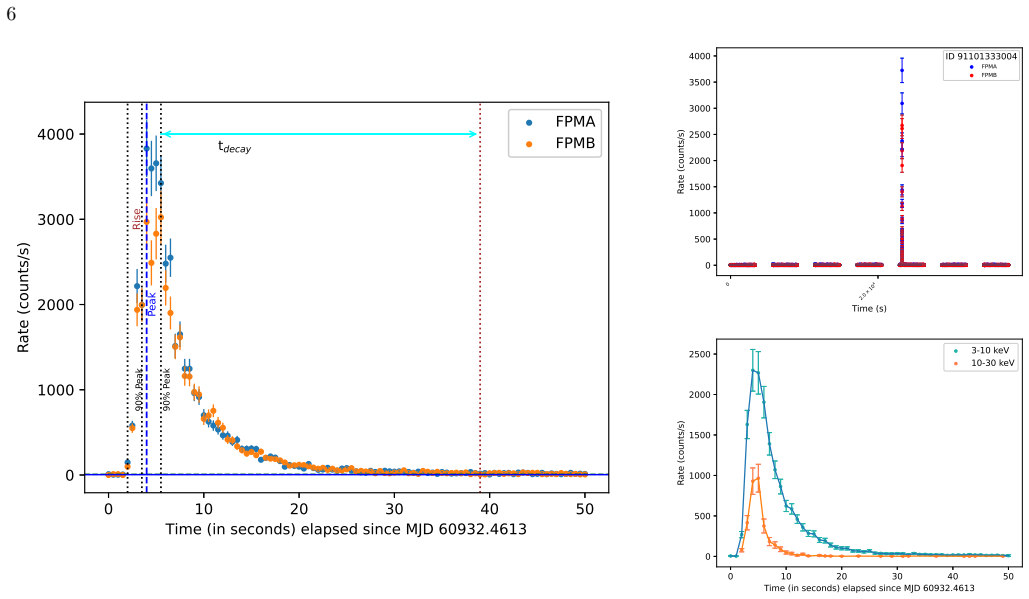
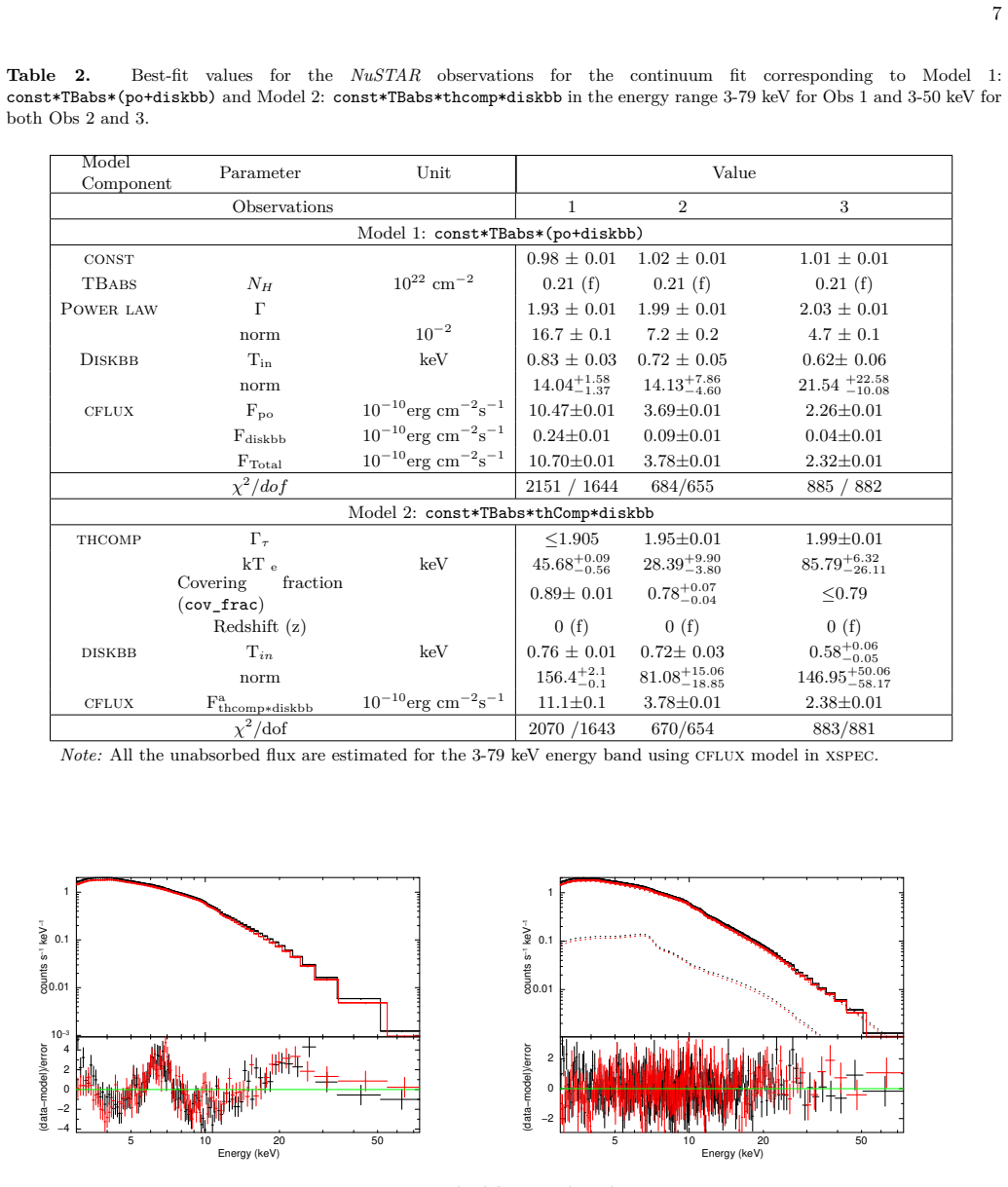
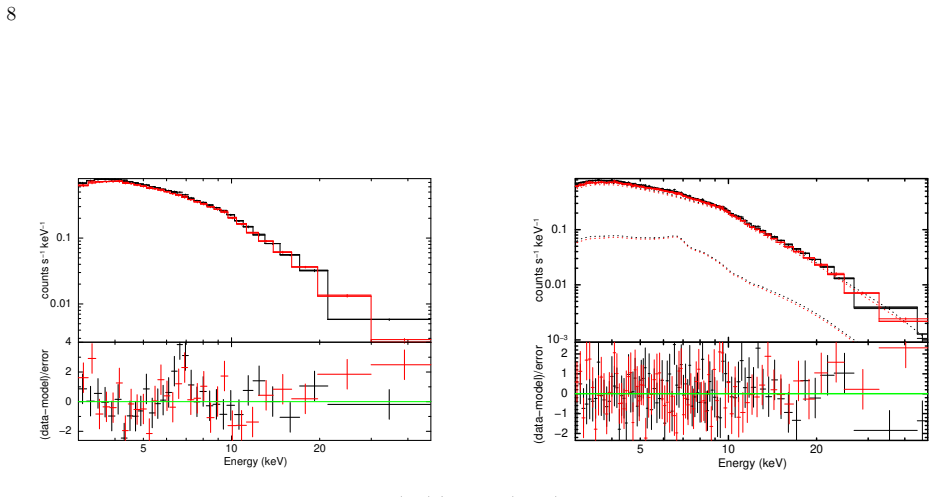
We analyze three NuSTAR observations and two NICER observations of the transient accreting millisecond pulsar SAX J1808.4-3658 in the hard spectral state during its most recent outbursts in 2022 and 2025. The spectral analysis of the persistent emission shows that the continuum is well described by an absorbed thermal Comptonization model with a high plasma temperature of ~25-90 keV. A prominent iron emission line around 5-8 keV and a Compton hump around 15-30 keV have been detected from all NuSTAR observations, indicating the reflection of the hard X-ray photon from the accretion disk. We employ the relativistic reflection model relxillCP to describe the reflection phenomena. The spectral fit of three NuSTAR observations shows that the inner disk radius moves outward, the Comptonized thermal emission decreases in flux, the mass accretion rate decreases, and the disk becomes less ionized as we proceed from the 2022 to the 2025 observations. Reflection studies also reveal a moderate inclination of the source within ~30-50 degrees. During the 2025 September observation, the inner radius of the disk is significantly truncated (~23R_g), and the corresponding magnetospheric radius is comprehensively larger than the disk's co-rotation radius, suggesting a hint of the transition to the propeller regime. Although the disk is truncated at the larger radius, accreted material is still reaching the surface of the neutron star, which is confirmed through the detection of a Type-I X-ray burst during this NuSTAR observation. The spectral analysis of the burst suggests helium burning at a low ignition depth.
Editorial analysis
A structured set of objections, weighed in public.
Referee Report
Summary. The manuscript analyzes three NuSTAR and two NICER observations of SAX J1808.4-3658 in the hard state during the 2022 and 2025 outbursts. Spectral fits employ an absorbed thermal Comptonization continuum plus the relativistic reflection model relxillCP, yielding an outward-moving inner disk radius that reaches ~23 R_g in the 2025 September epoch. The authors derive a magnetospheric radius exceeding the co-rotation radius and interpret this as evidence for a transition toward the propeller regime, while a detected Type-I burst confirms that accretion onto the neutron star surface continues.
Significance. If the inner-radius measurement proves robust, the result supplies direct observational support for the propeller-regime transition in a transient accreting millisecond pulsar, with implications for disk-magnetosphere coupling and the conditions under which accretion can persist despite truncation. The multi-epoch NuSTAR reflection spectroscopy and the burst detection during the truncated state are concrete strengths that would be of interest to the high-energy astrophysics community.
major comments (2)
- [Spectral analysis of the persistent emission (NuSTAR epochs)] The central claim that the disk is truncated at ~23 R_g and that the magnetospheric radius exceeds the co-rotation radius (thereby indicating a propeller transition) rests entirely on the inner-disk radius returned by relxillCP. No fits with alternative continua (e.g., cutoffpl + diskbb) or other reflection models (relxill, relxillD) are reported to test whether the truncation is stable against changes in the assumed Comptonization shape or ionization profile. A systematic outward bias of only 5–10 R_g would remove the reported R_m > R_co inequality.
- [Discussion of accretion geometry and propeller regime] The comparison of the derived magnetospheric radius to the fixed co-rotation radius does not include a full propagation of uncertainties from the fitted parameters (inner radius, inclination, ionization, plasma temperature). Without this, it is unclear whether the inequality remains significant once 1σ errors on R_in are taken into account.
minor comments (2)
- The phrase 'comprehensively larger' in the abstract is imprecise; replace with a quantitative statement of how much larger the magnetospheric radius is relative to the co-rotation radius.
- Observation IDs and exact MJDs for the three NuSTAR pointings should be listed explicitly in the text or a table to facilitate reproducibility.
Simulated Author's Rebuttal
We thank the referee for their constructive comments and positive evaluation of the manuscript's significance. We address each major comment below and will revise the manuscript to incorporate additional tests and analyses that strengthen the robustness of our results on the disk truncation and propeller regime transition.
read point-by-point responses
-
Referee: [Spectral analysis of the persistent emission (NuSTAR epochs)] The central claim that the disk is truncated at ~23 R_g and that the magnetospheric radius exceeds the co-rotation radius (thereby indicating a propeller transition) rests entirely on the inner-disk radius returned by relxillCP. No fits with alternative continua (e.g., cutoffpl + diskbb) or other reflection models (relxill, relxillD) are reported to test whether the truncation is stable against changes in the assumed Comptonization shape or ionization profile. A systematic outward bias of only 5–10 R_g would remove the reported R_m > R_co inequality.
Authors: We agree that testing the stability of the inner-disk radius against alternative models is important for confirming the robustness of the truncation measurement. In the revised manuscript, we will add spectral fits using a cutoffpl + diskbb continuum model as well as the relxill and relxillD reflection models. These additional fits will be presented alongside the original relxillCP results to demonstrate that the inner radius remains consistent at ~23 R_g in the 2025 epoch, with no systematic outward bias sufficient to reverse the R_m > R_co conclusion. Any differences in best-fit parameters will be discussed explicitly. revision: yes
-
Referee: [Discussion of accretion geometry and propeller regime] The comparison of the derived magnetospheric radius to the fixed co-rotation radius does not include a full propagation of uncertainties from the fitted parameters (inner radius, inclination, ionization, plasma temperature). Without this, it is unclear whether the inequality remains significant once 1σ errors on R_in are taken into account.
Authors: We acknowledge that a complete propagation of uncertainties is required to rigorously evaluate the significance of the magnetospheric radius exceeding the co-rotation radius. In the revised manuscript, we will include a full error propagation analysis that incorporates the 1σ uncertainties on the inner radius, inclination, ionization parameter, and plasma temperature. This will be performed using both analytical methods and Monte Carlo sampling from the parameter posteriors. The updated discussion will report the propagated errors on R_m and confirm whether the inequality holds at the 1σ level or better. revision: yes
Circularity Check
No significant circularity in the propeller-regime claim
full rationale
The paper fits the inner-disk radius directly from NuSTAR spectra using the external relxillCP reflection model, then applies standard (non-self-derived) formulas to obtain the magnetospheric radius from that fitted value and compares it to the co-rotation radius fixed solely by the independently known spin period. No step equates a fitted parameter to a prediction by construction, renames a known result, or relies on a load-bearing self-citation whose content reduces to the present work; the chain remains open to external data and standard accretion relations.
Axiom & Free-Parameter Ledger
free parameters (4)
- inner disk radius
- plasma temperature
- inclination angle
- ionization parameter
axioms (2)
- domain assumption The relativistic reflection model relxillCP correctly maps the observed iron line and Compton hump to the inner disk radius.
- standard math Standard formulas convert the fitted inner radius to magnetospheric radius and compare it to co-rotation radius.
Reference graph
Works this paper leans on
-
[1]
2008, The Astrophysical Journal, 678, 102–115, doi: 10.1086/529418
Ajello, M., Greiner, J., Kanbach, G., et al. 2008, The Astrophysical Journal, 678, 102–115, doi: 10.1086/529418
-
[2]
Alpar, M. A., Cheng, A. F., Ruderman, M. A., & Shaham, J. 1982, Nature, 300, 728, doi: 10.1038/300728a0
-
[3]
Arnaud, K. A. 1996, in Astronomical Society of the Pacific Conference Series, Vol. 101, Astronomical Data Analysis Software and Systems V, ed. G. H. Jacoby & J. Barnes, 17
1996
-
[4]
Arons, J., & Lea, S. M. 1976, ApJ, 207, 914, doi: 10.1086/154562
-
[5]
Baglio, M. C., Russell, D. M., Crespi, S., et al. 2020, ApJ, 905, 87, doi: 10.3847/1538-4357/abc685
-
[6]
2022, doi: 10.1007/978-981-16-4544-0_94-1
Bahramian, A., & Degenaar, N. 2022, doi: 10.1007/978-981-16-4544-0_94-1
-
[7]
Ballantyne, D. R., McDuffie, J. R., & Rusin, J. S. 2011, The Astrophysical Journal, 734, 112, doi: 10.1088/0004-637X/734/2/112
-
[8]
2025, The Astronomer’s Telegram, 17369, 1
Ballocco, C., Trois, A., Papitto, A., et al. 2025, The Astronomer’s Telegram, 17369, 1
2025
-
[9]
2026, A&A, 707, A42, doi: 10.1051/0004-6361/202556075
Ballocco, C., Papitto, A., Miraval Zanon, A., et al. 2026, A&A, 707, A42, doi: 10.1051/0004-6361/202556075
-
[10]
2017, ApJ, 835, 4, doi: 10.3847/1538-4357/835/1/4
Bhattacharyya, S., & Chakrabarty, D. 2017, ApJ, 835, 4, doi: 10.3847/1538-4357/835/1/4
-
[11]
Bhattacharyya, S., & Strohmayer, T. E. 2007, The Astrophysical Journal, 656, 414
2007
-
[12]
2001, ApJ, 557, 292, doi: 10.1086/321633
Bildsten, L., & Chakrabarty, D. 2001, ApJ, 557, 292, doi: 10.1086/321633
-
[13]
1987, in HE-UHE Behaviour of Accreting X-ray Sources, ed
Brinkmann, W. 1987, in HE-UHE Behaviour of Accreting X-ray Sources, ed. F. Giovannelli & C. Mannocchi, Vol. 8, 35
1987
-
[14]
Bruce, K., Tsuruta, S., Liebmann, A. C., & Teter, M. 2026, ApJ, 996, 73, doi: 10.3847/1538-4357/ae2605
-
[15]
, year = 2020, month = jul, volume =
Bult, P., Chakrabarty, D., Arzoumanian, Z., et al. 2020, The Astrophysical Journal, 898, 38, doi: 10.3847/1538-4357/ab9827
-
[16]
M., Altamirano, D., Patruno, A., et al
Cackett, E. M., Altamirano, D., Patruno, A., et al. 2009, The Astrophysical Journal, 694, L21, doi: 10.1088/0004-637X/694/1/L21
-
[17]
Cackett, E. M., Miller, J. M., Ballantyne, D. R., et al. 2010, ApJ, 720, 205, doi: 10.1088/0004-637X/720/1/205
-
[18]
Campana, S., Stella, L., & Kennea, J. A. 2008, The Astrophysical Journal Letters, 684, L99
2008
-
[19]
Chakrabarty, D., & Morgan, E. H. 1998, Nature, 394, 346
1998
-
[20]
2001, Astronomy & Astrophysics, 372, 916
Cornelisse, R., Kuulkers, E., Heise, J., et al. 2001, Astronomy & Astrophysics, 372, 916
2001
-
[21]
Cumming, A. 2004, Nuclear Physics B - Proceedings Supplements, 132, 435–445, doi: 10.1016/j.nuclphysbps.2004.04.078
-
[22]
Dauser, T., García, J., Walton, D. J., et al. 2016, A&A, 590, A76, doi: 10.1051/0004-6361/201628135 De Luca, A., Caraveo, P. A., Mereghetti, S., Negroni, M., &
-
[23]
Bignami, G. F. 2005, ApJ, 623, 1051, doi: 10.1086/428567
-
[24]
Deloye, C. J., Heinke, C. O., Taam, R. E., & Jonker, P. G. 2008, Monthly Notices of the Royal Astronomical Society, 391, 1619, doi: 10.1111/j.1365-2966.2008.14021.x di Salvo, T., Burderi, L., Riggio, A., Papitto, A., & Menna, M. T. 2008, in American Institute of Physics Conference
-
[25]
1054, Cool Discs, Hot Flows: The Varying Faces of Accreting Compact Objects, ed
Series, Vol. 1054, Cool Discs, Hot Flows: The Varying Faces of Accreting Compact Objects, ed. M. Axelsson (AIP), 173–182, doi: 10.1063/1.3002500 Di Salvo, T., Papitto, A., Marino, A., Iaria, R., & Burderi, L. 2023, https://arxiv.org/abs/2311.12516 Di Salvo, T., Sanna, A., Burderi, L., et al. 2019, MNRAS, 483, 767, doi: 10.1093/mnras/sty2974
-
[26]
Dickey, J. M., & Lockman, F. J. 1990, ARA&A, 28, 215, doi: 10.1146/annurev.aa.28.090190.001243
-
[27]
Esin, A. A., McClintock, J. E., & Narayan, R. 1997, ApJ, 489, 865, doi: 10.1086/304829
-
[28]
P., Belloni, T
Fender, R. P., Belloni, T. M., & Gallo, E. 2004, Monthly Notices of the Royal Astronomical Society, 355, 1105
2004
-
[29]
Galloway, D. K., & Cumming, A. 2006, The Astrophysical Journal, 652, 559, doi: 10.1086/507598
-
[30]
Galloway, D. K., Muno, M. P., Hartman, J. M., Psaltis, D., & Chakrabarty, D. 2008, The Astrophysical Journal Supplement Series, 179, 360 García, J., Dauser, T., Lohfink, A., et al. 2014, ApJ, 782, 76, doi: 10.1088/0004-637X/782/2/76
-
[31]
Space Telescopes and Instrumentation 2016: Ultraviolet to Gamma Ray , year = 2016, editor =
Gendreau, K. C., Arzoumanian, Z., Adkins, P. W., et al. 2016, in Society of Photo-Optical Instrumentation Engineers (SPIE) Conference Series, Vol. 9905, Space Telescopes and Instrumentation 2016: Ultraviolet to Gamma Ray, ed. J.-W. A. den Herder, T. Takahashi, & M. Bautz, 99051H, doi: 10.1117/12.2231304
-
[32]
1979a, Astrophysical Journal, Part 1, vol
Ghosh, P., & Lamb, F. 1979a, Astrophysical Journal, Part 1, vol. 232, Aug. 15, 1979, p. 259-276., 232, 259 19
1979
-
[33]
1979b, Astrophysical Journal, Part 1, vol
Ghosh, P., & Lamb, F. 1979b, Astrophysical Journal, Part 1, vol. 234, Nov. 15, 1979, p. 296-316., 234, 296
1979
-
[34]
A., Craig, W
Harrison, F. A., Craig, W. W., Christensen, F. E., et al. 2013, The Astrophysical Journal, 770, 103
2013
-
[35]
M., Patruno, A., Chakrabarty, D., et al
Hartman, J. M., Patruno, A., Chakrabarty, D., et al. 2009, ApJ, 702, 1673, doi: 10.1088/0004-637X/702/2/1673
-
[36]
1999, New Astronomy Reviews, 43, 1
Hartmann, L. 1999, New Astronomy Reviews, 43, 1
1999
-
[37]
F., & Balbus, S
Hawley, J. F., & Balbus, S. A. 1999, Physics of Plasmas, 6, 4444
1999
-
[38]
Ibragimov, A., & Poutanen, J. 2009, MNRAS, 400, 492, doi: 10.1111/j.1365-2966.2009.15477.x
-
[39]
F., & Sunyaev, R
Illarionov, A. F., & Sunyaev, R. A. 1975, A&A, 39, 185
1975
-
[40]
2023, ApJL, 942, L40, doi: 10.3847/2041-8213/acad81 in ’t Zand, J
Illiano, G., Papitto, A., Sanna, A., et al. 2023, ApJL, 942, L40, doi: 10.3847/2041-8213/acad81 in ’t Zand, J. J. M., Heise, J., Muller, J. M., et al. 1998, Discovery of the X-ray transient SAX J1808.4-3658, a likely low mass X-ray binary, https://arxiv.org/abs/astro-ph/9802098 in’t Zand, J. J. M., Galloway, D. K., Marshall, H. L., et al. 2013, A&A, 553, ...
-
[41]
L., Tomsick, J
King, A. L., Tomsick, J. A., Miller, J. M., et al. 2016, The Astrophysical Journal Letters, 819, 6pp
2016
-
[42]
Kuulkers, E., den Hartog, P. R., in ’t Zand, J. J. M., et al. 2003, A&A, 399, 663, doi: 10.1051/0004-6361:20021781
-
[43]
K., Boutloukos, S., Van Wassenhove, S., et al
Lamb, F. K., Boutloukos, S., Van Wassenhove, S., et al. 2009, ApJ, 706, 417, doi: 10.1088/0004-637X/706/1/417
-
[44]
Lewin, W. H. G., van Paradijs, J., & Taam, R. E. 1993, SSRv, 62, 223, doi: 10.1007/BF00196124
-
[45]
2011, The Astrophysical Journal, 728, 12
Lo, K.-W., & Lin, L.-M. 2011, The Astrophysical Journal, 728, 12
2011
-
[46]
2023, Monthly Notices of the Royal Astronomical Society, 520, 4315
Lyutikov, M. 2023, Monthly Notices of the Royal Astronomical Society, 520, 4315
2023
-
[47]
1986, ApJ, 308, 635, doi: 10.1086/164534
Makishima, K., Maejima, Y., Mitsuda, K., et al. 1986, ApJ, 308, 635, doi: 10.1086/164534
-
[48]
2009, PASJ, 61, 999, doi: 10.1093/pasj/61.5.999
Matsuoka, M., Kawasaki, K., Ueno, S., et al. 2009, PASJ, 61, 999, doi: 10.1093/pasj/61.5.999
-
[49]
2016, ApJ, 818, 49, doi: 10.3847/0004-637X/818/1/49
Melatos, A., & Mastrano, A. 2016, ApJ, 818, 49, doi: 10.3847/0004-637X/818/1/49
-
[50]
Miller, J. M. 2007, ARA&A, 45, 441, doi: 10.1146/annurev.astro.45.051806.110555
-
[51]
Miller, M. C., Lamb, F. K., & Cook, G. B. 1998, ApJ, 509, 793, doi: 10.1086/306533
-
[52]
1984, PASJ, 36, 741, doi: 10.1093/pasj/36.4.741
Mitsuda, K., Inoue, H., Koyama, K., et al. 1984, PASJ, 36, 741, doi: 10.1093/pasj/36.4.741
-
[53]
2018, arXiv preprint arXiv:1803.06708 NICER Team
Morbidelli, A. 2018, arXiv preprint arXiv:1803.06708 NICER Team. 2023, NICER Data Analysis Software and Calibration, https://heasarc.gsfc.nasa.gov/docs/nicer/ analysis_threads/noise-ringers/ Niedźwiecki, A., Szanecki, M., & Zdziarski, A. A. 2019, MNRAS, 485, 2942, doi: 10.1093/mnras/stz487
-
[54]
2009, EAS Publications Series, 39, 223
Owocki, S. 2009, EAS Publications Series, 39, 223
2009
-
[55]
Pan, Y. Y., Zhang, C. M., Song, L. M., et al. 2018, MNRAS, 480, 692, doi: 10.1093/mnras/sty1851
-
[56]
Patruno, A., Maitra, D., Curran, P. A., et al. 2016, ApJ, 817, 100, doi: 10.3847/0004-637X/817/2/100
-
[57]
2009, The Astrophysical Journal, 707, 1296, doi: 10.1088/0004-637X/707/2/1296
Patruno, A., Watts, A., Klein Wolt, M., Wijnands, R., & van der Klis, M. 2009, The Astrophysical Journal, 707, 1296, doi: 10.1088/0004-637X/707/2/1296
-
[58]
Patruno, A., & Watts, A. L. 2021, in Astrophysics and Space Science Library, Vol. 461, Timing Neutron Stars:
2021
-
[59]
Belloni, M. Méndez, & C. Zhang, 143–208, doi: 10.1007/978-3-662-62110-3_4
-
[60]
2001, The Astrophysical Journal, 547, 355, doi: 10.1086/318336
Popham, R., & Sunyaev, R. 2001, The Astrophysical Journal, 547, 355, doi: 10.1086/318336
-
[61]
1982, Current Science, 51, 1096
Radhakrishnan, V., & Srinivasan, G. 1982, Current Science, 51, 1096
1982
-
[62]
A., Loewenstein, M., Steiner, J
Remillard, R. A., Loewenstein, M., Steiner, J. F., et al. 2022, The Astronomical Journal, 163, 130
2022
-
[63]
2018, in 42nd COSPAR Scientific Assembly, Vol
Riggio, A., Maselli, A., Papitto, A., et al. 2018, in 42nd COSPAR Scientific Assembly, Vol. 42, E1.3–14–18
2018
-
[64]
M., Alabarta, K., Saikia, P., et al
Russell, D. M., Alabarta, K., Saikia, P., et al. 2025, The Astronomer’s Telegram, 17323, 1
2025
-
[65]
2026, ApJ, 999, 133, doi: 10.3847/1538-4357/ae3f99
Sharma, R., Sanna, A., & Sharma, P. 2026, ApJ, 999, 133, doi: 10.3847/1538-4357/ae3f99
-
[66]
1984, Astrophysical Journal, Part 1 (ISSN 0004-637X), vol
Stella, L., & Rosner, R. 1984, Astrophysical Journal, Part 1 (ISSN 0004-637X), vol. 277, Feb. 1, 1984, p. 312-321., 277, 312
1984
-
[67]
Taam, R. E., & van den Heuvel, E. P. J. 1986, ApJ, 305, 235, doi: 10.1086/164243
-
[68]
1997, in Accretion Disks - New Aspects, ed
Tanaka, Y. 1997, in Accretion Disks - New Aspects, ed. E. Meyer-Hofmeister & H. Spruit, Vol. 487, 1, doi: 10.1007/BFb0105817
-
[69]
Ustyugova, G., Koldoba, A., Romanova, M. M., & Lovelace, R. 2006, The Astrophysical Journal, 646, 304 van den Eijnden, J., Bagnoli, T., Degenaar, N., et al. 2016, Monthly Notices of the Royal Astronomical Society: Letters, 466, L98, doi: 10.1093/mnrasl/slw244 van der Klis, M., Jansen, F., van Paradijs, J., & Stollman, G. 1985, SSRv, 40, 287, doi: 10.1007/...
-
[70]
Verner, D. A., Ferland, G. J., Korista, K. T., & Yakovlev, D. G. 1996, ApJ, 465, 487, doi: 10.1086/177435
-
[71]
White, N. E., & Stella, L. 1988, MNRAS, 231, 325, doi: 10.1093/mnras/231.2.325
-
[72]
1998, Nature, 394, 344, doi: 10.1038/28557
Wijnands, R., & van der Klis, M. 1998, Nature, 394, 344, doi: 10.1038/28557
-
[73]
2000, The Astrophysical Journal, 542, 914, doi: 10.1086/317016
Wilms, J., Allen, A., & McCray, R. 2000, ApJ, 542, 914, doi: 10.1086/317016
work page internal anchor Pith review doi:10.1086/317016 2000
-
[74]
1998, arXiv preprint astro-ph/9802098 20
Zand, J., Heise, J., Muller, J., et al. 1998, arXiv preprint astro-ph/9802098 20
-
[75]
Zdziarski, A. A., Johnson, W. N., & Magdziarz, P. 1996, MNRAS, 283, 193, doi: 10.1093/mnras/283.1.193
-
[76]
A., Szanecki, M., Poutanen, J., Gierliński, M., & Biernacki, P
Zdziarski, A. A., Szanecki, M., Poutanen, J., Gierliński, M., & Biernacki, P. 2020, MNRAS, 492, 5234, doi: 10.1093/mnras/staa159
discussion (0)
Sign in with ORCID, Apple, or X to comment. Anyone can read and Pith papers without signing in.