Recognition: 2 theorem links
· Lean TheoremRegularized Nonstationary Phase Estimation via Proximal Maximization of Skewness and Kurtosis
Pith reviewed 2026-05-10 17:55 UTC · model grok-4.3
The pith
Closed-form proximity operators for scale-invariant inverse kurtosis and skewness enable stable nonstationary seismic phase estimation.
A machine-rendered reading of the paper's core claim, the machinery that carries it, and where it could break.
Core claim
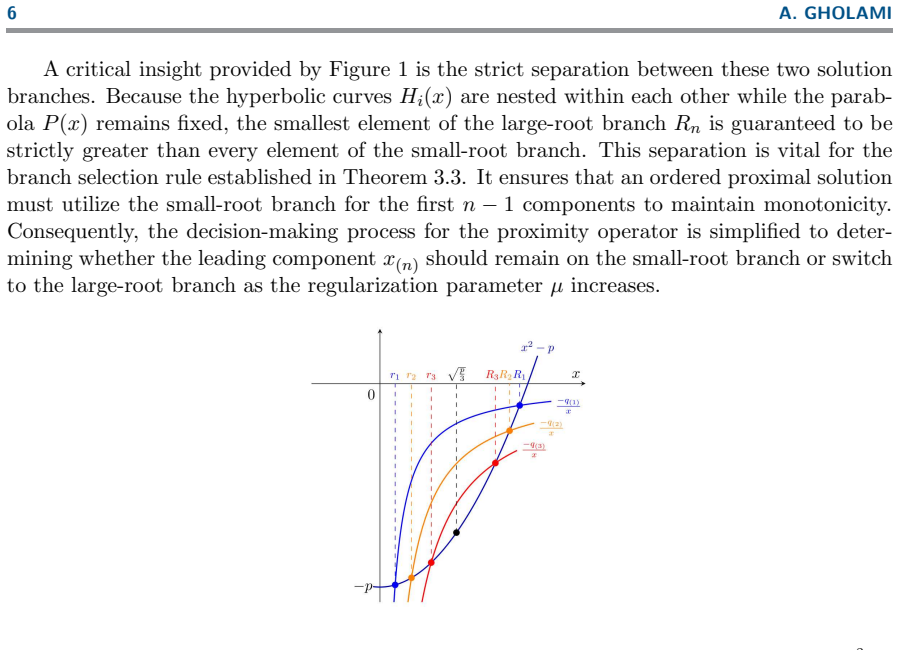
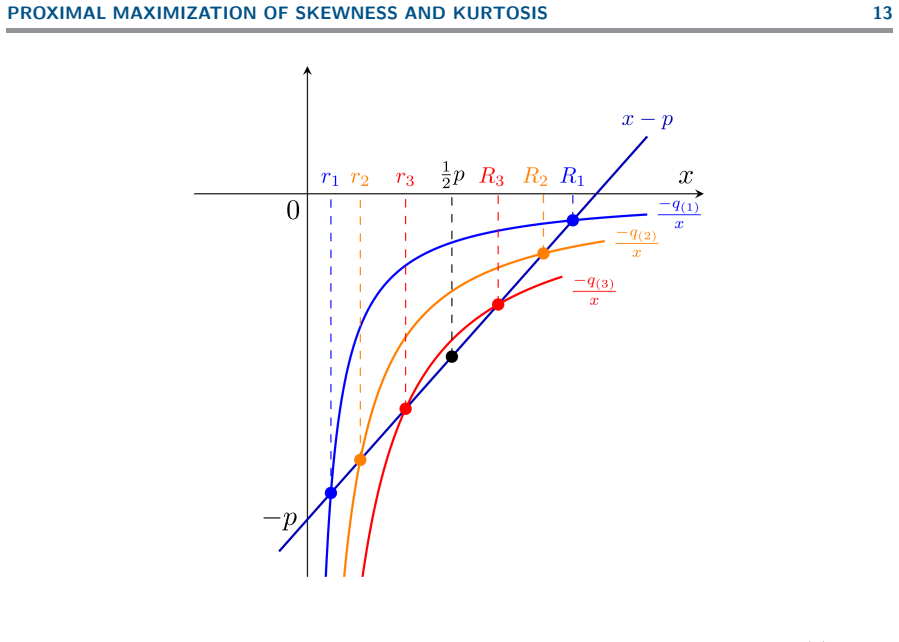
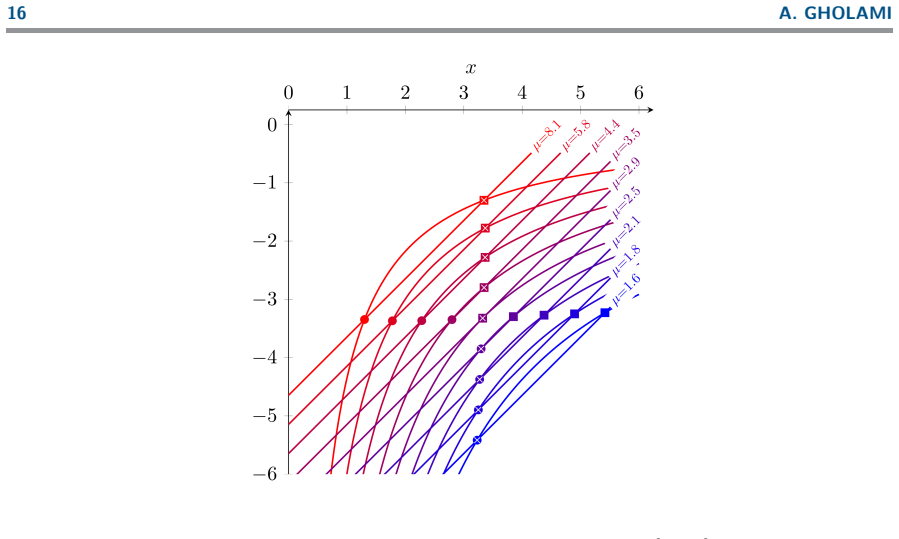
The central claim is that the proximal operators for scale-invariant inverse kurtosis and inverse skewness admit closed-form expressions obtained by reducing the problems to one-dimensional root finding via signed permutation invariance. The optimality conditions admit a geometric interpretation in which a branch-separation property and an explicit critical threshold together select the global minimizer among multiple stationary points, allowing the ADMM scheme to drive nonstationary wavelets reliably toward the desired zero-phase state.
What carries the argument
The scale-invariant inverse kurtosis and inverse skewness functionals, whose first closed-form proximity operators are obtained by reducing high-dimensional proximal subproblems to one-dimensional root-finding tasks through signed permutation invariance.
Load-bearing premise
Maximizing the scale-invariant inverse kurtosis and skewness via the derived proximal operators reliably drives nonstationary wavelets to the global zero-phase state identified by the branch-separation property and critical threshold without additional tuning.
What would settle it
A controlled synthetic seismic gather with a known nonstationary phase shift in which the algorithm converges to a local rather than global minimum or fails to restore zero phase despite the critical threshold being applied.
Figures




read the original abstract
Wavelet phase is a critical parameter in seismic processing, where zero-phase wavelets are essential for maximizing temporal resolution and ensuring accurate interpretation of subsurface structures. In practice, however, the seismic wavelet is often nonstationary, exhibiting a phase that varies in space and time due to physical factors such as attenuation, dispersion, and thin-bed tuning effects. Higher-order statistical measures-specifically kurtosis and skewness-are traditionally maximized to drive the signal toward a maximally non-Gaussian or maximally asymmetric zero-phase state. This paper addresses the computational and stability challenges inherent in nonstationary estimation by casting the problem as a regularized non-convex optimization task. We propose a robust framework based on the Alternating Direction Method of Multipliers (ADMM) that eliminates the instability and artifacts associated with traditional piecewise-stationary windowed approaches. The core of our contribution is the derivation of the first closed-form proximity operators for the scale-invariant inverse kurtosis and inverse skewness functionals. By exploiting the signed permutation invariance of these statistical measures, we reduce the high-dimensional proximal subproblems to efficient one-dimensional root-finding tasks. We provide a detailed geometric interpretation of the optimality conditions, demonstrating that the global minimizer is governed by a branch-separation property. Furthermore, we derive an explicit critical threshold parameter which provides a theoretical rule for identifying the global minimum among multiple stationary points. Numerical validations on synthetic and real seismic data demonstrate that the proposed proximal algorithms achieve linear computational complexity and superior stability compared to traditional methods, effectively enabling nonstationary phase correction.
Editorial analysis
A structured set of objections, weighed in public.
Referee Report
Summary. The manuscript introduces a proximal optimization approach using ADMM to estimate nonstationary seismic wavelet phase by maximizing scale-invariant versions of inverse kurtosis and skewness. It derives closed-form proximity operators for these functionals by reducing the problem to one-dimensional root-finding via signed permutation invariance, provides a geometric interpretation with a branch-separation property, and an explicit critical threshold to select the global minimizer. The method is validated numerically on synthetic and real seismic data, claiming improved stability and linear complexity over traditional methods.
Significance. If the central derivations hold and the proximal operators reliably find the global minimizer, the paper offers a theoretically grounded and computationally efficient solution to a practical problem in geophysics. The explicit derivation of closed-form operators and the parameter-free nature of the optimality conditions are strengths that could advance the field if the global optimality guarantee is confirmed.
major comments (1)
- [Derivation of proximity operators and optimality conditions] The reduction to 1D root-finding and the branch-separation property with critical threshold are presented as ensuring the global minimizer (core of the contribution). However, there is no direct verification by comparing the proposed 1D solver output to the result of numerically minimizing the high-dimensional proximal subproblem for representative input vectors. This verification is necessary to confirm that the threshold correctly identifies the global minimum in all cases, which is load-bearing for the stability claims of the ADMM iterates.
minor comments (2)
- [Abstract] The abstract states that the approach eliminates instability and artifacts but does not quantify the reduction or provide a specific metric comparison.
- [Introduction and methods] Notation for the scale-invariant functionals could be introduced with more explicit definitions in the early sections to aid readability.
Simulated Author's Rebuttal
We thank the referee for the constructive feedback and for recognizing the potential of the proximal ADMM framework. We address the single major comment below and will incorporate the requested verification in the revised manuscript.
read point-by-point responses
-
Referee: The reduction to 1D root-finding and the branch-separation property with critical threshold are presented as ensuring the global minimizer (core of the contribution). However, there is no direct verification by comparing the proposed 1D solver output to the result of numerically minimizing the high-dimensional proximal subproblem for representative input vectors. This verification is necessary to confirm that the threshold correctly identifies the global minimum in all cases, which is load-bearing for the stability claims of the ADMM iterates.
Authors: We agree that an explicit numerical cross-check strengthens the central claim. Although the derivation exploits signed-permutation invariance to reduce the proximal subproblem to a 1D root-finding task and the geometric branch-separation argument together with the explicit critical threshold analytically identify the global minimizer, we did not include a direct comparison against high-dimensional numerical minimization in the original submission. In the revision we will add a dedicated verification subsection (with a new figure) that applies the 1D solver and a reference high-dimensional optimizer (e.g., projected gradient descent with multiple random initializations) to representative random vectors drawn from the same distribution as the seismic data. The results will confirm that the threshold consistently selects the global minimum, thereby supporting the stability of the subsequent ADMM iterates. revision: yes
Circularity Check
Derivation of closed-form proximal operators is self-contained first-principles math
full rationale
The paper derives new proximity operators for scale-invariant inverse kurtosis and inverse skewness by exploiting signed permutation invariance to reduce high-dimensional problems to 1D root-finding, with an explicit branch-separation property and critical threshold for global minimizer selection. This chain is presented as independent mathematical derivation (optimality conditions, geometric interpretation) without reducing to fitted data parameters, prior self-citations as load-bearing premises, or renaming known results. The ADMM framework and numerical validations on seismic data are downstream applications, not inputs that force the claimed operators by construction. No self-definitional loops or fitted-input predictions appear in the core contribution.
Axiom & Free-Parameter Ledger
Lean theorems connected to this paper
-
IndisputableMonolith/Cost/FunctionalEquation.leanwashburn_uniqueness_aczel unclear?
unclearRelation between the paper passage and the cited Recognition theorem.
The core of our contribution is the derivation of the first closed-form proximity operators for the scale-invariant inverse kurtosis (ℓ₂⁴/ℓ₄⁴) and inverse skewness (ℓ₂³/ℓ₃³) functionals... branch-separation property... explicit critical threshold parameter μ_c
-
IndisputableMonolith/Foundation/BranchSelection.leanbranch_selection echoes?
echoesECHOES: this paper passage has the same mathematical shape or conceptual pattern as the Recognition theorem, but is not a direct formal dependency.
geometric interpretation... branch-separation property... critical threshold μ_c
What do these tags mean?
- matches
- The paper's claim is directly supported by a theorem in the formal canon.
- supports
- The theorem supports part of the paper's argument, but the paper may add assumptions or extra steps.
- extends
- The paper goes beyond the formal theorem; the theorem is a base layer rather than the whole result.
- uses
- The paper appears to rely on the theorem as machinery.
- contradicts
- The paper's claim conflicts with a theorem or certificate in the canon.
- unclear
- Pith found a possible connection, but the passage is too broad, indirect, or ambiguous to say the theorem truly supports the claim.
Reference graph
Works this paper leans on
-
[1]
R. C. Aster, B. Borchers, and C. H. Thurber , Parameter Estimation and Inverse Problems , Aca- demic Press, 2004. PROXIMAL MAXIMIZATION OF SKEWNESS AND KURTOSIS 23 Time (s) Amplitude Skewness Time (s) Amplitude Kurtosis Time (s) Time (s) Time (s) Amplitude Time (s) Amplitude Iteration Skewness Iteration Kurtosis Figure 9. Nonstationary phase correction of...
2004
-
[2]
Beck and M
A. Beck and M. Teboulle , A fast iterative shrinkage-thresholding algorithm for lin ear inverse problems, SIAM Journal Imaging Sciences, 2(1) (2009), pp. 183–202
2009
-
[3]
S. Boyd, N. P arikh, E. Chu, B. Peleato, and J. Eckstein , Distributed optimization and statisti- cal learning via the alternating direction method of multip liers, Foundations and trends in machine learning, 3 (2010), pp. 1–122
2010
-
[4]
Donoho , On minimum entropy deconvolution , in Applied time series analysis II, Elsevier, 1981, pp
D. Donoho , On minimum entropy deconvolution , in Applied time series analysis II, Elsevier, 1981, pp. 565–608
1981
-
[5]
Fomel and M
S. Fomel and M. van der Baan , Local skewness attribute as a seismic phase detector , Interpretation, 2 (2014), pp. SA49–SA56
2014
-
[6]
Levy and D
S. Levy and D. Oldenburg , Automatic phase correction of common-midpoint stacked dat a, Geophysics, 52 (1987), pp. 51–59
1987
-
[7]
Nocedal and S
J. Nocedal and S. J. Wright , Numerical Optimization , Springer, 2 nd ed., 2006
2006
-
[8]
M. J. Powell , A method for nonlinear constraints in minimization problem s, Optimization, (1969), pp. 283–298
1969
-
[9]
E. A. Robinson and S. Treitel , Geophysical signal analysis , Society of Exploration Geophysicists, 2000
2000
-
[10]
Schoenberger , Resolution comparison of minimum-phase and zero-phase sig nals, Geophysics, 39 (1974), pp
M. Schoenberger , Resolution comparison of minimum-phase and zero-phase sig nals, Geophysics, 39 (1974), pp. 826–833
1974
-
[11]
R. A. Tapia , Diagonalized multiplier methods and quasi-newton methods for constrained optimization , Journal of Optimization Theory and Applications, 22 (1977) , pp. 135–194
1977
-
[12]
V ali Siadat and A
M. V ali Siadat and A. Tholen , Omar khayyam: Geometric algebra and cubic equations , Math Hori- zons, 28 (2021), pp. 12–15
2021
-
[13]
V an der Baan , Time-varying wavelet estimation and deconvolution by kurt osis maximization , Geo- physics, 73 (2008), pp
M. V an der Baan , Time-varying wavelet estimation and deconvolution by kurt osis maximization , Geo- physics, 73 (2008), pp. V11–V18
2008
-
[14]
van der Baan and S
M. van der Baan and S. Fomel , Nonstationary phase estimation using regularized local ku rtosis max- 24 A. GHOLAMI imization, Geophysics, 74 (2009), pp. A75–A80
2009
-
[15]
R. A. Wiggins , Minimum entropy deconvolution , Geoexploration, 16 (1978), pp. 21–35
1978
-
[16]
Zucker , The cubic equation-a new look at the irreducible case , The Mathematical Gazette, 92 (2008), pp
I. Zucker , The cubic equation-a new look at the irreducible case , The Mathematical Gazette, 92 (2008), pp. 264–268
2008
discussion (0)
Sign in with ORCID, Apple, or X to comment. Anyone can read and Pith papers without signing in.