Recognition: no theorem link
Towards using renewable energy in Mezcal production
Pith reviewed 2026-05-10 18:03 UTC · model grok-4.3
The pith
Electrical distillation with solar power can produce mezcal of equal quality to traditional firewood methods while lowering environmental impact.
A machine-rendered reading of the paper's core claim, the machinery that carries it, and where it could break.
Core claim
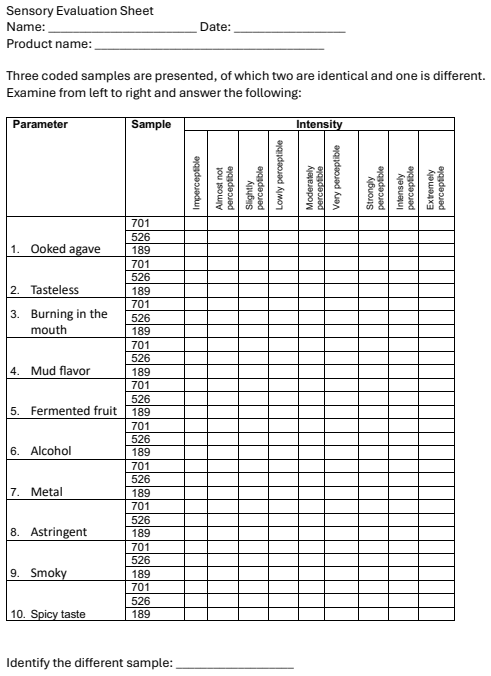
The authors propose and trial a photovoltaic-powered electrical distillation unit for mezcal. Their chromatography, FTIR spectra, and blind sensory comparisons indicate that the resulting mezcal matches traditional firewood-distilled mezcal in chemical profile and organoleptic qualities. They conclude that this electrification route reduces environmental impact and raises energy efficiency without compromising product quality.
What carries the argument
A photovoltaic system supplying electricity for the distillation step, paired with direct side-by-side chemical (chromatography and FTIR) and sensory comparisons of the two mezcal batches.
Load-bearing premise
That the chemical analyses and sensory tests performed are sufficient and representative to establish that product quality is not compromised, and that the photovoltaic system can be reliably implemented in the target communities.
What would settle it
A larger-scale blind sensory panel or expanded chemical assay that detects statistically significant differences in volatile compounds or consistent taste preferences between the two distillation methods would falsify the no-compromise claim.
Figures


read the original abstract
This paper explores the electrification of mezcal distilling in Oaxaca, Mexico, as a sustainable alternative to traditional firewood methods. We investigate the mezcal process, including cooking, grinding, fermentation, and distillation, and propose a photovoltaic system for distillation. The research also includes scientific outreach activities in the producing communities. We, in collaboration with the communities, proposed novel uses of renewable energies. The results of chemical analysis (chromatography and FTIR) and sensory data for distillation using firewood and electricity are presented to compare the mezcal produced with solar energy and traditional mezcal. Our studies conclude that electrical distillation can reduce environmental impact and improve energy efficiency without compromising product quality.
Editorial analysis
A structured set of objections, weighed in public.
Referee Report
Summary. The manuscript investigates the electrification of mezcal distillation in Oaxaca, Mexico, using a proposed photovoltaic system as a sustainable alternative to traditional firewood methods. It outlines the full mezcal production process (cooking, grinding, fermentation, distillation), describes community outreach activities, and reports chemical comparisons (chromatography and FTIR) plus sensory evaluations between firewood- and electricity-distilled batches. The central conclusion is that electrical distillation reduces environmental impact and improves energy efficiency without compromising product quality.
Significance. If the quality equivalence holds under rigorous testing and the efficiency gains are quantified with local data, the work could inform practical transitions to renewables in artisanal industries, supporting reduced deforestation and community-level sustainability. The emphasis on collaboration with producing communities is a positive aspect, though the lack of supporting energy metrics limits the strength of the impact claims.
major comments (2)
- [Abstract and results section] Abstract and results: The assertion that electrical distillation 'can reduce environmental impact and improve energy efficiency' lacks any quantitative support. No measurements of firewood consumption, electrical energy draw of the still, PV array output under Oaxaca conditions, or life-cycle assessment are reported; the efficiency and impact conclusions rest on an untested assumption rather than data.
- [Abstract and results section] Abstract and results: The chemical (chromatography, FTIR) and sensory comparisons provide no sample sizes, statistical methods, error bars, exclusion criteria, or raw data. Without these, it is impossible to determine whether the reported similarities establish that product quality is maintained at a statistically meaningful level.
minor comments (1)
- [Methods or system proposal] The proposal for the photovoltaic system would be strengthened by including a schematic diagram or basic specifications (array size, inverter details) to allow readers to assess feasibility.
Simulated Author's Rebuttal
We thank the referee for their constructive comments on our manuscript. We have revised the text to address the concerns about unsupported claims and missing methodological details, while accurately reflecting the scope of the work as an initial exploration of electrical distillation feasibility.
read point-by-point responses
-
Referee: [Abstract and results section] Abstract and results: The assertion that electrical distillation 'can reduce environmental impact and improve energy efficiency' lacks any quantitative support. No measurements of firewood consumption, electrical energy draw of the still, PV array output under Oaxaca conditions, or life-cycle assessment are reported; the efficiency and impact conclusions rest on an untested assumption rather than data.
Authors: We agree that the original manuscript did not provide direct quantitative measurements or a life-cycle assessment to support the claims of reduced environmental impact and improved energy efficiency. The conclusions were based on the qualitative substitution of firewood with solar electricity and general knowledge of the local context. In the revised version, we have removed the specific claim of improved energy efficiency from the abstract and conclusions. We now state that electrical distillation 'offers a sustainable alternative with the potential to reduce environmental impact by eliminating firewood consumption.' We have added a brief discussion of estimated energy requirements drawn from published values for traditional mezcal stills and average solar irradiance in Oaxaca, along with a note that detailed on-site measurements and a full LCA are planned as follow-up work with the communities. This revision clarifies the current evidence base without overstating the results. revision: partial
-
Referee: [Abstract and results section] Abstract and results: The chemical (chromatography, FTIR) and sensory comparisons provide no sample sizes, statistical methods, error bars, exclusion criteria, or raw data. Without these, it is impossible to determine whether the reported similarities establish that product quality is maintained at a statistically meaningful level.
Authors: The referee is correct that these essential details were omitted from the submitted text. The chemical analyses (chromatography and FTIR) and sensory evaluations were performed on replicate samples from the distillation batches, but the reporting was incomplete. We have revised the results section to specify the sample sizes used, describe the statistical methods applied (including comparative tests for compound profiles and sensory data), add error bars to the figures, note any exclusion criteria, and include the raw data as supplementary material. These changes allow readers to evaluate the strength of the quality equivalence findings. revision: yes
Circularity Check
No circularity; empirical comparison rests on direct measurements with no derivations or self-referential modeling
full rationale
The paper reports direct empirical results from chromatography, FTIR spectroscopy, and sensory panel tests comparing mezcal batches produced by traditional firewood distillation versus electric distillation. No equations, fitted parameters, ansatzes, uniqueness theorems, or modeling steps appear in the described work. The central claim that electrical distillation reduces environmental impact and improves efficiency while preserving quality is presented as following from the observed chemical and sensory equivalence, without any derivation chain that reduces to its own inputs by construction. Absence of quantitative energy-consumption or emissions data is an evidentiary limitation, not a circularity problem. The work is self-contained against external benchmarks as a straightforward experimental comparison.
Axiom & Free-Parameter Ledger
Reference graph
Works this paper leans on
-
[1]
Alc´ ıbar
M. Alc´ ıbar. Comunicaci´ on p´ ublica de la ciencia y la tecnolog´ ıa: una aprox- imaci´ on cr´ ıtica a su historia conceptual.Arbor, 191(773):a242, 2015
2015
-
[2]
Barajas-Ram´ ırez, J
J.A. Barajas-Ram´ ırez, J. Pardo-Nu˜ nez, V.G. Aguilar-Raymundo, and A.L. Guti´ errez-Salom´ on. Influence of taste sensitivity on preference and sensory perception of mezcal.Food Research International, 181:114125, 2024
2024
-
[3]
Mexico exports of beverages, spirits and vinegar, 2024
Trading Economics. Mexico exports of beverages, spirits and vinegar, 2024
2024
-
[4]
G´ omez-Hern´ andez, B
D.F. G´ omez-Hern´ andez, B. Domenech, J. Moreir, N. Farrera, A. L´ opez- Gonz´ alez, and L. Ferrer-Mart´ ı. Comparative evaluation of rural electrifi- cation project plans: A case study in mexico.Energy Policy, 129:23–33, 2019
2019
-
[5]
L´ opez-Rosas, Camila S
Agust´ ın E. L´ opez-Rosas, Camila S. G´ omez-Navarro, Walter M. Warren- Vega, Ana I. Z´ arate-Guzm´ an, and Luis A. Romero-Cano. Advancements towards the development artificial intelligence for sensory analysis: In- tegrating pattern recognition and signal processing in atr-ftir analysis of spirits.Journal of Food Composition and Analysis, 131:106224, 7 2024
2024
-
[6]
On the electrification of rural mexico.Solar & Wind Technology, 5(2):177–180, 1988
Manuel Mart´ ınez. On the electrification of rural mexico.Solar & Wind Technology, 5(2):177–180, 1988
1988
-
[7]
Olive.La ciencia y la tecnolog´ ıa en la sociedad del conocimiento
L. Olive.La ciencia y la tecnolog´ ıa en la sociedad del conocimiento. ´Etica, pol´ ıtica y epostemolog´ ıa. Fondo de Cultura Econ´ omica, 2007
2007
-
[8]
Identification and quantification of valuable plant substances by ir and raman spectroscopy.Vibrational Spectroscopy, 43:13–25, 1 2007
Hartwig Schulz and Malgorzata Baranska. Identification and quantification of valuable plant substances by ir and raman spectroscopy.Vibrational Spectroscopy, 43:13–25, 1 2007. 19
2007
-
[9]
The bending mode of water: A powerful probe for hydrogen bond structure of aqueous systems.Journal of Physical Chemistry Letters, 11:8459–8469, 10 2020
Takakazu Seki, Kuo Yang Chiang, Chun Chieh Yu, Xiaoqing Yu, Masanari Okuno, Johannes Hunger, Yuki Nagata, and Mischa Bonn. The bending mode of water: A powerful probe for hydrogen bond structure of aqueous systems.Journal of Physical Chemistry Letters, 11:8459–8469, 10 2020
2020
-
[10]
Mezcal boom and extinction debts
Alfonso Valiente-Banuet. Mezcal boom and extinction debts. In R Jones, C Ornelas-Garc´ ıa, R Pineda-L´ opez, and F´Alvarez, editors,Mexican Fauna in the Anthropocene. Springer, 2023. 20
2023
discussion (0)
Sign in with ORCID, Apple, or X to comment. Anyone can read and Pith papers without signing in.