Recognition: 9 theorem links
· Lean TheoremMultidimensional cost geometry
Pith reviewed 2026-05-05 22:53 UTC · model claude-opus-4-7
The pith
A single reciprocal cost function carries two inequivalent Hessian geometries — degenerate in log coordinates, pseudo-Riemannian in ratio coordinates.
A machine-rendered reading of the paper's core claim, the machinery that carries it, and where it could break.
Core claim
The paper extends a one-variable reciprocal cost J(x)=½(x+x⁻¹)−1 to n variables by replacing x with the weighted product R=∏xᵢ^αᵢ, then shows that the same function generates two qualitatively different Hessian geometries depending on the affine chart. In logarithmic coordinates the cost reduces to cosh(α·t)−1, so the Hessian is cosh(S)αα^T, of rank one everywhere, with an integrable (n−1)-dimensional null distribution along α·v=0. In x-coordinates the Hessian is generically nondegenerate and pseudo-Riemannian, singular precisely on R=1 and on the locus tanh(S)=Σαᵢ (when |Σαᵢ|<1). The two flat connections are not projectively equivalent for n≥2.
What carries the argument
The identity J = cosh(α·t)−1 = ½(R+R⁻¹)−1 with R=∏xᵢ^αᵢ. This identity is the entire engine: in t-coordinates it forces the Hessian to factor as cosh(S)αα^T (rank one), while in x-coordinates the chain rule splits the Hessian into a rank-one piece plus a diagonal piece, producing a generically invertible metric with explicit, computable singular loci.
If this is right
- <parameter name="value">["The choice of affine chart
- not the cost function
- determines whether information-geometric quantities derived from J are degenerate or pseudo-Riemannian — so any 'natural' geometry built from this cost must commit to a chart up front."
- "Bregman and symmetrized Itakura–Saito divergences built from this cost inherit a one-dimensional effective geometry along α
- regardless of ambient dimension n."
- "Levi-Civita curvature on the x-manifold blows up exactly on the zero-cost surface R=1
- so any optimization or transport that crosses J=0 will see a true geometric singularity rather than a coordinate artifact."
- "Gradient descent on J in log coordinates moves only along the line spanned by α
Where Pith is reading between the lines
- <parameter name="value">["Because the geometry is effectively one-dimensional in log coordinates
- any 'multidimensional' optimization story built on this cost is really a one-parameter problem dressed in n variables — a useful warning for anyone trying to read curvature into α."
- "The non-projective-equivalence result for n≥2 means there is no reparametrization rescuing a single canonical connection
- downstream theories that need a unique geodesic structure will have to pick a chart and live with that choice."
- "The singular hypersurface tanh(S)=Σαᵢ exists only when |Σαᵢ|<1
- which suggests a natural normalization Σαᵢ=1 (as in the symmetric αᵢ=1/n case) where the secondary singular locus disappears and only R=1 remains."
- "The Fisher-Rao realization via Gaussians with mean ∫₀^S √cosh is non-unique
- other one-parameter exponential families with the same Fisher metric should exist
Load-bearing premise
That the chosen multidimensional extension — taking the same reciprocal cost but applied to a weighted product of variables — is the right one. The paper itself notes that one-dimensional uniqueness does not carry over, so the canonical status of this particular ansatz rests on extra postulates (permutation symmetry and reduction to the 1D case when all variables coincide).
What would settle it
Compute the Hessian of J(x)=½(R+R⁻¹)−1 with R=∏xᵢ^αᵢ in t-coordinates and in x-coordinates: if the t-Hessian fails to have rank one at some point, or the x-Hessian fails to be invertible off the stated loci R=1 and tanh(α·t)=Σαᵢ, the central structural claim breaks. Equivalently, exhibit a 1-form ψ realizing the projective relation tΓⁱ_{jk}=δⁱ_j ψ_k+δⁱ_k ψ_j for n≥2 to refute the non-equivalence claim.
Figures

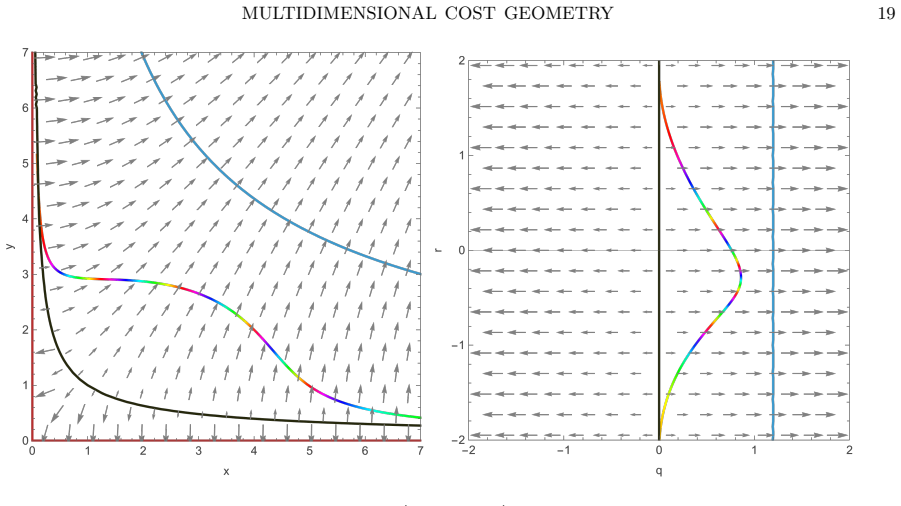
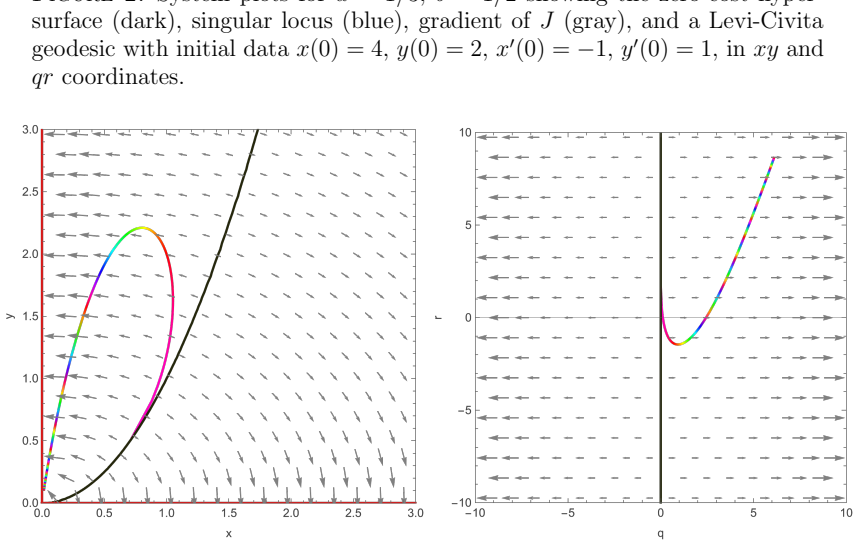

read the original abstract
In this paper we study the geometric structure induced by the canonical reciprocal cost function and its natural $n$-dimensional extension. In logarithmic coordinates, the potential depends only on the linear combination $S=\alpha\cdot t$, and the associated Hessian metric has rank one at every point. The geometry is intrinsically degenerate and effectively 1-dimensional, with an $(n-1)$-dimensional null distribution. On the other hand, when the same function is expressed in the original $x$-coordinates, the corresponding Hessian is generically nondegenerate and defines a pseudo-Riemannian metric away from explicit singular hypersurfaces. We further analyze affine and Levi-Civita geodesics and compare their behavior. In particular, affine geodesics in logarithmic coordinates are globally defined, while in $x$-coordinates their behavior is restricted by the domain and the singular set. Finally, we relate the construction to symmetrized Itakura-Saito and Bregman divergences, and give a Fisher-Rao realization of the logarithmic Hessian metric
Editorial analysis
A structured set of objections, weighed in public.
Referee Report
Summary. The authors define an n-dimensional reciprocal cost J(x) = ½(R + R⁻¹) − 1 with R = Π xᵢ^{αᵢ} on (ℝ_{>0})ⁿ, and study the Hessian geometries it induces in the two natural affine charts. In logarithmic coordinates t = log x, J = cosh(α·t) − 1, so the Hessian is cosh(S)αα^T, has rank one everywhere, and admits an integrable (n−1)-dimensional null distribution. In x-coordinates the Hessian is the sum of a rank-one and a diagonal matrix; via the matrix-determinant lemma the singular locus is shown to be R=1 together with the hypersurface tanh(S)=Σαᵢ (when |Σαᵢ|<1). The two flat connections are shown to be not projectively equivalent for n ≥ 2. The 2-dimensional case is worked out explicitly: Christoffel symbols, Ricci scalar, Levi-Civita geodesics with a formal expansion at the zero-cost locus, affine geodesics, and gradient flows. Finally, the cost is identified as a symmetrized Itakura–Saito divergence and the logarithmic Hessian metric is realized as a Fisher–Rao metric of an embedded 1-parameter Gaussian family.
Significance. The paper is a careful, internally consistent piece of Hessian-geometry work. Its strengths: (a) the derivations are explicit and reproducible, with Christoffel symbols and the Ricci scalar verified in Mathematica (footnote 1 in §4.5); (b) the singular-locus identity tanh(S) = Σαᵢ via the matrix-determinant lemma is clean and the existence condition |Σαᵢ|<1 is a falsifiable, parameter-controlled prediction; (c) the projective non-equivalence proof in Proposition 3.2 is short and decisive; (d) the Fisher–Rao realization in §5 is a nontrivial concrete embedding. The main caveat is novelty/scope: by the authors' own Remark 3.1, the rank-one statement and integrable null foliation hold for any J = f(α·t), so the load-bearing logarithmic-side results are a specialization of a generic phenomenon. The genuine new content is therefore the x-coordinate analysis (singular locus, curvature, geodesic expansion) for this specific cosh ansatz, plus the explicit 2D worked example. Within that more modest scope, the paper is a solid contribution.
major comments (4)
- [§1 abstract / §2 / Title] The framing as the 'canonical' multidimensional extension overstates what §2 actually proves. Lemma 2.1 plus the all-equal-reduction argument fixes only αᵢ = ±1/n given the assumed ansatz form J = ½(R + R⁻¹) − 1 with R = Π xᵢ^{αᵢ}; it does not select that ansatz among the infinitely many f(α·t) − 1 that would yield the same rank-one t-geometry (as Remark 3.1 itself acknowledges). The 1D uniqueness theorem of [19] does not lift, and §2 says so. I recommend (i) replacing 'canonical' by 'natural' or 'a permutation-symmetric extension' in the title and abstract, or (ii) stating an explicit theorem in §2 of the form: 'Among ansätze of the form ½(F(R) + F(R⁻¹)) with R = Π xᵢ^{αᵢ}, conditions X, Y, Z single out F = id and αᵢ = 1/n,' so the canonicity claim is matched to a precise statement.
- [§3, Example 3.1] As written this example does not illustrate what the surrounding text claims. The map Φ: ℝ² → ℝ⁸ has a 2-dimensional image, and J₈ = cosh(S₈(r,s)) − 1 is a function on the 2-dimensional (r,s)-domain. Because S₈ is a nonlinear function of (r,s), the Hessian of J₈ in (r,s) is generically NOT rank one (the formula ∂ᵢ∂ⱼ(cosh∘g) = cosh(g)∂ᵢg ∂ⱼg + sinh(g)∂ᵢ∂ⱼg has both a rank-one and a non-rank-one term). The sentence 'J₈ depends only on the scalar quantity S₈, showing that even in higher-dimensional ambient spaces the induced geometry is effectively 1-dimensional' is therefore misleading: 'depends on a single scalar' is not the same property as 'Hessian has rank one'. Either reformulate the example so that S is a genuine linear function of independent coordinates in ℝ⁸, or remove it; otherwise it undermines the rank-one message of §3.
- [§4.5, Eqs. (4.18)–(4.23)] The Levi-Civita Christoffel symbols in (s,t)-coordinates are written with coth(as+bt) factors that are individually singular at the zero-cost locus q = 0, while the metric (4.9) is itself degenerate there. It would be helpful to (i) state explicitly the open set on which (4.18)–(4.23) are valid (presumably q ≠ 0 together with the secondary singular locus), and (ii) reconcile these formulas with the regular coefficients written in (q,r)-coordinates in (4.27)–(4.28), or note where the apparent simplification comes from. As presently written it is hard for a reader to check that the two coordinate presentations of the same connection agree on their common domain.
- [§4.6.2, Eq. (4.15)–(4.17)] The 'formal expansion' near the zero-cost hypersurface is presented as if it determined admissible tangent directions, but the analysis only extracts the leading-order constraint. Please clarify (a) whether the two solution branches x₁ = y₁ z₀^{1/a+1/b} and x₁ = −(b/a) y₁ z₀^{1/a+1/b} actually correspond to extendible C¹ geodesics or merely to formal power series, (b) whether higher-order coefficients can be solved recursively (i.e. whether the Fuchsian-type indicial conditions admit consistent solutions at all orders), and (c) what this implies geometrically — e.g. whether geodesics generically reach R=1 in finite affine parameter and whether they can be continued through it. As stated, the result is suggestive but does not yet support a sharp claim.
minor comments (9)
- [§2, proof of Lemma 2.1] The notation in (2.7)–(2.8) is dense; spelling out which factors are 'top sign' versus 'bottom sign' would help. Also, the statement should make clear that 'α ≠ 0' means the vector α is nonzero, not that all αᵢ are nonzero.
- [§3.3, Theorem 3.1(ii)] The hypothesis 'αᵢ ≠ 0 for all i' is needed to invert A in the matrix-determinant-lemma step, but it is also independently needed for ∇²J to be invertible (variables with αᵢ=0 drop out and produce a kernel direction). Worth noting explicitly.
- [§3.4, Proposition 3.2] The argument is phrased as 'in x-coordinates ˣΓ = 0; in t-coordinates expressed in x, the Christoffels are ...'. Strictly, both connections should be compared in the same chart, which is what the proof does, but a one-line clarification that this is the standard projective-equivalence test would aid the reader.
- [§4.1, Eq. (4.2)] Stating 'on the zero-cost hypersurface y = x^{−a/b}' implicitly assumes b ≠ 0; please note this.
- [§5, Fisher–Rao realization] The model p(z;t) depends on t only through S = α·t, so the Fisher information is automatically rank one in t — this should be stated as the reason the construction matches gᵢⱼ, rather than as a coincidence.
- [§4.5, Figure 1] The caption refers to 'orange curves' and 'blue curves' but the figure would benefit from labeling the loci by their defining equations (Z=1, (a+b−1)Z+(a+b+1)=0, a+b=0).
- [References] Reference [12] is listed but, as far as I can tell, never cited in the body. Either cite it where relevant or remove. Reference [6] (arXiv:2510.21651) is from after the paper's date stamp; please verify.
- [Date] The 'Date: April 9, 2026' on a manuscript discussing references from 2026 is fine, but please double-check internal consistency of dates with the arXiv submission.
- [Typography] Several formulas have spacing issues from the source (e.g. 'x>0', '∇^2_x J', subscripts on αᵢ in displayed equations). A pass with the journal's style file would clean these up.
Simulated Author's Rebuttal
We thank the referee for a careful and substantive report. The four major comments are well-taken, and we accept three of them as outright corrections to the manuscript and the fourth as a needed honest weakening of a claim. Specifically: (1) we will replace 'canonical' by 'natural'/'permutation-symmetric' in the title, abstract, and introduction, and add an explicit caveat at the end of §2 acknowledging that the rank-one t-geometry is shared by every J = f(α·t), so §2 fixes α within the cosh ansatz rather than the ansatz itself; (2) Example 3.1 is genuinely flawed as written — we conflated 'depends on one scalar' with 'rank-one Hessian' — and will be replaced by a corrected version in which S is a linear functional on ℝ⁸ in independent affine coordinates; (3) we will state the open domain of validity for the (s,t) Christoffel symbols (4.18)–(4.23) and add a short reconciliation showing that the (q,r) equations (4.27)–(4.28) are the same connection cleared of the ∆-denominator; (4) the §4.6.2 'formal expansion' will be rewritten to call the result a leading-order indicial constraint, report the order-4 consistency check we have, and present finite-parameter arrival at R=1 and non-continuation only as a numerical observation, with the sharp analytic claims left open. Two items remain as standing limitations rather than resolved points, listed below.
read point-by-point responses
-
Referee: The framing as the 'canonical' multidimensional extension overstates what §2 proves. Lemma 2.1 plus the all-equal-reduction fixes only αᵢ = ±1/n given the assumed ansatz J = ½(R+R⁻¹)−1 with R = Πxᵢ^{αᵢ}; it does not select that ansatz among the infinitely many f(α·t)−1 yielding the same rank-one t-geometry. Either weaken 'canonical' to 'natural', or state an explicit theorem of the form 'Among ansätze ½(F(R)+F(R⁻¹)), conditions X,Y,Z single out F=id and αᵢ=1/n.'
Authors: We agree. The §2 argument is conditional on the multiplicative ansatz R = Πxᵢ^{αᵢ} and on the d'Alembert composition law in [20] supplying F = id; given that input, Lemma 2.1 plus the diagonal-reduction step fixes αᵢ = ±1/n, but as stated this does not single out F = id among arbitrary f(α·t). We will adopt option (i) and rephrase: the title and abstract will be revised to 'a natural permutation-symmetric extension', and the introduction wording 'canonical multidimensional extension' will be replaced by 'natural extension'. We will also add a sentence at the end of §2 explicitly noting that, by Remark 3.1, the rank-one t-geometry is shared by every J = f(α·t), so what §2 fixes is the parameter vector α (up to sign) within the multiplicative-cosh ansatz, not the ansatz itself. We considered option (ii) — formulating a uniqueness theorem within the family ½(F(R)+F(R⁻¹)) — but the natural conditions (composition law, unit log-curvature) reduce to the 1-D theorem of [19,20] applied to F, and we feel a re-statement here would duplicate that result without new content. We therefore prefer the honest weakening of language. revision: yes
-
Referee: Example 3.1 does not illustrate what the surrounding text claims. Φ:ℝ²→ℝ⁸ has 2-D image, J₈ = cosh(S₈(r,s))−1 lives on the (r,s)-domain, and since S₈ is nonlinear in (r,s), ∂ᵢ∂ⱼ(cosh∘g) = cosh(g)∂ᵢg∂ⱼg + sinh(g)∂ᵢ∂ⱼg has a non-rank-one term. 'Depends on a single scalar' ≠ 'rank-one Hessian'. Reformulate so S is genuinely linear in independent coordinates, or remove.
Authors: The referee is correct, and we thank them for catching this. As written, Example 3.1 conflates two distinct properties: dependence on a single scalar (which holds), and rank-one Hessian (which does not hold in (r,s) because S₈ is nonlinear in (r,s); the sinh(S₈)·∂²S₈ term spoils the rank-one structure). Our intended point — that the rank-one phenomenon survives in higher ambient dimension — is correctly captured only when S is a linear function of independent affine coordinates. We will replace Example 3.1 with a corrected version in which the eight components of Φ are themselves treated as independent affine coordinates (uᵢ) on an open subset of ℝ⁸, and S₈ = (1/√8)Σ aᵢuᵢ is a genuine linear form, so that ∇²J₈ = cosh(S₈)aaᵀ has rank one on ℝ⁸. The (r,s)-pulled-back picture will be removed, since it carries the misleading non-rank-one Hessian the referee points out. The surrounding sentence will be rewritten accordingly to refer to a linear functional on the ambient space rather than a nonlinearly embedded 2-D image. revision: yes
-
Referee: The Christoffel symbols (4.18)–(4.23) in (s,t) involve coth(as+bt) factors individually singular at the zero-cost locus q=0, while the metric (4.9) is itself degenerate there. Please (i) state explicitly the open set on which (4.18)–(4.23) are valid, and (ii) reconcile these formulas with the regular-looking coefficients in (q,r)-coordinates (4.27)–(4.28), or note where the simplification comes from.
Authors: Agreed. The Levi-Civita connection on Mₓ in (s,t)-coordinates is defined only on the open set where the metric (4.9) is nondegenerate, namely D_{st} = {(s,t) : q := as+bt ≠ 0 and (a+b)coth(q) ≠ 1}, the latter being the (s,t)-image of the secondary singular locus ∆ = 0. The coth(q) factors in (4.18)–(4.23) reflect precisely the q=0 boundary of D_{st}; they are not artifacts. We will add an explicit statement of D_{st} immediately before (4.18). Regarding reconciliation with (4.27)–(4.28): the (q,r)-form is obtained by the linear change of variables (4.24)–(4.25), which is global and nonsingular (Jacobian a²+b² ≠ 0). The apparent regularization is cosmetic — multiplying through by ∆ (or equivalently by 2((a+b)cosh q − sinh q)) clears the denominators, so (4.27)–(4.28) are the geodesic equations in the form ∆·(LHS) = 0 rather than (LHS) = 0. We will add a remark stating this explicitly: the (q,r) equations have the same singular set, encoded now as the vanishing of the leading coefficient of q'' and r'', and a one-line algebraic identity showing that pulling back (4.27)–(4.28) through (4.24)–(4.25) reproduces (4.18)–(4.23) on D_{st}. revision: yes
-
Referee: The 'formal expansion' near R=1 in §4.6.2 only extracts a leading-order constraint. Please clarify (a) whether x₁ = y₁ z₀^{1/a+1/b} and x₁ = −(b/a)y₁ z₀^{1/a+1/b} correspond to extendible C¹ geodesics or only to formal power series, (b) whether higher-order coefficients can be solved recursively (Fuchsian indicial conditions consistent at all orders), (c) what this implies geometrically — finite affine parameter to R=1, continuability through it.
Authors: We agree the present statement is suggestive rather than sharp, and we will moderate the language and add what we can substantiate. (a) At present we have established only formal-series solvability at leading order; we have not proved C¹ extendibility of either branch through R=1, and we will say so explicitly, removing any implication that the two values of x₁ correspond to bona fide geodesic tangent directions at q=0. (b) For the second branch x₁ = −(b/a)y₁ z₀^{1/a+1/b} the system is genuinely Fuchsian at q=0 and we have verified that the recursion for (xₙ,yₙ) is solvable to order n=4 with no obstruction; we will add this as a remark, while noting we do not have an all-orders proof. The first branch x₁ = y₁ z₀^{1/a+1/b} corresponds (via (4.30)) to r₁ = ((a−b)/(a+b))q₁, which is the direction tangent to the q=0 locus and is degenerate at this order. (c) Numerically (Figures 2–4) Levi-Civita geodesics reach R=1 in finite affine parameter and the residual blows up there, consistent with non-extendibility through the curvature singularity, but we do not have an analytic proof of finite-time arrival or non-continuability. We will rewrite §4.6.2 to (i) call the result a 'formal indicial constraint', (ii) report the order-4 recursive check, and (iii) state the finite-parameter arrival and non-continuation only as a numerical observation supported by Figure 4, leaving the sharp claim as an open question. revision: partial
- We do not, in this revision, prove extendibility (or non-extendibility) of Levi-Civita geodesics through the zero-cost hypersurface R=1, nor do we establish all-orders solvability of the Fuchsian recursion in §4.6.2. These remain open and will be flagged as such rather than resolved.
- We do not provide a uniqueness theorem singling out F = id within the family ½(F(R)+F(R⁻¹)); instead we weaken the canonicity language. A reader seeking a sharp axiomatic characterization in n ≥ 2 will not find one here.
Circularity Check
No significant circularity. Self-citations [19,20] motivate the 1D cost; the multidimensional geometric results are independent direct calculations and the paper explicitly disclaims 1D-style uniqueness in higher dimensions.
full rationale
The paper's load-bearing claims are geometric: (i) rank-one Hessian of J(t)=cosh(α·t)−1 in t-coordinates, (ii) integrable null distribution, (iii) singular locus tanh(S)=Σα_i in x-coordinates, (iv) non-projective-equivalence of the two affine connections for n≥2. Each is verified by direct computation in Sections 3–4 and does not depend on the truth of the cited 1D theorem. Indeed, Remark 3.1 explicitly says "If J(t)=f(α·t), then the Hessian has rank one," generalizing beyond the cited cosh ansatz. Self-citations [19] (Washburn–Zlatanović) and [20] (Washburn–Zlatanović–Allahyarov) are invoked only in Section 1–2 to motivate the choice of cost function J=½(x+x⁻¹)−1 in 1D. The paper is candid in §2: "We stress that uniqueness in one dimension does not extend to higher dimensions. Some additional assumptions are needed." It then derives the multidimensional form from (a) permutation symmetry (Lemma 2.1) and (b) all-equal reduction to the 1D case, fixing α_i=±1/n. This is an honest acknowledgement that multidimensional canonicity is conditional, not imported from a self-citation chain. The "canonical" framing in the abstract/title is therefore conditional rather than circular — it depends on (i) the 1D theorem of [19], (ii) permutation symmetry, (iii) dimensional-reduction matching. None of the geometric theorems require these to be true; replacing cosh with any f(α·t) leaves rank-one in t-coordinates intact (Remark 3.1). The x-coordinate singular hypersurface result does use the specific cosh form, but it is presented as a calculation about the chosen ansatz, not as a derivation of the ansatz. There is no fitted parameter being renamed as a prediction, no smuggled ansatz in the geometric proofs, and no uniqueness theorem being invoked to forbid alternatives in the load-bearing steps. The only mild concern is rhetorical: "canonical" in the title overstates what §2 actually establishes — but that is a framing/correctness issue, not circularity. Score 1: one minor self-citation pair that motivates but does not carry the central geometric claims.
Axiom & Free-Parameter Ledger
free parameters (1)
- weight vector α=(α₁,...,αₙ) =
general; canonical case αᵢ=1/n
axioms (2)
- ad hoc to paper Permutation symmetry plus dimensional-reduction matching single out αᵢ=1/n as canonical.
- standard math Standard Hessian-geometry and projective-equivalence framework.
Lean theorems connected to this paper
-
IndisputableMonolith/Cost.leanJcost, Jlog_as_cosh, Jcost_exp_cosh matchesJ(x) := ½(x + x⁻¹) − 1, x > 0. ... In logarithmic coordinates t = log x, one has J(eᵗ) = cosh(t) − 1.
-
IndisputableMonolith/Cost/FunctionalEquation.leanwashburn_uniqueness_aczel, SatisfiesCompositionLaw, IsCalibrated matchesTheorem 2.1 [19]: F(xy) + F(x/y) = 2F(x)F(y) + 2F(x) + 2F(y) and unit log-curvature ⇒ F(x) = ½(x+x⁻¹) − 1.
-
IndisputableMonolith/Foundation/DAlembert/Inevitability.leanbilinear_family_forced, axiom_bundle_necessary matchesThe relation (2.3) may be viewed as a multiplicative d'Alembert-type functional equation on the positive reals [20].
-
IndisputableMonolith/Foundation/DAlembert/WLOGAlphaOne.leanCostAlpha, CostAlphaLog, cost_alpha_rescaling refinesJ(x₁,...,xₙ) = ½(R + R⁻¹) − 1 with R = ∏xᵢ^αᵢ; in logarithmic coordinates J(t) = cosh(Σαᵢtᵢ) − 1.
-
IndisputableMonolith/Cost/FunctionalEquation.leanIsReciprocalCost, IsNormalized, IsCalibrated refinesPermutation symmetry plus reduction to 1D when all variables coincide forces αᵢ = 1/n; the cost depends only on the geometric mean (xᵢ-form) or arithmetic mean (tᵢ-form).
-
IndisputableMonolith/Cost/Convexity.leanJlog_strictConvexOn, deriv2_Jcost (1D version) refinesThe Hessian ∇²J(t) = cosh(S)αα^T has rank one at every point; null distribution {v : α·v = 0} is integrable.
-
IndisputableMonolith/Cost.leanJcost_eq_sq, Jcost_symm (algebraic identities used) echoes1 + β u^T A⁻¹ u = 1 − coth(S)Σαᵢ, so singular hypersurface is tanh(S) = Σαᵢ when |Σαᵢ| < 1.
-
IndisputableMonolith/Cost.leanJcost_symm, Jcost_nonneg, Jlog_as_cosh echoesSymmetrized Itakura-Saito: ½(D_IS(1‖x) + D_IS(x‖1)) = J(x); Hessian metric in log coords is Fisher-Rao of normal family with mean m(S) = ∫₀^S √cosh u du.
-
IndisputableMonolith/Foundation/ArithmeticFromLogic.leanembed (orbit on positive reals via γⁿ) echoesAffine geodesics on M_t are straight lines in log-coordinates, globally defined; on M_x they are restricted by xᵢ > 0.
discussion (0)
Sign in with ORCID, Apple, or X to comment. Anyone can read and Pith papers without signing in.