Microresonators induced at the optical fiber intersections
Pith reviewed 2026-05-10 17:49 UTC · model grok-4.3
The pith
Extremely small curvature of weakly twisted fibers controls the spectrum of microresonators at their intersections.
A machine-rendered reading of the paper's core claim, the machinery that carries it, and where it could break.
Core claim
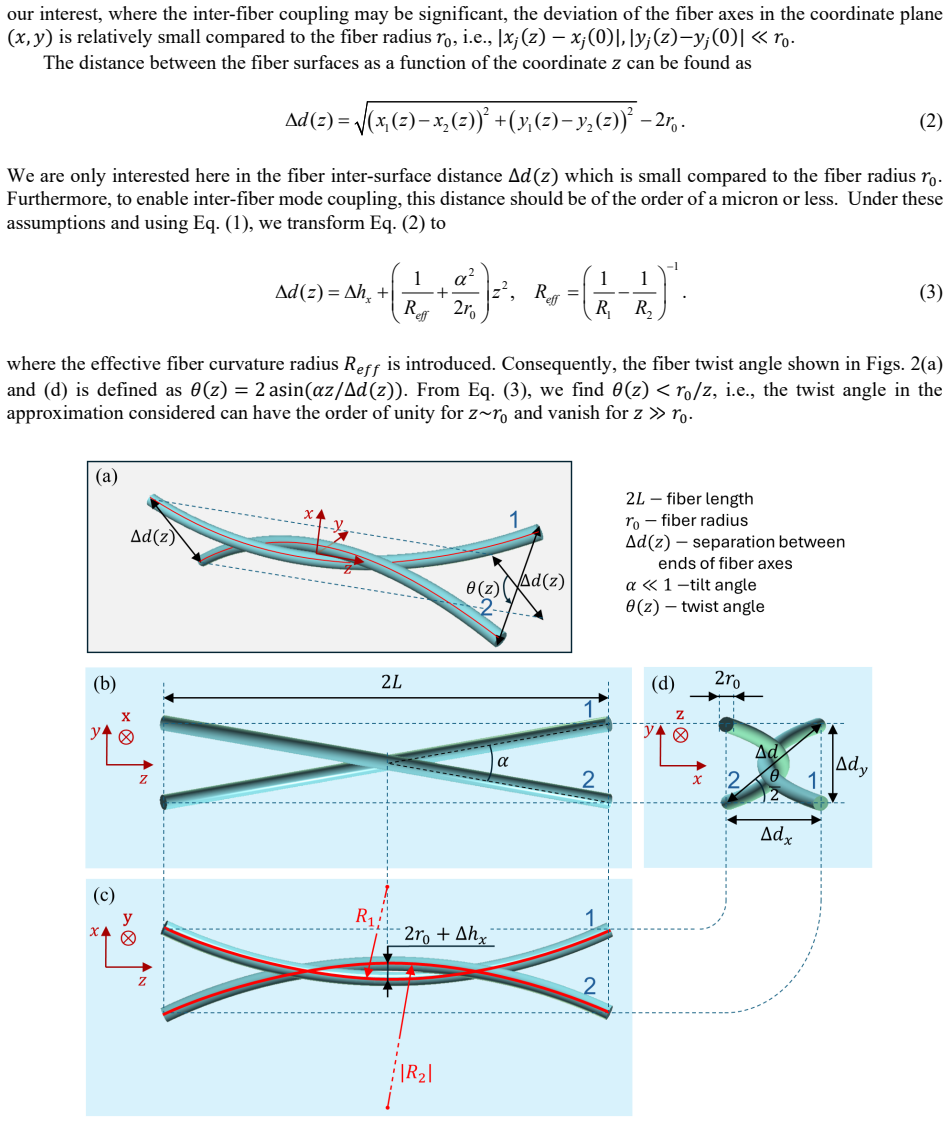
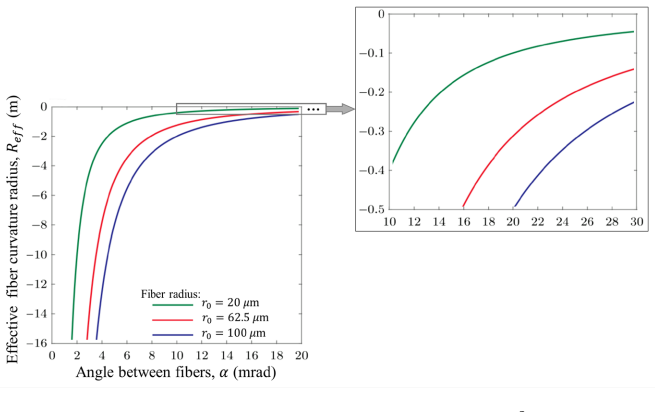
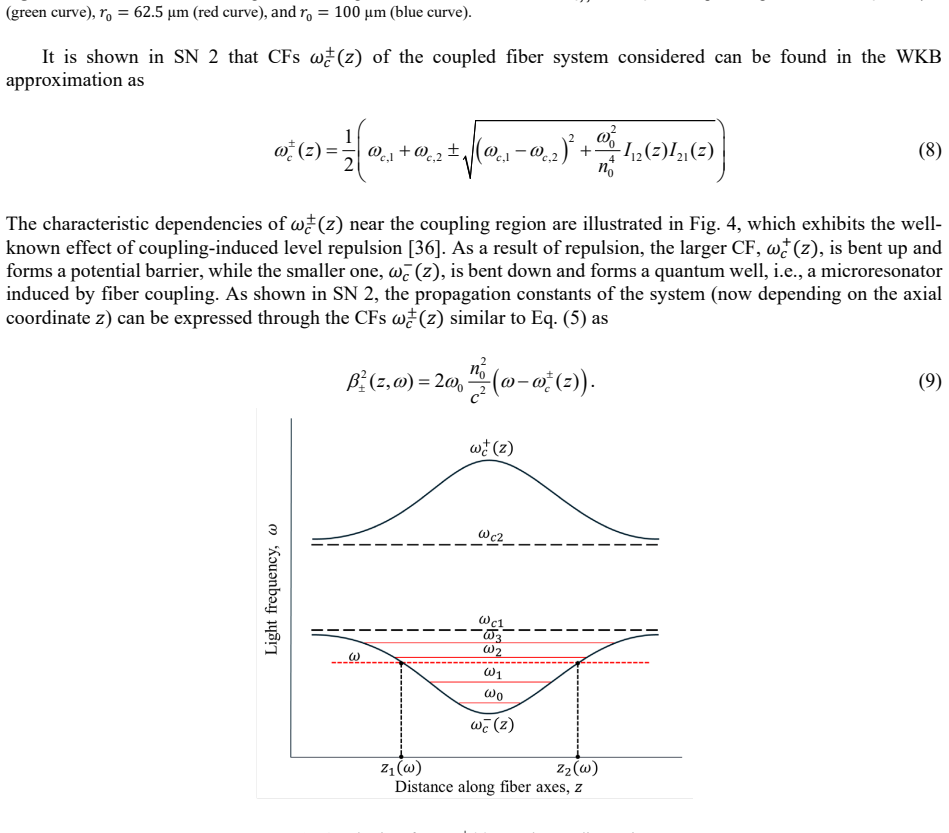
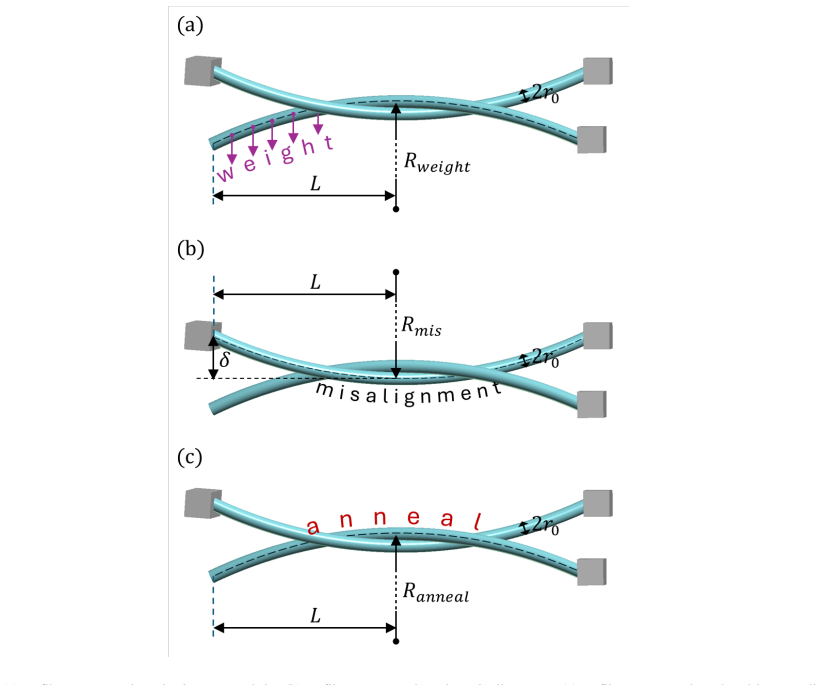
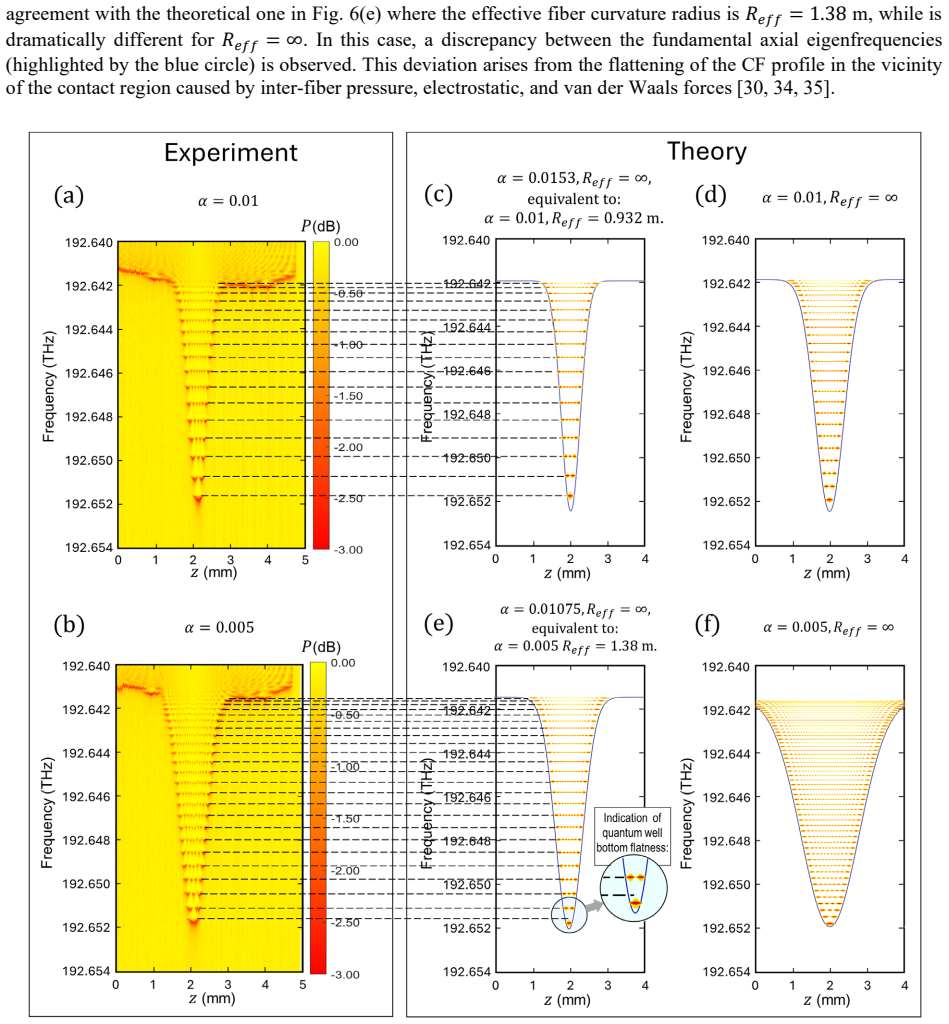
We consider weakly twisted fibers, whose geometry can be decomposed into tilting and bending. We show that an extremely small curvature of fibers critically affects the shape and spectrum of the induced microresonators. We discuss the physical origin of this curvature and show that taking it into account leads to excellent agreement between the developed theory and the experimental results.
What carries the argument
Decomposition of weakly twisted fiber geometry into tilting and bending components whose curvature dominates the induced whispering-gallery-mode microresonator spectrum.
If this is right
- Extensive tuning of the microresonator free spectral range is possible through fiber bending, tilting, and twisting.
- High-Q whispering-gallery-mode resonators form at the fiber side-coupling points.
- This configuration supports applications in tunable delay lines, frequency comb generators, and reconfigurable optical sensors.
Where Pith is reading between the lines
- The curvature effect may allow simpler analytical models for resonator design instead of full numerical simulations.
- Similar geometric decompositions could apply to other waveguide intersections in photonic circuits.
Load-bearing premise
The geometry of weakly twisted fibers can be decomposed into tilting and bending components whose curvature effects dominate the induced microresonator spectrum.
What would settle it
Experimental spectra of the induced microresonator measured for varying fiber twist angles, compared against the theory both with and without the small curvature term; significant deviation without the term would confirm its necessity.
Figures
read the original abstract
A widely tunable free spectral range (FSR) is essential for many optical microresonator applications, but achieving it remains a significant challenge. Recently, it has been experimentally demonstrated that side-coupling between two optical fibers can induce a high-Q whispering-gallery-mode (WGM) microresonator. In contrast to broadly explored monolithic optical microresonators, this configuration enables extensive tuning of the microresonator FSR through fiber bending, tilting, and twisting. Beyond fundamental interest, this class of microresonators is particularly important for a range of critical applications, including tunable delay lines, frequency comb generators, and reconfigurable optical sensors. Here, we develop the theory of such microresonators, which has remained largely unexplored. We consider weakly twisted fibers, whose geometry can be decomposed into tilting and bending. We show that an extremely small curvature of fibers critically affects the shape and spectrum of the induced microresonators. We discuss the physical origin of this curvature and show that taking it into account leads to excellent agreement between the developed theory and the experimental results.
Editorial analysis
A structured set of objections, weighed in public.
Referee Report
Summary. The manuscript develops a theory for whispering-gallery-mode microresonators formed at the intersection of two weakly twisted optical fibers. It decomposes the fiber geometry into tilting and bending components, shows that an extremely small curvature critically shapes the resonator spectrum, and claims that including this curvature produces excellent agreement with experimental results on tunable free spectral range.
Significance. If the model holds, the work supplies the first detailed theory for this non-monolithic, geometrically tunable class of microresonators, which is relevant for applications including tunable delay lines, frequency-comb generators, and reconfigurable sensors. The explicit linkage of an extremely small curvature to spectral features is a potentially useful insight, and the effort to reconcile theory with cited experiments is a positive feature.
major comments (2)
- [Theory section (geometry decomposition)] Geometry decomposition (theory section): the assumption that weakly twisted fiber geometry decomposes additively into independent tilting and bending curvatures overlooks possible non-separable torsional coupling and geometric-phase terms that arise because the Frenet-Serret frame rotates along the arc length. These effects could alter the effective potential for WGMs at a level comparable to the reported curvature correction, weakening the claim that curvature alone explains the observed FSR and mode structure.
- [Results / experimental comparison] Experimental comparison (results section): the assertion of 'excellent agreement' after including curvature is not supported by any displayed equations, derivation steps, or quantitative metrics (e.g., before/after FSR values, R², or mode-frequency tables). Without these, it remains unclear whether the curvature radius is an independent first-principles input or a fitted parameter, undermining the central claim.
minor comments (1)
- The abstract would be strengthened by a single sentence stating the key curvature term or the quantitative improvement in agreement (e.g., change in FSR mismatch).
Simulated Author's Rebuttal
We thank the referee for the constructive comments, which help clarify the theoretical approximations and strengthen the experimental validation in our manuscript. We address each major comment below.
read point-by-point responses
-
Referee: Geometry decomposition (theory section): the assumption that weakly twisted fiber geometry decomposes additively into independent tilting and bending curvatures overlooks possible non-separable torsional coupling and geometric-phase terms that arise because the Frenet-Serret frame rotates along the arc length. These effects could alter the effective potential for WGMs at a level comparable to the reported curvature correction, weakening the claim that curvature alone explains the observed FSR and mode structure.
Authors: We appreciate the referee drawing attention to possible higher-order effects from the rotating Frenet-Serret frame. In the weakly twisted regime analyzed in the manuscript, the twist rate is sufficiently small that torsional coupling and geometric-phase contributions are higher-order corrections that remain negligible compared with the leading curvature term in the effective potential. Explicit scaling shows these terms are suppressed by additional factors of the small twist angle and do not reach the magnitude of the curvature-induced shift for the mode indices and fiber parameters considered. To make this justification explicit, we will add a short paragraph in the revised theory section that estimates the size of the neglected terms relative to the retained curvature correction. revision: partial
-
Referee: Experimental comparison (results section): the assertion of 'excellent agreement' after including curvature is not supported by any displayed equations, derivation steps, or quantitative metrics (e.g., before/after FSR values, R², or mode-frequency tables). Without these, it remains unclear whether the curvature radius is an independent first-principles input or a fitted parameter, undermining the central claim.
Authors: We agree that the present manuscript states the agreement without supplying the requested quantitative metrics or expanded derivation steps. The curvature radius is obtained directly from the measured fiber geometry and the weak-twist condition; it is not adjusted as a free parameter. In the revised version we will insert a table of experimental versus theoretical FSR values (before and after the curvature term), a corresponding list of mode frequencies, and an R² figure of merit for the spectral match. We will also expand the derivation outline in the results section and move supporting algebraic steps to the main text or a new supplementary note so that the first-principles origin of the curvature is transparent. revision: yes
Circularity Check
No significant circularity detected
full rationale
The paper develops a geometric decomposition of weakly twisted fibers into tilting and bending components, derives the effect of an extremely small curvature on the induced WGM spectrum from first-principles considerations of fiber geometry, and presents the resulting agreement with cited experiments as validation. No equations or sections are exhibited in which a central prediction reduces by construction to a fitted parameter, a self-referential definition, or a load-bearing self-citation chain. The derivation chain therefore remains self-contained against external experimental benchmarks.
Axiom & Free-Parameter Ledger
free parameters (1)
- fiber curvature radius
axioms (1)
- domain assumption Weakly twisted fibers can be decomposed into independent tilting and bending components
Lean theorems connected to this paper
-
IndisputableMonolith/Foundation/AlexanderDuality.leanalexander_duality_circle_linking unclear?
unclearRelation between the paper passage and the cited Recognition theorem.
We consider weakly twisted fibers, whose geometry can be decomposed into tilting and bending... the fiber axis profiles can be approximated by quadratic dependencies on z... both fiber axes have zero torsion... planar bending
-
IndisputableMonolith/Cost/FunctionalEquation.leanwashburn_uniqueness_aczel unclear?
unclearRelation between the paper passage and the cited Recognition theorem.
the CF variation has a universal Gaussian shape described by Eq. (13)... exp(-σ z²) with parameter σ simply expressed through the geometric parameters
What do these tags mean?
- matches
- The paper's claim is directly supported by a theorem in the formal canon.
- supports
- The theorem supports part of the paper's argument, but the paper may add assumptions or extra steps.
- extends
- The paper goes beyond the formal theorem; the theorem is a base layer rather than the whole result.
- uses
- The paper appears to rely on the theorem as machinery.
- contradicts
- The paper's claim conflicts with a theorem or certificate in the canon.
- unclear
- Pith found a possible connection, but the passage is too broad, indirect, or ambiguous to say the theorem truly supports the claim.
Reference graph
Works this paper leans on
-
[1]
Chang, R. K. & Campillo, A. J. (eds.) Optical Processes in Microcavities (World Scientific, Singapore, 1996)
work page 1996
-
[2]
Vahala, K. J. Optical microcavities. Nature 424, 839–846 (2003)
work page 2003
-
[3]
Matsko, A. B. (ed.) Practical Applications of Microresonators in Optics and Photonics (CRC Press, Boca Raton, 2009)
work page 2009
-
[4]
Strekalov, D. V., Marquardt, C., Matsko, A. B., Schwefel, H. G. L. & Leuchs, G. Nonlinear and quantum optics with whispering gallery resonators. J. Opt. 18, 123002 (2016)
work page 2016
-
[5]
Yu, D., Humar, M., Meserve, K., Bailey, R. C., Chormaic, S. N., & Vollmer, F. Whispering-gallery-mode sensors for biological and physical sensing. Nat. Rev. Methods Primers 1, 83 (2021)
work page 2021
-
[6]
Ultra-high-Q tunable whispering-gallery-mode microresonator
Pöllinger, M., O’Shea, D., Warken, F., & Rauschenbeutel, A. Ultra-high-Q tunable whispering-gallery-mode microresonator. Phys. Rev. Lett. 103, 053901 (2009)
work page 2009
-
[7]
Xia, K., Sardi, F., Sauerzapf, C., Kornher, T., Becker, H.W., Kis, Z., Kovacs, L., Dertli, D., Foglszinger, J., Kolesov, R. & Wrachtrup, J. Tunable microcavities coupled to rare-earth quantum emitters. Optica 9, 445–448 (2022)
work page 2022
-
[8]
Yang, J., Chen, Y., Rao, Z., Zheng, Z., Song, C., Chen, Y., Xiong, K., Chen, P., Zhang, C., Wu, W. & Yu, Y. Tunable quantum dots in monolithic Fabry–Perot microcavities for high-performance single-photon sources. Light Sci. Appl. 13, 33 (2024)
work page 2024
- [9]
-
[10]
Ko, J. H., Yoo, Y. J., Lee, Y., Jeong, H. H., & Song, Y. M. A review of tunable photonics: optically active materials and applications from visible to terahertz. iScience 25, 104727 (2022)
work page 2022
-
[11]
Chang, L., Liu, S. T. & Bowers, J. E. Integrated optical frequency comb technologies. Nat. Photon. 16, 95–108 (2022)
work page 2022
-
[12]
Sun, Y., Wu, J., Tan, M., Xu, X., Li, Y., Morandotti, R., Mitchell, A. & Moss, D.J. Applications of optical microcombs. Adv. Opt. Photon. 15, 86–152 (2023)
work page 2023
-
[13]
Savchenkov, A. A., Ilchenko, V. S., Matsko, A. B., & Maleki, L. Tunable filter based on whispering gallery modes. Electron. Lett. 39, 389–391 (2003). 12
work page 2003
-
[14]
Armani, D., Min, B., Martin, A., & Vahala, K. J. Electrical thermo-optic tuning of ultrahigh-Q microtoroid resonators. Appl. Phys. Lett. 85, 5439–5441 (2004)
work page 2004
-
[15]
Sumetsky, M., Dulashko, Y. & Windeler, R. S. Super free spectral range tunable optical microbubble resonator. Opt. Lett. 35, 1866–1868 (2010)
work page 2010
-
[16]
Kovach, A., He, J., Saris, P. J., Chen, D., & Armani, A. M. Optically tunable microresonator using an azobenzene monolayer. AIP Adv. 10, 045117 (2020)
work page 2020
-
[17]
Theory of SNAP devices: basic equations and comparison with the experiment
Sumetsky, M. Theory of SNAP devices: basic equations and comparison with the experiment. Opt. Express 20, 22537– 22554 (2012)
work page 2012
-
[18]
Sumetsky, M. & Dulashko, Y. SNAP: fabrication of long coupled microresonator chains with sub-angstrom precision. Opt. Express 20, 27896–27901 (2012)
work page 2012
-
[19]
Sumetsky, M. Delay of light in an optical bottle resonator with nanoscale radius variation: dispersionless, broadband, and low loss. Phys. Rev. Lett. 111, 163901 (2013)
work page 2013
-
[20]
Toropov, N. A. & Sumetsky, M. Permanent matching of coupled optical bottle resonators with better than 0.16 GHz precision. Opt. Lett. 41, 2278–2281 (2016)
work page 2016
-
[21]
Dynamic fabrication method of SNAP microresonators
Wang, Z., Crespo-Ballesteros, M., Collins, C., Yang, Y., Zhang, Q., Zhang, X., & Sumetsky, M. Dynamic fabrication method of SNAP microresonators. Opt. Lett. 50, 3042–3045 (2025)
work page 2025
-
[22]
Gardosi, G., Mangan, B. J., Puc, G. S., & Sumetsky, M. Photonic microresonators created by slow optical cooking. ACS Photonics 8, 436-442 (2021)
work page 2021
- [23]
-
[24]
Sumetsky, M. & Vassiliev, V. Angstrom-precise fabrication of surface nanoscale axial photonics (SNAP) microresonators with a flame. Laser Phys. Lett. 19, 056202 (2022)
work page 2022
-
[25]
Kudashkin, D., Sumetsky, M. & Vatnik, I. Fabrication of SNAP structures by wire heating. Opt. Lett. 49, 4298–4301 (2024)
work page 2024
-
[26]
SNAP microresonators introduced by strong bending of optical fibers
Bochek, D., Toropov, N., Vatnik, I., Churkin, D., & Sumetsky, M. SNAP microresonators introduced by strong bending of optical fibers. Opt. Lett. 44, 3218–3221 (2019)
work page 2019
-
[27]
Crespo-Ballesteros, M. & Sumetsky, M. Ultra-precise, sub-picometer tunable free spectral range in a parabolic microresonator induced by optical fiber bending. Opt. Lett. 49, 4354–4357 (2024)
work page 2024
-
[28]
Crespo-Ballesteros, M. & Sumetsky, M. Compact, reconfigurable optical delay line on a bent silica fiber. Photon. Res. DOI: 10.1364/PRJ.592857 (2026, in press)
-
[29]
Vassiliev, V. & Sumetsky, M. High Q-factor reconfigurable microresonators induced in side-coupled optical fibres. Light Sci. Appl. 12, 197 (2023)
work page 2023
-
[30]
Sharma, I. & Sumetsky, M. Widely FSR tunable high Q-factor microresonators formed at the intersection of straight optical fibers. Optica 12, 890–893 (2025)
work page 2025
-
[31]
Sharma, I. & Sumetsky, M. Widely tunable SNAP microresonators via translation of side-coupled optical fibers. Opt. Lett. 51, 2008-2011 (2026)
work page 2008
-
[32]
High-Q-factor tunable microresonators induced by twisting optical fibers
Deep, S., Crespo-Ballesteros, M., Bianucci, P., & Sumetsky, M. High-Q-factor tunable microresonators induced by twisting optical fibers. In Laser Resonators, Microresonators, and Beam Control XXVIII. Vol. 13879, pp. 3-5. SPIE. (2026)
work page 2026
-
[33]
Do Carmo, M. P. Differential geometry of curves and surfaces. (Courier Dover Publications, 2016)
work page 2016
-
[34]
Israelachvili, J. N. Intermolecular and Surface Forces. (Academic, 2011)
work page 2011
-
[35]
Butt, H. J., Graf, K., & Kappl, M. Physics and Chemistry of Interfaces. (Wiley, 2023)
work page 2023
-
[36]
Landau L.D. and Lifshitz E. M. Quantum Mechanics, Nonrelativistic Theory. Course of theoretical physics, vol. III (Pergamon Press, 1977)
work page 1977
-
[37]
Landau, L. D., Pitaevskii, L. P., Kosevich, A. M., and Lifshitz, E. M. Theory of elasticity. vol VII (Elsevier, 2012)
work page 2012
-
[38]
Yablon, A. D. Optical and mechanical effects of frozen-in stresses and strains in optical fibers. IEEE J. Sel. Top. Quantum Electron. 10, 300-311 (2004)
work page 2004
-
[39]
Timoshenko, S. P. Analysis of bi-metal thermostats. JOSA 11, 233-255 (1925). Funding This work was supported by the Engineering and Physical Sciences Research Council (EPSRC) (grants EP/X03772X/1 and EP/W002868/1). Competing interests The author declares no competing interest. Additional Information The details of calculations are presented Supplemental I...
work page 1925
discussion (0)
Sign in with ORCID, Apple, or X to comment. Anyone can read and Pith papers without signing in.