Recognition: 2 theorem links
· Lean TheoremNot all tokens contribute equally to diffusion learning
Pith reviewed 2026-05-10 18:50 UTC · model grok-4.3
The pith
A rectification framework corrects diffusion models' neglect of important tokens in text prompts by suppressing dominant ones and realigning attention.
A machine-rendered reading of the paper's core claim, the machinery that carries it, and where it could break.
Core claim
We observe that conditional diffusion models neglect semantically important tokens during inference due to distributional bias from long-tailed token frequencies and cross-attention misalignment. To address this, we propose Distribution-Aware Rectification and Spatial Ensemble (DARE), consisting of Distribution-Rectified Classifier-Free Guidance (DR-CFG) that dynamically suppresses dominant low semantic-density tokens and Spatial Representation Alignment (SRA) that adaptively reweights cross-attention maps to enforce representation consistency for important tokens.
What carries the argument
The Distribution-Aware Rectification and Spatial Ensemble (DARE) framework, which combines dynamic suppression of dominant tokens in classifier-free guidance with adaptive reweighting of cross-attention maps based on token semantic importance.
If this is right
- Consistent gains in generation fidelity and semantic alignment across multiple benchmark datasets.
- Better capture of underrepresented semantic cues without overfitting to frequent low-density tokens.
- Prevention of attention dilution so that high semantic-density tokens exert stronger spatial guidance.
- More balanced conditional distributions learned by the model during the rectified training process.
Where Pith is reading between the lines
- The same token-balancing logic could apply to text-to-image diffusion models where prompt fidelity is also limited by attention and frequency effects.
- Measuring semantic density at inference time might enable automatic prompt editing to further boost results without retraining.
- If early data curation incorporated similar density balancing, the learned models might require less correction at generation time.
- The approach suggests checking whether non-diffusion generative models exhibit comparable token neglect under classifier-free guidance.
Load-bearing premise
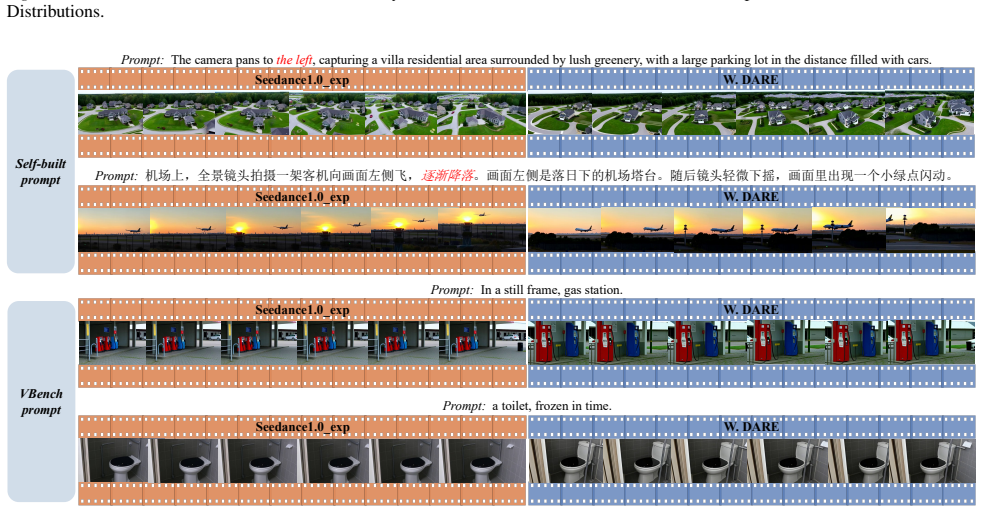
The observed neglect of important tokens stems primarily from long-tailed frequency bias and cross-attention misalignment, and that suppressing dominant tokens plus reweighting attention will improve balance without introducing new artifacts or reducing overall quality.
What would settle it
Compare generations from the same prompts and model with and without DARE on a test set containing both frequent and rare but semantically critical tokens; if the versions with DARE show no increase in inclusion of elements specified by the rare tokens, the central claim fails.
Figures




read the original abstract
With the rapid development of conditional diffusion models, significant progress has been made in text-to-video generation. However, we observe that these models often neglect semantically important tokens during inference, leading to biased or incomplete generations under classifier-free guidance. We attribute this issue to two key factors: distributional bias caused by the long-tailed token frequency in training data, and spatial misalignment in cross-attention where semantically important tokens are overshadowed by less informative ones. To address these issues, we propose Distribution-Aware Rectification and Spatial Ensemble (DARE), a unified framework that improves semantic guidance in diffusion models from the perspectives of distributional debiasing and spatial consistency. First, we introduce Distribution-Rectified Classifier-Free Guidance (DR-CFG), which regularizes the training process by dynamically suppressing dominant tokens with low semantic density, encouraging the model to better capture underrepresented semantic cues and learn a more balanced conditional distribution. This design mitigates the risk of the model distribution overfitting to tokens with low semantic density. Second, we propose Spatial Representation Alignment (SRA), which adaptively reweights cross-attention maps according to token importance and enforces representation consistency, enabling semantically important tokens to exert stronger spatial guidance during generation. This mechanism effectively prevents low semantic-density tokens from dominating the attention allocation, thereby avoiding the dilution of the spatial and distributional guidance provided by high semantic-density tokens. Extensive experiments on multiple benchmark datasets demonstrate that DARE consistently improves generation fidelity and semantic alignment, achieving significant gains over existing approaches.
Editorial analysis
A structured set of objections, weighed in public.
Referee Report
Summary. The manuscript observes that conditional diffusion models for text-to-video generation frequently neglect semantically important tokens, resulting in biased or incomplete outputs under classifier-free guidance. It attributes this to long-tailed token frequency bias in the training data and spatial misalignment in cross-attention maps. To mitigate these issues, the authors propose the Distribution-Aware Rectification and Spatial Ensemble (DARE) framework, comprising Distribution-Rectified Classifier-Free Guidance (DR-CFG) that dynamically suppresses dominant low-semantic-density tokens to encourage balanced conditional distributions, and Spatial Representation Alignment (SRA) that adaptively reweights cross-attention according to token importance while enforcing representation consistency. The paper claims that DARE yields consistent improvements in generation fidelity and semantic alignment across multiple benchmark datasets, outperforming prior approaches.
Significance. If the empirical claims hold under rigorous validation, the work could meaningfully advance practical control in text-conditioned diffusion models by directly targeting token-level biases that degrade semantic fidelity. The dual focus on distributional debiasing during training and spatial reweighting at inference offers a coherent extension of classifier-free guidance techniques, with potential applicability to related conditional generation tasks.
major comments (1)
- Abstract: the central empirical claim that DARE 'consistently improves generation fidelity and semantic alignment, achieving significant gains over existing approaches' is asserted without any quantitative metrics, specific baselines, dataset names, or statistical controls, which is load-bearing for assessing whether DR-CFG and SRA deliver the promised benefits.
minor comments (1)
- Abstract: the notions of 'low semantic density' and 'high semantic-density' tokens are invoked repeatedly but receive no formal definition or operationalization, which could be clarified to support reproducibility.
Simulated Author's Rebuttal
We thank the referee for the constructive feedback on our manuscript. We address the major comment point by point below and agree that revisions to the abstract are warranted to strengthen the presentation of our empirical claims.
read point-by-point responses
-
Referee: Abstract: the central empirical claim that DARE 'consistently improves generation fidelity and semantic alignment, achieving significant gains over existing approaches' is asserted without any quantitative metrics, specific baselines, dataset names, or statistical controls, which is load-bearing for assessing whether DR-CFG and SRA deliver the promised benefits.
Authors: We agree that the abstract would be strengthened by including concrete quantitative details. The full manuscript reports extensive experiments with specific metrics (e.g., FID, CLIP similarity, and user study scores), baselines (standard classifier-free guidance and prior token-aware methods), and datasets in the experimental section. To address the concern, we will revise the abstract to explicitly reference key quantitative gains, name the primary benchmarks and baselines, and note the consistency of improvements. This change will be incorporated in the revised version. revision: yes
Circularity Check
No significant circularity detected in derivation or method definition
full rationale
The paper introduces DARE as a new framework with DR-CFG for distributional debiasing via dynamic token suppression and SRA for spatial reweighting of attention maps. These are presented as novel techniques motivated by observed token neglect from frequency bias and attention misalignment, with claims supported by empirical results on benchmarks. No equations, derivations, or self-referential reductions appear in the abstract or summary. The methods do not reduce by construction to prior fitted quantities, self-citations, or renamed known results; they are described as independent interventions. The central claims rest on external validation rather than internal definitional loops, making the derivation chain self-contained.
Axiom & Free-Parameter Ledger
Lean theorems connected to this paper
-
IndisputableMonolith/Cost/FunctionalEquation.leanwashburn_uniqueness_aczel echoesDR-CFG... dynamically suppressing dominant tokens with low semantic density... mitigating the risk of the model distribution overfitting to tokens with low semantic density... Pw reflects the model’s convergence state regarding the low-importance tokens c′; a smaller Pw indicates a higher degree of fitting to c′. By adjusting the weight of L_fm via Pw, we amplify the contribution of high-importance tokens
-
IndisputableMonolith/Foundation/BranchSelection.leanbranch_selection echoesSRA... adaptively reweights cross-attention maps according to token importance... preventing low semantic-density tokens from dominating the attention allocation, thereby avoiding the dilution of the spatial and distributional guidance provided by high semantic-density tokens
Reference graph
Works this paper leans on
-
[1]
Bai, J., Bai, S., Chu, Y ., Cui, Z., Dang, K., Deng, X., Fan, Y ., Ge, W., Han, Y ., Huang, F., Hui, B., Ji, L., Li, M., Lin, J., Lin, R., Liu, D., Liu, G., Lu, C., Lu, K., Ma, J., Men, R., Ren, X., Ren, X., Tan, C., Tan, S., Tu, J., Wang, P., Wang, S., Wang, W., Wu, S., Xu, B., Xu, J., Yang, A., Yang, H., Yang, J., Yang, S., Yao, Y ., Yu, B., Yuan, H., Y...
work page internal anchor Pith review Pith/arXiv arXiv
-
[2]
Stable Video Diffusion: Scaling Latent Video Diffusion Models to Large Datasets
Blattmann, A., Dockhorn, T., Kulal, S., Mendelevitch, D., Kilian, M., Lorenz, D., Levi, Y ., English, Z., V oleti, V ., Letts, A., et al. Stable video diffusion: Scaling latent video diffusion models to large datasets.arXiv preprint arXiv:2311.15127,
work page internal anchor Pith review arXiv
-
[3]
Chen, D.-Y ., Bandyopadhyay, H., Zou, K., and Song, Y .-Z. Normalized attention guidance: Universal neg- ative guidance for diffusion model.arXiv preprint arXiv:2505.21179,
-
[4]
Seedance 1.0: Exploring the Boundaries of Video Generation Models
Gao, Y ., Guo, H., Hoang, T., Huang, W., Jiang, L., Kong, F., Li, H., Li, J., Li, L., Li, X., et al. Seedance 1.0: Exploring the boundaries of video generation models.arXiv preprint arXiv:2506.09113,
work page internal anchor Pith review arXiv
-
[5]
AnimateDiff: Animate Your Personalized Text-to-Image Diffusion Models without Specific Tuning
Guo, Y ., Yang, C., Rao, A., Liang, Z., Wang, Y ., Qiao, Y ., Agrawala, M., Lin, D., and Dai, B. Animatediff: Animate your personalized text-to-image diffusion models without specific tuning.arXiv preprint arXiv:2307.04725,
work page internal anchor Pith review arXiv
-
[6]
Latent video diffusion models for high-fidelity video generation with arbitrary lengths
He, Y ., Yang, T., Zhang, Y ., Shan, Y ., and Chen, Q. Latent video diffusion models for high-fidelity video genera- tion with arbitrary lengths. arxiv 2022.arXiv preprint arXiv:2211.13221. Ho, J. and Salimans, T. Classifier-free diffusion guidance. arXiv preprint arXiv:2207.12598,
-
[7]
CogVideo: Large-scale Pretraining for Text-to-Video Generation via Transformers
Hong, W., Ding, M., Zheng, W., Liu, X., and Tang, J. Cogvideo: Large-scale pretraining for text-to-video gener- ation via transformers.arXiv preprint arXiv:2205.15868,
work page internal anchor Pith review arXiv
-
[8]
HunyuanVideo: A Systematic Framework For Large Video Generative Models
Kong, W., Tian, Q., Zhang, Z., Min, R., Dai, Z., Zhou, J., Xiong, J., Li, X., Wu, B., Zhang, J., et al. Hunyuan- video: A systematic framework for large video generative models.arXiv preprint arXiv:2412.03603,
work page internal anchor Pith review Pith/arXiv arXiv
-
[9]
Flow Matching for Generative Modeling
Lipman, Y ., Chen, R. T., Ben-Hamu, H., Nickel, M., and Le, M. Flow matching for generative modeling.arXiv preprint arXiv:2210.02747,
work page internal anchor Pith review Pith/arXiv arXiv
- [10]
-
[11]
Make-A-Video: Text-to-Video Generation without Text-Video Data
Singer, U., Polyak, A., Hayes, T., Yin, X., An, J., Zhang, S., Hu, Q., Yang, H., Ashual, O., Gafni, O., et al. Make-a- video: Text-to-video generation without text-video data. arXiv preprint arXiv:2209.14792,
work page internal anchor Pith review arXiv
-
[12]
Score-Based Generative Modeling through Stochastic Differential Equations
Song, Y ., Sohl-Dickstein, J., Kingma, D. P., Kumar, A., Er- mon, S., and Poole, B. Score-based generative modeling through stochastic differential equations.arXiv preprint arXiv:2011.13456,
work page internal anchor Pith review Pith/arXiv arXiv 2011
-
[13]
Wan: Open and Advanced Large-Scale Video Generative Models
Wan, T., Wang, A., Ai, B., Wen, B., Mao, C., Xie, C.-W., Chen, D., Yu, F., Zhao, H., Yang, J., et al. Wan: Open and advanced large-scale video generative models.arXiv preprint arXiv:2503.20314,
work page internal anchor Pith review Pith/arXiv arXiv
-
[14]
Wang, F.-Y ., Shui, Y ., Piao, J., Sun, K., and Li, H. Diffusion- npo: Negative preference optimization for better pref- erence aligned generation of diffusion models.arXiv preprint arXiv:2505.11245, 2025a. Wang, J., Yuan, H., Chen, D., Zhang, Y ., Wang, X., and Zhang, S. Modelscope text-to-video technical report. arXiv preprint arXiv:2308.06571,
-
[15]
Wang, Y ., Chen, X., Ma, X., Zhou, S., Huang, Z., Wang, Y ., Yang, C., He, Y ., Yu, J., Yang, P., et al. Lavie: High- quality video generation with cascaded latent diffusion models.International Journal of Computer Vision, 133 (5):3059–3078, 2025b. Xie, E., Chen, J., Chen, J., Cai, H., Tang, H., Lin, Y ., Zhang, Z., Li, M., Zhu, L., Lu, Y ., et al. Sana: ...
-
[16]
CogVideoX: Text-to-Video Diffusion Models with An Expert Transformer
Yang, Z., Teng, J., Zheng, W., Ding, M., Huang, S., Xu, J., Yang, Y ., Hong, W., Zhang, X., Feng, G., et al. Cogvideox: Text-to-video diffusion models with an ex- pert transformer.arXiv preprint arXiv:2408.06072,
work page internal anchor Pith review Pith/arXiv arXiv
-
[17]
Representation Alignment for Generation: Training Diffusion Transformers Is Easier Than You Think
Yu, S., Kwak, S., Jang, H., Jeong, J., Huang, J., Shin, J., and Xie, S. Representation alignment for generation: Training diffusion transformers is easier than you think. arXiv preprint arXiv:2410.06940,
work page internal anchor Pith review arXiv
-
[18]
Magicvideo: Efficient video generation with latent diffusion models
Zhou, D., Wang, W., Yan, H., Lv, W., Zhu, Y ., and Feng, J. Magicvideo: Efficient video generation with latent diffu- sion models.arXiv preprint arXiv:2211.11018,
-
[19]
Compared with traditional manually annotated datasets, it offers much larger scale and richer semantic diversity, covering a wide range of scenarios
is a large-scale web video–text alignment dataset containing over 10 million video–caption pairs. Compared with traditional manually annotated datasets, it offers much larger scale and richer semantic diversity, covering a wide range of scenarios. This makes it well suited for pretraining and fine-tuning models for video generation and cross-modal alignme...
2024
-
[20]
and EvalCrafter (Liu et al., 2024a) frameworks using self-designed evaluation prompts. B.2. Evaluation Metrics To comprehensively evaluate the video generation capability of our model, we conduct a thorough assessment of the gen- erated results using the EvalCrafter (Liu et al., 2024a) and VBench (Huang et al., 2024
2024
-
[21]
As shown in Table 3, after introducing DARE, the performance improves across multi- ple evaluation aspects compared with Seedance (Gao et al., 2025)
and Eval- Crafter (Liu et al., 2024a). As shown in Table 3, after introducing DARE, the performance improves across multi- ple evaluation aspects compared with Seedance (Gao et al., 2025). However, the improvement is relatively modest. In contrast, our method achieves significant performance gains on Wan (Wan et al., 2025). This is mainly because existing...
2025
discussion (0)
Sign in with ORCID, Apple, or X to comment. Anyone can read and Pith papers without signing in.