Recognition: 2 theorem links
· Lean TheoremTSO-DSO Coordinated Reactive Power Dispatch for Smart Inverters with Multiple Control Modes Real-Time Implementation
Pith reviewed 2026-05-10 18:19 UTC · model grok-4.3
The pith
A sensitivity-aware mixed-integer linear program coordinates reactive power dispatch from smart inverters between transmission and distribution operators in real time while modeling multiple IEEE 1547 droop modes.
A machine-rendered reading of the paper's core claim, the machinery that carries it, and where it could break.
Core claim
The authors present a sensitivity-aware MILP that incorporates SOS1 branching to represent the piecewise-linear droop characteristics of IEEE 1547-compliant smart inverters in Volt-VAR, Volt-Watt, and Watt-VAR modes, augmented by recursive least squares estimation for limited-measurement cases, and demonstrate that the resulting hierarchical TSO-DSO optimization solves fast enough on combined transmission-distribution test systems to improve voltage regulation while reducing active-power curtailment.
What carries the argument
The sensitivity-aware mixed-integer linear program that linearizes the droop curves of the three inverter control modes with Special Ordered Sets of type 1.
Load-bearing premise
The network sensitivity estimates and recursive least-squares fits remain accurate enough that the linear program correctly predicts inverter behavior in each droop mode under real operating conditions and limited data.
What would settle it
Running the algorithm on a physical or high-fidelity simulated feeder with actual IEEE 1547 inverters and finding that voltage violations increase or active-power curtailment does not decrease relative to uncoordinated operation, or that solution times exceed the real-time window.
Figures


read the original abstract
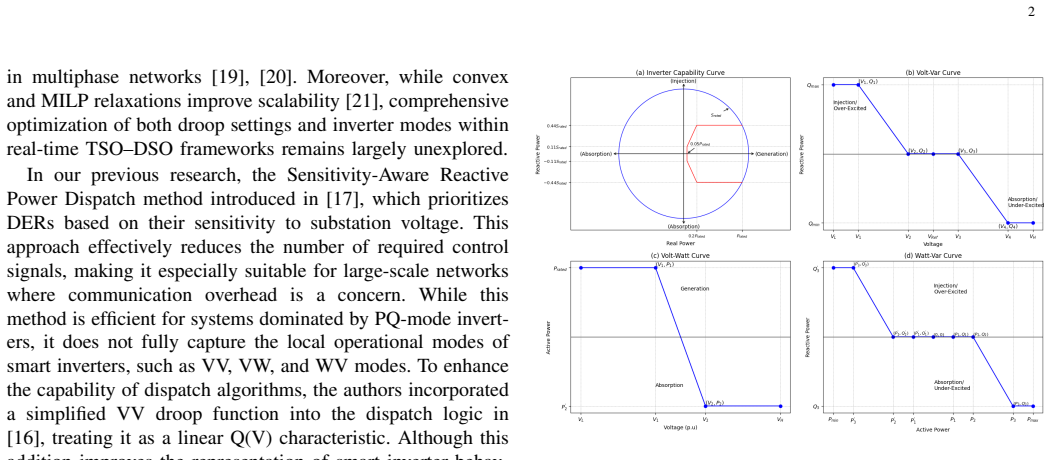
This paper presents TSO-DSO coordinated reactive power dispatch, with a focus on real-time implementation. A sensitivity-aware, mixed-integer linear programming (MILP) formulation is developed to model the IEEE 1547-compliant droop-based control modes Volt VAR (VV), Volt Watt (VW), and Watt VAR (WV) of smart inverters. The algorithm employs a hierarchical optimization strategy using Special Ordered Sets (SOS1) to enhance computational efficiency and supports limited measurement scenarios through Recursive Least Squares (RLS) estimation. The proposed method is tested on the IEEE 13-bus and 123-bus distribution networks, which are connected to a 9-bus transmission system. Results demonstrate the feasibility and effectiveness of the real-time dispatch framework in improving voltage regulation and minimizing power curtailment.
Editorial analysis
A structured set of objections, weighed in public.
Referee Report
Summary. The paper presents a TSO-DSO coordinated reactive power dispatch framework for real-time operation. It develops a sensitivity-aware MILP formulation to model IEEE 1547-compliant droop-based control modes (Volt-VAR, Volt-Watt, Watt-VAR) of smart inverters, employs a hierarchical optimization strategy with SOS1 sets for efficiency, and uses RLS estimation to handle limited measurements. The approach is tested on IEEE 13-bus and 123-bus distribution networks connected to a 9-bus transmission system, with claims that it demonstrates feasibility and effectiveness in improving voltage regulation and minimizing power curtailment.
Significance. If the quantitative claims hold under rigorous validation, the work could offer a practical contribution to TSO-DSO coordination in systems with high DER penetration by explicitly handling multiple inverter control modes and limited observability. The MILP encoding of control modes via SOS1 and the real-time focus are potentially useful technical elements.
major comments (2)
- [Results] Results section: the abstract asserts that the framework improves voltage regulation and minimizes curtailment on the IEEE test cases, yet no quantitative metrics (e.g., voltage deviation reductions, curtailment percentages, computation times, or comparisons to baselines or exact-sensitivity cases) are supplied, preventing verification that the data support the effectiveness claim.
- [Methodology] Sensitivity estimation subsection: the RLS-based sensitivity estimates are treated as fixed inputs to the MILP, but no error bounds, convergence analysis, validation against exact sensitivities, or ablation on measurement density are reported. This is load-bearing because the central claim of accurate real-time dispatch under limited measurements rests on the fidelity of these estimates.
minor comments (2)
- [Abstract] The abstract would be strengthened by including at least one key numerical outcome (e.g., average voltage improvement or solve time) to support the effectiveness statement.
- [Formulation] Notation for the three control modes and their droop parameters could be introduced with explicit equations early in the formulation section for clarity.
Simulated Author's Rebuttal
We thank the referee for the constructive comments, which highlight opportunities to strengthen the quantitative support for our claims and the validation of the sensitivity estimation. We address each major comment below and commit to revisions that will make the effectiveness and robustness of the framework more verifiable.
read point-by-point responses
-
Referee: [Results] Results section: the abstract asserts that the framework improves voltage regulation and minimizes curtailment on the IEEE test cases, yet no quantitative metrics (e.g., voltage deviation reductions, curtailment percentages, computation times, or comparisons to baselines or exact-sensitivity cases) are supplied, preventing verification that the data support the effectiveness claim.
Authors: We agree that the results section requires explicit quantitative metrics to substantiate the abstract claims. In the revised manuscript we will add tables and figures reporting: (i) average and maximum voltage deviation reductions (in per-unit and percentage terms) for the IEEE 13-bus and 123-bus systems before and after coordinated dispatch; (ii) active-power curtailment percentages relative to available generation; (iii) wall-clock computation times for the hierarchical MILP solver; and (iv) direct comparisons against uncoordinated local control and against an exact-sensitivity oracle. These additions will allow readers to verify the reported improvements in voltage regulation and curtailment minimization. revision: yes
-
Referee: [Methodology] Sensitivity estimation subsection: the RLS-based sensitivity estimates are treated as fixed inputs to the MILP, but no error bounds, convergence analysis, validation against exact sensitivities, or ablation on measurement density are reported. This is load-bearing because the central claim of accurate real-time dispatch under limited measurements rests on the fidelity of these estimates.
Authors: We acknowledge that a more rigorous characterization of the RLS sensitivity estimates is needed. We will expand the sensitivity-estimation subsection (and add an appendix) to include: (i) analytical and empirical error bounds on the RLS estimates; (ii) convergence analysis of the recursive updates under the measurement noise levels present in the test cases; (iii) side-by-side validation of RLS-estimated versus exact sensitivities obtained from the full admittance matrix; and (iv) an ablation study that varies measurement density (e.g., 30 %, 50 %, 70 % of buses observed) and reports the resulting impact on dispatch quality and voltage-regulation metrics. These additions will directly address the load-bearing nature of the limited-observability claim. revision: yes
Circularity Check
No circularity; direct modeling and optimization construction from standard techniques
full rationale
The paper develops a sensitivity-aware MILP formulation that incorporates IEEE 1547 droop modes (VV, VW, WV) via SOS1 sets and uses RLS to estimate sensitivities from limited measurements as an explicit preprocessing step. These estimated sensitivities serve as fixed parameters in the linear program rather than being derived from or redefined by the optimization outputs. No self-citations are invoked to justify uniqueness or load-bearing assumptions, and the test results on IEEE 13-bus and 123-bus systems are presented as empirical validation of the framework's feasibility, not as a renaming or self-fulfilling prediction. The derivation chain remains self-contained against external benchmarks such as standard MILP solvers and recursive estimation methods.
Axiom & Free-Parameter Ledger
Lean theorems connected to this paper
-
IndisputableMonolith/Cost/FunctionalEquation.leanwashburn_uniqueness_aczel unclear?
unclearRelation between the paper passage and the cited Recognition theorem.
A sensitivity-aware, mixed-integer linear programming (MILP) formulation is developed to model the IEEE 1547-compliant droop-based control modes... using Special Ordered Sets (SOS1)... Recursive Least Squares (RLS) estimation.
-
IndisputableMonolith/Foundation/RealityFromDistinction.leanreality_from_one_distinction unclear?
unclearRelation between the paper passage and the cited Recognition theorem.
hierarchical optimization strategy... Stage 1: Real Power Maximization... Stage 2a: DSO aggregation... TSO Real Time Dispatch
What do these tags mean?
- matches
- The paper's claim is directly supported by a theorem in the formal canon.
- supports
- The theorem supports part of the paper's argument, but the paper may add assumptions or extra steps.
- extends
- The paper goes beyond the formal theorem; the theorem is a base layer rather than the whole result.
- uses
- The paper appears to rely on the theorem as machinery.
- contradicts
- The paper's claim conflicts with a theorem or certificate in the canon.
- unclear
- Pith found a possible connection, but the passage is too broad, indirect, or ambiguous to say the theorem truly supports the claim.
Reference graph
Works this paper leans on
-
[1]
Ieee standard for interconnection and interoperability of dis- tributed energy resources with associated electric power systems inter- faces,
IEEE, “Ieee standard for interconnection and interoperability of dis- tributed energy resources with associated electric power systems inter- faces,”IEEE Std 1547-2018 (Revision of IEEE Std 1547-2003), pp. 1– 138, 2018
2018
-
[2]
Ferc order no. 2222 and considerations for distributed wind,
R. M. Tapio and A. C. Orrell, “Ferc order no. 2222 and considerations for distributed wind,” Pacific Northwest National Laboratory (PNNL), Richland, W A (United States), Tech. Rep., 2023
2023
-
[3]
Solar pv integration challenges,
F. Katiraei and J. R. Ag ¨uero, “Solar pv integration challenges,”IEEE Power and Energy Magazine, vol. 9, no. 3, pp. 62–71, 2011
2011
-
[4]
Draft electric rule 21 test protocols for advanced inverter functions,
J. T. Johnson, S. Gonzalez, T. Zgonena, M. McGirr, J. Hopkins, B. Seal, F. Cleveland, T. Tansy, and B. Fox, “Draft electric rule 21 test protocols for advanced inverter functions,” Sandia National Lab. (SNL-NM), Albuquerque, NM (United States), Tech. Rep., 12 2014. [Online]. Available: https://www.osti.gov/biblio/1762017
-
[5]
Rule No. 14 – Service Connections and Facilities on Customer’s Premises,
Hawaiian Electric, “Rule No. 14 – Service Connections and Facilities on Customer’s Premises,” https://www.hawaiianelectric.com/documents/ billing and payment/rates/hawaiian electric rules/14.pdf, accessed: Jun. 16, 2022
2022
-
[6]
Real-time local volt/var control under external disturbances with high pv penetration,
A. Singhal, V . Ajjarapu, J. Fuller, and J. Hansen, “Real-time local volt/var control under external disturbances with high pv penetration,” IEEE Transactions on Smart Grid, vol. 10, no. 4, pp. 3849–3859, 2019
2019
-
[7]
Common functions for smart inverters, 4th ed
B. Seal and B. Ealey, “Common functions for smart inverters, 4th ed.” Electric Power Research Institute, Washington, DC, USA, Tech. Rep. 3002008217, 2016
2016
-
[8]
Renewable electricity future — scenario viewer,
NREL, “Renewable electricity future — scenario viewer,” https:// scenarioviewer.nrel.gov/, accessed: 2024-10-13
2024
-
[9]
Online voltage stability monitoring using var reserves,
L. Bao, Z. Huang, and W. Xu, “Online voltage stability monitoring using var reserves,”IEEE Transactions on Power Systems, vol. 18, no. 4, pp. 1461–1469, 2003
2003
-
[10]
Deriving ders var-capability curve at tso-dso interface to provide grid services,
A. Singhal, A. K. Bharati, and V . Ajjarapu, “Deriving ders var-capability curve at tso-dso interface to provide grid services,”IEEE Transactions on Power Systems, vol. 38, no. 2, pp. 1820–1833, 2023
2023
-
[11]
Options for control of reactive power by distributed photovoltaic generators,
K. Turitsyn, P. Sulc, S. Backhaus, and M. Chertkov, “Options for control of reactive power by distributed photovoltaic generators,”Proceedings of the IEEE, vol. 99, no. 6, pp. 1063–1073, 2011
2011
-
[12]
Optimal inverter var control in distribution systems with high pv penetration,
M. Farivar, R. Neal, C. Clarke, and S. Low, “Optimal inverter var control in distribution systems with high pv penetration,” in2012 IEEE Power and Energy Society General Meeting, 2012, pp. 1–7
2012
-
[13]
Optimal pv inverter reactive power control and real power curtailment to improve performance of unbalanced four-wire lv distribution networks,
X. Su, M. A. S. Masoum, and P. J. Wolfs, “Optimal pv inverter reactive power control and real power curtailment to improve performance of unbalanced four-wire lv distribution networks,”IEEE Transactions on Sustainable Energy, vol. 5, no. 3, pp. 967–977, 2014
2014
-
[14]
Distribution grid optimal power flow with volt-var and volt-watt settings of smart inverters,
A. Inaolaji, A. Savasci, and S. Paudyal, “Distribution grid optimal power flow with volt-var and volt-watt settings of smart inverters,” in2021 IEEE Industry Applications Society Annual Meeting (IAS), 2021, pp. 1–7
2021
-
[15]
Interaction between coordinated and droop control pv inverters,
P. Lusis, L. L. Andrew, A. Liebman, and G. Tack, “Interaction between coordinated and droop control pv inverters,” inProceedings of the Eleventh ACM International Conference on Future Energy Systems, 2020, pp. 314–324
2020
-
[16]
Extended sensitivity- aware reactive power dispatch algorithm for smart inverters with multiple control modes,
M. Almomani, A. Alkhonain, and V . Ajjarapu, “Extended sensitivity- aware reactive power dispatch algorithm for smart inverters with multiple control modes,”IEEE PES General Meeting, 2025
2025
-
[17]
Sensitivity- aware reactive power dispatch of ders to support transmission grid during emergency,
A. Alkhonain, A. Singhal, A. K. Bharati, and V . Ajjarapu, “Sensitivity- aware reactive power dispatch of ders to support transmission grid during emergency,” in2023 North American Power Symposium (NAPS), 2023, pp. 1–6
2023
-
[18]
Determination of the potential to provide reactive power from distribution grids to the transmission grid using optimal power flow,
P. Goergens, F. Potratz, M. G ¨odde, and A. Schnettler, “Determination of the potential to provide reactive power from distribution grids to the transmission grid using optimal power flow,” in2015 50th International Universities Power Engineering Conference (UPEC), 2015, pp. 1–6
2015
-
[19]
Optimal droop settings of smart inverters,
A. Inaolaji, A. Savasci, and S. Paudyal, “Optimal droop settings of smart inverters,”2021 IEEE 48th Photovoltaic Specialists Conference (PVSC), vol. 99, no. 6, pp. 2584–2589, 2021
2021
-
[20]
Two-stage optimiza- tion strategy for solving the vvo problem considering high penetration of plug-in electric vehicles to unbalanced distribution networks,
T. M. Aljohani, A. Saad, and O. A. Mohammed, “Two-stage optimiza- tion strategy for solving the vvo problem considering high penetration of plug-in electric vehicles to unbalanced distribution networks,”IEEE Transactions on Industry Applications, vol. 57, no. 4, pp. 3425–3440, 2021
2021
-
[21]
A survey of relaxations and approximations of the power flow equations,
D. K. Molzahn, I. A. Hiskenset al., “A survey of relaxations and approximations of the power flow equations,”Foundations and Trends® in Electric Energy Systems, vol. 4, no. 1-2, pp. 1–221, 2019
2019
-
[22]
L. A. Wolsey,Integer programming. John Wiley & Sons, 2020
2020
-
[23]
M. D. Sankur, R. Dobbe, E. Stewart, D. S. Callaway, and D. B. Arnold, “A linearized power flow model for optimization in unbalanced distribution systems,”arXiv preprint arXiv:1606.04492, vol. 144, 2016
-
[24]
Linear decision rules for control of reactive power by dis- tributed photovoltaic generators,
R. A. Jabr, “Linear decision rules for control of reactive power by dis- tributed photovoltaic generators,”IEEE Transactions on Power Systems, vol. 33, no. 2, pp. 2165–2174, 2018
2018
-
[25]
Distribution system modeling and analysis,
W. H. Kersting, “Distribution system modeling and analysis,” inElectric power generation, transmission, and distribution. CRC press, 2018, pp. 26–1
2018
-
[26]
Optimal dispatch of reactive power for voltage regulation and balancing in unbalanced distribution systems,
D. B. Arnold, M. Sankur, R. Dobbe, K. Brady, D. S. Callaway, and A. V on Meier, “Optimal dispatch of reactive power for voltage regulation and balancing in unbalanced distribution systems,” in2016 IEEE Power and Energy Society General Meeting (PESGM). IEEE, 2016, pp. 1–5
2016
-
[27]
L. A. Wolsey and G. L. Nemhauser,Integer and combinatorial opti- mization. John Wiley & Sons, 2014
2014
-
[28]
Farhang-Boroujeny,Adaptive filters: theory and applications
B. Farhang-Boroujeny,Adaptive filters: theory and applications. John wiley & sons, 2013
2013
-
[29]
Time series optimization-based characteristic curve calculation for local reactive power control using pandapower-powermodels interface,
Z. Liu, M. Majidi, H. Wang, D. Mende, and M. Braun, “Time series optimization-based characteristic curve calculation for local reactive power control using pandapower-powermodels interface,”Energies, vol. 16, no. 11, p. 4385, 2023
2023
discussion (0)
Sign in with ORCID, Apple, or X to comment. Anyone can read and Pith papers without signing in.