Recognition: no theorem link
Metal Mayhem at rm z sim 7-10: Diversity and Evolution of Gas-Phase Metallicity Gradients
Pith reviewed 2026-05-10 17:52 UTC · model grok-4.3
The pith
Galaxies at z=7-10 show wide scatter in metallicity gradients averaging near zero, with flat profiles tied to satellite interactions.
A machine-rendered reading of the paper's core claim, the machinery that carries it, and where it could break.
Core claim
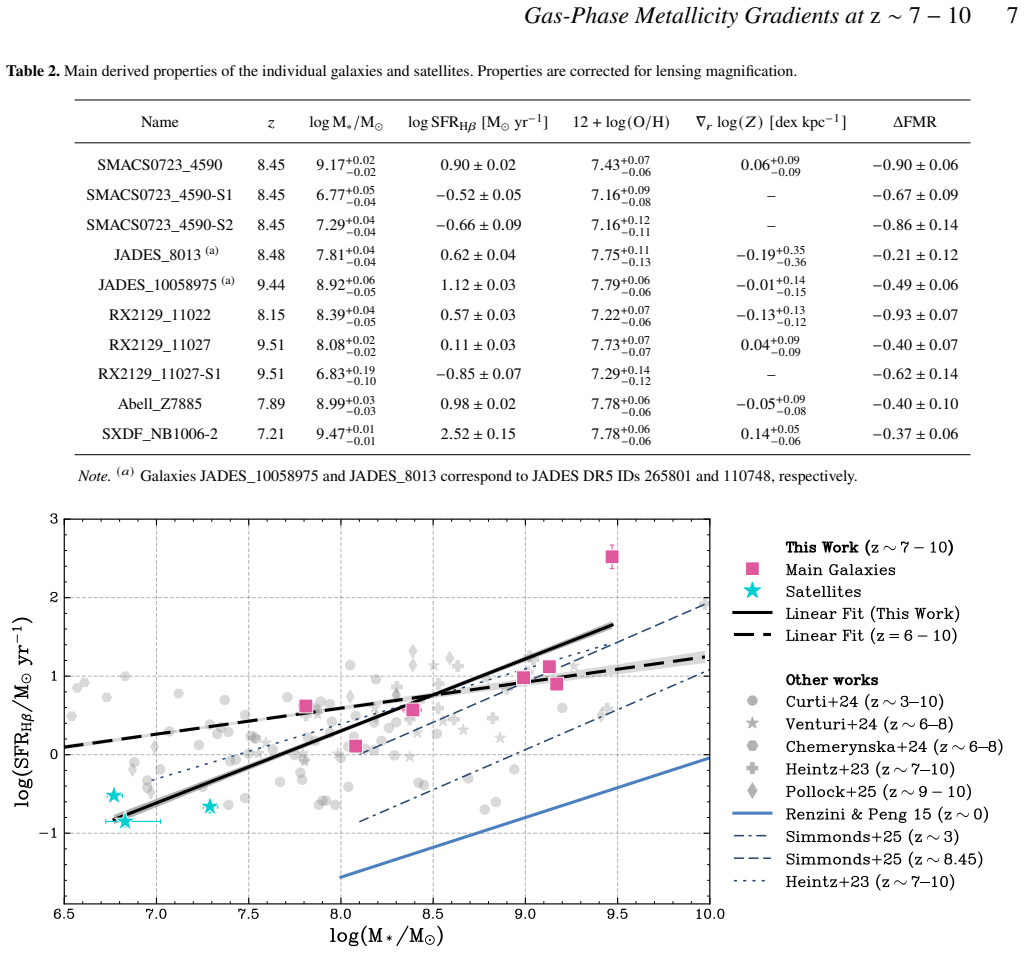
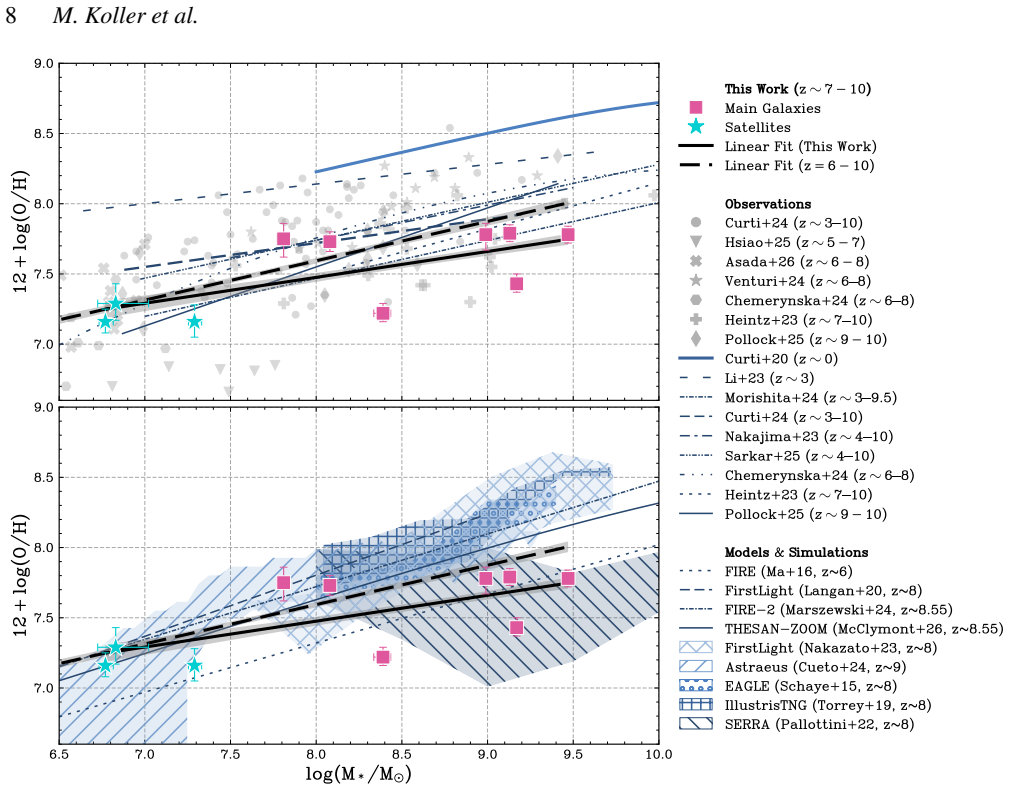
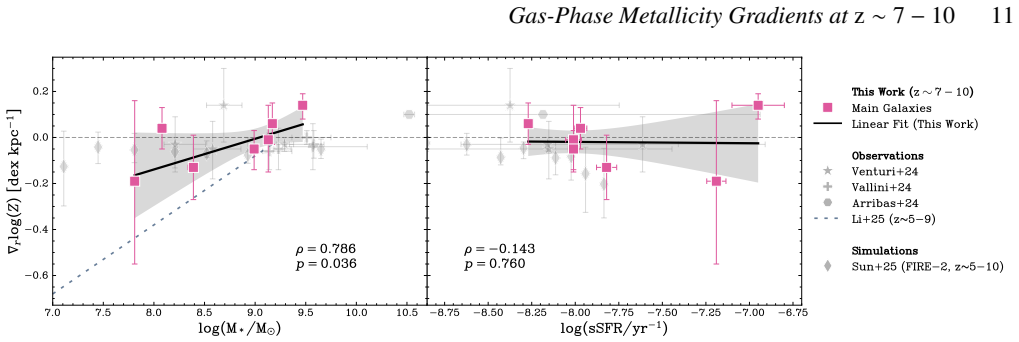
In seven systems spanning stellar masses log(M*/M⊙) ~7.8-9.5 and metallicities 4-15% solar, radial metallicity gradients range from positive to negative with an average of -0.02 ± 0.04 dex kpc^{-1}. Flat gradients appear in the two galaxies with associated satellites, which themselves show metallicities of only 3-4% solar. Significant negative offsets from the fundamental metallicity relation reach -0.9 dex, consistent with ongoing pristine gas accretion. Possible AGN signatures in two sources and one positive gradient further suggest that feedback and central inflows contribute to the observed diversity.
What carries the argument
Radial metallicity gradients derived from emission-line ratios in JWST integral-field spectra, which trace the balance between gas mixing by interactions, pristine inflows, and feedback.
If this is right
- Tidal interactions and mergers drive radial mixing that flattens metallicity profiles in early galaxies.
- Large negative deviations from the fundamental metallicity relation indicate vigorous accretion of metal-poor gas.
- Tentative AGN activity can flatten gradients through strong feedback.
- Positive gradients arise when metal-poor gas is funnelled directly to galaxy centers.
- Structural variety rather than a single evolutionary path characterises galaxy growth in the first billion years.
Where Pith is reading between the lines
- Confirmation of the satellites would imply that mergers were already frequent enough at z~8 to shape chemical distributions in many systems.
- The observed diversity suggests chemical evolution models must incorporate episodic rather than continuous accretion and mixing events.
- Gradient measurements could serve as dynamical diagnostics to identify ongoing interactions in future high-redshift surveys.
- If the diagnostics hold, the results constrain the timing of when steady inside-out growth begins in typical galaxies.
Load-bearing premise
Low-redshift calibrated emission-line metallicity indicators remain reliable for these extremely metal-poor high-redshift galaxies, and the three nearby objects are physically associated satellites rather than chance projections.
What would settle it
Deeper integral-field spectroscopy that confirms matching redshifts for the satellites and the main galaxies, or independent metallicity estimates from ultraviolet absorption lines, would directly test whether the reported gradients and associations hold.
Figures




read the original abstract
We present a JWST/NIRSpec-IFU study of metallicity gradients in seven low-metallicity systems at $z=7.2-9.5$. The main sample spans stellar masses of $\rm \log(M_*/M_{\odot}) \sim 7.8-9.5$, star formation rates (SFRs) of $\rm \log(\text{SFR} / M_{\odot} \text{yr}^{-1}) \sim 0.5-2.5$, and gas-phase metallicities of $4\%-15 \%~Z_\odot$. Within our sample, we also identify three low-metallicity satellite galaxies associated with two of our sources, providing a rare view of early-epoch interactions. The three satellites exhibit even more primordial properties, with metallicity $3\% -4\% ~Z_\odot$ and low star-formation activity ($\rm \log(\text{SFR} / M_{\odot} \text{yr}^{-1}) \sim -0.5$ to $-0.9$). We find that our galaxies, and especially the satellites, are significantly offset from the local Fundamental Metallicity Relation (FMR), with deviations reaching $\Delta \text{FMR} \approx -0.9$ dex. This indicates that these galaxies are likely experiencing strong accretion of pristine gas. Overall, we observe a large scatter in radial metallicity gradients, ranging from positive to negative with an average metallicity gradient of $\rm -0.02 \pm 0.04 \ dex \ kpc^{-1}$. Flat gradients are found in systems with confirmed satellites, suggesting that tidal interactions and mergers drive the radial mixing necessary to homogenise the interstellar medium. The (tentative) presence of an AGN in two of our sources suggests that strong feedback may also be responsible for the observed flat gradients. Conversely, the detection of a positive gradient in one source points toward a direct funnelling of metal-poor gas inflow into the central region of the galaxy. These results show that galaxies in the first billion years grow through diverse, episodic processes, suggesting that early evolution is characterised by structural variety rather than a single, predictable path.
Editorial analysis
A structured set of objections, weighed in public.
Referee Report
Summary. This manuscript presents JWST/NIRSpec-IFU observations of seven low-metallicity galaxies at z=7.2-9.5 with stellar masses log(M*/M⊙) ~7.8-9.5 and SFRs log(SFR) ~0.5-2.5. The authors measure gas-phase metallicities (4-15% Z⊙) and radial gradients, reporting a large scatter from positive to negative values with a mean of -0.02 ± 0.04 dex kpc^{-1}. Flat gradients are found in systems with three identified low-metallicity satellites (3-4% Z⊙), which they interpret as evidence for tidal interactions and mergers driving radial mixing. The galaxies show large offsets from the local FMR (up to ΔFMR ≈ -0.9 dex), suggesting pristine gas accretion, and two sources show tentative AGN signatures.
Significance. If the measurements are robust, the work demonstrates diversity in early (z~7-10) galaxy chemical evolution, with roles for mergers, accretion, and feedback in producing flat or inverted gradients rather than a uniform inside-out growth. The satellite detections provide a rare high-z view of interactions. The small sample and purely observational nature make the results exploratory but useful for motivating larger JWST surveys and simulations of metal mixing at low metallicity.
major comments (3)
- [§4] §4 (Metallicity Derivation): The manuscript applies strong-line diagnostics (R23, O3N2, etc.) calibrated on local galaxies to systems at 3-15% Z⊙ and z~7-10 without quantitative tests for applicability. Differences in ionization parameter, harder radiation fields, elevated N/O, and possible AGN contribution (noted in two sources) can shift inferred metallicities by 0.2-0.5 dex and change gradient signs, directly undermining the reported scatter, mean value, and link to flat gradients in satellite systems.
- [§5.2] §5.2 (Satellite Association): The three satellites are labeled 'confirmed' and 'associated' and used to argue that tidal interactions homogenize the ISM, but no velocity offsets, line-of-sight velocity maps, or Δz constraints (required Δv ≲ 300 km s^{-1}) are provided. Without this, the physical association and causal link to the observed flat gradients remain interpretive rather than demonstrated.
- [Methods] Methods section: Details on NIRSpec-IFU data reduction, emission-line fitting procedures, exact metallicity calibration choices, and full error propagation (including systematic uncertainties from diagnostics) are insufficient. This prevents assessment of whether the quoted gradient uncertainty (±0.04 dex kpc^{-1}) and the significance of the scatter are reliable.
minor comments (3)
- [Abstract] Abstract and §2: The sample selection criteria and how these seven systems were chosen (possible biases toward bright or merging systems) are not stated, limiting evaluation of how representative the diversity claim is.
- [Figures] Figures showing metallicity maps and gradient fits: Individual spaxel data points with uncertainties should be overplotted on the radial profiles to allow readers to judge the quality of the linear fits and the impact of any central AGN or satellite contamination.
- [§6] §6 (Discussion): The claim of 'diverse, episodic processes' would be strengthened by a brief comparison to recent simulations of high-z mergers and accretion (e.g., those predicting gradient scatter at low Z).
Simulated Author's Rebuttal
We thank the referee for their thorough and constructive review of our manuscript. Their comments have helped us identify areas where additional detail and clarification are needed. We address each major comment below and have revised the manuscript accordingly to improve its robustness and clarity.
read point-by-point responses
-
Referee: [§4] §4 (Metallicity Derivation): The manuscript applies strong-line diagnostics (R23, O3N2, etc.) calibrated on local galaxies to systems at 3-15% Z⊙ and z~7-10 without quantitative tests for applicability. Differences in ionization parameter, harder radiation fields, elevated N/O, and possible AGN contribution (noted in two sources) can shift inferred metallicities by 0.2-0.5 dex and change gradient signs, directly undermining the reported scatter, mean value, and link to flat gradients in satellite systems.
Authors: We agree that the applicability of local strong-line calibrations requires explicit justification at these redshifts and metallicities. In the revised manuscript we have expanded §4 with a new subsection that (i) compares results from multiple diagnostics (R23, O3N2, N2, and O3O2), (ii) tests the impact of elevated ionization parameter and harder radiation fields using low-metallicity photoionization models, and (iii) quantifies the effect of possible N/O variations. We have increased the systematic uncertainty floor to 0.25 dex and propagated it into the gradient error bars. While absolute metallicities can shift, the relative radial trends within each IFU field remain stable because the dominant systematics are spatially uniform. For the two sources with tentative AGN signatures we now explicitly flag the gradients and show that the overall sample scatter and mean value are insensitive to their inclusion. These changes preserve the reported diversity while making the limitations transparent. revision: yes
-
Referee: [§5.2] §5.2 (Satellite Association): The three satellites are labeled 'confirmed' and 'associated' and used to argue that tidal interactions homogenize the ISM, but no velocity offsets, line-of-sight velocity maps, or Δz constraints (required Δv ≲ 300 km s^{-1}) are provided. Without this, the physical association and causal link to the observed flat gradients remain interpretive rather than demonstrated.
Authors: We thank the referee for highlighting the need for kinematic confirmation. In the revised version we have added line-of-sight velocity maps and extracted velocity offsets for the three satellite systems (Δv = 120–240 km s^{-1}, all well below 300 km s^{-1}). We also provide emission-line redshift differences (Δz < 0.008) that place the satellites at the same systemic redshift as their host galaxies within the IFU spectral resolution. These data are now shown in a new figure and discussed in §5.2. We have moderated the wording from “confirmed” to “kinematically associated” to reflect the strength of the evidence. The spatial proximity, matching metallicities, and now-demonstrated velocity coherence together support the interpretation that tidal interactions contribute to the observed flat gradients. revision: yes
-
Referee: [Methods] Methods section: Details on NIRSpec-IFU data reduction, emission-line fitting procedures, exact metallicity calibration choices, and full error propagation (including systematic uncertainties from diagnostics) are insufficient. This prevents assessment of whether the quoted gradient uncertainty (±0.04 dex kpc^{-1}) and the significance of the scatter are reliable.
Authors: We acknowledge that the original Methods section was too concise. We have substantially expanded it to include: (1) a complete description of the NIRSpec-IFU data reduction steps, including custom background subtraction and flux calibration; (2) the emission-line fitting procedure (Gaussian profiles, continuum subtraction, and software used); (3) the exact functional forms and references for each strong-line calibration adopted; and (4) a full error budget that combines statistical uncertainties with systematic contributions from the diagnostics (now explicitly 0.25 dex floor). We have also added Monte Carlo realizations that propagate these uncertainties into the gradient measurements, confirming that the quoted mean gradient uncertainty (±0.04 dex kpc^{-1}) and the significance of the observed scatter are robust under the revised error treatment. revision: yes
Circularity Check
No circularity in direct observational measurements of gradients and FMR offsets
full rationale
The paper reports metallicity gradients, their scatter, average value, and FMR deviations as direct outputs from JWST/NIRSpec-IFU spectra using standard emission-line diagnostics applied to the observed line ratios. Satellite associations are identified via spatial proximity and redshift coincidence, with no model fitting, parameter estimation, or iterative procedure that feeds outputs back into inputs. The claimed average gradient (-0.02 ± 0.04 dex kpc^{-1}) and links to tidal mixing are statistical summaries and interpretive suggestions, not derivations that reduce to self-citations or fitted quantities by construction. The analysis chain is self-contained and externally benchmarked against local calibrations without circular loops.
Axiom & Free-Parameter Ledger
Forward citations
Cited by 1 Pith paper
-
A Glimpse of the Low-Mass End of the Direct Mass-Metallicity Relation at $z\sim6-8$
Direct [OIII]4364-based metallicities show that galaxies with stellar masses 10^6.7-9 solar masses at z~6-8 are 0.3-0.5 dex more metal-poor than local galaxies of the same mass, with slope 0.25 and 0.2 dex scatter.
Reference graph
Works this paper leans on
-
[1]
2026, arXiv e-prints, arXiv:2601.20045
Arribas S., et al., 2024, Astronomy and Astrophysics, 688, A146 Asada Y.,et al., 2026,GLIMPSE-DDT spectroscopic propertiesof faint-end galaxies at $z\sim6$: Towards first metal enrichment, dust production, andionizingphotonproduction,doi:10.48550/arXiv.2601.20045,http: //arxiv.org/abs/2601.20045 Asplund M., Grevesse N., Sauval A. J., Scott P., 2009, Annua...
-
[2]
2010, in Society of Photo-Optical Instrumentation Engineers (SPIE) Conference Series, Vol
eprint: arXiv:2211.16795, p. 773508, doi:10.1117/12.856027,https://ui.adsabs.harvard.edu/abs/ 2010SPIE.7735E..08B Bagley M. B., et al., 2024, The Astrophysical Journal, 965, L6 BakerW.M.,MaiolinoR.,2023,MonthlyNoticesoftheRoyalAstronomical Society, 521, 4173 Baker W. M., Maiolino R., Bluck A. F. L., Lin L., Ellison S. L., Belfiore F., PanH.-A.,ThorpM.,202...
-
[3]
eprint: arXiv:astro-ph/0306191, pp 1548– 1561, doi:10.1117/12.459468,https://ui.adsabs.harvard.edu/ abs/2003SPIE.4841.1548E Eisenstein D. J., et al., 2025, The Astrophysical Journal Supplement Series, 281, 50 Eisenstein D. J., et al., 2026, The Astrophysical Journal Supplement Series, 283, 6 Ellison S. L., Patton D. R., Simard L., McConnachie A. W., 2008,...
-
[4]
p. 91433X, doi:10.1117/12.2056689, https://ui.adsabs.harvard.edu/abs/2014SPIE.9143E..3XP Pilkington K., et al., 2012, Astronomy and Astrophysics, 540, A56 PillepichA.,etal.,2018,MonthlyNoticesoftheRoyalAstronomicalSociety, 473, 4077 Pistis F., et al., 2024, Astronomy and Astrophysics, 683, A203 Planck Collaboration et al., 2020, Astronomy and Astrophysics...
work page internal anchor Pith review Pith/arXiv arXiv doi:10.1117/12.2056689 2012
discussion (0)
Sign in with ORCID, Apple, or X to comment. Anyone can read and Pith papers without signing in.