Recognition: no theorem link
Leveraging Artist Catalogs for Cold-Start Music Recommendation
Pith reviewed 2026-05-10 17:44 UTC · model grok-4.3
The pith
New tracks get collaborative filtering embeddings by attending to their artist's existing catalog, more than doubling recall and NDCG.
A machine-rendered reading of the paper's core claim, the machinery that carries it, and where it could break.
Core claim
Since most new tracks come from artists with previous history, cold-start track recommendation can be reframed as semi-cold. Artist-aware methods more than double Recall and NDCG compared to content-only baselines. ACARec generates CF embeddings for new tracks by attending over the artist's existing catalog, offering advantages in predicting preferences for new tracks and estimating cold item popularity.
What carries the argument
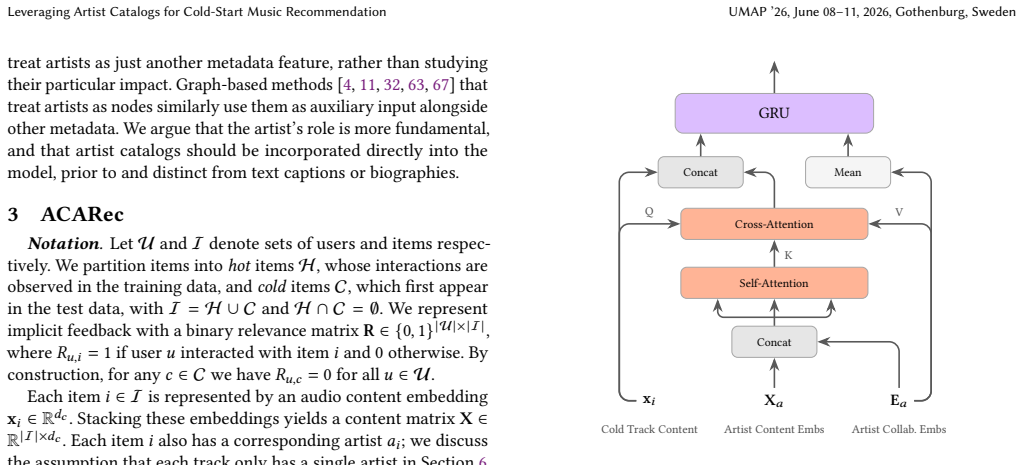
ACARec, an attention-based architecture that generates collaborative filtering embeddings for new tracks by attending over the artist's existing catalog.
If this is right
- Artist-aware methods more than double Recall and NDCG compared to content-only baselines for cold tracks.
- ACARec improves prediction of user preferences for new tracks from known artists.
- The approach yields more accurate estimation of cold item popularity.
- It supports better new artist discovery by leveraging existing collaborative signals at the artist level.
Where Pith is reading between the lines
- Platforms could prioritize collecting and maintaining artist-level interaction data to handle new releases more effectively.
- The hierarchical attention idea might transfer to other domains with creator histories, such as books by author or videos by channel.
- Hybrid models combining artist-catalog attention with audio or metadata features could add robustness when artist data is sparse.
Load-bearing premise
The collaborative signal present at the artist level transfers reliably to new tracks from the same artist, and most new tracks come from artists with prior history.
What would settle it
Measure performance on a test set of tracks from artists with no prior catalog at all; if artist-aware gains vanish and results match content-only baselines, the semi-cold transfer assumption fails.
Figures


read the original abstract
The item cold-start problem poses a fundamental challenge for music recommendation: newly added tracks lack the interaction history that collaborative filtering (CF) requires. Existing approaches often address this problem by learning mappings from content features such as audio, text, and metadata to the CF latent space. However, previous works either omit artist information or treat it as just another input modality, missing the fundamental hierarchy of artists and items. Since most new tracks come from artists with previous history available, we frame cold-start track recommendation as 'semi-cold' by leveraging the rich collaborative signal that exists at the artist level. We show that artist-aware methods can more than double Recall and NDCG compared to content-only baselines, and propose ACARec, an attention-based architecture that generates CF embeddings for new tracks by attending over the artist's existing catalog. We show that our approach has notable advantages in predicting user preferences for new tracks, especially for new artist discovery and more accurate estimation of cold item popularity.
Editorial analysis
A structured set of objections, weighed in public.
Referee Report
Summary. The paper addresses the item cold-start problem in music recommendation by reframing it as a 'semi-cold' task that exploits artist-level collaborative filtering signals. It proposes ACARec, an attention-based model that generates CF embeddings for new tracks by attending over an artist's existing catalog, and reports that artist-aware methods more than double Recall and NDCG relative to content-only baselines, with particular gains for new artist discovery and cold-item popularity estimation.
Significance. If the empirical claims hold under rigorous validation, the work would be significant for cold-start recommendation because it directly leverages the artist-item hierarchy that is ubiquitous in music data but often treated as just another feature. The attention mechanism for proxy embedding generation is a clean architectural idea that could generalize beyond music if intra-artist preference consistency can be demonstrated.
major comments (2)
- [Abstract] Abstract: the headline claim that artist-aware methods 'more than double' Recall and NDCG is presented without any experimental details, baseline definitions, dataset descriptions, statistical tests, or ablation results. Because this quantitative improvement is the central empirical support for the semi-cold framing and for ACARec, the absence of these elements makes the primary result unverifiable from the manuscript as written.
- [Abstract / Method] The core modeling assumption—that collaborative signals at the artist level transfer reliably to new tracks from the same artist—is load-bearing for both the method and the reported gains, yet no direct evidence (e.g., intra-artist embedding variance, per-artist performance breakdowns, or correlation analysis across catalog tracks) is supplied to test this transfer. If intra-artist preference correlation is low for many artists, the attention-based proxy embeddings would be unreliable and the doubling of metrics could be driven by a small subset of homogeneous catalogs.
minor comments (2)
- [Abstract] The abstract states that 'most new tracks come from artists with previous history' but provides no supporting statistic or dataset analysis to quantify this prevalence.
- [Method] Notation for the attention mechanism and the mapping from artist catalog to track embedding should be introduced with explicit equations rather than prose description alone.
Simulated Author's Rebuttal
We thank the referee for their constructive and detailed feedback. We address each major comment below and describe the revisions we will make to strengthen the manuscript.
read point-by-point responses
-
Referee: [Abstract] Abstract: the headline claim that artist-aware methods 'more than double' Recall and NDCG is presented without any experimental details, baseline definitions, dataset descriptions, statistical tests, or ablation results. Because this quantitative improvement is the central empirical support for the semi-cold framing and for ACARec, the absence of these elements makes the primary result unverifiable from the manuscript as written.
Authors: We agree that the abstract, as a concise summary, would be more informative if it provided minimal context for the headline claim. The full details—including dataset description, baseline definitions, ablation studies, and statistical significance tests—are presented in Sections 3 and 4 of the manuscript. In the revised version we will expand the abstract to briefly reference the dataset, the content-only baselines, and the fact that reported improvements are statistically significant. This change will improve verifiability without exceeding typical abstract length constraints. revision: yes
-
Referee: [Abstract / Method] The core modeling assumption—that collaborative signals at the artist level transfer reliably to new tracks from the same artist—is load-bearing for both the method and the reported gains, yet no direct evidence (e.g., intra-artist embedding variance, per-artist performance breakdowns, or correlation analysis across catalog tracks) is supplied to test this transfer. If intra-artist preference correlation is low for many artists, the attention-based proxy embeddings would be unreliable and the doubling of metrics could be driven by a small subset of homogeneous catalogs.
Authors: We acknowledge that direct validation of the intra-artist transfer assumption would strengthen the paper. While the reported gains, particularly the advantages for new artist discovery, provide indirect support for the assumption holding on average, the manuscript does not include explicit analyses such as intra-artist embedding variance or per-artist breakdowns. In the revision we will add these analyses, including intra-artist CF embedding similarity statistics and performance stratified by artist catalog characteristics, to directly test the assumption and address the possibility of subset-driven effects. revision: yes
Circularity Check
No significant circularity; derivation is empirical and self-contained
full rationale
The paper proposes ACARec, an attention-based model that generates CF embeddings for new tracks by attending over an artist's existing catalog, and reports empirical gains in Recall/NDCG over content-only baselines. No equations, derivations, or first-principles results are present that reduce claimed predictions to fitted inputs by construction. The core claim rests on external evaluation against baselines and the observation that most new tracks come from artists with prior history, which is a domain fact rather than a self-referential definition. No self-citations are load-bearing for uniqueness theorems or ansatzes, and the architecture is presented as a novel combination rather than a renaming of known results. The derivation chain is therefore independent of its own outputs.
Axiom & Free-Parameter Ledger
axioms (1)
- domain assumption Most new tracks come from artists with previous history available
Forward citations
Cited by 1 Pith paper
-
Sparse Contrastive Learning for Content-Based Cold Item Recommendation
SEMCo uses sparse entmax contrastive learning for purely content-based cold-start item recommendation, outperforming standard methods in ranking accuracy.
Reference graph
Works this paper leans on
-
[1]
Pablo Alonso-Jiménez, Xavier Favory, Hadrien Foroughmand, Grigoris Bourdalas, Xavier Serra, Thomas Lidy, and Dmitry Bogdanov. 2023. Pre-Training Strategies Using Contrastive Learning and Playlist Information for Music Classification and Similarity. http://arxiv.org/abs/2304.12257
-
[2]
Haoyue Bai, Min Hou, Le Wu, Yonghui Yang, Kun Zhang, Richang Hong, and Meng Wang. 2023. Gorec: a generative cold-start recommendation framework. InProc. of the 31st ACM international conf. on multimedia. 1004–1012
2023
-
[3]
Niels Bertram, Jürgen Dunkel, and Ramón Hermoso. 2023. I am all EARS: Using open data and knowledge graph embeddings for music recommendations.Expert Systems with Applications229 (2023), 120347
2023
-
[4]
Matej Bevec, Marko Tkalčič, and Matevž Pesek. 2024. Hybrid music recommen- dation with graph neural networks.User Modeling and User-Adapted Interaction 34, 5 (2024), 1891–1928
2024
-
[5]
Rodrigo Borges and Marcelo Queiroz. 2023. Audio-Based Sequential Music Recommendation. In2023 31st European Signal Processing Conference (EUSIPCO). IEEE, 421–425
2023
-
[6]
Léa Briand, Théo Bontempelli, Walid Bendada, Mathieu Morlon, François Rigaud, Benjamin Chapus, Thomas Bouabça, and Guillaume Salha-Galvan. 2024. Let’s get it started: fostering the discoverability of new releases on Deezer. InEuropean Conference on Information Retrieval. Springer, 286–291
2024
-
[7]
Yukuo Cen, Jianwei Zhang, Xu Zou, Chang Zhou, Hongxia Yang, and Jie Tang
-
[8]
InProceedings of the 26th ACM SIGKDD international conference on knowledge discovery & data mining
Controllable multi-interest framework for recommendation. InProceedings of the 26th ACM SIGKDD international conference on knowledge discovery & data mining. 2942–2951
-
[9]
Hao Chen, Zefan Wang, Feiran Huang, Xiao Huang, Yue Xu, Yishi Lin, Peng He, and Zhoujun Li. 2022. Generative adversarial framework for cold-start item recommendation. InProc. of the 45th International ACM SIGIR Conf. on Research and Development in Information Retrieval. 2565–2571
2022
-
[10]
Ke Chen, Beici Liang, Xiaoshuan Ma, and Minwei Gu. 2021. Learning audio embeddings with user listening data for content-based music recommendation. InICASSP 2021-2021 IEEE International Conference on Acoustics, Speech and Signal Processing (ICASSP). IEEE, 3015–3019
2021
- [11]
-
[12]
Xiaohui Cui, Xiaolong Qu, Dongmei Li, Yu Yang, Yuxun Li, and Xiaoping Zhang
-
[13]
doi:10.3390/electronics12122688
MKGCN: Multi-Modal Knowledge Graph Convolutional Network for Music Recommender Systems.Electronics12, 12 (2023). doi:10.3390/electronics12122688
-
[14]
Angelo Cesar Mendes da Silva, Diego Furtado Silva, and Ricardo Marcondes Mar- cacini. 2024. Artist Similarity based on Heterogeneous Graph Neural Networks. IEEE/ACM Transactions on Audio, Speech, and Language Processing(2024)
2024
-
[15]
Yashar Deldjoo, Dietmar Jannach, Alejandro Bellogin, Alessandro Difonzo, and Dario Zanzonelli. 2024. Fairness in recommender systems: research landscape and future directions.User Modeling and User-Adapted Interaction34, 1 (2024)
2024
-
[16]
Yashar Deldjoo, Markus Schedl, and Peter Knees. 2024. Content-driven music recommendation: Evolution, state of the art, and challenges.Computer Science Review51 (2024), 100618. doi:10.1016/j.cosrev.2024.100618
-
[17]
Jacob Devlin, Ming-Wei Chang, Kenton Lee, and Kristina Toutanova. 2019. Bert: Pre-training of deep bidirectional transformers for language understanding. In Proceedings of the 2019 conference of the North American chapter of the association for computational linguistics: human language technologies, volume 1 (long and short papers). 4171–4186
2019
-
[18]
Andres Ferraro, Xavier Favory, Konstantinos Drossos, Yuntae Kim, and Dmitry Bogdanov. 2021. Enriched music representations with multiple cross-modal contrastive learning.IEEE Signal Processing Letters28 (2021), 733–737
2021
-
[19]
Bruce Ferwerda, Eveline Ingesson, Michaela Berndl, and Markus Schedl. 2023. I don’t care how popular you are! investigating popularity bias in music recom- mendations from a user’s perspective. InProceedings of the 2023 conference on human information interaction and retrieval. 357–361
2023
-
[20]
Christian Ganhör, Marta Moscati, Anna Hausberger, Shah Nawaz, and Markus Schedl. 2024. A Multimodal Single-Branch Embedding Network for Recommen- dation in Cold-Start and Missing Modality Scenarios. InProceedings of the 18th ACM Conference on Recommender Systems. 380–390
2024
-
[21]
Florian Grötschla, Luca Strässle, Luca A Lanzendörfer, and Roger Wattenhofer
- [22]
-
[23]
Jordan, and Nikhil Garg
Wenshuo Guo, Karl Krauth, Michael I. Jordan, and Nikhil Garg. 2021. The Stereotyping Problem in Collaboratively Filtered Recommender Systems.Equity and Access in Algorithms, Mechanisms, and Optimization(2021)
2021
-
[24]
Ruining He and Julian McAuley. 2016. VBPR: visual bayesian personalized ranking from implicit feedback. InProc. of the AAAI conf. on artificial intelligence
2016
-
[25]
Feiran Huang, Yuanchen Bei, Zhenghang Yang, Junyi Jiang, Hao Chen, Qijie Shen, Senzhang Wang, Fakhri Karray, and Philip S Yu. 2025. Large Language Model Simulator for Cold-Start Recommendation. InProceedings of the Eighteenth ACM International Conference on Web Search and Data Mining. 261–270
2025
-
[26]
Feiran Huang, Zefan Wang, Xiao Huang, Yufeng Qian, Zhetao Li, and Hao Chen
-
[27]
Aligning Distillation For Cold-start Item Recommendation. InProc. of the 46th International ACM SIGIR Conf. on Research and Development in Information Retrieval (SIGIR ’23). Association for Computing Machinery, New York, NY, USA
-
[28]
Yitong Ji, Aixin Sun, Jie Zhang, and Chenliang Li. 2023. A critical study on data leakage in recommender system offline evaluation.ACM Transactions on Information Systems41, 3 (2023), 1–27
2023
-
[29]
Jinri Kim, Eungi Kim, Kwangeun Yeo, Yujin Jeon, Chanwoo Kim, Sewon Lee, and Joonseok Lee. 2024. Content-based Graph Reconstruction for Cold-start Item Recommendation. InProc. of the 47th International ACM SIGIR Conf. on Research and Development in Information Retrieval. 1263–1273
2024
-
[30]
Adam: A Method for Stochastic Optimization
Diederik P. Kingma and Jimmy Ba. 2014. Adam: A Method for Stochastic Opti- mization.CoRRabs/1412.6980 (2014)
work page internal anchor Pith review Pith/arXiv arXiv 2014
-
[31]
Anastasiia Klimashevskaia, Dietmar Jannach, Mehdi Elahi, and Christoph Trat- tner. 2024. A survey on popularity bias in recommender systems.User Modeling and User-Adapted Interaction34, 5 (2024), 1777–1834
2024
-
[32]
Filip Korzeniowski, Sergio Oramas, and Fabien Gouyon. 2022. Artist Similarity for Everyone: A Graph Neural Network Approach.Transactions of the International Society for Music Information Retrieval(Oct 2022). doi:10.5334/tismir.143
-
[33]
Wo Jae Lee, Rifat Joyee, Emanuele Coviello, and Sudev Mukherjee. 2025. Mul- timodal music tokenization with residual quantization for generative retrieval. (2025)
2025
-
[34]
Chao Li, Zhiyuan Liu, Mengmeng Wu, Yuchi Xu, Huan Zhao, Pipei Huang, Guoliang Kang, Qiwei Chen, Wei Li, and Dik Lun Lee. 2019. Multi-interest network with dynamic routing for recommendation at Tmall. InProceedings of the 28th ACM international conference on information and knowledge management. 2615–2623
2019
-
[35]
Dawen Liang, Minshu Zhan, and Daniel PW Ellis. 2015. Content-Aware Collab- orative Music Recommendation Using Pre-trained Neural Networks.. InISMIR. 295–301
2015
-
[36]
Xinqiao Liu, Zhisheng Yang, and Jinyong Cheng. 2024. Music recommendation algorithms based on knowledge graph and multi-task feature learning.Scientific Reports14, 1 (2024), 2055
2024
-
[37]
Paul Magron and Cédric Févotte. 2022. Neural content-aware collaborative filtering for cold-start music recommendation.Data Mining and Knowledge Discovery36, 5 (2022), 1971–2005
2022
-
[38]
Brian McFee, Luke Barrington, and Gert Lanckriet. 2012. Learning content similarity for music recommendation.IEEE transactions on audio, speech, and language processing20, 8 (2012), 2207–2218
2012
-
[39]
Gregor Meehan and Johan Pauwels. 2025. Artist Considerations in Offline Eval- uation of Music Recommender Systems. MuRS 2025: 3rd Music Recommender Systems Workshop, September 22nd, 2025
2025
-
[40]
Gregor Meehan and Johan Pauwels. 2025. Evaluating Contrastive Methodologies for Music Representation Learning Using Playlist Data. InICASSP 2025 - 2025 IEEE International Conference on Acoustics, Speech and Signal Processing (ICASSP). 1–5. doi:10.1109/ICASSP49660.2025.10888157
-
[41]
Gregor Meehan and Johan Pauwels. 2025. On Inherited Popularity Bias in Cold- Start Item Recommendation. InProc. of the Nineteenth ACM Conf. on Recommender Systems. 649–654
2025
-
[42]
M Jeffrey Mei, Florian Henkel, Samuel E Sandberg, Oliver Bembom, and Andreas F Ehmann. 2025. Semantic ids for music recommendation. InProceedings of the Nineteenth ACM Conference on Recommender Systems. 1070–1073
2025
-
[43]
Zaiqiao Meng, Richard McCreadie, Craig Macdonald, and Iadh Ounis. 2020. Ex- ploring data splitting strategies for the evaluation of recommendation models. In Proceedings of the 14th acm conference on recommender systems. 681–686
2020
-
[44]
Julien Monteil, Volodymyr Vaskovych, Wentao Lu, Anirban Majumder, and Anton Van Den Hengel. 2024. Marec: Metadata alignment for cold-start recommendation. InProceedings of the 18th ACM Conference on Recommender Systems. 401–410
2024
-
[45]
Marta Moscati, Emilia Parada-Cabaleiro, Yashar Deldjoo, Eva Zangerle, and Markus Schedl. 2022. Music4All-Onion–A Large-Scale Multi-faceted Content- Centric Music Recommendation Dataset. InProceedings of the 31st ACM Interna- tional Conference on Information & Knowledge Management. 4339–4343
2022
-
[46]
Sergio Oramas, Andres Ferraro, Alvaro Sarasua, and Fabien Gouyon. 2024. Talking to Your Recs: Multimodal Embeddings For Recommendation and Retrieval. (2024)
2024
-
[47]
Sergio Oramas, Oriol Nieto, Mohamed Sordo, and Xavier Serra. 2017. A deep multimodal approach for cold-start music recommendation. InProceedings of the 2nd workshop on deep learning for recommender systems. 32–37
2017
-
[48]
Alexander Ploshkin, Vladislav Tytskiy, Alexey Pismenny, Vladimir Baikalov, Evgeny Taychinov, Artem Permiakov, Daniil Burlakov, and Eugene Krofto. 2025. Yambda-5B—A Large-Scale Multi-Modal Dataset for Ranking and Retrieval. In Proceedings of the Nineteenth ACM Conference on Recommender Systems. 894–901
2025
-
[49]
Michael Pulis and Josef Bajada. 2021. Siamese Neural Networks for Content-based Cold-Start Music Recommendation.. InProceedings of the 15th ACM conference on recommender systems. 719–723
2021
-
[50]
Shashank Rajput, Nikhil Mehta, Anima Singh, Raghunandan Hulikal Keshavan, Trung Vu, Lukasz Heldt, Lichan Hong, Yi Tay, Vinh Tran, Jonah Samost, et al
-
[51]
UMAP ’26, June 08–11, 2026, Gothenburg, Sweden Tamm and Meehan et al
Recommender systems with generative retrieval.Advances in Neural Information Processing Systems36 (2023), 10299–10315. UMAP ’26, June 08–11, 2026, Gothenburg, Sweden Tamm and Meehan et al
2023
-
[52]
Steffen Rendle, Christoph Freudenthaler, Zeno Gantner, and Lars Schmidt-Thieme
-
[53]
BPR: Bayesian personalized ranking from implicit feedback. InProc. of the Twenty-Fifth Conf. on Uncertainty in Artificial Intelligence (UAI ’09)
-
[54]
Rebecca Salganik, Xiaohao Liu, Yunshan Ma, Jian Kang, and Tat-Seng Chua. 2024. Larp: Language audio relational pre-training for cold-start playlist continuation. InProceedings of the 30th ACM SIGKDD Conference on Knowledge Discovery and Data Mining. 2524–2535
2024
-
[55]
Igor André Pegoraro Santana, Fabio Pinhelli, Juliano Donini, Leonardo Catharin, Rafael Biazus Mangolin, Valéria Delisandra Feltrim, Marcos Aurélio Domingues, et al. 2020. Music4all: A new music database and its applications. In2020 In- ternational Conference on Systems, Signals and Image Processing (IWSSIP). IEEE, 399–404
2020
-
[56]
Andrew I Schein, Alexandrin Popescul, Lyle H Ungar, and David M Pennock
-
[57]
Methods and metrics for cold-start recommendations. InProc. of the 25th annual international ACM SIGIR conf. on Research and development in information retrieval. 253–260
-
[58]
Noam Shazeer. 2020. Glu variants improve transformer.arXiv preprint arXiv:2002.05202(2020)
work page internal anchor Pith review Pith/arXiv arXiv 2020
-
[59]
Noam Shazeer, Azalia Mirhoseini, Krzysztof Maziarz, Andy Davis, Quoc Le, Geoffrey Hinton, and Jeff Dean. 2017. Outrageously large neural networks: The sparsely-gated mixture-of-experts layer.arXiv preprint arXiv:1701.06538(2017)
work page internal anchor Pith review Pith/arXiv arXiv 2017
-
[60]
Anima Singh, Trung Vu, Nikhil Mehta, Raghunandan Keshavan, Maheswaran Sathiamoorthy, Yilin Zheng, Lichan Hong, Lukasz Heldt, Li Wei, Devansh Tandon, et al. 2024. Better generalization with semantic ids: A case study in ranking for recommendations. InProceedings of the 18th ACM Conference on Recommender Systems. 1039–1044
2024
- [61]
-
[62]
Changfeng Sun, Han Liu, Meng Liu, Zhaochun Ren, Tian Gan, and Liqiang Nie
-
[63]
LARA: Attribute-to-feature adversarial learning for new-item recommen- dation. InProc. of the 13th international conf. on web search and data mining
-
[64]
Yan-Martin Tamm and Anna Aljanaki. 2024. Comparative Analysis of Pretrained Audio Representations in Music Recommender Systems. In18th ACM Confer- ence on Recommender Systems (RecSys ’24). ACM, 934–938. doi:10.1145/3640457. 3688172
- [65]
- [66]
-
[67]
Robin Ungruh, Karlijn Dinnissen, Anja Volk, Maria Soledad Pera, and Hanna Hauptmann. 2024. Putting Popularity Bias Mitigation to the Test: A User-Centric Evaluation in Music Recommenders. InProceedings of the 18th ACM Conference on Recommender Systems. 169–178
2024
-
[68]
Aaron Van den Oord, Sander Dieleman, and Benjamin Schrauwen. 2013. Deep content-based music recommendation.Advances in neural information processing systems26 (2013)
2013
-
[69]
Ashish Vaswani, Noam Shazeer, Niki Parmar, Jakob Uszkoreit, Llion Jones, Aidan N Gomez, Łukasz Kaiser, and Illia Polosukhin. 2017. Attention is all you need.Advances in neural information processing systems30 (2017)
2017
-
[70]
Maksims Volkovs, Guangwei Yu, and Tomi Poutanen. 2017. Dropoutnet: Ad- dressing cold start in recommender systems.Advances in neural information processing systems30 (2017)
2017
-
[71]
Dongjing Wang, Xin Zhang, Yuyu Yin, Dongjin Yu, Guandong Xu, and Shuiguang Deng. 2023. Multi-view enhanced graph attention network for session-based music recommendation.ACM Transactions on Information Systems42, 1 (2023), 1–30
2023
-
[72]
Jianling Wang, Haokai Lu, and Minmin Chen. 2024. Fresh content recommenda- tion at scale: A multi-funnel solution and the potential of LLMs. InProceedings of the 17th ACM International Conference on Web Search and Data Mining. 1186– 1187
2024
-
[73]
Wenbo Wang, Bingquan Liu, Lili Shan, Chengjie Sun, Ben Chen, and Jian Guan
-
[74]
Preference Aware Dual Contrastive Learning for Item Cold-Start Recom- mendation. InProc. of the AAAI Conf. on Artificial Intelligence, Vol. 38. 9125–9132
-
[75]
Yinwei Wei, Xiang Wang, Qi Li, Liqiang Nie, Yan Li, Xuanping Li, and Tat-Seng Chua. 2021. Contrastive learning for cold-start recommendation. InProceedings of the 29th ACM international conference on multimedia. 5382–5390
2021
-
[76]
He Weng, Jianjiang Chen, Dongjing Wang, Xin Zhang, and Dongjin Yu. 2022. Graph-Based Attentive Sequential Model With Metadata for Music Recommen- dation.IEEE Access10 (2022), 108226–108240. doi:10.1109/ACCESS.2022.3213812
-
[77]
Neil Zeghidour, Alejandro Luebs, Ahmed Omran, Jan Skoglund, and Marco Tagliasacchi. 2021. Soundstream: An end-to-end neural audio codec.IEEE/ACM Transactions on Audio, Speech, and Language Processing30 (2021), 495–507
2021
-
[78]
Weizhi Zhang, Yuanchen Bei, Liangwei Yang, Henry Peng Zou, Peilin Zhou, Aiwei Liu, Yinghui Li, Hao Chen, Jianling Wang, Yu Wang, et al. 2025. Cold-start rec- ommendation towards the era of large language models (llms): A comprehensive survey and roadmap.arXiv preprint arXiv:2501.01945(2025)
-
[79]
Xu Zhao, Yi Ren, Ying Du, Shenzheng Zhang, and Nian Wang. 2022. Improv- ing item cold-start recommendation via model-agnostic conditional variational autoencoder. InProc. of the 45th International ACM SIGIR Conf. on Research and Development in Information Retrieval. 2595–2600
2022
-
[80]
Zhihui Zhou, Lilin Zhang, and Ning Yang. 2023. Contrastive collaborative filtering for cold-start item recommendation. InProc. of the ACM Web Conf. 2023
2023
discussion (0)
Sign in with ORCID, Apple, or X to comment. Anyone can read and Pith papers without signing in.