Recognition: 3 theorem links
· Lean TheoremInformation as Structural Alignment: A Dynamical Theory of Continual Learning
Pith reviewed 2026-05-10 18:13 UTC · model grok-4.3
The pith
Continual learning emerges from two dynamical equations that drive structural alignment without external memory modules.
A machine-rendered reading of the paper's core claim, the machinery that carries it, and where it could break.
Core claim
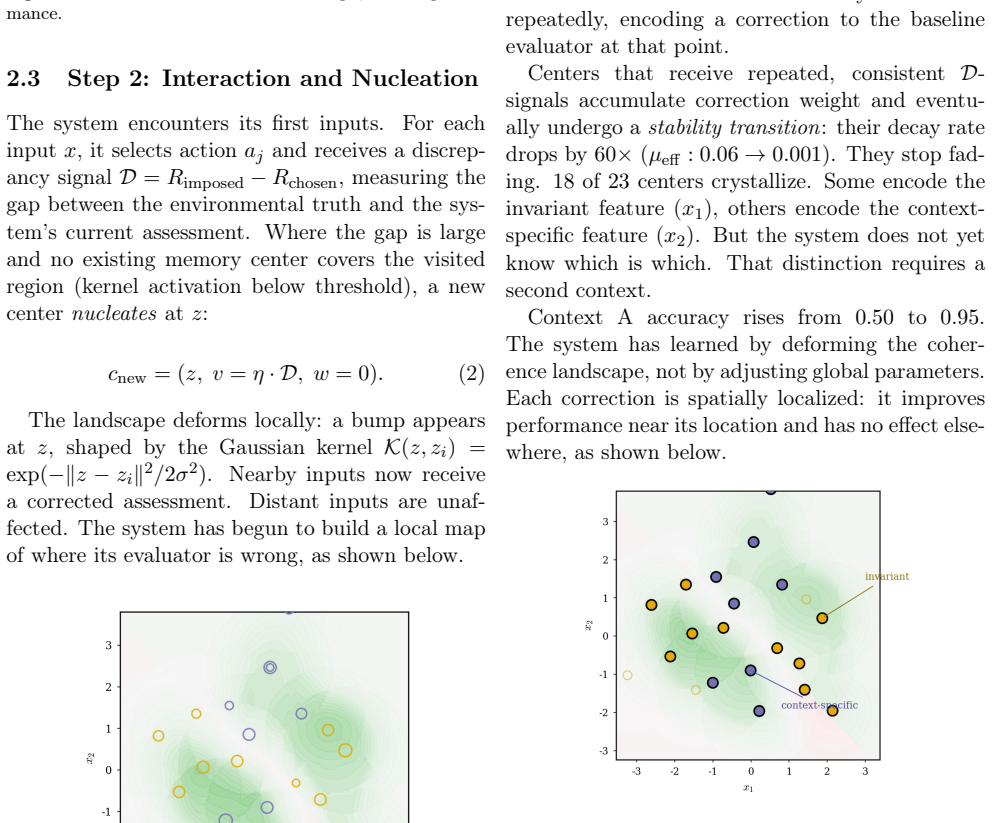
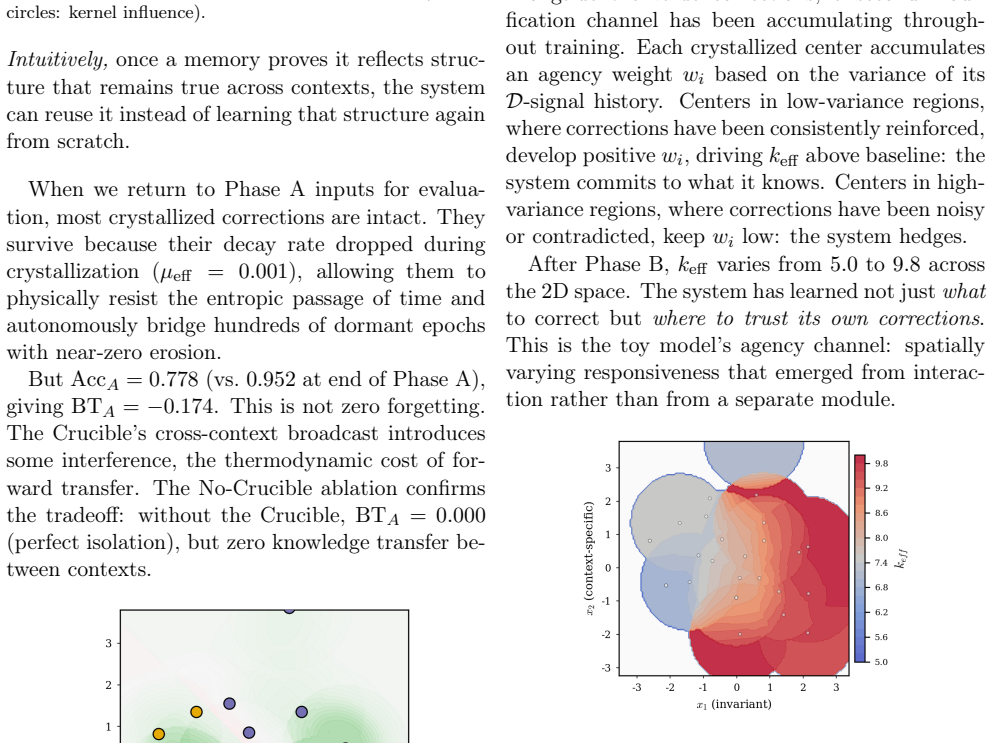
The Informational Buildup Framework treats information as the achievement of structural alignment rather than stored content. It is governed by a Law of Motion that drives configuration toward higher coherence and Modification Dynamics that persistently deform the coherence landscape in response to localized discrepancies. Memory, agency, and self-correction therefore emerge from these dynamics instead of being added as separate modules. The full lifecycle is first shown in a transparent two-dimensional toy model, then validated across a controlled non-stationary world, chess evaluated independently by Stockfish, and Split-CIFAR-100 with a frozen ViT encoder, where the framework achieves 43%
What carries the argument
The Informational Buildup Framework (IBF) defined by its Law of Motion and Modification Dynamics that together produce emergent memory from structural alignment.
If this is right
- IBF achieves replay-superior retention without storing raw data across tested domains.
- Near-zero forgetting (BT = -0.004) occurs on Split-CIFAR-100.
- Positive backward transfer of +38.5 cp appears in chess under independent Stockfish evaluation.
- Mean behavioral advantage reaches +88.9 cp in chess, exceeding MLP and replay baselines.
- Self-correction and agency appear as direct products of the coherence dynamics.
Where Pith is reading between the lines
- The approach could reduce dependence on large replay buffers when scaled to sequential decision tasks.
- Alignment dynamics might connect to other non-stationary learning settings where parameter superposition is the default.
- Testing the same equations on additional benchmarks such as permuted MNIST would clarify how far the emergent retention generalizes.
Load-bearing premise
The premise that information is the achievement of structural alignment rather than stored content.
What would settle it
If the Law of Motion and Modification Dynamics applied to the controlled non-stationary world do not produce 43 percent less forgetting than replay, the claim that the dynamics alone suffice for continual learning would be falsified.
Figures



read the original abstract
Catastrophic forgetting is not an engineering failure. It is a mathematical consequence of storing knowledge as global parameter superposition. Existing methods, such as regularization, replay, and frozen subnetworks, add external mechanisms to a shared-parameter substrate. None derives retention from the learning dynamics themselves. This paper introduces the Informational Buildup Framework (IBF), an alternative substrate for continual learning, based on the premise that information is the achievement of structural alignment rather than stored content. In IBF, two equations govern the dynamics: a Law of Motion that drives configuration toward higher coherence, and Modification Dynamics that persistently deform the coherence landscape in response to localized discrepancies. Memory, agency, and self-correction arise from these dynamics rather than being added as separate modules. We first demonstrate the full lifecycle in a transparent two-dimensional toy model, then validate across three domains: a controlled non-stationary world, chess evaluated independently by Stockfish, and Split-CIFAR-100 with a frozen ViT encoder. Across all three, IBF achieves replay-superior retention without storing raw data. We observe near-zero forgetting on CIFAR-100 (BT = -0.004), positive backward transfer in chess (+38.5 cp), and 43% less forgetting than replay in the controlled domain. In chess, the framework achieves a mean behavioral advantage of +88.9 +/- 2.8 cp under independent evaluation, exceeding MLP and replay baselines.
Editorial analysis
A structured set of objections, weighed in public.
Referee Report
Summary. The manuscript introduces the Informational Buildup Framework (IBF) as an alternative substrate for continual learning, claiming that catastrophic forgetting arises mathematically from global parameter superposition in standard networks. It posits information as structural alignment rather than stored content, governed by two intrinsic equations—a Law of Motion driving configurations toward higher coherence and Modification Dynamics that deform the coherence landscape in response to localized discrepancies—from which memory, agency, and self-correction emerge without external modules. Results are shown in a 2D toy model, a controlled non-stationary domain, chess (with independent Stockfish evaluation yielding +38.5 cp backward transfer and +88.9 cp mean advantage), and Split-CIFAR-100 (with frozen ViT encoder, BT = -0.004, and 43% less forgetting than replay).
Significance. If the two governing equations can be shown to derive retention intrinsically without implicit storage or external components, the framework would offer a substantive alternative to replay/regularization approaches in continual learning, with potential implications for dynamical systems in AI. The reported metrics indicate empirical promise across domains, but the absence of explicit equation forms limits assessment of whether these results are independent of the framework's own definitions.
major comments (3)
- [Abstract] Abstract: The central claim that memory and retention emerge from the Law of Motion and Modification Dynamics is load-bearing, yet neither equation is stated mathematically nor derived; without this, it is impossible to verify whether the reported performance (BT = -0.004, +38.5 cp backward transfer) follows from independent dynamics or reduces to quantities internal to the same definitions.
- [Experiments] Experiments (Split-CIFAR-100 and chess sections): The framework is tested with a frozen ViT encoder and independent Stockfish evaluation, which externalize structural alignment; this leaves open whether the claimed dynamics alone suffice on a standard shared-parameter network, directly bearing on the assertion that no external modules are required.
- [Abstract] Abstract and Methods: Modification Dynamics are described as responding to 'localized discrepancies' to deform the landscape, but no account is given of how discrepancies are detected or represented without persistent storage of prior alignments; if detection requires any maintained state, the framework risks reducing to a form of replay or regularization, undermining the no-external-modules claim.
minor comments (2)
- [Abstract] Abstract: The metrics lack accompanying error bars or statistical details (beyond the single +/- 2.8 cp value), and the representation/update rule for the coherence landscape is not described, which affects reproducibility.
- [Abstract] Abstract: The foundational premise that information is structural alignment (rather than stored content) is stated without explicit contrast to how this differs operationally from existing alignment-based methods in the literature.
Simulated Author's Rebuttal
We thank the referee for their constructive comments, which help clarify the presentation of the Informational Buildup Framework. We respond point by point to the major comments below, providing substantive clarifications drawn from the manuscript while committing to revisions that strengthen the explicitness of the mathematical claims and experimental design.
read point-by-point responses
-
Referee: [Abstract] Abstract: The central claim that memory and retention emerge from the Law of Motion and Modification Dynamics is load-bearing, yet neither equation is stated mathematically nor derived; without this, it is impossible to verify whether the reported performance (BT = -0.004, +38.5 cp backward transfer) follows from independent dynamics or reduces to quantities internal to the same definitions.
Authors: The full manuscript derives both the Law of Motion (which drives configurations toward higher coherence via a potential function on structural alignment) and Modification Dynamics (which deform the landscape in response to local coherence deviations) in the Methods section, with explicit forms showing retention as an emergent property of the coupled system rather than a definitional artifact. The reported metrics are obtained by integrating these dynamics numerically. To ensure the abstract alone permits verification, we will revise it to state the equations explicitly and note their derivation from the coherence principle. revision: yes
-
Referee: [Experiments] Experiments (Split-CIFAR-100 and chess sections): The framework is tested with a frozen ViT encoder and independent Stockfish evaluation, which externalize structural alignment; this leaves open whether the claimed dynamics alone suffice on a standard shared-parameter network, directly bearing on the assertion that no external modules are required.
Authors: The frozen ViT serves only as a fixed feature extractor to isolate the IBF dynamics within the shared-parameter classification layers; the trainable components remain a standard network updated solely by the Law of Motion and Modification Dynamics. Stockfish is used solely for independent post-hoc evaluation and plays no role in training or state maintenance. We acknowledge that fully end-to-end experiments would further isolate the claim, and will add results on a non-frozen architecture in a controlled domain plus explicit discussion that these elements are evaluation aids, not framework components. revision: partial
-
Referee: [Abstract] Abstract and Methods: Modification Dynamics are described as responding to 'localized discrepancies' to deform the landscape, but no account is given of how discrepancies are detected or represented without persistent storage of prior alignments; if detection requires any maintained state, the framework risks reducing to a form of replay or regularization, undermining the no-external-modules claim.
Authors: Discrepancies are computed on-the-fly as instantaneous deviations between the current configuration's local coherence and the alignment implied by the incoming input, using only the present state and the coherence potential; no prior alignments or data are stored. This is formalized in the Methods as part of the Modification Dynamics equation. We will expand the Methods with an explicit algorithmic description and pseudocode of the detection step to demonstrate its intrinsic, storage-free character. revision: yes
Circularity Check
No significant circularity in derivation chain
full rationale
The paper defines the Informational Buildup Framework via two original dynamical equations (Law of Motion toward coherence and Modification Dynamics on discrepancies) whose premise is stated explicitly as foundational rather than derived from prior results. No load-bearing step reduces by construction to a fitted parameter renamed as prediction, a self-citation chain, or an ansatz smuggled from the authors' own prior work; the reported outcomes (near-zero forgetting on Split-CIFAR-100, positive backward transfer in chess) are measured against independent external evaluators (Stockfish, frozen ViT encoder) rather than internal quantities of the same dynamics. The framework is therefore self-contained against the benchmarks it cites.
Axiom & Free-Parameter Ledger
axioms (1)
- domain assumption Information is the achievement of structural alignment rather than stored content.
invented entities (3)
-
Informational Buildup Framework (IBF)
no independent evidence
-
Law of Motion
no independent evidence
-
Modification Dynamics
no independent evidence
Lean theorems connected to this paper
-
IndisputableMonolith/Cost/FunctionalEquation.leanwashburn_uniqueness_aczel echoestwo equations govern the dynamics: a Law of Motion that drives configuration toward higher coherence, and Modification Dynamics that persistently deform the coherence landscape in response to localized discrepancies
-
IndisputableMonolith/Foundation/RealityFromDistinction.leanreality_from_one_distinction echoesinformation is the achievement of structural alignment between a system’s internal configuration and the structure of its environment
Reference graph
Works this paper leans on
-
[1]
Michael McCloskey and Neal J. Cohen. Catas- trophic interference in connectionist networks: The sequential learning problem.Psychology of Learning and Motivation, 24:109–165, 1989
1989
-
[2]
Robert M. French. Catastrophic forgetting in connectionist networks.Trends in Cognitive Sciences, 3(4):128–135, 1999
1999
-
[3]
Rusu, Kieran Milan, John Quan, Tiago Ramalho, Agnieszka Grabska- Barwinska, et al
James Kirkpatrick, Razvan Pascanu, Neil Rabinowitz, Joel Veness, Guillaume Des- jardins, Andrei A. Rusu, Kieran Milan, John Quan, Tiago Ramalho, Agnieszka Grabska- Barwinska, et al. Overcoming catastrophic for- getting in neural networks.Proceedings of the National Academy of Sciences, 114(13):3521– 3526, 2017
2017
-
[4]
Lillicrap, and Gregory Wayne
David Rolnick, Arun Ahuja, Jonathan Schwarz, Timothy P. Lillicrap, and Gregory Wayne. Experience replay for continual 25 learning. InAdvances in Neural Information Processing Systems, volume 32, 2019
2019
-
[5]
Lifelong learning with dynamically expandable networks
Jaehong Yoon, Eunho Yang, Jeongtae Lee, and Sung Ju Hwang. Lifelong learning with dynamically expandable networks. InInterna- tional Conference on Learning Representations (ICLR), 2018
2018
-
[6]
Andrei A. Rusu, Neil C. Rabinowitz, Guil- laume Desjardins, Hubert Soyer, James Kirk- patrick, Koray Kavukcuoglu, Razvan Pascanu, andRaiaHadsell. Progressiveneuralnetworks. InarXiv preprint arXiv:1606.04671, 2016
work page internal anchor Pith review arXiv 2016
-
[7]
McCulloch and Walter Pitts
Warren S. McCulloch and Walter Pitts. A logical calculus of the ideas immanent in ner- vous activity.The Bulletin of Mathematical Biophysics, 5(4):115–133, 1943. doi: 10.1007/ BF02478259
1943
-
[8]
The free-energy principle: a uni- fied brain theory?Nature Reviews Neuro- science, 11(2):127–138, 2010
Karl Friston. The free-energy principle: a uni- fied brain theory?Nature Reviews Neuro- science, 11(2):127–138, 2010
2010
-
[9]
Competitive learning: From interactive activation to adaptive reso- nance.Cognitive Science, 11(1):23–63, 1987
Stephen Grossberg. Competitive learning: From interactive activation to adaptive reso- nance.Cognitive Science, 11(1):23–63, 1987
1987
-
[10]
Carpenter, Stephen Grossberg, and JohnH.Reynolds
Gail A. Carpenter, Stephen Grossberg, and JohnH.Reynolds. ARTMAP:Supervisedreal- time learning and classification of nonstation- ary data by a self-organizing neural network. Neural Networks, 4(5):565–588, 1991
1991
-
[11]
Z., Rae, J., Wierstra, D., and Hass- abis, D
Charles Blundell, Benigno Uria, Alexander Pritzel, Yazhe Li, Avraham Ruderman, Joel Z. Leibo, Jack Rae, Daan Wierstra, and Demis Hassabis. Model-free episodic control.arXiv preprint arXiv:1606.04460, 2016
-
[12]
Neural episodic control
Alexander Pritzel, Benigno Uria, Sriram Srini- vasan, Adrià Puigdomènech, Oriol Vinyals, Demis Hassabis, Daan Wierstra, and Charles Blundell. Neural episodic control. InInterna- tional Conference on Machine Learning, 2017
2017
-
[13]
Titsias, Jonathan Schwarz, Alexander G
Michalis K. Titsias, Jonathan Schwarz, Alexander G. de G. Matthews, Razvan Pas- canu, and Yee Whye Teh. Functional regulari- sationforcontinuallearningwithgaussianpro- cesses. InInternational Conference on Learn- ing Representations, 2020
2020
-
[14]
Kernel con- tinuallearning
Mohammad Mahdi Derakhshani, Xiantong Zhen, Ling Shao, and Cees Snoek. Kernel con- tinuallearning. InInternational Conference on Machine Learning, 2021
2021
-
[15]
Turner, and Mohammad Emtiyaz Khan
Pingbo Pan, Siddharth Swaroop, Alexan- der Immer, Runa Eschenhagen, Richard E. Turner, and Mohammad Emtiyaz Khan. Con- tinual deep learning by functional regularisa- tion of memorable past. InAdvances in Neural Information Processing Systems, 2021
2021
-
[16]
Buhmann.Radial Basis Functions: Theory and Implementations
Martin D. Buhmann.Radial Basis Functions: Theory and Implementations. Cambridge Uni- versity Press, 2003
2003
-
[17]
Masse, Gregory D
Nicolas Y. Masse, Gregory D. Grant, and David J. Freedman. Alleviating catastrophic forgetting using context-dependent gating and synaptic stabilization.Proceedings of the Na- tional Academy of Sciences, 115(44):E10467– E10475, 2018. 26 Table 4:Formal Primitives of the Informational Buildup Framework.Nine primitives define the ontological substrate. The c...
2018
discussion (0)
Sign in with ORCID, Apple, or X to comment. Anyone can read and Pith papers without signing in.