Recognition: 2 theorem links
· Lean TheoremDDP-SA: Scalable Privacy-Preserving Federated Learning via Distributed Differential Privacy and Secure Aggregation
Pith reviewed 2026-05-10 17:50 UTC · model grok-4.3
The pith
DDP-SA adds calibrated Laplace noise to client gradients then splits them via additive secret sharing so no single server sees any individual update.
A machine-rendered reading of the paper's core claim, the machinery that carries it, and where it could break.
Core claim
By applying client-side Laplace perturbation followed by full-threshold additive secret sharing, DDP-SA ensures that reconstruction of any client's contribution requires all shares and that the final aggregator obtains only the sum of already-noisy gradients, delivering joint privacy stronger than either technique used separately.
What carries the argument
Two-stage client protection: local Laplace noise addition followed by decomposition of the noisy gradient into additive secret shares sent to distinct intermediate servers.
If this is right
- The central server never reconstructs any client-specific update, only the aggregate of noisy gradients.
- Privacy is preserved against any proper subset of the intermediate servers being compromised.
- Communication and computation costs increase linearly with the number of participating clients.
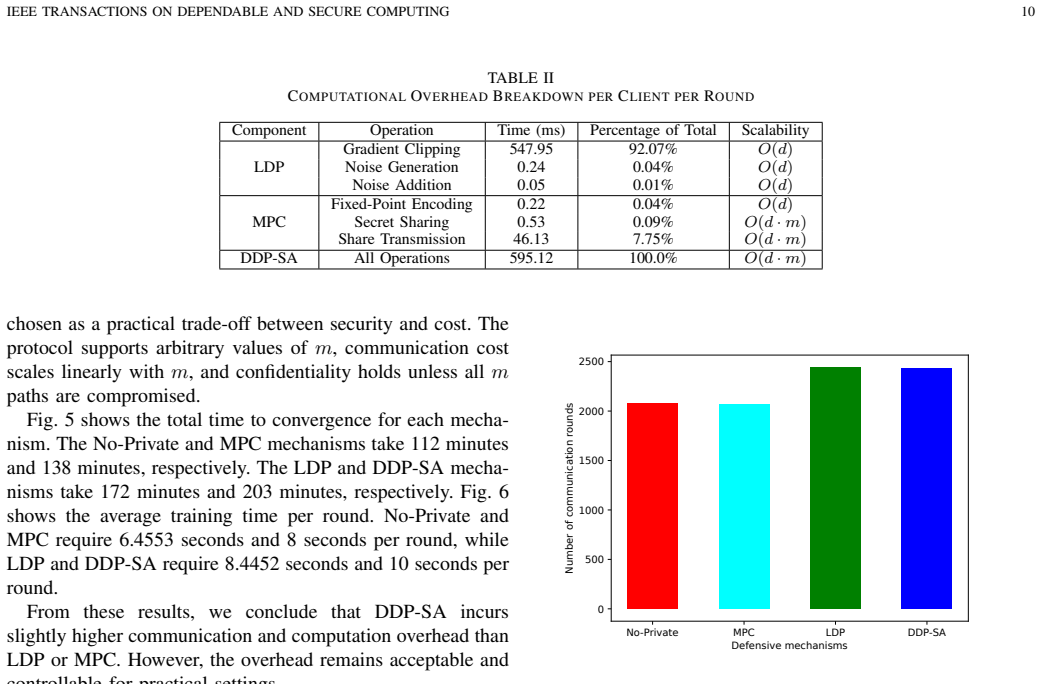
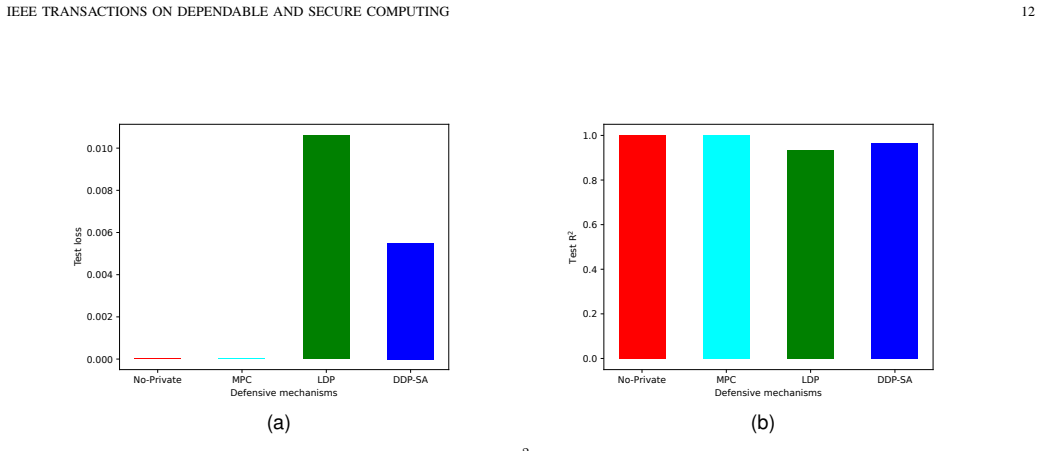
- Model accuracy stays higher than with local differential privacy applied in isolation.
Where Pith is reading between the lines
- The same two-stage pattern could be tested on non-convex models or with other noise distributions to check whether the accuracy gain generalizes.
- Reducing the number of intermediate servers while keeping the full-threshold requirement would be a direct next measurement of the privacy-communication tradeoff.
- The design leaves open whether the same privacy-utility balance holds when clients have heterogeneous data distributions.
Load-bearing premise
The threat model holds that no single intermediate server or communication channel is fully compromised and that the Laplace noise scale can be set to meet the stated privacy level without destroying utility.
What would settle it
A reconstruction of any individual client's original gradient from the shares held by the intermediate servers, or an accuracy measurement showing DDP-SA falls below standalone LDP performance at the same privacy budget.
Figures






read the original abstract
This article presents DDP-SA, a scalable privacy-preserving federated learning framework that jointly leverages client-side local differential privacy (LDP) and full-threshold additive secret sharing (ASS) for secure aggregation. Unlike existing methods that rely solely on differential privacy or on secure multi-party computation (MPC), DDP-SA integrates both techniques to deliver stronger end-to-end privacy guarantees while remaining computationally practical. The framework introduces a two-stage protection mechanism: clients first perturb their local gradients with calibrated Laplace noise, then decompose the noisy gradients into additive secret shares that are distributed across multiple intermediate servers. This design ensures that (i) no single compromised server or communication channel can reveal any information about individual client updates, and (ii) the parameter server reconstructs only the aggregated noisy gradient, never any client-specific contribution. Extensive experiments show that DDP-SA achieves substantially higher model accuracy than standalone LDP while providing stronger privacy protection than MPC-only approaches. The proposed framework scales linearly with the number of participants and offers a practical, privacy-preserving solution for federated learning applications with controllable computational and communication overhead.
Editorial analysis
A structured set of objections, weighed in public.
Referee Report
Summary. The manuscript presents DDP-SA, a federated learning framework combining client-side Laplace noise (LDP) with full-threshold additive secret sharing (ASS) for secure aggregation across intermediate servers. Clients perturb local gradients with calibrated noise then distribute shares; the parameter server reconstructs only the aggregate noisy gradient. The paper claims this yields stronger end-to-end privacy than LDP or MPC alone, substantially higher model accuracy than standalone LDP, linear scaling with participants, and practical overhead.
Significance. If the accuracy and privacy claims are substantiated by properly controlled experiments that isolate the effect of the ASS layer, the work would supply a concrete, scalable design point between pure LDP and full MPC. The linear scaling and explicit two-stage mechanism are positive features that could be useful for deployments where a single server must not see individual updates.
major comments (2)
- [Abstract / mechanism description] Abstract and mechanism description: the claim of 'substantially higher model accuracy than standalone LDP' is not supported by the stated construction. Clients add Laplace noise and then secret-share the noisy values; the parameter server recovers exactly the sum of those noisy gradients. This produces identical stochastic gradients to a baseline in which clients transmit noisy gradients directly to a single server. Any accuracy difference must therefore arise from unstated differences in noise scale, clipping threshold, effective privacy budget, or baseline implementation rather than from the DDP-SA architecture itself.
- [Threat model / privacy analysis] Threat model and privacy analysis: the paper asserts 'stronger privacy protection than MPC-only approaches' yet provides no formal composition theorem or comparison of the resulting (ε,δ) bounds when LDP noise is combined with ASS. It is unclear whether the end-to-end guarantee is strictly stronger than LDP alone or merely shifts the trust assumptions to the intermediate servers.
minor comments (2)
- [Abstract / Experiments] The abstract and introduction omit concrete experimental details (datasets, model architectures, number of clients, privacy budgets ε, baseline implementations, and statistical significance tests). These must be supplied with tables or figures to allow evaluation of the accuracy and scalability claims.
- [Preliminaries / Framework] Notation for the Laplace scale and the secret-sharing threshold is introduced without an explicit equation linking them to the final privacy budget; a short derivation or reference to the composition would improve clarity.
Simulated Author's Rebuttal
We thank the referee for the constructive comments. We address each major point below and indicate the revisions that will be incorporated into the next version of the manuscript.
read point-by-point responses
-
Referee: [Abstract / mechanism description] Abstract and mechanism description: the claim of 'substantially higher model accuracy than standalone LDP' is not supported by the stated construction. Clients add Laplace noise and then secret-share the noisy values; the parameter server recovers exactly the sum of those noisy gradients. This produces identical stochastic gradients to a baseline in which clients transmit noisy gradients directly to a single server. Any accuracy difference must therefore arise from unstated differences in noise scale, clipping threshold, effective privacy budget, or baseline implementation rather than from the DDP-SA architecture itself.
Authors: We acknowledge that this observation is correct. Because clients apply Laplace noise before secret-sharing, the parameter server reconstructs precisely the same sum of noisy gradients that would be obtained by transmitting the noisy values directly. Consequently, any accuracy advantage observed in our experiments cannot be attributed to the DDP-SA mechanism itself and must result from uncontrolled differences in noise calibration, clipping, privacy budget allocation, or baseline implementation details. We will revise the abstract, introduction, and experimental discussion to remove the claim of 'substantially higher model accuracy' as an architectural benefit. The revised text will state that accuracy is comparable to a correctly implemented LDP baseline while highlighting the additional privacy and trust-distribution advantages of the two-stage construction. revision: yes
-
Referee: [Threat model / privacy analysis] Threat model and privacy analysis: the paper asserts 'stronger privacy protection than MPC-only approaches' yet provides no formal composition theorem or comparison of the resulting (ε,δ) bounds when LDP noise is combined with ASS. It is unclear whether the end-to-end guarantee is strictly stronger than LDP alone or merely shifts the trust assumptions to the intermediate servers.
Authors: We agree that a formal privacy analysis is required. The current manuscript only provides an informal argument. DDP-SA composes local Laplace noise with full-threshold additive secret sharing so that (i) each client’s update satisfies LDP against reconstruction by any proper subset of intermediate servers and (ii) the parameter server receives only the noisy aggregate. This yields a strictly stronger guarantee than MPC-only (which reveals an exact aggregate) and, from the parameter server’s viewpoint, stronger than direct LDP (which exposes individual noisy gradients). We will add a dedicated privacy-analysis section that states the trust assumptions (non-collusion of the intermediate servers), derives the end-to-end (ε, δ) bounds via sequential composition, and supplies explicit comparisons with both LDP and MPC baselines. revision: yes
Circularity Check
No significant circularity in framework description or claims
full rationale
The paper proposes a hybrid privacy framework that combines client-side Laplace noise addition with additive secret sharing for secure aggregation, with the parameter server reconstructing only the sum of noisy gradients. This construction is presented as a design choice rather than a mathematical derivation. The accuracy claim is explicitly tied to experimental results, not to any first-principles prediction or fitted parameter that reduces to its own inputs by construction. No self-definitional steps, load-bearing self-citations, or ansatz smuggling are present in the abstract or described mechanism. The architecture is self-contained against the stated threat model and does not rely on renaming known results or importing uniqueness theorems.
Axiom & Free-Parameter Ledger
free parameters (1)
- Laplace noise scale
axioms (2)
- domain assumption Additive secret sharing is secure when at most one server is compromised
- standard math Laplace mechanism satisfies epsilon-differential privacy for the chosen scale
Lean theorems connected to this paper
-
IndisputableMonolith/Cost/FunctionalEquation.leanwashburn_uniqueness_aczel unclear?
unclearRelation between the paper passage and the cited Recognition theorem.
clients first perturb their local gradients with calibrated Laplace noise, then decompose the noisy gradients into additive secret shares
-
IndisputableMonolith/Foundation/RealityFromDistinction.leanreality_from_one_distinction unclear?
unclearRelation between the paper passage and the cited Recognition theorem.
Theorem 1 (End-to-end Privacy Guarantee) ... post-processing invariance
What do these tags mean?
- matches
- The paper's claim is directly supported by a theorem in the formal canon.
- supports
- The theorem supports part of the paper's argument, but the paper may add assumptions or extra steps.
- extends
- The paper goes beyond the formal theorem; the theorem is a base layer rather than the whole result.
- uses
- The paper appears to rely on the theorem as machinery.
- contradicts
- The paper's claim conflicts with a theorem or certificate in the canon.
- unclear
- Pith found a possible connection, but the passage is too broad, indirect, or ambiguous to say the theorem truly supports the claim.
Reference graph
Works this paper leans on
-
[1]
Federated machine learning: Concept and applications,
Q. Yang, Y . Liu, T. Chen, and Y . Tong, “Federated machine learning: Concept and applications,”ACM Transactions on Intelligent Systems and Technology (TIST), vol. 10, no. 2, pp. 1–19, 2019
2019
-
[2]
Communication-efficient learning of deep networks from decentral- ized data,
B. McMahan, E. Moore, D. Ramage, S. Hampson, and B. A. y Arcas, “Communication-efficient learning of deep networks from decentral- ized data,” inArtificial intelligence and statistics. PMLR, 2017, pp. 1273–1282
2017
-
[3]
Privacy- preserving deep learning: Revisited and enhanced,
L. T. Phong, Y . Aono, T. Hayashi, L. Wang, and S. Moriai, “Privacy- preserving deep learning: Revisited and enhanced,” inApplications and Techniques in Information Security: 8th International Conference, ATIS 2017, Auckland, New Zealand, July 6–7, 2017, Proceedings. Springer, 2017, pp. 100–110
2017
-
[4]
Comprehensive privacy analysis of deep learning: Passive and active white-box inference attacks against centralized and federated learning,
M. Nasr, R. Shokri, and A. Houmansadr, “Comprehensive privacy analysis of deep learning: Passive and active white-box inference attacks against centralized and federated learning,” in2019 IEEE symposium on security and privacy (SP). IEEE, 2019, pp. 739–753
2019
-
[5]
Advances and open problems in federated learning,
P. Kairouz, H. B. McMahan, B. Avent, A. Bellet, M. Bennis, A. N. Bhagoji, K. Bonawitz, Z. Charles, G. Cormode, R. Cummingset al., “Advances and open problems in federated learning,”Foundations and Trends® in Machine Learning, vol. 14, no. 1–2, pp. 1–210, 2021
2021
-
[6]
On defensive neural networks against inference attack in federated learning,
H. Lee, J. Kim, R. Hussain, S. Cho, and J. Son, “On defensive neural networks against inference attack in federated learning,” inICC 2021- IEEE International Conference on Communications. IEEE, 2021, pp. 1–6
2021
-
[7]
The algorithmic foundations of differential privacy,
C. Dwork and A. Roth, “The algorithmic foundations of differential privacy,”Foundations and Trends® in Theoretical Computer Science, vol. 9, no. 3–4, pp. 211–407, 2014
2014
-
[8]
Practical secure aggre- gation for privacy-preserving machine learning,
K. Bonawitz, V . Ivanov, B. Kreuter, A. Marcedone, H. B. McMahan, S. Patel, D. Ramage, A. Segal, and K. Seth, “Practical secure aggre- gation for privacy-preserving machine learning,” inproceedings of the 2017 ACM SIGSAC Conference on Computer and Communications Security, 2017, pp. 1175–1191
2017
-
[9]
Verifynet: Secure and verifiable federated learning,
G. Xu, H. Li, S. Liu, K. Yang, and X. Lin, “Verifynet: Secure and verifiable federated learning,”IEEE Transactions on Information Forensics and Security, vol. 15, pp. 911–926, 2020
2020
-
[10]
Privacy-preserving deep learning via additively homomorphic encryption,
Y . Aono, T. Hayashi, L. Wang, S. Moriaiet al., “Privacy-preserving deep learning via additively homomorphic encryption,”IEEE transac- tions on information forensics and security, vol. 13, no. 5, pp. 1333– 1345, 2017. IEEE TRANSACTIONS ON DEPENDABLE AND SECURE COMPUTING 15
2017
-
[11]
Towards efficient and privacy-preserving federated deep learning,
M. Hao, H. Li, G. Xu, S. Liu, and H. Yang, “Towards efficient and privacy-preserving federated deep learning,” inICC 2019-2019 IEEE international conference on communications (ICC). IEEE, 2019, pp. 1–6
2019
-
[12]
Efficient and privacy-enhanced federated learning for industrial artificial intelli- gence,
M. Hao, H. Li, X. Luo, G. Xu, H. Yang, and S. Liu, “Efficient and privacy-enhanced federated learning for industrial artificial intelli- gence,”IEEE Transactions on Industrial Informatics, vol. 16, no. 10, pp. 6532–6542, 2020
2020
-
[13]
Communication-efficient learning of deep networks from decentralized data,
H. B. McMahan, E. Moore, D. Ramage, and B. A. y Arcas, “Federated learning of deep networks using model averaging,” ArXiv, vol. abs/1602.05629, 2016. [Online]. Available: https://api. semanticscholar.org/CorpusID:16861557
-
[14]
Exploiting unintended feature leakage in collaborative learning,
L. Melis, C. Song, E. De Cristofaro, and V . Shmatikov, “Exploiting unintended feature leakage in collaborative learning,” in2019 IEEE symposium on security and privacy (SP). IEEE, 2019, pp. 691–706
2019
-
[15]
Model inversion attacks that exploit confidence information and basic countermeasures,
M. Fredrikson, S. Jha, and T. Ristenpart, “Model inversion attacks that exploit confidence information and basic countermeasures,” in Proceedings of the 22nd ACM SIGSAC conference on computer and communications security, 2015, pp. 1322–1333
2015
-
[16]
Deep leakage from gradients,
L. Zhu, Z. Liu, and S. Han, “Deep leakage from gradients,” inPro- ceedings of the 33rd International Conference on Neural Information Processing Systems, 2019, pp. 14 774–14 784
2019
-
[17]
idlg: Improved deep leakage from gradients.arXiv preprint arXiv:2001.02610, 2020
B. Zhao, K. R. Mopuri, and H. Bilen, “idlg: Improved deep leakage from gradients,”arXiv preprint arXiv:2001.02610, 2020
-
[18]
Deep models under the gan: information leakage from collaborative deep learning,
B. Hitaj, G. Ateniese, and F. Perez-Cruz, “Deep models under the gan: information leakage from collaborative deep learning,” inProceedings of the 2017 ACM SIGSAC conference on computer and communications security, 2017, pp. 603–618
2017
-
[19]
Inverting gradients-how easy is it to break privacy in federated learning?
J. Geiping, H. Bauermeister, H. Dr ¨oge, and M. Moeller, “Inverting gradients-how easy is it to break privacy in federated learning?”Ad- vances in neural information processing systems, vol. 33, pp. 16 937– 16 947, 2020
2020
-
[20]
Personalized federated learning with differential privacy,
R. Hu, Y . Guo, H. Li, Q. Pei, and Y . Gong, “Personalized federated learning with differential privacy,”IEEE Internet of Things Journal, vol. 7, no. 10, pp. 9530–9539, 2020
2020
-
[21]
R. C. Geyer, T. Klein, and M. Nabi, “Differentially private federated learning: A client level perspective,”arXiv preprint arXiv:1712.07557, 2017
-
[22]
Federated learning with differential privacy: Algorithms and performance analysis,
K. Wei, J. Li, M. Ding, C. Ma, H. H. Yang, F. Farokhi, S. Jin, T. Q. Quek, and H. V . Poor, “Federated learning with differential privacy: Algorithms and performance analysis,”IEEE Transactions on Information Forensics and Security, vol. 15, pp. 3454–3469, 2020
2020
-
[23]
Fedsel: Federated sgd under local differential privacy with top-k dimension selection,
R. Liu, Y . Cao, M. Yoshikawa, and H. Chen, “Fedsel: Federated sgd under local differential privacy with top-k dimension selection,” inDatabase Systems for Advanced Applications: 25th International Conference, DASFAA 2020, Jeju, South Korea, September 24–27, 2020, Proceedings, Part I 25. Springer, 2020, pp. 485–501
2020
-
[24]
Local differential privacy-based federated learning for internet of things,
Y . Zhao, J. Zhao, M. Yang, T. Wang, N. Wang, L. Lyu, D. Niyato, and K.-Y . Lam, “Local differential privacy-based federated learning for internet of things,”IEEE Internet of Things Journal, vol. 8, no. 11, pp. 8836–8853, 2021
2021
-
[25]
Federated f-differential privacy,
Q. Zheng, S. Chen, Q. Long, and W. Su, “Federated f-differential privacy,” inInternational Conference on Artificial Intelligence and Statistics. PMLR, 2021, pp. 2251–2259
2021
-
[26]
Wireless federated learning with local differential privacy,
M. Seif, R. Tandon, and M. Li, “Wireless federated learning with local differential privacy,” in2020 IEEE International Symposium on Information Theory (ISIT). IEEE, 2020, pp. 2604–2609
2020
-
[27]
Differentially private federated learning on non-iid data: Convergence analysis and adaptive optimization,
L. Chen, X. Ding, Z. Bao, P. Zhou, and H. Jin, “Differentially private federated learning on non-iid data: Convergence analysis and adaptive optimization,”IEEE Transactions on Knowledge and Data Engineering, vol. 36, no. 9, pp. 4567–4581, 2024
2024
-
[28]
Noise-aware algorithm for heterogeneous differentially private federated learning,
S. Malekmohammadi, Y . Yu, and Y . Cao, “Noise-aware algorithm for heterogeneous differentially private federated learning,” inProceedings of the 41st International Conference on Machine Learning, 2024, pp. 34 461–34 498
2024
-
[29]
Cross-silo feder- ated learning with record-level personalized differential privacy,
J. Liu, J. Lou, L. Xiong, J. Liu, and X. Meng, “Cross-silo feder- ated learning with record-level personalized differential privacy,” in Proceedings of the 2024 ACM SIGSAC Conference on Computer and Communications Security, 2024, pp. 303–317
2024
-
[30]
Ali-dpfl: Differentially private federated learning with adaptive local iterations,
X. Ling, J. Fu, K. Wang, H. Liu, and Z. Chen, “Ali-dpfl: Differentially private federated learning with adaptive local iterations,” in2024 IEEE 25th International Symposium on a World of Wireless, Mobile and Multimedia Networks (WoWMoM). IEEE, 2024, pp. 349–358
2024
-
[31]
Private, efficient, and accurate: Protecting models trained by multi-party learn- ing with differential privacy,
W. Ruan, M. Xu, W. Fang, L. Wang, L. Wang, and W. Han, “Private, efficient, and accurate: Protecting models trained by multi-party learn- ing with differential privacy,” in2023 IEEE Symposium on Security and Privacy (SP). IEEE, 2023, pp. 1926–1943
2023
-
[32]
Differentially private feder- ated learning on heterogeneous data,
M. Noble, A. Bellet, and A. Dieuleveut, “Differentially private feder- ated learning on heterogeneous data,” inInternational Conference on Artificial Intelligence and Statistics. PMLR, 2022, pp. 10 110–10 145
2022
-
[33]
Differentially private federated learning: A systematic review,
J. Fu, Y . Hong, X. Ling, L. Wang, X. Ran, Z. Sun, W. H. Wang, Z. Chen, and Y . Cao, “Differentially private federated learning: A systematic review,”arXiv preprint arXiv:2405.08299, 2024
-
[34]
Practical differentially private and byzantine-resilient federated learning,
Z. Xiang, T. Wang, W. Lin, and D. Wang, “Practical differentially private and byzantine-resilient federated learning,”Proceedings of the ACM on Management of Data, vol. 1, no. 2, pp. 1–26, 2023
2023
-
[35]
Adap dp-fl: Differentially private federated learning with adaptive noise,
J. Fu, Z. Chen, and X. Han, “Adap dp-fl: Differentially private federated learning with adaptive noise,” in2022 IEEE International Conference on Trust, Security and Privacy in Computing and Communications (TrustCom). IEEE, 2022, pp. 656–663
2022
-
[36]
Soteriafl: A unified framework for private federated learning with communication compression,
Z. Li, H. Zhao, B. Li, and Y . Chi, “Soteriafl: A unified framework for private federated learning with communication compression,”Advances in Neural Information Processing Systems, vol. 35, pp. 4285–4300, 2022
2022
-
[37]
Differentially private federated learning via inexact admm with multiple local updates,
M. Ryu and K. Kim, “Differentially private federated learning via inexact admm with multiple local updates,”arXiv preprint arXiv:2202.09409, 2022
-
[38]
User- level privacy-preserving federated learning: Analysis and performance optimization,
K. Wei, J. Li, M. Ding, C. Ma, H. Su, B. Zhang, and H. V . Poor, “User- level privacy-preserving federated learning: Analysis and performance optimization,”IEEE Transactions on Mobile Computing, vol. 21, no. 9, pp. 3388–3401, 2021
2021
-
[39]
Projected federated averaging with heterogeneous differential privacy,
J. Liu, J. Lou, L. Xiong, J. Liu, and X. Meng, “Projected federated averaging with heterogeneous differential privacy,”Proceedings of the VLDB Endowment, vol. 15, no. 4, pp. 828–840, 2021
2021
-
[40]
Dp- fl: a novel differentially private federated learning framework for the unbalanced data,
X. Huang, Y . Ding, Z. L. Jiang, S. Qi, X. Wang, and Q. Liao, “Dp- fl: a novel differentially private federated learning framework for the unbalanced data,”World Wide Web, vol. 23, pp. 2529–2545, 2020
2020
-
[41]
Dp-admm: Admm-based distributed learning with differential privacy,
Z. Huang, R. Hu, Y . Guo, E. Chan-Tin, and Y . Gong, “Dp-admm: Admm-based distributed learning with differential privacy,”IEEE Transactions on Information Forensics and Security, vol. 15, pp. 1002– 1012, 2019
2019
-
[42]
Dynamic personalized federated learning with adaptive differential privacy,
X. Yang, W. Huang, and M. Ye, “Dynamic personalized federated learning with adaptive differential privacy,”Advances in Neural In- formation Processing Systems, vol. 36, pp. 72 181–72 192, 2023
2023
-
[43]
Learning to generate image em- beddings with user-level differential privacy,
Z. Xu, M. Collins, Y . Wang, L. Panait, S. Oh, S. Augenstein, T. Liu, F. Schroff, and H. B. McMahan, “Learning to generate image em- beddings with user-level differential privacy,” inProceedings of the IEEE/CVF Conference on Computer Vision and Pattern Recognition, 2023, pp. 7969–7980
2023
-
[44]
Make landscape flatter in differentially private federated learning,
Y . Shi, Y . Liu, K. Wei, L. Shen, X. Wang, and D. Tao, “Make landscape flatter in differentially private federated learning,” inProceedings of the IEEE/CVF Conference on Computer Vision and Pattern Recognition, 2023, pp. 24 552–24 562
2023
-
[45]
Understanding clipping for federated learning: Convergence and client-level differen- tial privacy,
X. Zhang, X. Chen, M. Hong, Z. S. Wu, and J. Yi, “Understanding clipping for federated learning: Convergence and client-level differen- tial privacy,” inInternational Conference on Machine Learning, ICML
-
[46]
26 048–26 067
PMLR, 2022, pp. 26 048–26 067
2022
-
[47]
Differentially private federated learning with local regularization and sparsification,
A. Cheng, P. Wang, X. S. Zhang, and J. Cheng, “Differentially private federated learning with local regularization and sparsification,” in Proceedings of the IEEE/CVF Conference on Computer Vision and Pattern Recognition, 2022, pp. 10 122–10 131
2022
-
[48]
Personal- ization improves privacy-accuracy tradeoffs in federated learning,
A. Bietti, C.-Y . Wei, M. Dudik, J. Langford, and S. Wu, “Personal- ization improves privacy-accuracy tradeoffs in federated learning,” in International Conference on Machine Learning. PMLR, 2022, pp. 1945–1962
2022
-
[49]
Differ- entially private learning with adaptive clipping,
G. Andrew, O. Thakkar, B. McMahan, and S. Ramaswamy, “Differ- entially private learning with adaptive clipping,”Advances in Neural Information Processing Systems, vol. 34, pp. 17 455–17 466, 2021
2021
-
[50]
Learning differentially private recurrent language models,
H. B. McMahan, D. Ramage, K. Talwar, and L. Zhang, “Learning differentially private recurrent language models,” inInternational Con- ference on Learning Representations, 2018, pp. 1–14
2018
-
[51]
The fun- damental price of secure aggregation in differentially private federated learning,
W.-N. Chen, C. A. C. Choo, P. Kairouz, and A. T. Suresh, “The fun- damental price of secure aggregation in differentially private federated learning,” inInternational Conference on Machine Learning. PMLR, 2022, pp. 3056–3089
2022
-
[52]
The poisson binomial mech- anism for unbiased federated learning with secure aggregation,
W.-N. Chen, A. Ozgur, and P. Kairouz, “The poisson binomial mech- anism for unbiased federated learning with secure aggregation,” in International Conference on Machine Learning. PMLR, 2022, pp. 3490–3506
2022
-
[53]
D2p-fed: Differentially private federated learning with efficient communication,
L. Wang, R. Jia, and D. Song, “D2p-fed: Differentially private federated learning with efficient communication,”arXiv preprint arXiv:2006.13039, 2020
-
[54]
Effi- cient differentially private secure aggregation for federated learning via IEEE TRANSACTIONS ON DEPENDABLE AND SECURE COMPUTING 16 hardness of learning with errors,
T. Stevens, C. Skalka, C. Vincent, J. Ring, S. Clark, and J. Near, “Effi- cient differentially private secure aggregation for federated learning via IEEE TRANSACTIONS ON DEPENDABLE AND SECURE COMPUTING 16 hardness of learning with errors,” in31st USENIX Security Symposium (USENIX Security 22), 2022, pp. 1379–1395
2022
-
[55]
The distributed discrete gaussian mechanism for federated learning with secure aggregation,
P. Kairouz, Z. Liu, and T. Steinke, “The distributed discrete gaussian mechanism for federated learning with secure aggregation,” inInter- national Conference on Machine Learning. PMLR, 2021, pp. 5201– 5212
2021
-
[56]
The skellam mechanism for dif- ferentially private federated learning,
N. Agarwal, P. Kairouz, and Z. Liu, “The skellam mechanism for dif- ferentially private federated learning,”Advances in Neural Information Processing Systems, vol. 34, pp. 5052–5064, 2021
2021
-
[57]
Compression boosts differentially private federated learning,
R. Kerkouche, G. ´Acs, C. Castelluccia, and P. Genev `es, “Compression boosts differentially private federated learning,” in2021 IEEE Euro- pean Symposium on Security and Privacy (EuroS&P). IEEE, 2021, pp. 304–318
2021
-
[58]
cpsgd: Communication-efficient and differentially-private distributed sgd,
N. Agarwal, A. T. Suresh, F. X. X. Yu, S. Kumar, and B. McMahan, “cpsgd: Communication-efficient and differentially-private distributed sgd,”Advances in Neural Information Processing Systems, vol. 31, 2018
2018
-
[59]
Local and central dif- ferential privacy for robustness and privacy in federated learning,
M. Naseri, J. Hayes, and E. De Cristofaro, “Local and central dif- ferential privacy for robustness and privacy in federated learning,” inProceedings of the 29th Network and Distributed System Security Symposium (NDSS), 2022
2022
-
[60]
{PrivateFL}: Accurate, differentially private federated learning via personalized data transformation,
Y . Yang, B. Hui, H. Yuan, N. Gong, and Y . Cao, “{PrivateFL}: Accurate, differentially private federated learning via personalized data transformation,” in32nd USENIX Security Symposium (USENIX Security 23), 2023, pp. 1595–1612
2023
-
[61]
Federated learning with bayesian differ- ential privacy,
A. Triastcyn and B. Faltings, “Federated learning with bayesian differ- ential privacy,” in2019 IEEE International Conference on Big Data (Big Data). IEEE, 2019, pp. 2587–2596
2019
-
[62]
Dynamic privacy allocation for locally differentially private federated learning with composite objectives,
J. Zhang, D. Fay, and M. Johansson, “Dynamic privacy allocation for locally differentially private federated learning with composite objectives,” inICASSP 2024-2024 IEEE International Conference on Acoustics, Speech and Signal Processing (ICASSP). IEEE, 2024, pp. 9461–9465
2024
-
[63]
Towards accurate and stronger local differential privacy for federated learning with staircase randomized response,
M. Varun, S. Feng, H. Wang, S. Sural, and Y . Hong, “Towards accurate and stronger local differential privacy for federated learning with staircase randomized response,” in14th ACM Conference on Data and Application Security and Privacy. ACM, 2024
2024
-
[64]
Personalized federated learning method based on bregman divergence and differ- ential privacy (in chinese),
S. Zhang, J. Zhang, G. Zhu, S. Long, and L. Zhetao, “Personalized federated learning method based on bregman divergence and differ- ential privacy (in chinese),”Journal of Software, vol. 35, no. 11, pp. 5249–5262, 2023
2023
-
[65]
Ppefl: Privacy-preserving edge federated learning with local differential privacy,
B. Wang, Y . Chen, H. Jiang, and Z. Zhao, “Ppefl: Privacy-preserving edge federated learning with local differential privacy,”IEEE Internet of Things Journal, vol. 10, no. 17, pp. 15 488–15 500, 2023
2023
-
[66]
Signds-fl: Local differentially private federated learning with sign-based dimension selection,
X. Jiang, X. Zhou, and J. Grossklags, “Signds-fl: Local differentially private federated learning with sign-based dimension selection,”ACM Transactions on Intelligent Systems and Technology (TIST), vol. 13, no. 5, pp. 1–22, 2022
2022
-
[67]
Fedta: Locally-differential federated learning with top-k mechanism and adam optimization,
Y . Li, G. Wang, T. Peng, and G. Feng, “Fedta: Locally-differential federated learning with top-k mechanism and adam optimization,” in Ubiquitous Security, G. Wang, K.-K. R. Choo, J. Wu, and E. Damiani, Eds. Singapore: Springer Nature Singapore, 2023, pp. 380–391
2023
-
[68]
Webfed: Cross-platform federated learning framework based on web browser with local dif- ferential privacy,
Z. Lian, Q. Yang, Q. Zeng, and C. Su, “Webfed: Cross-platform federated learning framework based on web browser with local dif- ferential privacy,” inICC 2022-IEEE International Conference on Communications. IEEE, 2022, pp. 2071–2076
2022
-
[69]
Local differential privacy for federated learning,
P. C. Mahawaga Arachchige, D. Liu, S. Camtepe, S. Nepal, M. Grobler, P. Bertok, and I. Khalil, “Local differential privacy for federated learning,” inEuropean Symposium on Research in Computer Security. Springer, 2022, pp. 195–216
2022
-
[70]
Safeguarding cross-silo federated learning with local differential privacy,
C. Wang, X. Wu, G. Liu, T. Deng, K. Peng, and S. Wan, “Safeguarding cross-silo federated learning with local differential privacy,”Digital Communications and Networks, vol. 8, no. 4, pp. 446–454, 2022
2022
-
[71]
Privacy-enhanced federated learning: A restrictively self-sampled and data-perturbed local differential privacy method,
J. Zhao, M. Yang, R. Zhang, W. Song, J. Zheng, J. Feng, and S. Matwin, “Privacy-enhanced federated learning: A restrictively self-sampled and data-perturbed local differential privacy method,”Electronics, vol. 11, no. 23, p. 4007, 2022
2022
-
[72]
Ldp-fl: Practical private aggregation in federated learning with local differential privacy,
L. Sun, J. Qian, and X. Chen, “Ldp-fl: Practical private aggregation in federated learning with local differential privacy,” inProceedings of the Thirtieth International Joint Conference on Artificial Intelligence. International Joint Conferences on Artificial Intelligence Organization, 2021
2021
-
[73]
Federated learning with personalized local differential privacy,
G. Yang, S. Wang, and H. Wang, “Federated learning with personalized local differential privacy,” in2021 IEEE 6th International Conference on Computer and Communication Systems (ICCCS). IEEE, 2021, pp. 484–489
2021
-
[74]
Federated latent dirichlet allocation: A local differential privacy based framework,
Y . Wang, Y . Tong, and D. Shi, “Federated latent dirichlet allocation: A local differential privacy based framework,” inProceedings of the AAAI Conference on Artificial Intelligence, vol. 34, no. 04, 2020, pp. 6283–6290
2020
-
[75]
Collecting and analyzing multidimensional data with local differential privacy,
N. Wang, X. Xiao, Y . Yang, J. Zhao, S. C. Hui, H. Shin, J. Shin, and G. Yu, “Collecting and analyzing multidimensional data with local differential privacy,” in2019 IEEE 35th International Conference on Data Engineering (ICDE). IEEE, 2019, pp. 638–649
2019
-
[76]
Ldp-fed: Federated learning with local differential privacy,
S. Truex, L. Liu, K.-H. Chow, M. E. Gursoy, and W. Wei, “Ldp-fed: Federated learning with local differential privacy,” inProceedings of the Third ACM International Workshop on Edge Systems, Analytics and Networking, 2020, pp. 61–66
2020
-
[77]
Echo of neighbors: Privacy amplification for personalized private federated learning with shuffle model,
Y . Liu, S. Zhao, L. Xiong, Y . Liu, and H. Chen, “Echo of neighbors: Privacy amplification for personalized private federated learning with shuffle model,” inProceedings of the AAAI Conference on Artificial Intelligence, 2023
2023
-
[78]
Shuffled check-in: Privacy amplification towards practical distributed learning,
S. P. Liew, S. Hasegawa, and T. Takahashi, “Shuffled check-in: Privacy amplification towards practical distributed learning,” inComputer Se- curity Symposium 2023 (CSS 2023). Information Processing Society of Japan, 2023
2023
-
[79]
Flame: Differ- entially private federated learning in the shuffle model,
R. Liu, Y . Cao, H. Chen, R. Guo, and M. Yoshikawa, “Flame: Differ- entially private federated learning in the shuffle model,” inProceedings of the AAAI Conference on Artificial Intelligence, vol. 35, no. 10, 2021, pp. 8688–8696
2021
-
[80]
A generalized shuffle framework for privacy amplification: Strengthening privacy guarantees and enhancing utility,
E. Chen, Y . Cao, and Y . Ge, “A generalized shuffle framework for privacy amplification: Strengthening privacy guarantees and enhancing utility,” vol. 38, no. 10, pp. 11 267–11 275, 2024
2024
discussion (0)
Sign in with ORCID, Apple, or X to comment. Anyone can read and Pith papers without signing in.