Recognition: unknown
Cut Finite Element Methods for Convection-Diffusion in Mixed-Dimensional Domains
Pith reviewed 2026-05-10 17:02 UTC · model grok-4.3
The pith
Cut finite element methods using a fixed background mesh converge for convection-diffusion problems posed on mixed-dimensional domains.
A machine-rendered reading of the paper's core claim, the machinery that carries it, and where it could break.
Core claim
The proposed CutFEM employs continuous piecewise linear elements on active meshes associated with each manifold component of the mixed-dimensional domain. Using a fixed background mesh that does not conform to the geometry, weak enforcement of the coupling conditions at interfaces, and appropriate stabilization terms, the method yields a priori error estimates in the energy norm and the L2 norm. Convergence is established for solutions belonging to the Sobolev space H^s where 1 < s ≤ 2.
What carries the argument
The mixed-dimensional directional derivative and divergence operators that allow the convection-diffusion problem to be written in a form analogous to the standard equation on a single domain, combined with active-mesh representations on a fixed background mesh.
If this is right
- The numerical solution approximates the true solution with an error bounded by a constant times the mesh size to the power s in the energy norm when the solution has regularity s.
- Corresponding error estimates hold in the L2 norm as a direct consequence of the energy-norm analysis.
- The method remains convergent under mesh refinement for convection-diffusion problems whose domains contain intersecting lower-dimensional features.
- Numerical experiments on model problems reproduce the theoretical convergence rates in both norms.
Where Pith is reading between the lines
- The single-background-mesh approach may reduce the implementation effort required when many intersecting lower-dimensional structures are present.
- The same abstract operator setting and stabilization strategy could be reused for other linear or nonlinear equations posed on the same class of domains.
- The weak-coupling formulation opens a route to coupling the present convection-diffusion model with different physics on the various manifold components without changing the underlying mesh.
Load-bearing premise
The mixed-dimensional domain must be representable as a hierarchical union of manifolds where lower-dimensional components form parts of the boundaries of higher-dimensional ones, and the problem must admit a compact abstract formulation using the mixed-dimensional directional derivative and divergence operators.
What would settle it
A concrete counterexample would be a specific mixed-dimensional geometry with an exact solution of regularity s = 1.5 for which the computed energy-norm error on a sequence of uniformly refined background meshes fails to decrease at the rate predicted by the theory as the mesh size tends to zero.
Figures


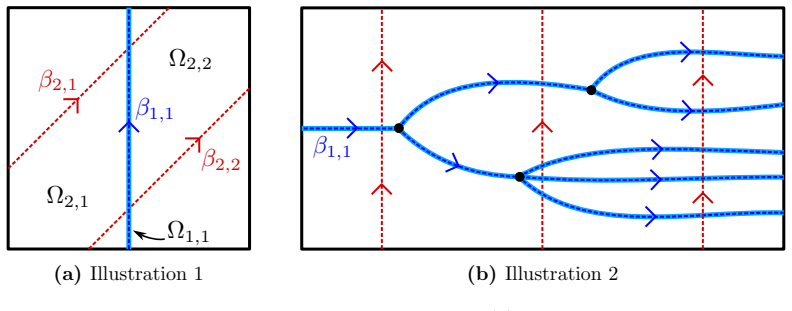


read the original abstract
We develop a cut finite element method (CutFEM) for convection-diffusion problems posed on mixed-dimensional domains, i.e., unions of manifolds of different dimensions arranged in a hierarchical structure where lower-dimensional components form parts of the boundaries of higher-dimensional ones. Such domains arise, for instance, in the modeling of fractured porous media with intersecting fractures. The model problem is formulated in a compact abstract form using mixed-dimensional directional derivative and divergence operators, which allows the problem to be expressed in a way that closely resembles the classical convection-diffusion equation. The proposed CutFEM is based on a fixed background mesh that does not conform to the geometry, with each manifold component represented through its associated active mesh. The method employs continuous piecewise linear elements together with weak enforcement of coupling conditions and suitable stabilization. We prove a priori error estimates in energy and $L^2$ norms and establish convergence, also for solutions with reduced regularity $u \in H^s$, $1 < s \le 2$. Numerical experiments confirm the theoretical convergence rates and illustrate the performance of the method.
Editorial analysis
A structured set of objections, weighed in public.
Referee Report
Summary. The manuscript develops a cut finite element method (CutFEM) for convection-diffusion problems on mixed-dimensional domains, formulated as hierarchical unions of manifolds of differing dimensions. The problem is recast in compact abstract form via mixed-dimensional directional derivative and divergence operators. The discretization employs a fixed background mesh with active meshes for each manifold component, continuous piecewise linear elements, weak enforcement of coupling conditions, and stabilization. A priori error estimates are proven in energy and L² norms, including convergence for solutions with reduced regularity u ∈ H^s (1 < s ≤ 2), and numerical experiments confirm the rates.
Significance. If the stated error estimates hold, the work supplies a theoretically supported CutFEM extension to mixed-dimensional convection-diffusion problems arising in fractured porous media. The abstract operator formulation permits direct application of standard Galerkin-plus-stabilization analysis, while the reduced-regularity bounds and accompanying numerical validation constitute a concrete advance for non-standard domain discretizations.
minor comments (3)
- [Method section] The description of the stabilization terms (ghost-penalty and Nitsche-type) would benefit from an explicit statement of the parameter scaling with mesh size and diffusion coefficient to aid reproducibility.
- [Numerical experiments] In the numerical experiments, the figures showing convergence rates would be clearer if the observed orders were annotated directly on the plots or in the captions.
- [Section 3] A short remark clarifying how the active-mesh construction handles intersections between manifolds of different dimensions would improve geometric clarity.
Simulated Author's Rebuttal
We thank the referee for the positive evaluation of our manuscript and for recommending minor revision. The summary accurately captures the main contributions of the work, including the abstract operator formulation, the CutFEM discretization on hierarchical mixed-dimensional domains, the a priori error estimates for solutions with reduced regularity, and the supporting numerical experiments. Since the report does not list any specific major comments, we interpret the recommendation as an invitation to prepare a revised version incorporating any minor editorial or typographical suggestions that may arise during the revision process.
Circularity Check
No significant circularity in derivation chain
full rationale
The paper formulates the mixed-dimensional convection-diffusion problem using abstract directional derivative and divergence operators on a hierarchical manifold union, then discretizes via standard CutFEM on a background mesh with active meshes per component, continuous P1 elements, weak coupling via Nitsche terms, and ghost-penalty stabilization. The a priori energy and L2 error estimates, including rates for u in H^s (1<s≤2), follow from classical Galerkin orthogonality plus consistency and stability bounds on the stabilization terms; these steps invoke only the problem's weak form, standard trace inequalities, and interpolation theory without any fitted parameters renamed as predictions, self-definitional reductions, or load-bearing self-citations that collapse the argument to its inputs. The derivation is therefore self-contained against external benchmarks.
Axiom & Free-Parameter Ledger
axioms (2)
- domain assumption Mixed-dimensional domains are unions of manifolds of different dimensions arranged hierarchically, with lower-dimensional components forming parts of higher-dimensional boundaries.
- domain assumption The convection-diffusion problem admits a compact abstract formulation using mixed-dimensional directional derivative and divergence operators that resembles the classical equation.
Reference graph
Works this paper leans on
-
[1]
C. Alboin, J. Jaffr´ e, J. E. Roberts, and C. Serres. Modeling fractures as interfaces for flow and transport in porous media. InFluid flow and transport in porous media: mathematical and numerical treatment (South Hadley, MA, 2001), volume 295 ofContemp. Math., pages 13–24. Amer. Math. Soc., Providence, RI, 2002. doi:10.1090/conm/295/04999
-
[3]
P. Angot, F. Boyer, and F. Hubert. Asymptotic and numerical modelling of flows in fractured porous media.M2AN Math. Model. Numer. Anal., 43(2):239–275, 2009. doi:10.1051/m2an/2008052
-
[4]
P. F. Antonietti, C. Facciol` a, A. Russo, and M. Verani. Discontinuous Galerkin approximation of flows in fractured porous media on polytopic grids.SIAM J. Sci. Comput., 41(1):A109–A138, 2019. doi:10.1137/17M1138194
-
[5]
A. Bendali and K. Lemrabet. The effect of a thin coating on the scattering of a time- harmonic wave for the Helmholtz equation.SIAM J. Appl. Math., 56(6):1664–1693, 1996. doi:10.1137/S0036139995281822
-
[6]
S. Berrone, S. Pieraccini, and S. Scial` o. A PDE-constrained optimization formulation for discrete fracture network flows.SIAM J. Sci. Comput., 35(2):B487–B510, 2013. doi:10.1137/120865884
-
[7]
W. M. Boon, J. M. Nordbotten, and J. E. Vatne. Functional analysis and exterior calculus on mixed- dimensional geometries.Ann. Mat. Pura Appl. (4), 200(2):757–789, 2021. doi:10.1007/s10231-020- 01013-1
-
[8]
W. M. Boon, J. M. Nordbotten, and I. Yotov. Robust discretization of flow in fractured porous media.SIAM J. Numer. Anal., 56(4):2203–2233, 2018. doi:10.1137/17M1139102
-
[9]
E. Burman, S. Claus, P. Hansbo, M. G. Larson, and A. Massing. CutFEM: discretizing geome- try and partial differential equations.Internat. J. Numer. Methods Engrg., 104(7):472–501, 2015. doi:10.1002/nme.4823
-
[10]
E. Burman, P. Hansbo, and M. G. Larson. A stabilized cut finite element method for partial differential equations on surfaces: the Laplace-Beltrami operator.Comput. Methods Appl. Mech. Engrg., 285:188–207, 2015. doi:10.1016/j.cma.2014.10.044
-
[11]
E. Burman, P. Hansbo, and M. G. Larson. A cut finite element method for a model of pressure in fractured media.Numer. Math., 146(4):783–818, 2020. doi:10.1007/s00211-020-01157-5
-
[12]
E. Burman, P. Hansbo, and M. G. Larson. Low regularity estimates for CutFEM approxima- tions of an elliptic problem with mixed boundary conditions.Math. Comp., 93(345):35–54, 2024. doi:10.1090/mcom/3875
-
[13]
E. Burman, P. Hansbo, M. G. Larson, and K. Larsson. Cut finite elements for convection in fractured domains.Comput. & Fluids, 179:726–734, 2019. doi:10.1016/j.compfluid.2018.07.022
-
[14]
E. Burman, P. Hansbo, M. G. Larson, K. Larsson, and A. Massing. Finite element approximation of the Laplace-Beltrami operator on a surface with boundary.Numer. Math., 141(1):141–172, 2019. doi:10.1007/s00211-018-0990-2
-
[15]
E. Burman, P. Hansbo, M. G. Larson, and A. Massing. A cut discontinuous Galerkin method for the Laplace-Beltrami operator.IMA J. Numer. Anal., 37(1):138–169, 2017. doi:10.1093/imanum/drv068
-
[16]
E. Burman, P. Hansbo, M. G. Larson, and A. Massing. Cut finite element methods for partial differential equations on embedded manifolds of arbitrary codimensions.ESAIM Math. Model. Numer. Anal., 52(6):2247–2282, 2018. doi:10.1051/m2an/2018038
-
[17]
E. Burman, P. Hansbo, M. G. Larson, A. Massing, and S. Zahedi. Full gradient stabilized cut finite element methods for surface partial differential equations.Comput. Methods Appl. Mech. Engrg., 310:278–296, 2016. doi:10.1016/j.cma.2016.06.033
-
[18]
E. Burman, P. Hansbo, M. G. Larson, A. Massing, and S. Zahedi. A stabilized cut streamline diffusion finite element method for convection-diffusion problems on surfaces.Comput. Methods Appl. Mech. Engrg., 358:112645, 19, 2020. doi:10.1016/j.cma.2019.112645
-
[19]
E. Burman, P. Hansbo, M. G. Larson, and S. Zahedi. Cut finite element methods for coupled bulk-surface problems.Numer. Math., 133(2):203–231, 2016. doi:10.1007/s00211-015-0744-3
-
[20]
E. Burman, P. Hansbo, M. G. Larson, and S. Zahedi. Stabilized CutFEM for the convection problem on surfaces.Numer. Math., 141(1):103–139, 2019. doi:10.1007/s00211-018-0989-8
-
[21]
E. Burman, P. Hansbo, M. G. Larson, and S. Zahedi. Cut finite element methods.Acta Numer., 34:1–121, 2025. doi:10.1017/S0962492925000017. 33
-
[22]
Cioranescu and P
D. Cioranescu and P. Donato.An Introduction to Homogenization. Oxford University Press, 11
-
[23]
doi:10.1093/oso/9780198565543.001.0001
-
[24]
C. D’Angelo. Finite element approximation of elliptic problems with Dirac measure terms in weighted spaces: applications to one- and three-dimensional coupled problems.SIAM J. Numer. Anal., 50(1):194–215, 2012. doi:10.1137/100813853
-
[25]
C. D’Angelo and A. Quarteroni. On the coupling of 1D and 3D diffusion-reaction equations. Ap- plication to tissue perfusion problems.Math. Models Methods Appl. Sci., 18(8):1481–1504, 2008. doi:10.1142/S0218202508003108
-
[26]
A. Ern and J.-L. Guermond.Finite elements I—Approximation and interpolation, volume 72 of Texts in Applied Mathematics. Springer, Cham, [2021]©2021. doi:10.1007/978-3-030-56341-7
-
[27]
Formaggia, A
L. Formaggia, A. Quarteroni, and A. Veneziani.Cardiovascular Mathematics: Modeling and Sim- ulation of the Circulatory System, volume 1 ofMS&A. Springer Science & Business Media, Milan,
-
[28]
doi:10.1007/978-88-470-1152-6
-
[29]
A. Fumagalli and E. Keilegavlen. Dual Virtual Element Methods for Discrete Fracture Matrix models.Oil & Gas Science and Technology–Revue d’IFP Energies nouvelles, 74(41):1–17, 2019. doi:https://doi.org/10.2516/ogst/2019008
-
[30]
J. Grande, C. Lehrenfeld, and A. Reusken. Analysis of a high-order trace finite element method for PDEs on level set surfaces.SIAM J. Numer. Anal., 56(1):228–255, 2018. doi:10.1137/16M1102203
-
[31]
S. Gross, M. A. Olshanskii, and A. Reusken. A trace finite element method for a class of coupled bulk-interface transport problems.ESAIM Math. Model. Numer. Anal., 49(5):1303–1330, 2015. doi:10.1051/m2an/2015013
-
[32]
F. Hellman, A. M˚ alqvist, and M. Mosquera. Well-posedness and finite element approxima- tion of mixed dimensional partial differential equations.BIT, 64(1):Paper No. 2, 22, 2024. doi:10.1007/s10543-023-01001-w
-
[33]
V. John, P. Knobloch, and J. Novo. Finite elements for scalar convection-dominated equations and incompressible flow problems: a never ending story?Comput. Vis. Sci., 19(5-6):47–63, 2018. doi:10.1007/s00791-018-0290-5
-
[34]
T. Jonsson, M. G. Larson, and K. Larsson. Cut finite element methods for elliptic problems on multipatch parametric surfaces.Comput. Methods Appl. Mech. Engrg., 324:366–394, 2017. doi:10.1016/j.cma.2017.06.018
-
[35]
T. K¨ oppl and B. Wohlmuth. Optimal a priori error estimates for an elliptic problem with Dirac right-hand side.SIAM J. Numer. Anal., 52(4):1753–1769, 2014. doi:10.1137/130927619
-
[36]
M. G. Larson and S. Zahedi. Stabilization of high order cut finite element methods on surfaces. IMA J. Numer. Anal., 40(3):1702–1745, 2020. doi:10.1093/imanum/drz021
-
[37]
V. Martin, J. Jaffr´ e, and J. E. Roberts. Modeling fractures and barriers as interfaces for flow in porous media.SIAM J. Sci. Comput., 26(5):1667–1691, 2005. doi:10.1137/S1064827503429363
-
[38]
N¨ avert.A finite element method for convection-diffusion problems
U. N¨ avert.A finite element method for convection-diffusion problems. Thesis, Chalmers University of Technology, Department of Computer Sciences, 1982
1982
-
[39]
J. M. Nordbotten and W. M. Boon. Modeling, structure and discretization of hierarchical mixed- dimensional partial differential equations. InDomain decomposition methods in science and engi- neering XXIV, volume 125 ofLect. Notes Comput. Sci. Eng., pages 87–101. Springer, Cham, 2018. doi:10.1007/978-3-319-93873-8 7
-
[40]
M. A. Olshanskii, A. Reusken, and J. Grande. A finite element method for elliptic equations on surfaces.SIAM J. Numer. Anal., 47(5):3339–3358, 2009. doi:10.1137/080717602
-
[41]
M. A. Olshanskii, A. Reusken, and X. Xu. A stabilized finite element method for advection-diffusion equations on surfaces.IMA J. Numer. Anal., 34(2):732–758, 2014. doi:10.1093/imanum/drt016
-
[42]
A. Reusken. Analysis of trace finite element methods for surface partial differential equations.IMA J. Numer. Anal., 35(4):1568–1590, 2015. doi:10.1093/imanum/dru047. 34 Authors’ addresses: Erik Burman, Mathematics, University College London, UK e.burman@ucl.ac.uk Peter Hansbo, Mechanical Engineering, J¨ onk¨ oping University, Sweden peter.hansbo@ju.se Ma...
discussion (0)
Sign in with ORCID, Apple, or X to comment. Anyone can read and Pith papers without signing in.