Recognition: 2 theorem links
· Lean TheoremPerpendicular electric field induced s^pm-wave to d-wave superconducting transition in thin film La₃Ni₂O₇
Pith reviewed 2026-05-10 17:06 UTC · model grok-4.3
The pith
A perpendicular electric field induces a transition from s±-wave to d-wave superconductivity in thin films of La3Ni2O7.
A machine-rendered reading of the paper's core claim, the machinery that carries it, and where it could break.
Core claim
In the imbalanced two-orbital bilayer Hubbard model for La3Ni2O7 thin films, dynamical cluster quantum Monte Carlo calculations reveal that a perpendicular electric field suppresses the s±-wave pairing symmetry originating from the dz2 orbital while inducing a transition to d-wave pairing from the dx2-y2 orbital, driven by the interlayer dz2 orbital mismatch and electron transfer under the field. The d-wave pairing exhibits a dome-like dependence on the electric field strength across undoped, hole-doped, and electron-doped regimes.
What carries the argument
The imbalanced two-orbital bilayer Hubbard model solved via dynamical cluster quantum Monte Carlo, which tracks electric-field-driven changes in orbital occupancies and selects between pairing channels.
If this is right
- s±-wave pairing from the dz2 orbital is suppressed as electric field strength increases due to growing interlayer mismatch.
- d-wave pairing from the dx2-y2 orbital emerges and reaches maximum strength at intermediate field values before declining.
- The symmetry transition and dome behavior occur in undoped, hole-doped, and electron-doped regimes.
- The non-perturbative results align with and extend prior weak-coupling expectations for the pairing mechanism.
- Large-scale calculations indicate the transition can be resolved without dominant finite-size artifacts.
Where Pith is reading between the lines
- Electric gating of thin films could switch between distinct pairing states to study competing orders in nickelates.
- Orbital-selective electron transfer under field may be a general route to tune superconductivity in layered nickelates.
- Similar perpendicular-field effects could appear in other Ruddlesden-Popper nickelate films or related bilayer systems.
- Direct experimental tests would require high-quality epitaxial films with controllable gate-induced fields and symmetry-sensitive probes.
Load-bearing premise
The chosen parameters of the imbalanced two-orbital bilayer Hubbard model together with the dynamical cluster approximation accurately capture the electronic structure and pairing physics of real La3Ni2O7 thin films under a perpendicular electric field.
What would settle it
Spectroscopic or transport measurements on La3Ni2O7 thin films that show no suppression of s±-wave pairing, no emergence of d-wave symmetry, or no dome-shaped dependence of the superconducting gap on perpendicular electric field strength would falsify the predicted transition.
Figures




read the original abstract
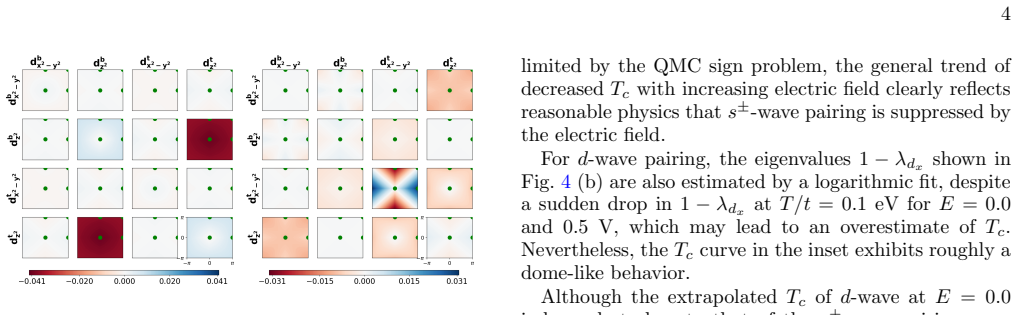
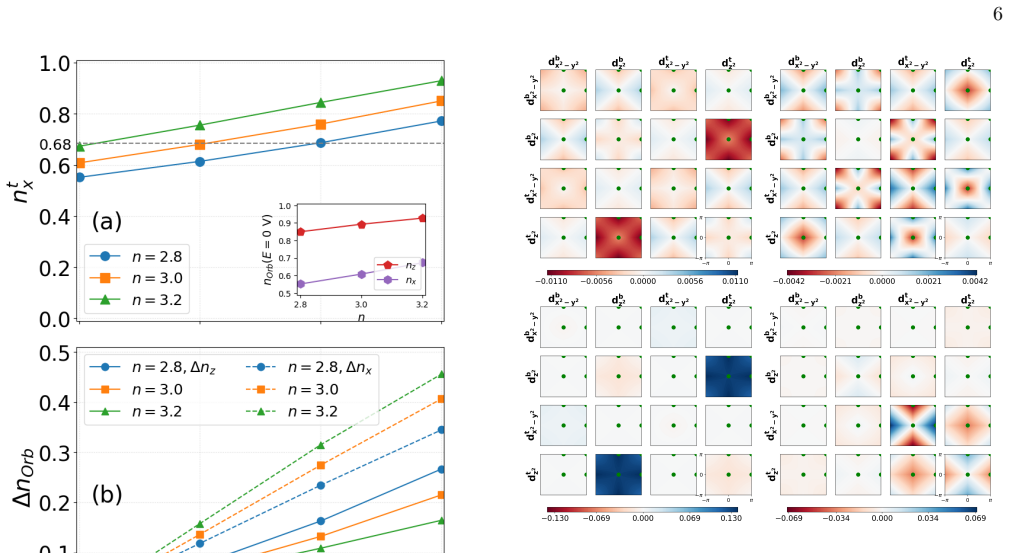
Inspired by the possibility that superconducting properties may be altered by applying a perpendicular electric field in the Ruddlesden-Popper (RP) bilayer nickelate La$_3$Ni$_2$O$_7$, we investigated the imbalanced two-orbital bilayer Hubbard model using dynamical cluster quantum Monte Carlo calculations. Focusing on the pairing symmetries induced by the electric field and their evolution with field strength in the undoped, hole-doped, and electron-doped regimes, we found that the $s^\pm$-wave pairing originating from the $d_{z^2}$ orbital is suppressed; while a pairing symmetry transition from $s^\pm$-wave to $d$-wave pairing occurs, driven by the interlayer $d_{z^2}$ orbital mismatch and the transfer of electrons into the $d_{x^2-y^2}$ orbital under the applied electric field. Intriguingly, the $d$-wave pairing arising from the $d_{x^2-y^2}$ orbital exhibits dome-like behavior with the electric field. Our large-scale many-body calculations align with the previous expectation from weak-coupling methods and provide further insight into the superconducting mechanism in RP nickelates.
Editorial analysis
A structured set of objections, weighed in public.
Referee Report
Summary. The manuscript models thin-film La₃Ni₂O₇ with an imbalanced two-orbital bilayer Hubbard Hamiltonian and employs dynamical cluster approximation (DCA) quantum Monte Carlo to study the effect of a perpendicular electric field. It reports that the field suppresses s±-wave pairing (primarily from the d_z² orbital) and induces a transition to d-wave pairing (from the d_x²-y² orbital) driven by interlayer orbital mismatch and charge transfer; the d-wave eigenvalue exhibits a dome-like dependence on field strength. Results are presented for undoped, hole-doped, and electron-doped regimes and are stated to align with prior weak-coupling expectations.
Significance. If the reported symmetry transition is robust, the work would provide non-perturbative evidence for electric-field control of pairing symmetry in Ruddlesden-Popper nickelates, offering a concrete mechanism (orbital mismatch plus charge redistribution) that could guide experiments on field-tunable superconductivity. The use of large-scale DCA calculations to confirm weak-coupling predictions is a positive feature, as it supplies a controlled numerical benchmark in a strongly correlated regime.
major comments (1)
- [Computational Methods / Results] Computational Methods / Results sections: The DCA cluster size (number of sites or patches) is never stated, and no convergence tests with respect to cluster size or number of patches are shown. Because the central claim is a field-driven change in the leading pairing eigenvalue from s± (d_z²) to d-wave (d_x²-y²), it is essential to verify that both the transition field value and the dome shape survive enlargement of the cluster; small DCA clusters are known to bias form-factor selection due to coarse momentum resolution and patch-constant self-energy.
minor comments (2)
- [Abstract] Abstract and introduction: The phrase 'large-scale many-body calculations' should be accompanied by at least the cluster size, interaction parameters (U, t), and doping values used, so readers can immediately assess the regime studied.
- [Figures and text] Figure captions and text: The electric-field strength is given in arbitrary units; providing the conversion to physical units (V/Å or equivalent) would improve comparability with experiment.
Simulated Author's Rebuttal
We thank the referee for the careful review and constructive comments on our manuscript. We address the major comment below and will revise the manuscript to improve the presentation of the computational details.
read point-by-point responses
-
Referee: The DCA cluster size (number of sites or patches) is never stated, and no convergence tests with respect to cluster size or number of patches are shown. Because the central claim is a field-driven change in the leading pairing eigenvalue from s± (d_z²) to d-wave (d_x²-y²), it is essential to verify that both the transition field value and the dome shape survive enlargement of the cluster; small DCA clusters are known to bias form-factor selection due to coarse momentum resolution and patch-constant self-energy.
Authors: We agree that the DCA cluster size must be explicitly stated. Our calculations were performed using a 4-site DCA cluster, which provides sufficient momentum resolution to distinguish the s±-wave (primarily d_z²) and d-wave (d_x²-y²) symmetries in the bilayer model. We will add this information to the Computational Methods section in the revised manuscript. While we acknowledge that larger clusters would be ideal to fully test robustness, the high computational cost of DCA+QMC prevented additional runs with enlarged clusters in the present work. The reported transition is driven by the interlayer orbital mismatch and charge transfer, which are captured at the level of our cluster, and the results remain consistent with the weak-coupling expectations cited in the manuscript. We will include a brief discussion of cluster-size considerations and potential limitations in the revised version. revision: partial
- Explicit verification that the transition field value and dome-like behavior of the d-wave eigenvalue survive enlargement of the DCA cluster.
Circularity Check
No significant circularity; results emerge from DCA simulation of explicitly defined model
full rationale
The paper defines an imbalanced two-orbital bilayer Hubbard model with parameters chosen to represent La3Ni2O7 under perpendicular field, then computes pairing eigenvalues and symmetries via dynamical cluster approximation quantum Monte Carlo. The reported s±-to-d-wave transition, orbital mismatch mechanism, and dome-like d-wave behavior are direct numerical outputs of this procedure rather than quantities fitted to the target data or defined circularly in terms of themselves. No load-bearing self-citation, ansatz smuggling, or uniqueness theorem imported from prior author work is used to force the central claim; the derivation chain remains self-contained against external benchmarks and does not reduce to a tautology by the paper's own equations.
Axiom & Free-Parameter Ledger
free parameters (1)
- Hubbard U and hopping parameters
axioms (2)
- domain assumption The imbalanced two-orbital bilayer Hubbard model captures the essential low-energy physics of La3Ni2O7
- domain assumption Dynamical cluster quantum Monte Carlo yields reliable pairing symmetries for this system
Lean theorems connected to this paper
-
IndisputableMonolith/Cost/FunctionalEquationwashburn_uniqueness_aczel unclear?
unclearRelation between the paper passage and the cited Recognition theorem.
We investigated the imbalanced two-orbital bilayer Hubbard model using dynamical cluster quantum Monte Carlo calculations... U=4.0 eV, U′=U−2J=2.4 eV with J=U/5=0.8 eV... Nc=8 (=4×2)-site DCA cluster
-
IndisputableMonolith/Foundation/AlphaCoordinateFixationJ_uniquely_calibrated_via_higher_derivative unclear?
unclearRelation between the paper passage and the cited Recognition theorem.
the extrapolated Tc of d-wave... exhibits dome-like behavior with the electric field
What do these tags mean?
- matches
- The paper's claim is directly supported by a theorem in the formal canon.
- supports
- The theorem supports part of the paper's argument, but the paper may add assumptions or extra steps.
- extends
- The paper goes beyond the formal theorem; the theorem is a base layer rather than the whole result.
- uses
- The paper appears to rely on the theorem as machinery.
- contradicts
- The paper's claim conflicts with a theorem or certificate in the canon.
- unclear
- Pith found a possible connection, but the passage is too broad, indirect, or ambiguous to say the theorem truly supports the claim.
Forward citations
Cited by 1 Pith paper
-
Superconductivity in bilayer La$_3$Ni$_2$O$_7$: A review focusing on the strong-coupling Hund's rule assisted pairing mechanism
Superconductivity in La3Ni2O7 arises from interlayer Cooper pairs of 3d_x2-y2 electrons driven by effective J_perp from Hund-assisted AFM exchange transfer, while localized 3d_z2 electrons form rung singlets that prod...
Reference graph
Works this paper leans on
-
[1]
H. Sun, M. Huo, X. Hu, J. Li, Z. Liu, Y. Han, L. Tang, Z. Mao, P. Yang, B. Wang, J. Cheng, D.-X. Yao, G.-M. Zhang, and M. Wang, Signatures of superconductivity near 80 K in a nickelate under high pressure, Natrue621, 493 (2023)
2023
-
[2]
Zhang, D
Y. Zhang, D. Su, Y. Huang, Z. Shan, H. Sun, M. Huo, K. Ye, J. Zhang, Z. Yang, Y. Xu, Y. Su, R. Li, M. Smidman, M. Wang, L. Jiao, and H. Yuan, High- temperature superconductivity with zero resistance and strange-metal behaviour in La 3Ni2O7−δ, Natrue Physics 20, 1269 (2024)
2024
-
[3]
G. Wang, N. N. Wang, X. L. Shen, J. Hou, L. Ma, L. F. Shi, Z. A. Ren, Y. D. Gu, H. M. Ma, P. T. Yang, Z. Y. Liu, H. Z. Guo, J. P. Sun, G. M. Zhang, S. Calder, J.-Q. Yan, B. S. Wang, Y. Uwatoko, and J.-G. Cheng, Pressure-Induced Superconductivity In Polycrystalline La3Ni2O7−δ, Phys. Rev. X14, 011040 (2024)
2024
-
[4]
Zhang, C
M. Zhang, C. Pei, Q. Wang, Y. Zhao, C. Li, W. Cao, S. Zhu, J. Wu, and Y. Qi, Effects of pressure and doping on Ruddlesden-Popper phases La n+1NinO3n+1, Journal of Materials Science and Technology185, 147 (2024)
2024
-
[5]
N. Wang, G. Wang, X. Shen, J. Hou, J. Luo, X. Ma, H. Yang, L. Shi, J. Dou, J. Feng, J. Yang, Y. Shi, Z. Ren, H. Ma, P. Yang, Z. Liu, Y. Liu, H. Zhang, X. Dong, Y. Wang, K. Jiang, J. Hu, S. Nagasaki, K. Kitagawa, S. Calder, J. Yan, J. Sun, B. Wang, R. Zhou, Y. Uwatoko, and J. Cheng, Bulk high-temperature superconductivity in pressurized tetragonal La 2PrNi...
2024
-
[6]
F. Li, Z. Xing, D. Peng, J. Dou, N. Guo, L. Ma, Y. Zhang, L. Wang, J. Luo, J. Yang, J. Zhang, T. Chang, Y.-S. Chen, W. Cai, J. Cheng, Y. Wang, Y. Liu, T. Luo, N. Hirao, T. Matsuoka, H. Kadobayashi, Z. Zeng, Q. Zheng, R. Zhou, Q. Zeng, X. Tao, and J. Zhang, Bulk superconductivity up to 96 K in pressurized nickelate single crystals, Natrue649, 871 (2026)
2026
- [7]
-
[8]
Y. Zhu, D. Peng, E. Zhang, B. Pan, X. Chen, L. Chen, H. Ren, F. Liu, Y. Hao, N. Li, Z. Xing, F. Lan, J. Han, J. Wang, D. Jia, H. Wo, Y. Gu, Y. Gu, L. Ji, W. Wang, H. Gou, Y. Shen, T. Ying, X. Chen, W. Yang, H. Cao, C. Zheng, Q. Zeng, J.-g. Guo, and J. Zhao, Superconductivity in pressurized trilayer La 4Ni3O10−δ single crystals, Natrue631, 521 (2024)
2024
-
[9]
Zhang, C
M. Zhang, C. Pei, D. Peng, X. Du, W. Hu, Y. Cao, Q. Wang, J. Wu, Y. Li, H. Liu, C. Wen, J. Song, Y. Zhao, C. Li, W. Cao, S. Zhu, Q. Zhang, N. Yu, P. Cheng, L. Zhang, Z. Li, J. Zhao, Y. Chen, C. Jin, H. Guo, C. Wu, F. Yang, Q. Zeng, S. Yan, L. Yang, and Y. Qi, Superconductivity in Trilayer Nickelate La4Ni3O10 under Pressure, Phys. Rev. X15, 021005 (2025)
2025
-
[10]
Li, Y.-J
Q. Li, Y.-J. Zhang, Z.-N. Xiang, Y. Zhang, X. Zhu, and H.-H. Wen, Signature of Superconductivity in Pressurized La 4Ni3O10, Chinese Physics Letters41, 017401 (2024)
2024
-
[11]
G. Zhou, W. Lv, H. Wang, Z. Nie, Y. Chen, Y. Li, H. Huang, W.-Q. Chen, Y.-J. Sun, Q.-K. Xue, and Z. Chen, Ambient-pressure superconductivity onset above 40 K in (La,Pr) 3Ni2O7 films, Natrue640, 641 (2025)
2025
-
[12]
Eun.Kyo, Y
K. Eun.Kyo, Y. Yijun, L. Yidi, B. Lopa, L. Jiarui, T. Vivek, K. Cheng-Tai, W. Bai-Yang, L. Yonghun, L. Kyuho, L. Jun-Sik, B. Goodge, M. David.A., and Y. Harold, Signatures of ambient pressure superconductivity in thin film La 3Ni2O7, Natrue638, 935 (2025)
2025
-
[13]
G. Zhou, H. Wang, H. Huang, Y. Chen, F. Peng, W. Lv, Z. Nie, W. Wang, J.-F. Jia, Q.-K. Xue, and Z. Chen, Superconductivity onset above 60 K in ambient-pressure nickelate films, National Science Review , nwag151 (2026)
2026
-
[14]
Y. Tarn, Y. Liu, F. Theuss, J. Li, B. Y. Wang, L. Bhatt, J. Wang, J. Song, V. Thampy, B. H. Goodge, D. A. Muller, Z.-X. Shen, Y. Yu, and H. Y. Hwang, Reducing the Strain Required for Ambient-Pressure Superconductivity in Ruddlesden- Popper Bilayer Nickelates, Advanced Materials , e20724 (2026)
2026
-
[15]
B. Hao, M. Wang, W. Sun, Y. Yang, Z. Mao, S. Yan, H. Sun, H. Zhang, L. Han, Z. Gu, J. Zhou, D. Ji, and Y. Nie, Superconductivity in Sr-doped La 3Ni2O7 thin films, Nature Materials24, 1756 (2025)
2025
-
[16]
D. Li, K. Lee, B. Y. Wang, M. Osada, S. Crossley, H. R. Lee, Y. Cui, Y. Hikita, and H. Y. Hwang, Superconductivity in an infinite-layer nickelate , Natrue 572, 624 (2019)
2019
-
[17]
Wenjie, J
S. Wenjie, J. Zhicheng, X. Chengliang, H. Bo, Y. Shengjun, W. Maosen, L. Yueying, L. Hongquan, D. Jianyang, L. Jiayu, L. Zhengtai, L. Jishan, C. Hanghui, S. Dawei, and N. Yuefeng, Electronic structure of superconducting infinite-layer lanthanum nickelates, Science Advances11, eadr5116 (2025)
2025
-
[18]
Yang, G.-M
Y.-f. Yang, G.-M. Zhang, and F.-C. Zhang, Interlayer valence bonds and two-component theory for high-T c superconductivity of La 3Ni2O7 under pressure, Phys. Rev. B108, L201108 (2023)
2023
-
[19]
C. Lu, Z. Pan, F. Yang, and C. Wu, Interlayer- Coupling-Driven High-Temperature Superconductivity in La 3Ni2O7 under Pressure, Phys. Rev. Lett.132, 146002 (2024)
2024
- [20]
- [21]
-
[22]
Z. Nie, Y. Li, W. Lv, L. Xu, Z. Jiang, P. Fu, G. Zhou, W. Song, Y. Chen, H. Wang, H. Huang, J. Lin, D. Shen, P. Li, Q.-K. Xue, and Z. Chen, Ambient- pressure superconductivity and electronic structures of engineered hybrid nickelate films, arXiv:2509.03502
work page internal anchor Pith review Pith/arXiv arXiv
-
[23]
J. Shen, G. Zhou, Y. Miao, P. Li, Z. Ou, Y. Chen, Z. Wang, R. Luan, H. Sun, Z. Feng, X. Yong, Y. Li, L. Xu, W. Lv, Z. Nie, H. Wang, H. Huang, Y.-J. Sun, Q.-K. Xue, J. He, and Z. Chen, Nodeless superconducting gap and electron-boson coupling in (La,Pr,Sm) 3Ni2O7 films, arXiv:2502.17831. 9
-
[24]
Z.-Y. Cao, D. Peng, S. Choi, F. Lan, L. Yu, E. Zhang, Z. Xing, Y. Liu, F. Zhang, T. Luo, L. Chen, V. T. A. Hong, S.-Y. Paek, H. Jang, J. Xie, H. Liu, H. Lou, Z. Zeng, Y. Ding, J. Zhao, C. Liu, T. Park, Q. Zeng, and H. kwang Mao, Direct Observation of d- Wave Superconducting Gap Symmetry in Pressurized La3Ni2O7-delta Single Crystals, arXiv:2509.12606
-
[25]
Z. Y. Shao, J. H. Ji, C. J. Wu, D. X. Yao, and F. Yang, Possible liquid-nitrogen-temperature superconductivity driven by perpendicular electric field in the single- bilayer film of La 3Ni2O7 at ambient pressure, Nature. Communications (2026)
2026
- [26]
-
[27]
H. Oh and Y.-H. Zhang, Pair-density-wave superconductivity and Anderson’s theorem in bilayer nickelates, arXiv:2512.15023
-
[28]
Huang and T
J. Huang and T. Zhou, Effective perpendicular electric field as a probe for interlayer pairing in ambient- pressure superconducting La 2.85Pr0.15Ni2O7 thin films, Phys. Rev. B112, 054506 (2025)
2025
-
[29]
H. W. Hu, W. Qiu, C. Q. Chen, and D. X. Yao, Electronic structures and multi-orbital models of La 3Ni2O7 thin films at ambient pressure, Communications. Physics8, 506 (2025)
2025
-
[30]
M. H. Hettler, A. N. Tahvildar-Zadeh, M. Jarrell, T. Pruschke, and H. R. Krishnamurthy, Nonlocal dynamical correlations of strongly interacting electron systems, Phys. Rev. B58, R7475 (1998)
1998
-
[31]
Maier, M
T. Maier, M. Jarrell, T. Pruschke, and M. H. Hettler, Quantum cluster theories, Rev. Mod. Phys.77, 1027 (2005)
2005
-
[32]
U. R. H¨ ahner, G. Alvarez, T. A. Maier, R. Solc` a, P. Staar, M. S. Summers, and T. C. Schulthess, DCA++: A software framework to solve correlated electron problems with modern quantum cluster methods, Computer Physics Communications246, 106709 (2020)
2020
-
[33]
E. Gull, P. Werner, O. Parcollet, and M. Troyer, Continuous-time auxiliary-field monte carlo for quantum impurity models, Europhysics Letters82, 57003 (2008)
2008
-
[34]
T. A. Maier, M. S. Jarrell, and D. J. Scalapino, Structure of the pairing interaction in the two-dimensional Hubbard model, Phys. Rev. Lett.96, 047005 (2006)
2006
-
[35]
D. J. Scalapino,Handbook of High-Temperature Superconductivity: Theory and Experiment(Springer, New York, NY, 2007) pp. 495–526
2007
-
[36]
T. A. Maier and D. J. Scalapino, Pairfield fluctuations of a 2D Hubbard model, npj Quantum Materials4, 1 (2019)
2019
-
[37]
D. J. Scalapino, Pair Tunneling as a Probe of Fluctuations in Superconductors, Phys. Rev. Lett.24, 1052 (1970)
1970
-
[38]
K. Ushio, S. Kamiyama, Y. Hoshi, R. Mizuno, M. Ochi, K. Kuroki, and H. Sakakibara, Theoretical study on ambient pressure superconductivity in La 3Ni2O7 thin films : structural analysis, model construction, and robustness ofs±-wave pairing, arXiv:2506.20497
work page internal anchor Pith review Pith/arXiv arXiv
-
[39]
J.-H. Ji, C. Lu, Z.-Y. Shao, Z. Pan, F. Yang, and C. Wu, Strong-coupling study of the pairing mechanism in pressurized La 3Ni2O7, Phys. Rev. B112, 214515 (2025)
2025
- [40]
-
[41]
Wu and A.-M.-S
W. Wu and A.-M.-S. Tremblay,d-wave superconductivity in the frustrated two-dimensional periodic Anderson model, Phys. Rev. X5, 011019 (2015)
2015
-
[42]
Zheng and W
Y.-Y. Zheng and W. W´ u,s ±-wave superconductivity in the bilayer two-orbital Hubbard model, Phys. Rev. B 111, 035108 (2025)
2025
-
[43]
T. A. Maier, P. Doak, L.-F. Lin, Y. Zhang, A. Moreo, and E. Dagotto, Interlayer pairing in bilayer nickelates , npj Quantum Materials11, 19 (2026)
2026
-
[44]
Jarrell, T
M. Jarrell, T. Maier, C. Huscroft, and S. Moukouri, Quantum Monte Carlo algorithm for nonlocal corrections to the dynamical mean-field approximation, Phys. Rev. B64, 195130 (2001)
2001
-
[45]
Jiang, C
G. Jiang, C. Qin, K. Foyevtsova, L. Si, M. Berciu, G. A. Sawatzky, and M. Jiang, Interlayer pairing in bilayer nickelates , Science China Physics, Mechanics and Astronomy68, 297411 (2025)
2025
-
[46]
Jiang, J
R. Jiang, J. Hou, Z. Fan, Z.-J. Lang, and W. Ku, Pressure Driven Fractionalization of Ionic Spins Results in Cupratelike High-T c Superconductivity in La 3Ni2O7, Phys. Rev. Lett.132, 126503 (2024)
2024
discussion (0)
Sign in with ORCID, Apple, or X to comment. Anyone can read and Pith papers without signing in.