Recognition: no theorem link
Revisiting the sphaleron and axion production rates in QCD at high temperatures
Pith reviewed 2026-05-11 01:41 UTC · model grok-4.3
The pith
Lattice calculations in an effective theory of soft gluons yield new sphaleron rates and show axion production deviating from perturbation theory at high temperatures.
A machine-rendered reading of the paper's core claim, the machinery that carries it, and where it could break.
Core claim
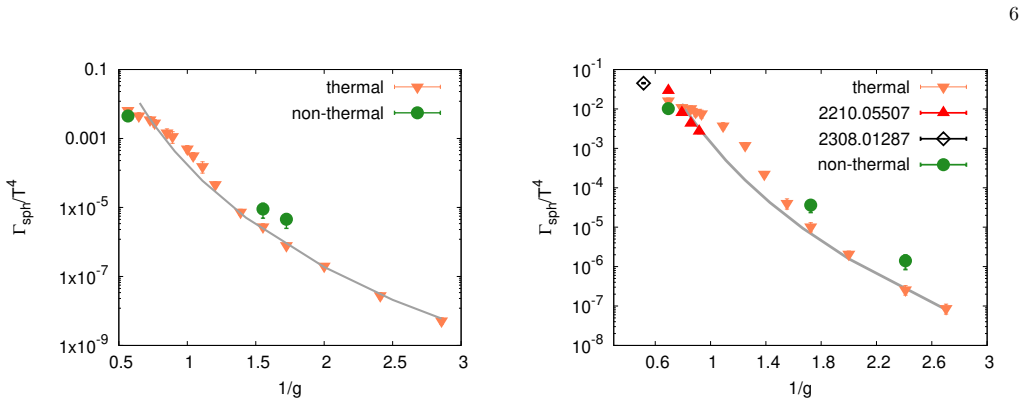
Within the thermal effective field theory for soft SU(N) gluons with momenta below the magnetic scale, lattice computations provide the sphaleron transition rate for N equals 2 and 3 across temperatures from 0.6 GeV up to 10 to the 15 GeV on large volumes. These rates, when contrasted with those in a non-thermal plasma of over-occupied infrared gluons, permit an estimate of the thermalization time for ultra-soft gluons in the reheating phase following inflation. The same non-perturbative gluon interactions lead to a thermal axion production rate that deviates substantially from the perturbative prediction, and this deviation remains large even at the electroweak scale.
What carries the argument
thermal effective field theory of soft SU(N) gluons below the magnetic scale, studied via lattice simulations
Load-bearing premise
The thermal effective field theory of soft SU(N) gluons accurately captures the relevant physics for the sphaleron rate and axion production across the stated temperature range, and that the non-thermal plasma comparison reliably estimates thermalization times.
What would settle it
If the axion production rate computed in full QCD lattice simulations at the electroweak scale matches the perturbative estimate rather than the soft-gluon EFT result, the claim of significant deviation would be falsified.
Figures




read the original abstract
We report our new lattice results for the sphaleron rate calculated within a thermal effective field theory of soft SU(N) gluons whose momenta are below the magnetic scale, where $N=2,3$, for a wide range of temperatures spanning from $0.6$-$10^{15}$ GeV at sufficiently large volumes. Comparing these results with sphaleron rates in a non-thermal SU(N) plasma where the infrared gluons are over-occupied, we estimate the typical thermalization time for these ultra-soft soft gluons during the early stages of reheating after inflation. We also calculate the thermal production rate of relativistic axions due to these non-perturbatively interacting soft gluons which shows a significant deviation from its perturbative estimate even at the electroweak scale.
Editorial analysis
A structured set of objections, weighed in public.
Referee Report
Summary. The paper reports new lattice results for the sphaleron rate in a thermal effective field theory of soft SU(N) gluons (N=2,3) with momenta below the magnetic scale, covering temperatures from 0.6 GeV to 10^15 GeV at large volumes. These are compared to sphaleron rates in a non-thermal over-occupied SU(N) plasma to estimate the thermalization timescale for ultra-soft gluons during post-inflation reheating. The work also computes the thermal production rate of relativistic axions from the non-perturbatively interacting soft gluons, finding a significant deviation from the perturbative estimate even at the electroweak scale.
Significance. If the lattice results are robust and the mapping to reheating dynamics holds, the findings would supply valuable non-perturbative data on sphaleron processes and axion production over an unusually broad temperature range, with direct relevance to early-universe cosmology, baryogenesis, and axion dark matter models. The lattice approach in the thermal EFT and the direct comparison to non-thermal simulations are positive features that go beyond purely perturbative estimates.
major comments (2)
- The central estimate of the typical thermalization time for ultra-soft gluons during reheating is obtained by taking the ratio of the sphaleron rate in the thermal EFT lattice calculation to the rate in the non-thermal over-occupied plasma. This mapping assumes a static configuration whose evolution is governed solely by the rate difference; it does not incorporate Hubble expansion or continuous gluon injection from inflaton decay, both of which can shift the effective timescale by an order of magnitude or more in a realistic expanding background.
- The manuscript provides no explicit details on the lattice discretization (action, spacing, volume sizes in physical units), the precise implementation of the thermal EFT, the method used to extract the sphaleron rate, or the error controls and finite-volume extrapolations. Without these, it is impossible to assess whether the quoted results remain reliable across the 15-order-of-magnitude temperature interval.
minor comments (2)
- The axion production rate section should state the precise axion-gluon coupling and the momentum integration limits used when comparing to the perturbative estimate.
- Clarify whether the same lattice ensembles are used for both the sphaleron rate and the axion production rate, or whether separate runs are required.
Simulated Author's Rebuttal
We thank the referee for their careful reading of our manuscript and for highlighting these important points. We address each major comment below and will revise the manuscript to improve clarity and completeness.
read point-by-point responses
-
Referee: The central estimate of the typical thermalization time for ultra-soft gluons during reheating is obtained by taking the ratio of the sphaleron rate in the thermal EFT lattice calculation to the rate in the non-thermal over-occupied plasma. This mapping assumes a static configuration whose evolution is governed solely by the rate difference; it does not incorporate Hubble expansion or continuous gluon injection from inflaton decay, both of which can shift the effective timescale by an order of magnitude or more in a realistic expanding background.
Authors: We agree that the mapping used to estimate the thermalization timescale is simplified and assumes a static setup without Hubble expansion or continuous gluon injection. This provides an order-of-magnitude indication of the timescale in the early reheating phase rather than a full dynamical prediction. In the revised manuscript we will add a dedicated paragraph in the discussion section explicitly stating these limitations, noting that the reported value should be interpreted as a baseline estimate, and suggesting that incorporating expansion and inflaton decay would require separate cosmological simulations. revision: partial
-
Referee: The manuscript provides no explicit details on the lattice discretization (action, spacing, volume sizes in physical units), the precise implementation of the thermal EFT, the method used to extract the sphaleron rate, or the error controls and finite-volume extrapolations. Without these, it is impossible to assess whether the quoted results remain reliable across the 15-order-of-magnitude temperature interval.
Authors: We acknowledge that the current version does not present these technical details with sufficient explicitness. In the revised manuscript we will expand the methods and appendix sections to include the lattice action, the range of lattice spacings and corresponding physical volumes for each temperature, the precise formulation of the thermal effective field theory, the procedure for extracting the sphaleron rate, and the full error budget together with finite-volume extrapolation details. This will allow readers to evaluate the robustness of the results over the reported temperature range. revision: yes
Circularity Check
No significant circularity; direct lattice computations
full rationale
The paper presents new lattice results for sphaleron rates in a thermal EFT of soft SU(N) gluons and axion production rates across a wide temperature range. These are obtained via direct numerical simulation on sufficiently large volumes rather than any analytical derivation. The subsequent comparison to non-thermal over-occupied plasma is used only to estimate a thermalization timescale; this interpretive mapping does not reduce any claimed result to a fitted parameter or self-referential definition by construction. No load-bearing self-citations, ansatzes smuggled via prior work, or uniqueness theorems imported from the same authors are invoked in the provided text. The central claims remain independent numerical outputs.
Axiom & Free-Parameter Ledger
Forward citations
Cited by 1 Pith paper
-
Topological Susceptibility and QCD at Finite Theta Angle
A pedagogical review summarizing analytic predictions and recent lattice results for theta-dependence and topological susceptibility in QCD.
Reference graph
Works this paper leans on
-
[1]
A. A. Belavin, A. M. Polyakov, A. S. Schwartz, and Y. S. Tyupkin, Pseudoparticle Solutions of the Yang- Mills Equations, Phys. Lett. B59, 85 (1975)
work page 1975
-
[2]
’t Hooft, Computation of the Quantum Effects Due to a Four-Dimensional Pseudoparticle, Phys
G. ’t Hooft, Computation of the Quantum Effects Due to a Four-Dimensional Pseudoparticle, Phys. Rev. D14, 3432 (1976), [Erratum: Phys.Rev.D 18, 2199 (1978)]
work page 1976
-
[3]
F. R. Klinkhamer and N. S. Manton, A Saddle Point Solution in the Weinberg-Salam Theory, Phys. Rev. D 30, 2212 (1984)
work page 1984
-
[4]
L. D. McLerran, E. Mottola, and M. E. Shaposhnikov, Sphalerons and Axion Dynamics in High Temperature QCD, Phys. Rev. D43, 2027 (1991)
work page 2027
- [5]
-
[6]
R. N. Mohapatra and X.-m. Zhang, QCD sphalerons at high temperature and baryogenesis at electroweak scale, Phys. Rev. D45, 2699 (1992)
work page 1992
-
[7]
D. Y. Grigoriev and V. A. Rubakov, Soliton Pair Cre- ation at Finite Temperatures. Numerical Study in (1+1)- dimensions, Nucl. Phys. B299, 67 (1988)
work page 1988
- [8]
-
[9]
Bodeker, On the effective dynamics of soft nonAbelian gauge fields at finite temperature, Phys
D. Bodeker, On the effective dynamics of soft nonAbelian gauge fields at finite temperature, Phys. Lett. B426, 351 (1998), arXiv:hep-ph/9801430
-
[10]
D. Bodeker, L. D. McLerran, and A. V. Smilga, Re- ally computing nonperturbative real time correlation functions, Phys. Rev. D52, 4675 (1995), arXiv:hep- th/9504123
- [11]
- [12]
-
[13]
Schlichting, Turbulent thermalization of weakly cou- pled non-abelian plasmas, Phys
S. Schlichting, Turbulent thermalization of weakly cou- pled non-abelian plasmas, Phys. Rev. D86, 065008 (2012), arXiv:1207.1450 [hep-ph]
- [14]
- [15]
- [16]
-
[17]
M. Bresciani, M. D. Brida, L. Giusti, and M. Pepe, QCD equation of state at very high temperature: Compu- tational strategy, simulations, and data analysis, Phys. Rev. D113, 034506 (2026), arXiv:2511.09160 [hep-lat]
-
[18]
T. Kunihiro, B. Muller, A. Ohnishi, A. Schafer, T. T. Takahashi, and A. Yamamoto, Chaotic behavior in clas- sical Yang-Mills dynamics, Phys. Rev. D82, 114015 (2010), arXiv:1008.1156 [hep-ph]
-
[19]
F. Gelis, E. Iancu, J. Jalilian-Marian, and R. Venu- gopalan, The Color Glass Condensate, Ann. Rev. Nucl. Part. Sci.60, 463 (2010), arXiv:1002.0333 [hep-ph]
work page Pith review arXiv 2010
-
[20]
J. Ambjorn and A. Krasnitz, Improved determination of the classical sphaleron transition rate, Nucl. Phys. B506, 387 (1997), arXiv:hep-ph/9705380
- [21]
-
[22]
M. Barroso Mancha and G. D. Moore, The sphaleron rate from 4D Euclidean lattices, JHEP01, 155, arXiv:2210.05507 [hep-lat]
-
[23]
C. Bonanno, F. D’Angelo, M. D’Elia, L. Maio, and M. Naviglio, Sphaleron Rate of Nf=2+1 QCD, Phys. Rev. Lett.132, 051903 (2024), arXiv:2308.01287 [hep-lat]
-
[24]
A. H. Guth, The Inflationary Universe: A Possible Solu- tion to the Horizon and Flatness Problems, Phys. Rev. D23, 347 (1981)
work page 1981
-
[25]
A. A. Starobinsky, A New Type of Isotropic Cosmological Models Without Singularity, Phys. Lett. B91, 99 (1980)
work page 1980
-
[26]
Planck 2018 results. X. Constraints on inflation
Y. Akramiet al.(Planck), Planck 2018 results. X. Con- straints on inflation, Astron. Astrophys.641, A10 (2020), arXiv:1807.06211 [astro-ph.CO]
work page internal anchor Pith review Pith/arXiv arXiv 2018
- [27]
- [28]
-
[29]
K. Harigaya and K. Mukaida, Thermalization af- ter/during Reheating, JHEP05, 006, arXiv:1312.3097 [hep-ph]
-
[30]
S. Passaglia, W. Hu, A. J. Long, and D. Zegeye, Achiev- ing the highest temperature during reheating with the Higgs condensate, Phys. Rev. D104, 083540 (2021), arXiv:2108.00962 [hep-ph]
-
[31]
M. Drees and B. Najjari, Energy spectrum of thermal- izing high energy decay products in the early universe, JCAP10, 009, arXiv:2105.01935 [hep-ph]
-
[32]
K. Mukaida and M. Yamada, Perturbative reheating and thermalization of pure Yang-Mills plasma, JHEP05, 174, arXiv:2402.14054 [hep-ph]
- [33]
-
[34]
R. Baier, A. H. Mueller, D. Schiff, and D. T. Son, ’Bottom up’ thermalization in heavy ion collisions, Phys. Lett. B 502, 51 (2001), arXiv:hep-ph/0009237
-
[35]
A. Kurkela and G. D. Moore, Bjorken Flow, Plasma Instabilities, and Thermalization, JHEP11, 120, arXiv:1108.4684 [hep-ph]
- [36]
- [37]
-
[38]
I. Rudenok, Y. Shtanov, and S. Vilchinskii, Post- inflationary preheating with weak coupling, Phys. Lett. B733, 193 (2014), arXiv:1401.7298 [astro-ph.CO]
- [39]
-
[40]
A. Caravano, E. Komatsu, K. D. Lozanov, and J. Weller, Lattice simulations of inflation, JCAP12(12), 010, arXiv:2102.06378 [astro-ph.CO]
-
[41]
F. L. Bezrukov and M. Shaposhnikov, The Standard Model Higgs boson as the inflaton, Phys. Lett. B659, 703 (2008), arXiv:0710.3755 [hep-th]
work page Pith review arXiv 2008
-
[42]
R. D. Peccei and H. R. Quinn, CP Conservation in the Presence of Instantons, Phys. Rev. Lett.38, 1440 (1977)
work page 1977
-
[43]
R. D. Peccei and H. R. Quinn, Constraints Imposed by CP Conservation in the Presence of Instantons, Phys. Rev. D16, 1791 (1977)
work page 1977
- [44]
-
[45]
J. Preskill, M. B. Wise, and F. Wilczek, Cosmology of the Invisible Axion, Phys. Lett. B120, 127 (1983)
work page 1983
-
[46]
L. F. Abbott and P. Sikivie, A Cosmological Bound on the Invisible Axion, Phys. Lett. B120, 133 (1983)
work page 1983
-
[47]
M. Dine and W. Fischler, The Not So Harmless Axion, Phys. Lett. B120, 137 (1983)
work page 1983
-
[48]
G. Grilli di Cortona, E. Hardy, J. Pardo Vega, and G. Villadoro, The QCD axion, precisely, JHEP01, 034, arXiv:1511.02867 [hep-ph]. 13
-
[49]
P. Graf and F. D. Steffen, Thermal axion production in the primordial quark-gluon plasma, Phys. Rev. D83, 075011 (2011), arXiv:1008.4528 [hep-ph]
-
[50]
J. Froustey, C. Pitrou, and M. C. Volpe, Neutrino decou- pling including flavour oscillations and primordial nucle- osynthesis, JCAP12, 015, arXiv:2008.01074 [hep-ph]
-
[51]
J. J. Bennett, G. Buldgen, P. F. De Salas, M. Drewes, S. Gariazzo, S. Pastor, and Y. Y. Y. Wong, Towards a precision calculation ofN eff in the Standard Model II: Neutrino decoupling in the presence of flavour os- cillations and finite-temperature QED, JCAP04, 073, arXiv:2012.02726 [hep-ph]
-
[52]
K. Bouzoud and J. Ghiglieri, Thermal axion pro- duction at hard and soft momenta, JHEP01, 163, arXiv:2404.06113 [hep-ph]
-
[53]
A. D. Linde, Infrared Problem in Thermodynamics of the Yang-Mills Gas, Phys. Lett. B96, 289 (1980)
work page 1980
-
[54]
On Axion Thermalization in the Early Universe
E. Masso, F. Rota, and G. Zsembinszki, On axion ther- malization in the early universe, Phys. Rev. D66, 023004 (2002), arXiv:hep-ph/0203221
work page Pith review arXiv 2002
-
[55]
J. Bernstein, L. S. Brown, and G. Feinberg, The Cosmo- logical Heavy Neutrino Problem Revisited, Phys. Rev. D 32, 3261 (1985)
work page 1985
-
[56]
M. S. Turneret al.,Thermal production of not so invisible axions in the early universe, Tech. Rep. (Fermi National Accelerator Lab., Batavia, IL (USA), 1986)
work page 1986
- [57]
-
[58]
Planck 2018 results. VI. Cosmological parameters
N. Aghanimet al.(Planck), Planck 2018 results. VI. Cosmological parameters, Astron. Astrophys.641, A6 (2020), [Erratum: Astron.Astrophys. 652, C4 (2021)], arXiv:1807.06209 [astro-ph.CO]
work page internal anchor Pith review Pith/arXiv arXiv 2018
discussion (0)
Sign in with ORCID, Apple, or X to comment. Anyone can read and Pith papers without signing in.