Recognition: 1 theorem link
· Lean TheoremGEMS JWST: HATS-75 b -- A giant planet with a sub-solar metallicity atmosphere orbiting an M-dwarf
Pith reviewed 2026-05-10 18:06 UTC · model grok-4.3
The pith
HATS-75 b has a sub-solar metallicity atmosphere with super-solar C/O after accounting for its M-dwarf host's starspots.
A machine-rendered reading of the paper's core claim, the machinery that carries it, and where it could break.
Core claim
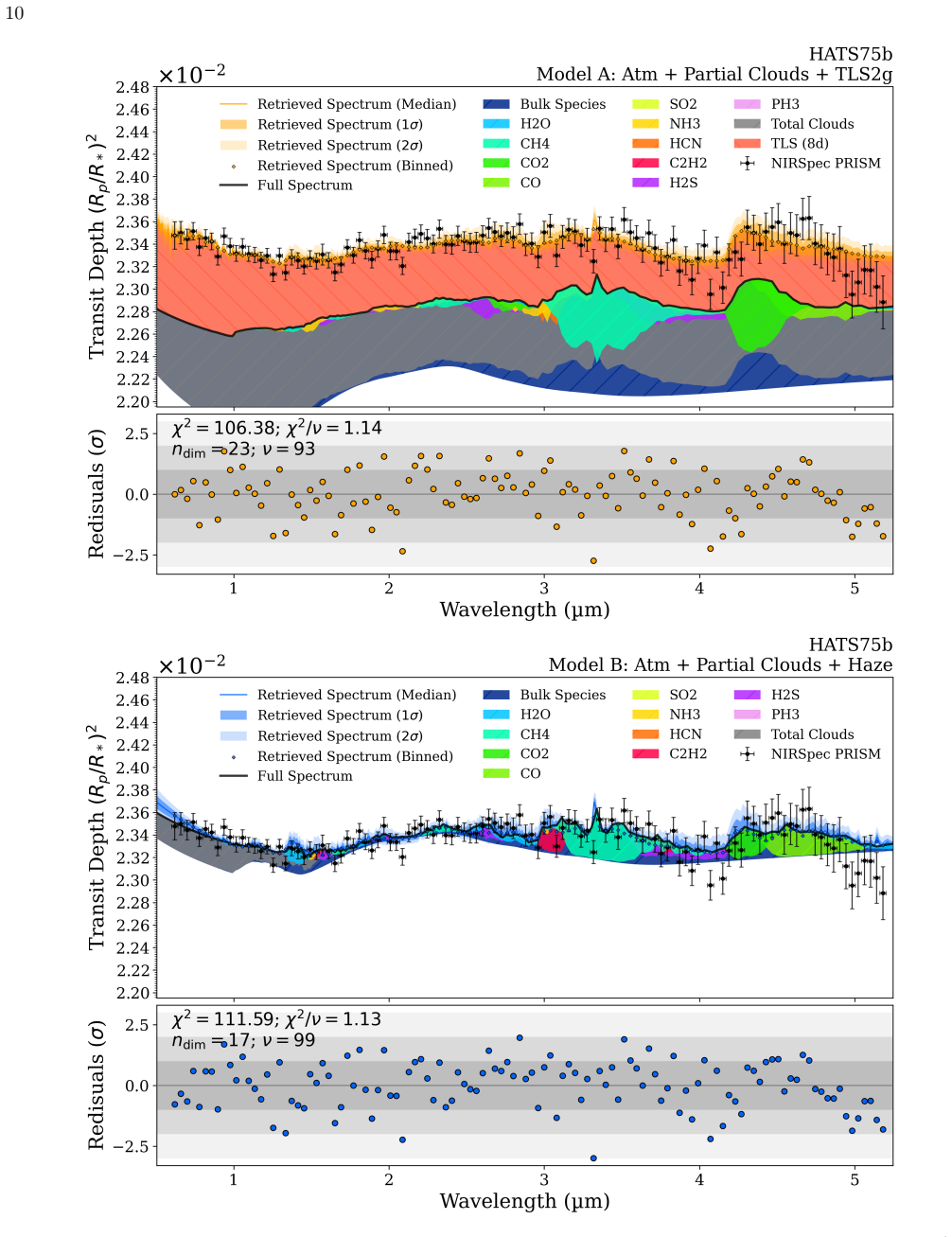
Within the stellar heterogeneity / TLS-based framework, atmospheric retrievals yield remarkably low atmospheric metallicity (log[M/H]=-1.74^{+0.92}_{-0.76}) and super-solar carbon-to-oxygen (C/O=1.04^{+0.40}_{-0.09}), which paired with a best-fit interior model with bulk metallicity of Z_p=0.20+/-0.04, implies poor vertical mixing within the planet. Retrievals also detect robust absorption signatures of CH4, CO, and CO2. We obtain only an upper limit for H2O, consistent with its atmospheric spectral features being masked by stellar contamination.
What carries the argument
The transit light source (TLS) effect, in which unocculted starspots and faculae on the active M-dwarf contaminate the out-of-transit flux and thereby reshape the apparent transmission spectrum.
If this is right
- Atmospheric retrievals detect clear CH4, CO, and CO2 absorption features.
- H2O absorption is only detected as an upper limit because stellar contamination masks its spectral features.
- The retrieved atmospheric metallicity is much lower than the bulk metallicity from interior modeling.
- The results demonstrate that stellar heterogeneity must be modeled to avoid misinterpreting exoplanet spectra around active M-dwarfs.
Where Pith is reading between the lines
- Similar giant planets around M-dwarfs may routinely require TLS corrections before their atmospheric metallicities can be trusted.
- The combination of low atmospheric metallicity and high C/O could indicate carbon-rich formation pathways that future population studies could test.
- Repeated observations at different stellar activity levels could confirm whether the retrieved abundances remain stable.
Load-bearing premise
That evidence from stellar rotation and spot-crossing events is strong enough to prefer the TLS stellar-heterogeneity model over a simple hazy-atmosphere explanation.
What would settle it
A new set of transit observations taken when the star shows no spot-crossing events or rotationally modulated variability that would instead support a high-metallicity hazy atmosphere model.
Figures






read the original abstract
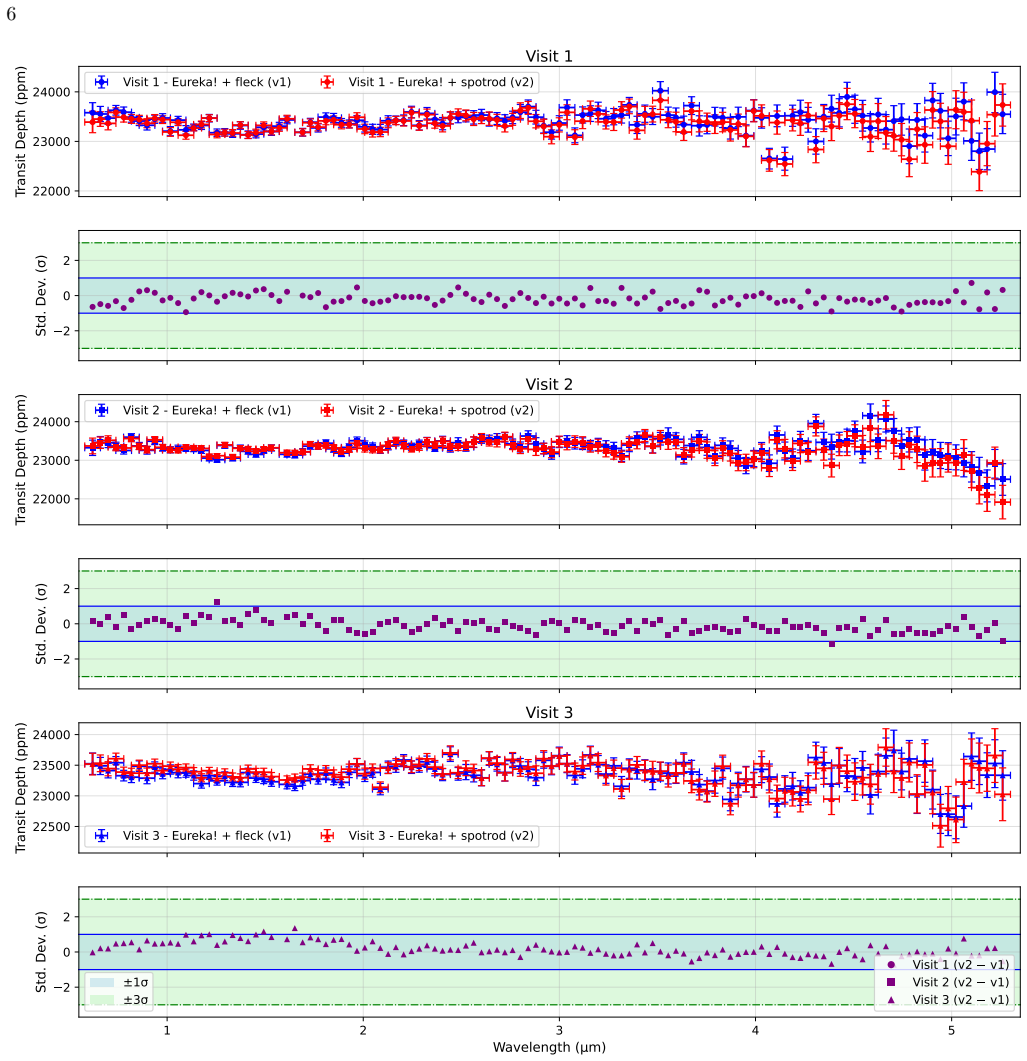
HATS-75 b is one of the recently discovered Giant Exoplanets orbiting M-dwarf Stars (GEMS) with a transmission spectrum shaped by both its atmosphere and the active stellar surface it transits. As part of a JWST program studying 7 GEMS, we observed three transits of HATS-75 b with the NIRSpec PRISM instrument (0.6-5.3 um). The planet's spectra exhibit a slightly larger transit depth at shorter wavelengths, indicative of hazes or stellar contamination due to stellar heterogeneities outside the transit chord, i.e., the transit light source (TLS) effect. While both a hazy atmospheric model or TLS model can replicate the transmission spectrum, independent evidence (.e.g, stellar rotation, spot-crossing events) favors a model that includes contamination from unocculted starspots and faculae. Within this stellar heterogeneity / TLS-based framework, atmospheric retrievals yield remarkably low atmospheric metallicity (log[M/H]=-1.74^{+0.92}_{-0.76}) and super-solar carbon-to-oxygen (C/O=1.04^{+0.40}_{-0.09}), which paired with a best-fit interior model with bulk metallicity of Z_p=0.20+/-0.04, implies poor vertical mixing within the planet. Retrievals also detect robust absorption signatures of CH4, CO, and CO2. We obtain only an upper limit for H2O, consistent with its atmospheric spectral features being masked by stellar contamination. These results underscore the importance of accounting for stellar heterogeneity when interpreting exoplanet transmission spectra and highlight HATS-75 b as a significant asset to our understanding of giant exoplanets around M-dwarfs with JWST.
Editorial analysis
A structured set of objections, weighed in public.
Referee Report
Summary. The manuscript reports JWST NIRSpec PRISM (0.6-5.3 μm) transmission spectroscopy from three transits of the giant exoplanet HATS-75 b orbiting an M-dwarf. The observed spectrum shows a slight increase in transit depth at shorter wavelengths, which both a hazy atmosphere model and a transit light source (TLS) model with unocculted starspots/faculae can reproduce. Independent stellar evidence (rotation period, spot-crossing events) is used to favor the TLS framework. Under this model, atmospheric retrievals yield log[M/H] = -1.74^{+0.92}_{-0.76}, C/O = 1.04^{+0.40}_{-0.09}, robust detections of CH4, CO, and CO2, and only an upper limit on H2O. Comparison of the retrieved atmospheric metallicity to a best-fit interior model (Z_p = 0.20 ± 0.04) is interpreted as evidence for poor vertical mixing.
Significance. If the TLS preference and retrievals hold, the work supplies one of the first detailed atmospheric constraints for a GEMS planet, demonstrates the practical impact of stellar heterogeneity on M-dwarf transmission spectra, and links atmospheric and interior metallicities to mixing efficiency. The multi-transit dataset and reported molecular detections constitute concrete observational assets for the field.
major comments (2)
- [Abstract] Abstract: Both hazy and TLS models are stated to replicate the spectrum, yet the TLS framework is adopted on the basis of stellar rotation and spot-crossing evidence without a reported Bayes factor, evidence ratio, or ΔBIC. Because the retrieved log[M/H] and C/O values (and the subsequent poor-mixing inference from comparison to Z_p) are direct outputs of the chosen framework, a quantitative model-selection statistic is required to justify preferring TLS over the equally viable hazy alternative.
- [Abstract] Abstract and retrieval description: The manuscript reports specific posterior values for metallicity and C/O together with molecular detections, but does not supply the full retrieval setup (prior ranges, number of free parameters, convergence diagnostics, or validation that stellar and planetary signals have been adequately separated). These details are load-bearing for the central claim that the atmosphere is markedly sub-solar in metallicity.
minor comments (1)
- [Abstract] Abstract: Typographical error in “(.e.g,” should read “(e.g.,”.
Simulated Author's Rebuttal
We thank the referee for their constructive and detailed comments, which help clarify the presentation of our model selection and retrieval methodology. We address each major comment point by point below and commit to revisions that strengthen the manuscript without altering its core conclusions.
read point-by-point responses
-
Referee: [Abstract] Abstract: Both hazy and TLS models are stated to replicate the spectrum, yet the TLS framework is adopted on the basis of stellar rotation and spot-crossing evidence without a reported Bayes factor, evidence ratio, or ΔBIC. Because the retrieved log[M/H] and C/O values (and the subsequent poor-mixing inference from comparison to Z_p) are direct outputs of the chosen framework, a quantitative model-selection statistic is required to justify preferring TLS over the equally viable hazy alternative.
Authors: We agree that a quantitative model-selection statistic would provide additional rigor to the preference for the TLS framework. The manuscript currently relies on independent stellar observables (rotation period and spot-crossing events) to favor TLS over a pure haze model, but we acknowledge that a direct statistical comparison between the two forward models was not reported. In the revised version we will add a nested-sampling model comparison, reporting the Bayes factor (or ΔlnZ) between the hazy-atmosphere-only and TLS-inclusive models. This will be included in the abstract, results, and methods sections, with the retrieved atmospheric parameters presented in the context of the favored model. revision: yes
-
Referee: [Abstract] Abstract and retrieval description: The manuscript reports specific posterior values for metallicity and C/O together with molecular detections, but does not supply the full retrieval setup (prior ranges, number of free parameters, convergence diagnostics, or validation that stellar and planetary signals have been adequately separated). These details are load-bearing for the central claim that the atmosphere is markedly sub-solar in metallicity.
Authors: The full retrieval configuration (priors, free-parameter count, and convergence checks) is described in the Methods section and supplementary tables, and the joint stellar-planetary modeling is used to separate the signals. However, we recognize that these details are not sufficiently prominent or self-contained for readers focused on the abstract and retrieval results. We will expand the retrieval description in the revised manuscript to explicitly list prior ranges, parameter counts, convergence diagnostics (e.g., Gelman-Rubin values), and additional validation steps confirming adequate separation of stellar heterogeneity from planetary absorption. This will be cross-referenced from the abstract and results. revision: yes
Circularity Check
No significant circularity; results are retrieval outputs under independently motivated model
full rationale
The paper selects the TLS/stellar heterogeneity framework on the basis of external stellar observables (rotation period and spot-crossing events) rather than the transmission spectrum itself. Atmospheric retrievals are then performed on the JWST data to obtain log[M/H] and C/O as direct fit parameters; these are compared to a separately derived interior bulk metallicity Z_p to reach the mixing conclusion. No equation, self-citation, or ansatz in the provided text reduces any reported value to a tautological restatement of the inputs. The derivation chain is therefore self-contained: model choice rests on independent data, and the quantitative atmospheric results are standard retrieval outputs, not predictions forced by construction.
Axiom & Free-Parameter Ledger
free parameters (2)
- atmospheric metallicity log[M/H] =
-1.74
- C/O ratio =
1.04
axioms (2)
- domain assumption The observed transmission spectrum can be decomposed into contributions from the planetary atmosphere and unocculted stellar heterogeneities (TLS effect).
- domain assumption Independent stellar observables (rotation period, spot-crossing events) reliably indicate the presence and impact of unocculted starspots and faculae.
Lean theorems connected to this paper
-
IndisputableMonolith/Foundation/RealityFromDistinction.leanreality_from_one_distinction unclear?
unclearRelation between the paper passage and the cited Recognition theorem.
atmospheric retrievals yield remarkably low atmospheric metallicity (log[M/H]=−1.74+0.92−0.76) and super-solar C/O
What do these tags mean?
- matches
- The paper's claim is directly supported by a theorem in the formal canon.
- supports
- The theorem supports part of the paper's argument, but the paper may add assumptions or extra steps.
- extends
- The paper goes beyond the formal theorem; the theorem is a base layer rather than the whole result.
- uses
- The paper appears to rely on the theorem as machinery.
- contradicts
- The paper's claim conflicts with a theorem or certificate in the canon.
- unclear
- Pith found a possible connection, but the passage is too broad, indirect, or ambiguous to say the theorem truly supports the claim.
Forward citations
Cited by 1 Pith paper
-
HAT-P-70b through the Eyes of MAROON-X: Constraining Elemental Abundances of Metals and Insights on Atmosphere Dynamics
New MAROON-X observations of HAT-P-70b detect multiple neutral and ionized metals with day-to-night wind signatures and demonstrate that ionization-aware retrievals yield abundance ratios closer to solar values except...
Reference graph
Works this paper leans on
-
[1]
Acu˜ na, L., Kreidberg, L., Zhai, M., & Molli` ere, P. 2024, GASTLI: An Open-Source Coupled Interior-Atmosphere Model to Unveil Gas Giant Composition, doi:10.48550/arXiv.2406.10032
-
[2]
M., Rosenfeld, K
Andrews, S. M., Rosenfeld, K. A., Kraus, A. L., & Wilner, D. J. 2013, ApJ, 771, 129
2013
-
[3]
B., Sing, D., et al
Ashtari, R., Stevenson, K. B., Sing, D., et al. 2025, The Astronomical Journal, 169, 106 Astropy Collaboration, Robitaille, T. P., Tollerud, E. J., et al. 2013, A&A, 558, A33 Astropy Collaboration, Price-Whelan, A. M., Sip˝ ocz, B. M., et al. 2018, The Astronomical Journal, 156, 123 Astropy Collaboration, Price-Whelan, A. M., Lim, P. L., et al. 2022, The ...
2025
-
[4]
K., & Heng, K
Barstow, J. K., & Heng, K. 2020, SSRv, 216, 82 B´ eky, B., Kipping, D. M., & Holman, M. J. 2014, MNRAS, 442, 3686
2020
-
[5]
2022, The Journal of Open Source Software, 7, 4503
Bell, T., Ahrer, E.-M., Brande, J., et al. 2022, The Journal of Open Source Software, 7, 4503
2022
-
[6]
Bodenheimer, P., Stevenson, D. J., Lissauer, J. J., & D’Angelo, G. 2025, Formation and Evolution Simulations of Saturn, Including Composition Gradients and Helium Immiscibility, arXiv:2504.17227
-
[7]
Boss, A. P. 1997, Science, 276, 1836 —. 2006, ApJ, 643, 501
1997
-
[8]
P., & Kanodia, S
Boss, A. P., & Kanodia, S. 2023, ApJ, 956, 4
2023
-
[9]
2014, A&A, 564, A125
Buchner, J., Georgakakis, A., Nandra, K., et al. 2014, A&A, 564, A125
2014
-
[10]
2021, A&A, 656, A72
Burn, R., Schlecker, M., Mordasini, C., et al. 2021, A&A, 656, A72
2021
-
[11]
2024, JWST Calibration Pipeline, 1.15.1 Zenodo, doi: 10.5281/zenodo.12692459
Bushouse, H., Eisenhamer, J., Dencheva, N., et al. 2024, JWST Calibration Pipeline, doi:10.5281/zenodo.12692459 Ca˜ nas, C. I., Lustig-Yaeger, J., Tsai, S.-M., et al. 2025, arXiv e-prints, arXiv:2502.06966 Ca˜ nas, C. I., Lustig-Yaeger, J., Tsai, S.-M., et al. 2025, GEMS JWST: Transmission Spectroscopy of TOI-5205b Reveals Significant Stellar Contaminatio...
-
[12]
L., May, E
Carter, A. L., May, E. M., Espinoza, N., et al. 2024, Nature Astronomy, 8, 1008
2024
-
[13]
Crossfield, I. J. M., Ahrer, E.-M., Brande, J., et al. 2025, Mapping the SO2 Shoreline in Gas Giant Exoplanets
2025
-
[14]
2019, ApJ, 872, 100
Debras, F., & Chabrier, G. 2019, ApJ, 872, 100
2019
-
[15]
2025, arXiv e-prints, arXiv:2510.11528
Dransfield, G., Timmermans, M., Sebastian, D., et al. 2025, arXiv e-prints, arXiv:2510.11528
-
[16]
D., Tull, R
Endl, M., Cochran, W. D., Tull, R. G., & MacQueen, P. J. 2003, AJ, 126, 3099
2003
-
[17]
G., & Guinan, E
Engle, S. G., & Guinan, E. F. 2023, The Astrophysical Journal, 954, L50
2023
-
[18]
P., & Bridges, M
Feroz, F., Hobson, M. P., & Bridges, M. 2009, MNRAS, 398, 1601
2009
-
[19]
2018, Monthly Notices of the Royal Astronomical Society, 481, 4698
Fisher, C., & Heng, K. 2018, Monthly Notices of the Royal Astronomical Society, 481, 4698
2018
-
[20]
W., Lang, D., & Goodman, J
Foreman-Mackey, D., Hogg, D. W., Lang, D., & Goodman, J. 2013, PASP, 125, 306
2013
-
[21]
P., Mather, J
Gardner, J. P., Mather, J. C., Clampin, M., et al. 2006, SSRv, 123, 485
2006
-
[22]
Glusman, R. I., Ca˜ nas, C. I., Kanodia, S., et al. 2025, arXiv e-prints, arXiv:2509.08773
-
[23]
E., Rothman, L
Gordon, I. E., Rothman, L. S., Hill, C., et al. 2017, JQSRT, 203, 3
2017
-
[24]
E., Rothman, L
Gordon, I. E., Rothman, L. S., Hargreaves, R. J., et al. 2022, Journal of Quantitative Spectroscopy and Radiative Transfer, 277, 107949
2022
-
[25]
2024, The Journal of Open Source Software, 9, 6816
Grant, D., & Wakeford, H. 2024, The Journal of Open Source Software, 9, 6816
2024
-
[26]
K., Wakeford, H
Grant, D., Lewis, N. K., Wakeford, H. R., et al. 2023, ApJL, 956, L32
2023
-
[27]
2022, The Nature of Gas Giant Planets
Helled, R., Movshovitz, N., & Nettelmann, N. 2022, The Nature of Gas Giant Planets
2022
-
[28]
2017, The Astrophysical Journal, 840, L4
Helled, R., & Stevenson, D. 2017, The Astrophysical Journal, 840, L4
2017
-
[29]
2017, Monthly Notices of the Royal Astronomical Society, 470, 2972
Heng, K., & Kitzmann, D. 2017, Monthly Notices of the Royal Astronomical Society, 470, 2972
2017
-
[30]
2024, The Evolution of Jupiter and Saturn with Helium Rain
Howard, S., M¨ uller, S., & Helled, R. 2024, The Evolution of Jupiter and Saturn with Helium Rain
2024
-
[31]
2023, A&A, 680, L2
Howard, S., Guillot, T., Markham, S., et al. 2023, A&A, 680, L2
2023
-
[32]
Ida, S., & Lin, D. N. C. 2005, ApJ, 626, 1045
2005
-
[33]
2022, A&A, 661, A80 Jord´ an, A., Hartman, J
Jakobsen, P., Ferruit, P., Alves de Oliveira, C., et al. 2022, A&A, 661, A80 Jord´ an, A., Hartman, J. D., Bayliss, D., et al. 2022, AJ, 163, 125 Jord´ an, A., Hartman, J. D., Bayliss, D., et al. 2022, The Astronomical Journal, 163, 125
2022
-
[34]
2024, ApJ, 978, 97
Kanodia, S. 2024, ApJ, 978, 97
2024
-
[35]
I., Mahadevan, S., et al
Kanodia, S., Ca˜ nas, C. I., Mahadevan, S., et al. 2024, AJ, 167, 161
2024
-
[36]
E., van der Avoird, A., et al
Karman, T., Gordon, I. E., van der Avoird, A., et al. 2019, Icarus, 328, 160
2019
-
[37]
Kipping, D. M. 2013, MNRAS, 435, 2152
2013
-
[38]
R., Bean, J
Kreidberg, L., Line, M. R., Bean, J. L., et al. 2015, ApJ, 814, 66 24
2015
-
[39]
Laughlin, G., Bodenheimer, P., & Adams, F. C. 2004, ApJL, 612, L73 Lecavelier Des Etangs, A., Pont, F., Vidal-Madjar, A., &
2004
-
[40]
Marley, M. S. 2015, ApJ, 807, 183
2015
-
[41]
2020, in Oxford Research Encyclopedia of Planetary Science
Lodders, K. 2020, in Oxford Research Encyclopedia of Planetary Science
2020
-
[42]
MacDonald, R. J. 2023, Journal of Open Source Software, 8, 4873
2023
-
[43]
J., & Madhusudhan, N
MacDonald, R. J., & Madhusudhan, N. 2017, MNRAS, 469, 1979
2017
-
[44]
F., Ansdell, M., Rosotti, G
Manara, C. F., Ansdell, M., Rosotti, G. P., et al. 2023, in Astronomical Society of the Pacific Conference Series, Vol. 534, Protostars and Planets VII, ed. S. Inutsuka, Y. Aikawa, T. Muto, K. Tomida, & M. Tamura, 539
2023
-
[45]
R., & Fortney, J
Mankovich, C. R., & Fortney, J. J. 2020, The Astrophysical Journal, 889, 51
2020
-
[46]
2022, A&A, 662, A18
Miguel, Y., Bazot, M., Guillot, T., et al. 2022, A&A, 662, A18
2022
-
[47]
1980, Progress of Theoretical Physics, 64, 544
Mizuno, H. 1980, Progress of Theoretical Physics, 64, 544
1980
-
[48]
E., Stevenson, K
Moran, S. E., Stevenson, K. B., Sing, D. K., et al. 2023, ApJL, 948, L11
2023
-
[49]
Morris, B. M. 2022, fleck: Fast starspot rotational modulation light curves, Astrophysics Source Code Library, record ascl:2203.009
2022
-
[50]
Mullens, E., Lewis, N. K., & MacDonald, R. J. 2024, ApJ, 977, 105 M¨ uller, S., & Helled, R. 2021, MNRAS, 507, 2094 M¨ uller, S., & Helled, R. 2023a, A&A, 669, A24 —. 2023b, Warm Giant Exoplanet Characterisation: Current State, Challenges and Outlook, arXiv:2304.12782 —. 2024, Can Jupiter’s Atmospheric Metallicity Be Different from the Deep Interior?, arX...
-
[51]
Murray, C. A., & Berta-Thompson, Z. 2025, arXiv e-prints, arXiv:2511.03045
-
[52]
J., et al
Pascucci, I., Testi, L., Herczeg, G. J., et al. 2016, ApJ, 831, 125
2016
-
[53]
J., & Mamajek, E
Pecaut, M. J., & Mamajek, E. E. 2013, ApJS, 208, 9
2013
-
[54]
B., Hubickyj, O., Bodenheimer, P., et al
Pollack, J. B., Hubickyj, O., Bodenheimer, P., et al. 1996, Icarus, 124, 62
1996
-
[55]
2017, The Astrophysical Journal, 834, 151 ReadTheDocs: Eureka! Control Files (.ecf)
Rackham, B., Espinoza, N., Apai, D., et al. 2017, The Astrophysical Journal, 834, 151 ReadTheDocs: Eureka! Control Files (.ecf). 2026, Eureka! Control Files (.ecf), accessed: 2026-02-04
2017
-
[56]
P., Venot, O., Lagage, P.-O., & Tinetti, G
Rocchetto, M., Waldmann, I. P., Venot, O., Lagage, P.-O., & Tinetti, G. 2016, ApJ, 833, 120
2016
-
[57]
2021, A&A, 653, A114
Sabotta, S., Schlecker, M., Chaturvedi, P., et al. 2021, A&A, 653, A114
2021
-
[58]
Speagle, J. S. 2020, MNRAS, 493, 3132
2020
-
[59]
W., Kitzmann, D., Patzer, A
Stock, J. W., Kitzmann, D., Patzer, A. B. C., & Sedlmayr, E. 2018, MNRAS, 479, 865 STScI Development Team. 2013, pysynphot: Synthetic photometry software package, Astrophysics Source Code Library, record ascl:1303.023, ascl:1303.023
2018
-
[60]
Sur, A., Arevalo, R. T., Su, Y., & Burrows, A. 2024, Simultaneous Evolutionary Fits for Jupiter and Saturn Incorporating Fuzzy Cores, arXiv:2412.17127
-
[61]
2008, Contemporary Physics, 49, 71
Trotta, R. 2008, Contemporary Physics, 49, 71
2008
-
[62]
2018, ˚ ap, 610, L14
Vazan, A., Helled, R., & Guillot, T. 2018, ˚ ap, 610, L14
2018
discussion (0)
Sign in with ORCID, Apple, or X to comment. Anyone can read and Pith papers without signing in.