Recognition: 2 theorem links
· Lean TheoremTwo-dimensional shelving spectroscopy of ultraviolet ground state transitions in dysprosium
Pith reviewed 2026-05-10 17:40 UTC · model grok-4.3
The pith
UV transitions in dysprosium have the largest decay strengths to its ultralong-lived first excited state, comparable to the strongest transitions in other dipolar atoms.
A machine-rendered reading of the paper's core claim, the machinery that carries it, and where it could break.
Core claim
Several UV excited states in dysprosium exhibit the largest decay strengths to the ultralong-lived first excited state, comparable to the strongest transitions found in dipolar atoms. Two-dimensional shelving spectroscopy measures the isotope shifts, hyperfine coefficients, and excited-state total angular momentum J, while King plots determine the electronic character of these states.
What carries the argument
Two-dimensional shelving spectroscopy, a technique that improves detection sensitivity and determines the hyperfine-isotope structure along with the excited-state total angular momentum J.
If this is right
- These UV transitions enable practical optical population of the first excited state.
- The transitions support construction of an optical clock based on dysprosium.
- High-resolution imaging becomes feasible in quantum gas microscopy setups.
- Lanthanide nuclei can be probed via enhanced Schiff moments to search for physics beyond the standard model.
Where Pith is reading between the lines
- Analogous UV transitions in other lanthanide atoms such as erbium could be characterized with the same shelving approach.
- The method may simplify state preparation in future experiments with complex atomic spectra.
- Combining the King plots with nuclear models could yield additional constraints on nuclear moments.
Load-bearing premise
The two-dimensional shelving spectroscopy method accurately determines the hyperfine-isotope structure and excited state total angular momentum J without significant unaccounted systematic effects from laser intensities, detection efficiencies, or data analysis choices.
What would settle it
An independent measurement of the spontaneous decay rates from the UV excited states to the first excited state that yields values substantially different from those inferred via the shelving spectroscopy data.
Figures


read the original abstract
The open inner-shell electronic structure of lanthanides with large magnetic moments gives rise to a rich spectrum of transitions available for laser cooling, trapping, and coherent control. Despite this, the large number of ultraviolet (UV) transitions below 400nm have so far been rarely utilized in dipolar atom experiments. Here, we investigate multiple UV ground state transitions in dysprosium. Several of these UV excited states have the largest decay strengths to the ultralong-lived, low-lying first excited state which are comparable to the most commonly used strongest transitions found in dipolar atoms. Using two-dimensional shelving spectroscopy which improves detection sensitivity and provides a straightforward way to determine the hyperfine-isotope structure and excited state total angular momentum $J$, we measure isotope shifts, hyperfine coefficients, and create King plots to determine their electronic nature. Such knowledge of these UV transitions which analogously exist in other magnetic atoms is important for optically populating the first excited state and can be used towards creating an optical clock, high resolution imaging in quantum gas microscopy, and probing lanthanide nuclei with enhanced Schiff moments in search of physics beyond the standard model.
Editorial analysis
A structured set of objections, weighed in public.
Referee Report
Summary. The manuscript introduces two-dimensional shelving spectroscopy as a technique to investigate multiple UV ground-state transitions in dysprosium. It asserts that several of these excited states possess the largest decay strengths to the ultralong-lived first excited state, comparable to the strongest transitions used in other dipolar atoms. The method is employed to extract isotope shifts and hyperfine coefficients, construct King plots for electronic character assignment, and support applications in optical clocks, quantum gas microscopy, and searches for physics beyond the Standard Model.
Significance. If the measurements and assignments hold, the work would provide practical routes to optically populate long-lived states in lanthanides and enable high-resolution imaging or nuclear probes with enhanced sensitivity. The emphasis on a detection-sensitive shelving approach for complex UV spectra is a methodological contribution that could generalize to other magnetic atoms.
major comments (2)
- [Method and results sections (shelving spectroscopy description)] The central claim that several UV states have the largest decay strengths to the first excited state, and that King plots determine their electronic nature, rests on the accuracy of J assignments and hyperfine extraction via two-dimensional shelving spectroscopy. The manuscript does not provide a quantitative analysis of potential systematics arising from laser intensity (saturation or optical pumping), isotope-dependent detection efficiency, background subtraction, or peak-fitting choices; these effects could shift extracted parameters and invalidate the decay-strength comparisons and electronic assignments.
- [Results and discussion] No raw spectra, fitted parameters with uncertainties, or direct comparison to known transitions are presented to validate the method's performance. Without such benchmarks, it is not possible to confirm that the reported isotope shifts, hyperfine coefficients, or King-plot slopes are free from unaccounted biases.
minor comments (2)
- [Abstract] The abstract states that measurements were performed but supplies no numerical values, error bars, or example data, which hinders immediate assessment of the results.
- [Introduction and methods] Notation for hyperfine coefficients and King-plot construction should be defined explicitly with reference to standard conventions in the field to improve clarity.
Simulated Author's Rebuttal
We thank the referee for their careful reading of the manuscript and for highlighting areas where additional detail would strengthen the presentation. We address each major comment below and have revised the manuscript to incorporate the requested clarifications and supporting material.
read point-by-point responses
-
Referee: [Method and results sections (shelving spectroscopy description)] The central claim that several UV states have the largest decay strengths to the first excited state, and that King plots determine their electronic nature, rests on the accuracy of J assignments and hyperfine extraction via two-dimensional shelving spectroscopy. The manuscript does not provide a quantitative analysis of potential systematics arising from laser intensity (saturation or optical pumping), isotope-dependent detection efficiency, background subtraction, or peak-fitting choices; these effects could shift extracted parameters and invalidate the decay-strength comparisons and electronic assignments.
Authors: We agree that an explicit quantitative treatment of these systematics improves the manuscript. In the revised version we have added a new subsection that evaluates each effect. Laser intensity is treated by reporting the saturation parameter for each transition and showing that optical pumping during the short probe pulse contributes less than 3 % to the extracted line centers. Isotope-dependent detection efficiency is bounded by noting that the same shelving and detection lasers are used for all isotopes; residual differences arising from hyperfine-dependent branching are calculated to be below 2 % and are folded into the systematic uncertainty. Background subtraction and peak-fitting choices are now documented with the precise functional forms employed and with the resulting covariance matrices; these uncertainties are propagated into the final isotope shifts, hyperfine coefficients, and King-plot slopes. With these additions the central claims remain supported within the stated uncertainties. revision: yes
-
Referee: [Results and discussion] No raw spectra, fitted parameters with uncertainties, or direct comparison to known transitions are presented to validate the method's performance. Without such benchmarks, it is not possible to confirm that the reported isotope shifts, hyperfine coefficients, or King-plot slopes are free from unaccounted biases.
Authors: We accept that explicit validation data were not included in the original submission. The revised manuscript now contains representative raw two-dimensional shelving spectra for the strongest transitions, together with the complete set of fitted parameters and their statistical and systematic uncertainties. In addition, we have added a direct comparison for one transition whose isotope shift and hyperfine structure were previously reported in the literature; the new values agree within combined uncertainties. These benchmarks confirm that the two-dimensional fitting procedure recovers known parameters without detectable bias and thereby support the reliability of the remaining assignments and King-plot analysis. revision: yes
Circularity Check
No circularity: experimental measurements of UV transitions and King plots are self-contained
full rationale
This is an experimental paper reporting direct measurements of isotope shifts, hyperfine coefficients, and electronic character via King plots for dysprosium UV transitions using two-dimensional shelving spectroscopy. No derivation chain, first-principles prediction, or fitted parameter is claimed to reduce by the paper's own equations to its inputs. The method is presented as a measurement technique whose outputs (J assignments, shifts, plots) stand on observed spectra rather than self-referential definitions or self-citation chains. Standard analysis tools like King plots are applied without renaming known results as novel derivations. The work is therefore self-contained against external benchmarks with no load-bearing circular steps.
Axiom & Free-Parameter Ledger
axioms (1)
- domain assumption Standard quantum-mechanical treatment of atomic hyperfine interactions and isotope shifts
Lean theorems connected to this paper
-
IndisputableMonolith/Cost/FunctionalEquation.leanwashburn_uniqueness_aczel unclearUsing two-dimensional shelving spectroscopy which improves detection sensitivity and provides a straightforward way to determine the hyperfine-isotope structure and excited state total angular momentum J, we measure isotope shifts, hyperfine coefficients, and create King plots to determine their electronic nature.
-
IndisputableMonolith/Foundation/DimensionForcing.leanalexander_duality_circle_linking unclearKing plot analysis... extract the specific mass shifts (SMS) and electronic field shift (EFS) ratios
Reference graph
Works this paper leans on
-
[1]
Two-dimensional shelving spectroscopy of ultraviolet ground state transitions in dysprosium
Physikalisches Institut and Center for Integrated Quantum Science and Technology, Universität Stuttgart, Pfaffenwaldring 57, 70569 Stuttgart, Germany 2Department of Physics, MIT-Harvard Center for Ultracold Atoms, and Research Laboratory of Electronics, MIT, Cambridge, Massachusetts 02139, USA The open inner-shell electronic structure of lanthanides with ...
work page internal anchor Pith review Pith/arXiv arXiv 2026
-
[2]
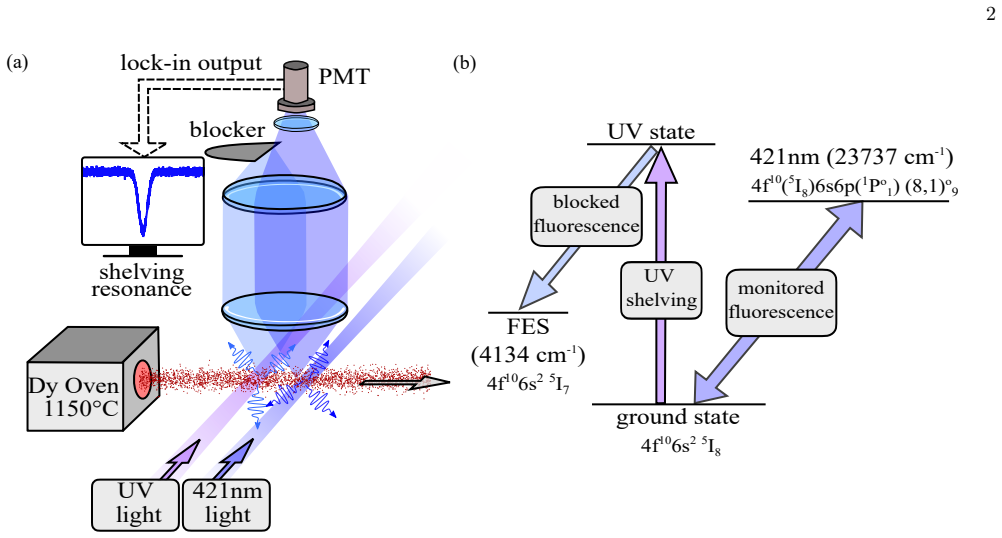
(8,1)o 9 UV state UV shelving monitored fluorescence FES (4134 cm -1 ) 4f106s2 5I7 blocked fluorescence (b) (a) UV light 421nm light PMT blocker lock-in output shelvingresonance Dy Oven 1150°C FIG. 1: (a) Experimental setup: Dy atoms (red) emerge from an oven and are illuminated subsequently by UV and then 421 nmlaser beams. The421 nmbeam fluorescence is ...
-
[3]
with two lenses in an approximate 4f-configuration and an additional focusing lens (Figure 1(a)). A linewidth filter centered at 420 nm (3dB width/ 10 nm full-widthhalfmaximum)ismountedinfrontofthePMT and we physically block fluorescence from reaching the PMT produced from decay to the FES at 4134 cm−1, as some transitions we study produce fluorescence at...
1986
-
[4]
Chomaz, I
L. Chomaz, I. Ferrier-Barbut, F. Ferlaino, B. Laburthe- Tolra, B. L. Lev, and T. Pfau, Reports on Progress in Physics 86, 026401 (2022)
2022
-
[5]
Böttcher, J.-N
F. Böttcher, J.-N. Schmidt, J. Hertkorn, K. S. H. Ng, S. D. Graham, M. Guo, T. Langen, and T. Pfau, Reports on Progress in Physics84, 012403 (2020)
2020
-
[6]
Kadau, M
H. Kadau, M. Schmitt, M. Wenzel, C. Wink, T. Maier, I. Ferrier-Barbut, and T. Pfau, Nature530, 194 (2016)
2016
-
[7]
Schmitt, M
M. Schmitt, M. Wenzel, F. Böttcher, I. Ferrier-Barbut, and T. Pfau, Nature539, 259 (2016)
2016
-
[8]
M. A. Norcia, C. Politi, L. Klaus, E. Poli, M. Sohmen, M. J. Mark, R. N. Bisset, L. Santos, and F. Ferlaino, Nature 596, 357 (2021)
2021
-
[9]
L. Su, A. Douglas, M. Szurek, R. Groth, S. F. Ozturk, A. Krahn, A. H. Hébert, G. A. Phelps, S. Ebadi, S. Dick- erson, F. Ferlaino, O. Marković, and M. Greiner, Nature 622, 724 (2023)
2023
-
[10]
Lepoutre, L
S. Lepoutre, L. Gabardos, K. Kechadi, P. Pedri, O. Gor- ceix, E. Maréchal, L. Vernac, and B. Laburthe-Tolra, Phys. Rev. Lett.121, 013201 (2018)
2018
-
[11]
Chalopin, T
T. Chalopin, T. Satoor, A. Evrard, V. Makhalov, J. Dal- ibard, R. Lopes, and S. Nascimbene, Nature Physics16, 1017 (2020). 9
2020
-
[12]
Budker, D
D. Budker, D. DeMille, E. D. Commins, and M. S. Zolo- torev, Phys. Rev. Lett.70, 3019 (1993)
1993
-
[13]
Van Tilburg, N
K. Van Tilburg, N. Leefer, L. Bougas, and D. Budker, Phys. Rev. Lett.115, 011802 (2015)
2015
-
[14]
Lepers, H
M. Lepers, H. Li, J.-F. Wyart, G. Quéméner, and O. Dulieu, Phys. Rev. Lett.121, 063201 (2018)
2018
-
[15]
Magnetic atoms with a large electric dipole moment
J. Seifert, S. C. Wright, B. G. Sartakov, G. Valtolina, and G. Meijer, Magnetic atoms with a large electric dipole moment (2025), arXiv:2511.14225 [physics.atom-ph]
work page internal anchor Pith review Pith/arXiv arXiv 2025
-
[16]
Thus, the differential dynamic scalar polarizability is very small
The FES of Dy, Ho and Tm arises due to fine structure splitting and the term symbols of the ground and FES only differ by∆J = −1. Thus, the differential dynamic scalar polarizability is very small. For Er, the ground state is 3H6, while the FES is3F4. Hence, the differential dynamic scalar polarizability between ground and FES is expected to also be small...
-
[17]
Sukachev, S
D. Sukachev, S. Fedorov, I. Tolstikhina, D. Tregubov, E. Kalganova, G. Vishnyakova, A. Golovizin, N. Ko- lachevsky, K. Khabarova, and V. Sorokin, Phys. Rev. A 94, 022512 (2016)
2016
-
[18]
Kozlov, V
A. Kozlov, V. A. Dzuba, and V. V. Flambaum, Phys. Rev. A88, 032509 (2013)
2013
-
[19]
Li, J.-F
H. Li, J.-F. Wyart, O. Dulieu, S. Nascimbène, and M. Lepers, Journal of Physics B: Atomic, Molecular and Optical Physics50, 014005 (2016)
2016
-
[20]
V. A. Dzuba, A. Kozlov, and V. V. Flambaum, Phys. Rev. A89, 042507 (2014)
2014
-
[21]
Li, J.-F
H. Li, J.-F. Wyart, O. Dulieu, and M. Lepers, Phys. Rev. A 95, 062508 (2017)
2017
-
[22]
Golovizin, E
A. Golovizin, E. Fedorova, D. Tregubov, D. Sukachev, K. Khabarova, V. Sorokin, and N. Kolachevsky, Nature Communications 10, 1724 (2019)
2019
-
[23]
Mishin, D
D. Mishin, D. Tregubov, N. Kolachevsky, and A. Golovizin, PRX Quantum6, 040329 (2025)
2025
-
[24]
Petersen, M
N. Petersen, M. Trümper, and P. Windpassinger, Phys. Rev. A101, 042502 (2020)
2020
-
[25]
Patscheider, B
A. Patscheider, B. Yang, G. Natale, D. Petter, L. Chomaz, M. J. Mark, G. Hovhannesyan, M. Lepers, and F. Ferlaino, Phys. Rev. Res.3, 033256 (2021)
2021
-
[26]
J. G. Conway and E. F. Worden, J. Opt. Soc. Am.61, 704 (1971)
1971
-
[27]
M. E. Wickliffe, J. E. Lawler, and G. Nave, Journal of Quantitative Spectroscopy and Radiative Transfer 66, 363 (2000)
2000
-
[28]
Unnikrishnan, P
G. Unnikrishnan, P. Ilzhöfer, A. Scholz, C. Hölzl, A. Götzelmann, R. K. Gupta, J. Zhao, J. Krauter, S. We- ber, N. Makki, H. P. Büchler, T. Pfau, and F. Meinert, Phys. Rev. Lett.132, 150606 (2024)
2024
-
[29]
J. E. Lawler, J.-F. Wyart, and E. A. Den Hartog, Journal of Physics B: Atomic, Molecular and Optical Physics43, 235001 (2010)
2010
-
[30]
M. E. Wickliffe and J. E. Lawler, J. Opt. Soc. Am. B14, 737 (1997)
1997
-
[31]
Al-Labady, B
N. Al-Labady, B. Özdalgiç, A. Er, F. Güzelçimen, I. K. Öztürk, S. Kröger, A. Kruzins, M. Tamanis, R. Ferber, and G. Başar, The Astrophysical Journal Supplement Se- ries 228, 16 (2017)
2017
-
[32]
Engel, Annual Review of Nuclear and Particle Science 75, 129 (2025)
J. Engel, Annual Review of Nuclear and Particle Science 75, 129 (2025)
2025
-
[33]
V. V. Flambaum and V. A. Dzuba, Phys. Rev. A101, 042504 (2020)
2020
-
[34]
V. V. Flambaum and A. J. Mansour, Phys. Rev. C111, 055501 (2025)
2025
-
[35]
Leefer, A
N. Leefer, A. Cingöz, and D. Budker, Opt. Lett.34, 2548 (2009)
2009
-
[36]
M. Lu, S. H. Youn, and B. L. Lev, Phys. Rev. A83, 012510 (2011)
2011
-
[37]
Schmitt, E
M. Schmitt, E. A. L. Henn, J. Billy, H. Kadau, T. Maier, A. Griesmaier, and T. Pfau, Opt. Lett.38, 637 (2013)
2013
-
[38]
R. J. Lipert and S. C. Lee, Applied Physics B Photo- physics and Laser Chemistry57, 373 (1993)
1993
-
[39]
W.-G.Jin, H.Ono,andT.Minowa,InternationalJournal of Spectroscopy2011, 578374 (2011)
2011
-
[40]
Demtröder,Laser Spectroscopy: Vol
W. Demtröder,Laser Spectroscopy: Vol. 2 Experimental Techniques (Springer-Verlag Berlin, 2008)
2008
-
[41]
Manai, A
I. Manai, A. Molineri, C. Fréjaville, C. Duval, P. Bataille, R. Journet, F. Wiotte, B. Laburthe-Tolra, E. Maréchal, M. Cheneau, and M. Robert-de Saint-Vincent, Journal of Physics B: Atomic, Molecular and Optical Physics53, 085005 (2020)
2020
-
[42]
White, N
B. White, N. C. M. Bulstrode, D. H. Forest, C. Honey- ball, B.Evans,andL.Butt,JournalofPhysicsB:Atomic, Molecular and Optical Physics58, 035001 (2025)
2025
-
[43]
Fraxanet, D
J. Fraxanet, D. González-Cuadra, T. Pfau, M. Lewen- stein, T. Langen, and L. Barbiero, Phys. Rev. Lett.128, 043402 (2022)
2022
-
[44]
W. C. Martin, R. Zalubas, and L. Hagan,Atomic en- ergy levels - the rare earth elements. (the spectra of lanthanum, cerium, praseodymium, neodymium, prome- thium, samarium, europium, gadolinium, terbium, dys- prosium, holmium, erbium, thulium, ytterbium, and lutetium). [66 atoms and ions], Tech. Rep. (Manchester Coll. of Science and Technology (UK). Dept....
1978
-
[45]
Colombe, D
Y. Colombe, D. H. Slichter, A. C. Wilson, D. Leibfried, and D. J. Wineland, Opt. Express22, 19783 (2014)
2014
-
[46]
Ahmad, A
S. Ahmad, A. Venugopalan, and G. Saksena, Spec- trochimica Acta Part B: Atomic Spectroscopy37, 181 (1982)
1982
-
[47]
Wyart, Physica75, 371 (1974)
J. Wyart, Physica75, 371 (1974)
1974
-
[48]
Ferch, W
J. Ferch, W. Dankwort, and H. Gebauer, Physics Letters A 49, 287 (1974)
1974
-
[49]
Afzal and S
S. Afzal and S. Ahmad, Spectrochimica Acta Part B: Atomic Spectroscopy55, 97 (2000)
2000
-
[50]
G. J. Zaal, W. Hogervorst, E. R. Eliel, K. A. H. van Leeuwen, and J. Blok, Journal of Physics B: Atomic and Molecular Physics13, 2185 (1980)
1980
-
[51]
This information is used to deduce J as de- scribed
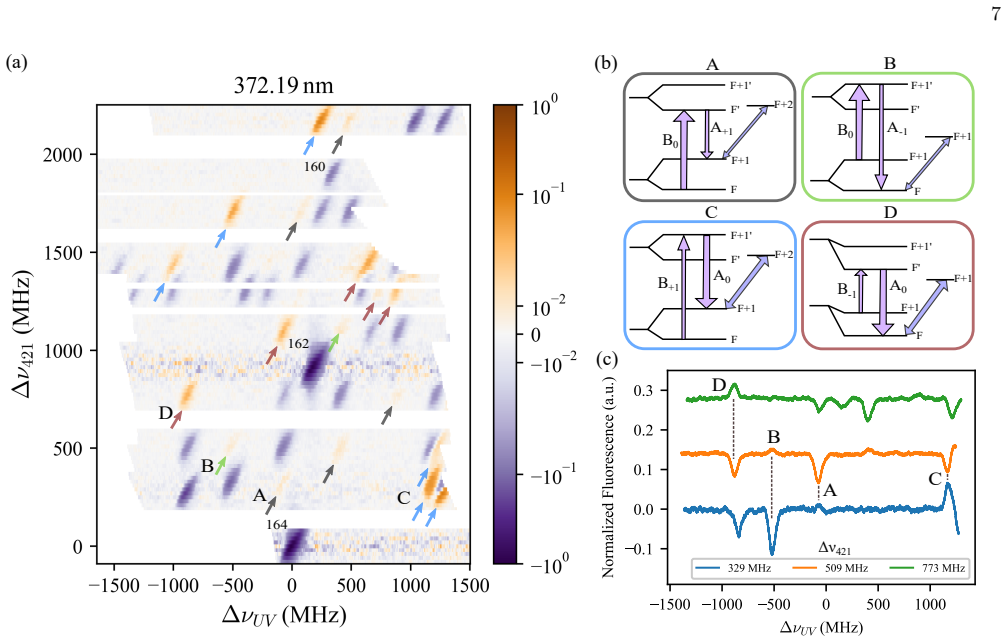
Our shelving technique directly measures the energy or- dering of hyperfine states in the excited state hyperfine manifold. This information is used to deduce J as de- scribed. From the measured transition frequencies of the dominant shelving resonances, the three excited hyper- fine states in the considered triplet monotonically in- crease in energy withF ′
-
[52]
J. J. Curry, E. A. D. Hartog, and J. E. Lawler, J. Opt. Soc. Am. B14, 2788 (1997)
1997
-
[53]
W. H. King, Isotope Shifts in Atomic Spectra, Physics of Atoms and Molecules (Springer Science & Business Media, New York, 2013). Supplementary Material: Two-dimensional shelving spectroscopy of ultraviolet ground state transitions in dysprosium Kevin S. H. Ng,1, ∗ Paul Uerlings,1 Fiona Hellstern,1 Jens Hertkorn,1, 2 Luis Weiß,1 Stephan Welte,1 Tilman Pfa...
2013
-
[54]
Physikalisches Institut and Center for Integrated Quantum Science and Technology, Universität Stuttgart, Pfaffenwaldring 57, 70569 Stuttgart, Germany 2Department of Physics, MIT-Harvard Center for Ultracold Atoms, and Research Laboratory of Electronics, MIT, Cambridge, Massachusetts 02139, USA UV TRANSITIONS Table S1 shows the electric-dipole allowed UV g...
-
[55]
We note that this error is not Gaussian-distributed. However, as the overall con- tribution of this error source is small and overestimated, the total error shown in Table IV which is obtained by simply adding the error sources in quadrature is also con- servative. C. Wavemeter accuracy Using the High Finesse wavemeter WS/8-2 approxi- mately 22 nmaway fro...
discussion (0)
Sign in with ORCID, Apple, or X to comment. Anyone can read and Pith papers without signing in.