Recognition: unknown
The Roberge-Weiss transition as a probe for conformality in many-flavor QCD
Pith reviewed 2026-05-10 17:13 UTC · model grok-4.3
The pith
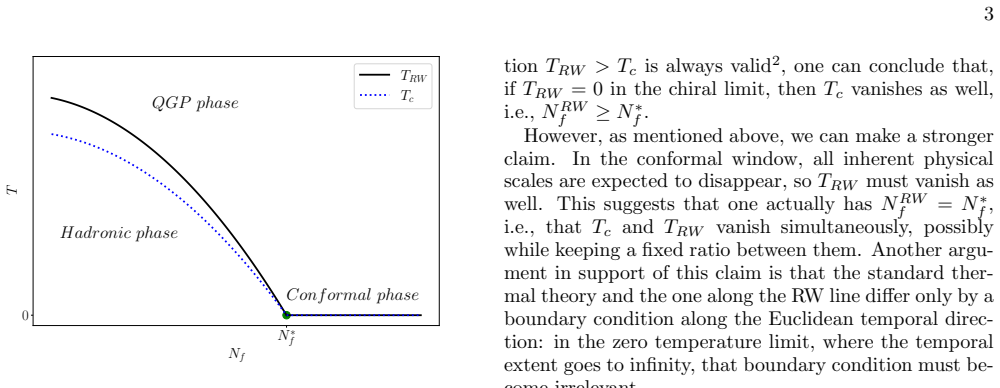
The Roberge-Weiss transition temperature vanishes in the chiral limit for eight-flavor QCD, marking the onset of the conformal window.
A machine-rendered reading of the paper's core claim, the machinery that carries it, and where it could break.
Core claim
The paper claims that the critical number of flavors where the Roberge-Weiss transition temperature vanishes in the chiral limit coincides with the lower edge of the conformal window. For N_f=8 the simulations show that T_RW already reaches zero after extrapolation to vanishing quark mass, placing eight-flavor QCD inside the conformal window.
What carries the argument
The Roberge-Weiss transition temperature T_RW at imaginary baryon chemical potential, which marks the spontaneous breaking of charge conjugation and remains a genuine phase transition for any quark mass, serving as the indicator that disappears at the conformal boundary.
If this is right
- Eight-flavor QCD is conformal in the chiral limit.
- The lower edge of the conformal window lies at or below eight flavors.
- The Roberge-Weiss temperature supplies a well-defined, mass-independent probe that works for any number of flavors.
- The method can be applied to neighboring flavor counts to map the window boundary more precisely.
Where Pith is reading between the lines
- Checking N_f=7 or N_f=9 with the same observable would tighten the location of the boundary.
- The probe could be applied to theories with fermions in other representations to test conformality there as well.
- If the coincidence holds, studies of chiral symmetry breaking or the coupling running in N_f=8 should be consistent with conformal rather than walking behavior.
Load-bearing premise
The vanishing of T_RW in the chiral limit exactly coincides with the onset of conformality and that the finite-N_t extrapolations to the continuum are reliable without large uncontrolled systematics.
What would settle it
A continuum extrapolation yielding a finite positive T_RW as the quark mass approaches zero for N_f=8 would show that the theory remains outside the conformal window.
Figures




read the original abstract
We consider the problem of identifying the onset of the conformal window for QCD with $N_f$ massless flavors in the fundamental representation, and propose a new effective method to determine it from lattice simulations. This method is based on the investigation of the so-called Roberge-Weiss transition temperature $T_{RW}$, which is encountered at specific values of the imaginary baryon chemical potential, and can also be interpreted as the inverse of the critical spatial size at which charge conjugation is spontaneously broken in a finite box. Since $T_{RW}$ corresponds to a genuine phase transition for any value of the quark masses, it is a well-defined quantity; we argue that the critical $N_f$ at which $T_{RW}$ vanishes in the chiral limit coincides with the onset of the conformal window. We implement our proposal by investigating QCD with $N_f = 8$ flavors, discretized via stout improved staggered fermions and the tree-level improved Symanzik pure gauge action, at Euclidean temporal extents $N_t = 8, 10, 12, 16, 24$. In this case, we find evidence that $T_{RW}$ already vanishes in the chiral limit, indicating that $N_f = 8$ is already in the conformal window.
Editorial analysis
A structured set of objections, weighed in public.
Referee Report
Summary. The manuscript proposes using the Roberge-Weiss transition temperature T_RW (at imaginary baryon chemical potential) as a new probe for the onset of the conformal window in many-flavor QCD. The authors argue that the critical N_f at which T_RW vanishes in the chiral limit coincides with the start of the conformal window. For N_f=8, they perform lattice simulations with stout-improved staggered fermions and tree-level Symanzik gauge action at N_t=8,10,12,16,24 and report evidence that T_RW already vanishes in the chiral limit, indicating that N_f=8 lies inside the conformal window.
Significance. If the proposed link between vanishing T_RW in the chiral limit and the conformal boundary holds, and if the N_f=8 evidence can be strengthened, the method would provide a useful new lattice tool for mapping the conformal window, a longstanding challenge in many-flavor QCD. The approach is grounded in a genuine phase transition that exists for any quark mass and relies on direct Monte Carlo measurements rather than fitted parameters. The use of improved actions is a positive technical choice.
major comments (2)
- [Abstract and numerical results for N_f=8] Abstract and numerical results for N_f=8: the central claim that T_RW vanishes in the chiral limit (implying N_f=8 is conformal) is based on simulations at N_t=8–24, yet the manuscript provides no details on the chiral extrapolation procedure, error budgets, finite-volume checks, or how taste-breaking effects are controlled. This leaves the evidence for a vanishing T_RW only weakly supported and makes the conclusion that N_f=8 is already in the conformal window difficult to assess.
- [Proposal section] Proposal section: the identification of the N_f where T_RW vanishes with the conformal window onset is presented as an argument rather than a derived result. Since the numerical evidence for N_f=8 carries the full weight, the lack of demonstrated control over continuum and chiral extrapolations (including possible O(a^2) or taste artifacts that grow with N_f) is load-bearing for the claim.
Simulated Author's Rebuttal
We thank the referee for the careful reading of our manuscript and the constructive comments. We address the major points below and have revised the manuscript to provide additional details and clarifications where needed.
read point-by-point responses
-
Referee: Abstract and numerical results for N_f=8: the central claim that T_RW vanishes in the chiral limit (implying N_f=8 is conformal) is based on simulations at N_t=8–24, yet the manuscript provides no details on the chiral extrapolation procedure, error budgets, finite-volume checks, or how taste-breaking effects are controlled. This leaves the evidence for a vanishing T_RW only weakly supported and makes the conclusion that N_f=8 is already in the conformal window difficult to assess.
Authors: We agree that the original manuscript would benefit from expanded discussion of these analysis aspects. In the revised version we have added a dedicated subsection on the chiral extrapolation, specifying the functional forms (linear and quadratic in m_q) employed, the fit ranges, and the resulting systematic error estimates obtained via bootstrap resampling. Finite-volume checks are now included by comparing results at two spatial volumes (L=16 and L=24) for selected N_t values, showing consistency within statistical errors. Taste-breaking effects are addressed through the stout smearing parameter and by noting that the observed scaling with N_t is consistent across the range 8–24; we have added a brief discussion of possible residual artifacts. These revisions strengthen the support for the vanishing of T_RW in the chiral limit. revision: yes
-
Referee: Proposal section: the identification of the N_f where T_RW vanishes with the conformal window onset is presented as an argument rather than a derived result. Since the numerical evidence for N_f=8 carries the full weight, the lack of demonstrated control over continuum and chiral extrapolations (including possible O(a^2) or taste artifacts that grow with N_f) is load-bearing for the claim.
Authors: The proposed correspondence between the vanishing of T_RW in the chiral limit and the lower edge of the conformal window follows from the absence of a mass gap and spontaneous symmetry breaking in the conformal regime, which precludes a finite-temperature transition; we have expanded the proposal section to articulate this reasoning more explicitly as a physically motivated conjecture rather than a strict derivation. For the N_f=8 data, the multi-N_t simulations already provide a partial continuum check, and the added analysis details (as described above) address the chiral extrapolation and taste-breaking control. While a full O(a^2) continuum extrapolation at multiple N_f would require substantial additional resources and is beyond the present scope, the consistency of the signal across N_t=8–24 supports the conclusion that N_f=8 lies inside the conformal window. We note that taste artifacts are expected to be milder with stout improvement and do not alter the qualitative vanishing trend. revision: partial
Circularity Check
No significant circularity; proposal is physically motivated and results follow from direct lattice simulations.
full rationale
The paper proposes that T_RW vanishing in the chiral limit coincides with the conformal window onset, presented as an argument rather than a self-referential definition or derivation. Numerical evidence for N_f=8 comes from Monte Carlo simulations with stout-staggered fermions at multiple N_t, followed by chiral extrapolations, without any fitted parameter being renamed as a prediction or any load-bearing self-citation. No step reduces by construction to its inputs; the chain is self-contained with independent content from the simulations.
Axiom & Free-Parameter Ledger
axioms (2)
- domain assumption The Roberge-Weiss transition is a genuine phase transition for any value of the quark masses.
- domain assumption Stout-improved staggered fermions with tree-level Symanzik gauge action on the listed N_t values suffice to control discretization effects for N_f=8.
Reference graph
Works this paper leans on
-
[1]
The Roberge-Weiss transition as a probe for conformality in many-flavor QCD
INTRODUCTION It has long been suggested that QCD withN f light flavors in the fundamental representation develops an in- frared fixed point whenN f exceeds a critical valueN ∗ f but is still below the threshold at which asymptotic free- dom is lost. In this regime, the theory is expected to become conformal, with the absence of dynamical mass generation, ...
work page internal anchor Pith review Pith/arXiv arXiv 2026
-
[2]
THE R W TRANSITION AND ITS CONNECTION TO CONFORMALITY The Roberge-Weiss symmetry and its spontaneous breaking are closely related to the center symmetry, which characterizesSU(N c) pure gauge theories. In the lattice theory with periodic boundary conditions in the Euclidean temporal direction, a center transformation is defined as the multiplication of al...
-
[3]
NUMERICAL SET-UP We study the lattice formulation of eight-flavor QCD, using the tree-level improved Symanzik pure gauge ac- tion [104, 105] and the stout improved rooted staggered fermion action [106, 107]. The partition function is Z= Z [DU]e −SY M det (M8 st) 1 4 ,(1) where [DU] is the Haar measure over the gauge links, while the staggered fermion matr...
2000
-
[4]
TheN s/Nt ratio is kept between 2 and 3, the bare quark mass ˆmis varied in the range 0.0025–0.08, while the quark chemical poten- tial is set to ˆµ=iθ q =iπ
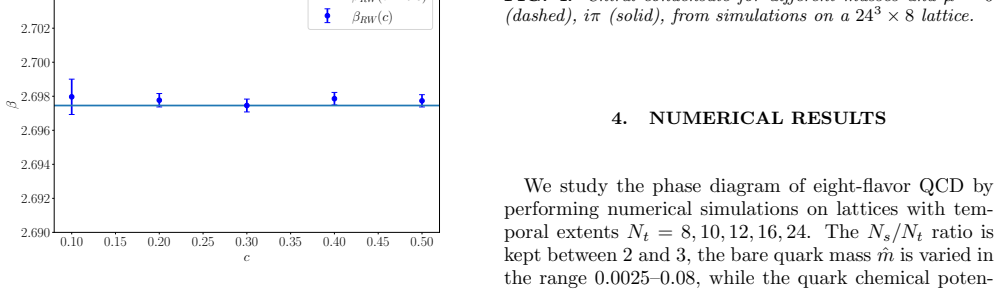
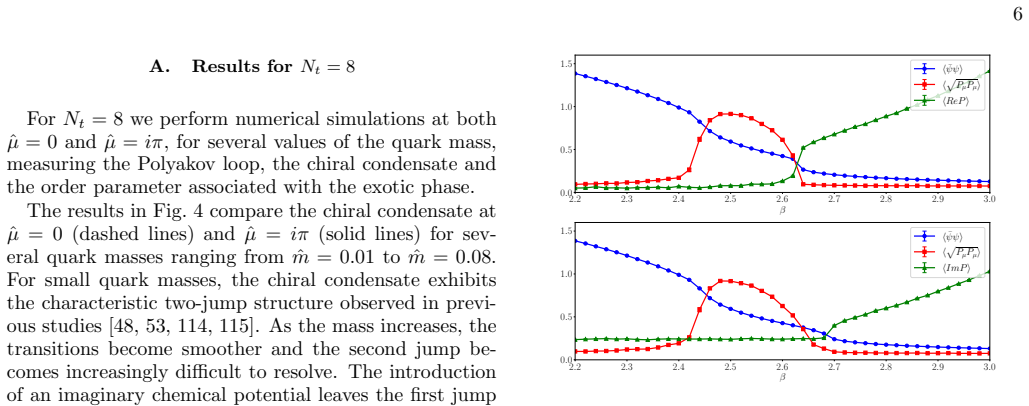
NUMERICAL RESUL TS We study the phase diagram of eight-flavor QCD by performing numerical simulations on lattices with tem- poral extentsN t = 8,10,12,16,24. TheN s/Nt ratio is kept between 2 and 3, the bare quark mass ˆmis varied in the range 0.0025–0.08, while the quark chemical poten- tial is set to ˆµ=iθ q =iπ. We simultaneously measure two observable...
-
[5]
DISCUSSION AND BARE QUARK MASS EXTRAPOLA TION Let us summarize and discuss our results. We have ex- plored the space of the bare lattice parameters,βand ˆm, for different values of the Euclidean temporal extentN t, determining for eachN t and for various values of ˆmthe critical couplings at which the RW and bulk transitions occur, denoted byβ RW ( ˆm, Nt...
-
[6]
CONCLUSIONS In this study, we have considered the problem of identi- fying the onset of the conformal window in QCD withN f chiral flavors in the fundamental representation, propos- ing the investigation of the Roberge-Weiss transition as an effective method to approach such problem by lat- tice QCD simulations. The idea of studying the thermal transition...
-
[7]
Non-perturbative as- pects of fundamental interactions, in the Standard Model and beyond
Moreover, the advantage of dealing with a real phase transition for all values of the quark mass has not been fully exploited, since we have not performed a finite size scaling (FSS) analysis to achieve a precise determination of the critical couplings in the thermodynamical limit. In this respect, future investigations should consider larger 11 volumes, ...
2022
-
[8]
W. E. Caswell, Asymptotic Behavior of Non-Abelian Gauge Theories to Two-Loop Order, Physical Review Letters33, 244 (1974)
1974
-
[9]
Banks and A
T. Banks and A. Zaks, On the phase structure of vector-like gauge theories with massless fermions, Nu- clear Physics B196, 189 (1982)
1982
-
[10]
V. A. Miransky and K. Yamawaki, Conformal phase transition in gauge theories, Physical Review D55, 5051 (1997)
1997
- [11]
-
[12]
T. Appelquist, J. Terning, and L. C. R. Wijeward- hana, The Zero Temperature Chiral Phase Transition in SU(N) Gauge Theories, Physical Review Letters77, 1214 (1996), arXiv:hep-ph/9602385
-
[13]
Appelquist, A
T. Appelquist, A. Ratnaweera, J. Terning, and L. C. R. Wijewardhana, Phase structure of anSU(N) gauge the- ory withN f flavors, Physical Review D58, 105017 (1998)
1998
- [14]
-
[15]
Holdom, Raising the sideways scale, Physical Review D24, 1441 (1981)
B. Holdom, Raising the sideways scale, Physical Review D24, 1441 (1981)
1981
-
[16]
Yamawaki, M
K. Yamawaki, M. Bando, and K.-i. Matumoto, Scale- Invariant Hypercolor Model and a Dilaton, Physical Re- view Letters56, 1335 (1986)
1986
-
[17]
Appelquist, D
T. Appelquist, D. Karabali, and L. C. R. Wijeward- hana, Chiral Hierarchies and Flavor-Changing Neutral Currents in Hypercolor, Physical Review Letters57, 957 (1986)
1986
-
[18]
Appelquist and L
T. Appelquist and L. C. R. Wijewardhana, Chiral hi- erarchies from slowly running couplings in technicolor theories, Physical Review D36, 568 (1987)
1987
- [19]
-
[20]
T. Appelquist, G. T. Fleming, and E. T. Neil, Lat- tice study of the conformal window in QCD-like the- ories, Phys. Rev. Lett.100, 171607 (2008), [Erratum: Phys.Rev.Lett. 102, 149902 (2009)], arXiv:0712.0609 [hep-ph]
-
[21]
T. Appelquist, G. T. Fleming, and E. T. Neil, Lattice Study of Conformal Behavior in SU(3) Yang-Mills The- ories, Phys. Rev. D79, 076010 (2009), arXiv:0901.3766 [hep-ph]
-
[22]
A. Hasenfratz, Infrared fixed point of the 12-fermion SU(3) gauge model based on 2-lattice MCRG matching, Phys. Rev. Lett.108, 061601 (2012), arXiv:1106.5293 [hep-lat]
- [23]
-
[24]
A. Hasenfratz, D. Schaich, and A. Veernala, Nonper- turbativeβfunction of eight-flavor SU(3) gauge theory, JHEP06, 143, arXiv:1410.5886 [hep-lat]
- [25]
-
[26]
A. Hasenfratz, C. Rebbi, and O. Witzel, Nonpertur- bative determination ofβfunctions for SU(3) gauge theories with 10 and 12 fundamental flavors using do- main wall fermions, Phys. Lett. B798, 134937 (2019), arXiv:1710.11578 [hep-lat]
-
[27]
A. Hasenfratz, C. Rebbi, and O. Witzel, Gradient flow step-scaling function for SU(3) with twelve flavors, Phys. Rev. D100, 114508 (2019), arXiv:1909.05842 [hep-lat]
-
[28]
A. Hasenfratz, C. Rebbi, and O. Witzel, Gradient flow step-scaling function for SU(3) with Nf=8 fun- damental flavors, Phys. Rev. D107, 114508 (2023), arXiv:2210.16760 [hep-lat]
-
[29]
O. Witzel and A. Hasenfratz (Lattice Strong Dynamics), Investigating SU(3) withN f = 8 fundamental fermions at strong renormalized coupling, PoSLA TTICE2024, 146 (2025), arXiv:2412.10322 [hep-lat]
- [30]
- [31]
-
[32]
T. Appelquist, G. T. Fleming, M. F. Lin, E. T. Neil, and D. A. Schaich, Lattice Simulations and In- frared Conformality, Phys. Rev. D84, 054501 (2011), arXiv:1106.2148 [hep-lat]
- [33]
- [34]
- [35]
-
[36]
Aokiet al.(LatKMI), Light composite scalar in eight- flavor QCD on the lattice, Phys
Y. Aokiet al.(LatKMI), Light composite scalar in eight- flavor QCD on the lattice, Phys. Rev. D89, 111502 (2014), arXiv:1403.5000 [hep-lat]
-
[37]
Y. Aokiet al.(LatKMI), Conformality in twelve- flavor QCD, PoSLA TTICE2014, 256 (2015), arXiv:1501.06660 [hep-lat]
-
[38]
Y. Aoki, T. Aoyama, E. Bennett, M. Kurachi, T. Maskawa, K. Miura, K.-i. Nagai, H. Ohki, E. Rinaldi, A. Shibata, K. Yamawaki, and T. Yamazaki, Light flavor-singlet scalars and walking signals inN f = 8 QCD on the lattice, Physical Review D96, 014508 (2017), arXiv:1610.07011 [hep-lat]
-
[39]
T. Appelquistet al.(LSD), Lattice simulations with eight flavors of domain wall fermions in SU(3) gauge the- ory, Phys. Rev. D90, 114502 (2014), arXiv:1405.4752 [hep-lat]
-
[40]
K.-i. Nagai, Walking signals in eight-flavor QCD on the lattice, inProceedings of KMI International Symposium 2013 on “Quest for the Origin of Particles and the Uni- verse — PoS(KMI2013)(Sissa Medialab, Nagoya Uni- versity, Japan, 2015) p. 005
2013
-
[41]
Appelquistet al., Strongly interacting dynamics and the search for new physics at the LHC, Phys
T. Appelquistet al., Strongly interacting dynamics and the search for new physics at the LHC, Phys. Rev. D 93, 114514 (2016), arXiv:1601.04027 [hep-lat]
-
[42]
T. Appelquistet al.(Lattice Strong Dynamics), Non- perturbative investigations of SU(3) gauge theory with eight dynamical flavors, Phys. Rev. D99, 014509 (2019), arXiv:1807.08411 [hep-lat]
-
[43]
J. Braun and H. Gies, Chiral phase boundary of QCD at finite temperature, JHEP06, 024, arXiv:hep- ph/0602226
-
[44]
K. Miura and M. P. Lombardo, Lattice Monte-Carlo study of pre-conformal dynamics in strongly flavoured QCD in the light of the chiral phase transition at fi- nite temperature, Nuclear Physics B871, 52 (2013), arXiv:1212.0955 [hep-lat]
- [45]
- [46]
- [47]
-
[48]
O. Philipsen, Constraining the phase diagram of QCD at finite temperature and density, PoSLA TTICE2019, 273 (2019), arXiv:1912.04827 [hep-lat]
- [49]
- [50]
- [51]
- [52]
-
[53]
A. Deuzeman, M. P. Lombardo, and E. Pallante, The Physics of eight flavours, PoSLA TTICE2008, 060 (2008), arXiv:0810.1719 [hep-lat]
-
[54]
A. Deuzeman, M. P. Lombardo, and E. Pallante, The Physics of eight flavours, Phys. Lett. B670, 41 (2008), arXiv:0804.2905 [hep-lat]
- [55]
- [56]
- [57]
- [58]
-
[59]
D. Schaich, A. Hasenfratz, and E. Rinaldi (LSD), Finite- temperature study of eight-flavor SU(3) gauge theory, inSakata Memorial KMI Workshop on Origin of Mass and Strong Coupling Gauge Theories(WSP, 2018) pp. 351–354, arXiv:1506.08791 [hep-lat]
- [60]
- [61]
-
[62]
DeGrand, Lattice tests of beyond Standard Model dynamics, Rev
T. DeGrand, Lattice tests of beyond Standard Model dynamics, Rev. Mod. Phys.88, 015001 (2016), arXiv:1510.05018 [hep-ph]
-
[63]
M. Golterman and Y. Shamir, Large-mass regime of the dilaton-pion low-energy effective theory, Phys. Rev. D 98, 056025 (2018), arXiv:1805.00198 [hep-ph]
-
[64]
M. Golterman, E. T. Neil, and Y. Shamir, Applica- tion of dilaton chiral perturbation theory toN f = 8, SU(3) spectral data, Phys. Rev. D102, 034515 (2020), arXiv:2003.00114 [hep-ph]
-
[65]
Roberge and N
A. Roberge and N. Weiss, Gauge Theories With Imagi- nary Chemical Potential and the Phases of QCD, Nucl. Phys. B275, 734 (1986). 13
1986
- [66]
-
[67]
Lombardo, Finite density (might well be easier) at finite temperature, Nucl
M.-P. Lombardo, Finite density (might well be easier) at finite temperature, Nucl. Phys. B Proc. Suppl.83, 375 (2000), arXiv:hep-lat/9908006
-
[68]
P. de Forcrand and O. Philipsen, The QCD phase diagram for small densities from imaginary chemical potential, Nucl. Phys. B642, 290 (2002), arXiv:hep- lat/0205016
-
[69]
M. D’Elia and M.-P. Lombardo, Finite density QCD via imaginary chemical potential, Phys. Rev. D67, 014505 (2003), arXiv:hep-lat/0209146
-
[70]
P. de Forcrand and O. Philipsen, The QCD phase di- agram for three degenerate flavors and small baryon density, Nucl. Phys. B673, 170 (2003), arXiv:hep- lat/0307020
-
[71]
M. D’Elia and M. P. Lombardo, QCD thermodynamics from an imaginary mu(B): Results on the four flavor lat- tice model, Phys. Rev. D70, 074509 (2004), arXiv:hep- lat/0406012
-
[72]
P. Giudice and A. Papa, Real and imaginary chemical potential in two color QCD, Phys. Rev. D69, 094509 (2004), arXiv:hep-lat/0401024
-
[73]
H.-S. Chen and X.-Q. Luo, Phase diagram of QCD at finite temperature and chemical potential from lattice simulations with dynamical Wilson quarks, Phys. Rev. D72, 034504 (2005), arXiv:hep-lat/0411023
-
[74]
V. Azcoiti, G. Di Carlo, A. Galante, and V. Laliena, Phase diagram of QCD with four quark flavors at finite temperature and baryon density, Nucl. Phys. B723, 77 (2005), arXiv:hep-lat/0503010
- [75]
-
[76]
M. D’Elia and F. Sanfilippo, The Order of the Roberge- Weiss endpoint (finite size transition) in QCD, Phys. Rev. D80, 111501 (2009), arXiv:0909.0254 [hep-lat]
- [77]
-
[78]
P. de Forcrand and O. Philipsen, Constraining the QCD phase diagram by tricritical lines at imaginary chem- ical potential, Phys. Rev. Lett.105, 152001 (2010), arXiv:1004.3144 [hep-lat]
- [79]
- [80]
discussion (0)
Sign in with ORCID, Apple, or X to comment. Anyone can read and Pith papers without signing in.