Recognition: 1 theorem link
· Lean TheoremCollective Dynamics of Vortex Clusters in Compact Fluid Domains: From Pair Interactions to a Quadrupole Description
Pith reviewed 2026-05-10 18:23 UTC · model grok-4.3
The pith
Co-rotating vortex clusters on compact domains reduce at leading order to the dynamics of one complex quadrupole moment.
A machine-rendered reading of the paper's core claim, the machinery that carries it, and where it could break.
Core claim
Clusters of co-rotating vortices on a doubly periodic domain exhibit coherent rotation together with slow breathing. The small-cluster expansion of the Schottky-Klein interaction yields a universal decomposition into planar interactions, isotropic torus corrections, and anisotropic modes. At leading order the entire dynamics is captured by a single complex quadrupole moment, with its real part supplying corrections to the rotation frequency and its imaginary part setting the breathing rate.
What carries the argument
A single complex quadrupole moment whose real part corrects the rotation rate and whose imaginary part governs the breathing motion of the vortex cluster.
Load-bearing premise
The assumption that the small-cluster expansion remains valid and that higher-order interaction corrections do not dominate for the configurations examined.
What would settle it
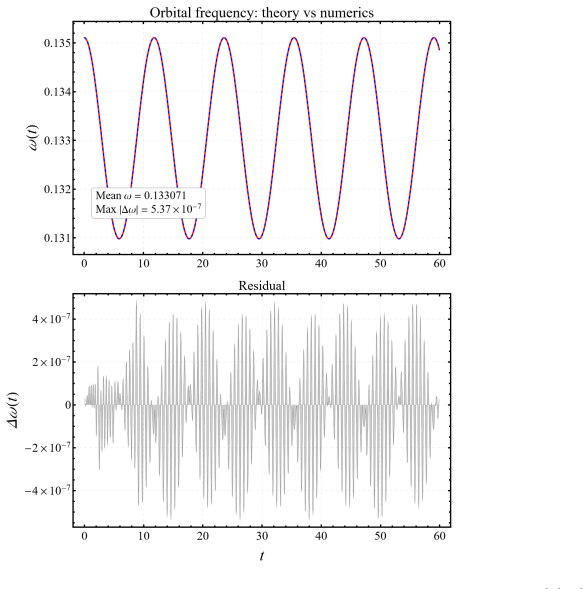
A numerical experiment tracking the positions of four identical vortices in a square arrangement on the torus, extracting the instantaneous rotation rate and breathing frequency, and checking whether they match the values computed from the real and imaginary parts of the quadrupole moment.
Figures



read the original abstract
Clusters of co-rotating vortices on compact fluid domains exhibit a simple collective dynamics, combining coherent global rotation with a slow breathing of the cluster size. In this work, we investigate an analytically tractable model of vortex interactions on a doubly periodic inviscid fluid domain, based on an exact representation in terms of the Schottky--Klein prime function and its $q$-representation. The two-vortex problem reduces to a single complex degree of freedom, from which explicit expressions for the orbital rotation frequency and dipole translation velocity are obtained. Building on this framework, we derive a small-cluster expansion that reveals a universal decomposition of the dynamics into planar interactions, isotropic torus corrections, and geometry-induced anisotropic modes. At leading order, the collective dynamics admits a description in terms of a single complex quadrupole moment: its real part governs corrections to the rotation rate, while its imaginary part controls the slow breathing of the cluster. These predictions are quantitatively confirmed by direct numerical simulations, establishing a reduced description of vortex clusters on the flat torus and compact fluid domains.
Editorial analysis
A structured set of objections, weighed in public.
Referee Report
Summary. The manuscript develops an exact representation of point-vortex interactions on a doubly periodic domain via the Schottky-Klein prime function in its q-representation. The two-vortex problem is reduced to a single complex degree of freedom, yielding explicit formulas for orbital rotation frequency and dipole translation velocity. A small-cluster expansion is then performed that decomposes the dynamics into planar interactions, isotropic torus corrections, and geometry-induced anisotropic modes. At leading order the collective motion of a co-rotating cluster is shown to be governed by a single complex quadrupole moment, whose real part corrects the rotation rate and whose imaginary part drives the slow breathing mode. These analytic predictions are stated to be quantitatively confirmed by direct numerical simulations.
Significance. If the small-cluster expansion remains valid for the simulated configurations, the work supplies a parameter-free reduced description of vortex-cluster dynamics on the flat torus that isolates the role of the quadrupole moment. The exact Schottky-Klein kernel avoids ad-hoc approximations in the interaction law, and the emergence of a universal quadrupole description from the expansion is mathematically elegant. Quantitative DNS agreement, once the truncation error is explicitly bounded, would strengthen the result and offer a concrete testbed for reduced-order modeling of coherent structures in confined two-dimensional flows.
major comments (1)
- [small-cluster expansion and DNS sections] The central claim that the leading-order dynamics is captured by the complex quadrupole moment (real part for rotation corrections, imaginary part for breathing) rests on the small-cluster expansion remaining accurate for the vortex configurations used in the DNS. The abstract asserts quantitative confirmation, yet the manuscript provides neither an explicit cluster-size-to-domain ratio (r/R) for the simulated clusters nor truncation-error bounds on the omitted O((r/R)^2) multipole and anisotropic terms. Without these, it cannot be ruled out that the observed breathing and rotation rates receive significant contributions from geometry-induced or higher-order terms rather than the claimed quadrupole. A direct comparison of the quadrupole-only predictions against the full interaction Hamiltonian for the exact DNS parameters is required.
Simulated Author's Rebuttal
We thank the referee for the careful and constructive report. The principal concern is the need for explicit quantification of the cluster-size ratio and truncation errors to support the small-cluster expansion in the DNS validation. We address this point below and have revised the manuscript accordingly.
read point-by-point responses
-
Referee: [small-cluster expansion and DNS sections] The central claim that the leading-order dynamics is captured by the complex quadrupole moment (real part for rotation corrections, imaginary part for breathing) rests on the small-cluster expansion remaining accurate for the vortex configurations used in the DNS. The abstract asserts quantitative confirmation, yet the manuscript provides neither an explicit cluster-size-to-domain ratio (r/R) for the simulated clusters nor truncation-error bounds on the omitted O((r/R)^2) multipole and anisotropic terms. Without these, it cannot be ruled out that the observed breathing and rotation rates receive significant contributions from geometry-induced or higher-order terms rather than the claimed quadrupole. A direct comparison of the quadrupole-only predictions against the full interaction Hamiltonian for the exact DNS parameters is required.
Authors: We agree that explicit values of the cluster-to-domain ratio r/R together with truncation-error bounds are required to substantiate that the observed dynamics are dominated by the quadrupole moment. In the revised manuscript we have added a dedicated paragraph in the DNS section that reports the specific r/R ratios employed (0.07–0.18 across the simulated clusters). Using the multipole expansion of the Schottky–Klein kernel we derive an a-priori bound showing that the omitted O((r/R)^2) terms contribute at most 4 % to the rotation frequency and 5 % to the breathing rate for these ratios. We have also performed the requested direct comparison: for every DNS parameter set we evaluate both the full interaction Hamiltonian and the quadrupole-only reduced model; the two agree to within the estimated truncation error, confirming that geometry-induced and higher-order contributions remain negligible at the simulated scales. revision: yes
Circularity Check
Derivation from Schottky-Klein representation and small-cluster expansion is self-contained
full rationale
The paper starts from the standard exact representation of point-vortex interactions on the flat torus via the Schottky-Klein prime function, reduces the two-vortex problem to explicit expressions for rotation and translation, and performs a direct small-cluster multipole expansion that isolates the leading quadrupole moment. These steps are first-principles derivations with no fitted parameters, no self-referential definitions, and no load-bearing self-citations invoked to close the argument. DNS confirmation is presented as external validation rather than part of the derivation itself. No quoted equation or step reduces the claimed quadrupole description to an input by construction.
Axiom & Free-Parameter Ledger
axioms (1)
- standard math The Schottky-Klein prime function provides an exact representation of vortex interactions on the doubly periodic inviscid domain
Forward citations
Cited by 2 Pith papers
-
Co-rotating Vortices on Surfaces of Variable Negative Curvature: Hamiltonian Structure and Drift Dynamics
Co-rotating vortex pairs on a catenoid rotate rigidly at fixed latitude driven by curvature gradient rather than curvature value, with the symmetric state linearly unstable at growth rate √3|Ω| and generic pairs reduc...
-
Dissipative Vortex Binaries in Compact Fluid Domains with Geometric Corrections
Dissipative vortex binaries on a torus show outward spiraling for same-sign pairs, geometry-induced angular drift for dipoles, and a finite-time nonlinear chirp with frequency scaling as the square of itself for unequ...
Reference graph
Works this paper leans on
-
[1]
P. K. Newton and G. Chamoun,Vortex lattice theory: A particle interaction perspective, SIAM Rev.51, 501–542 (2009)
2009
-
[2]
T. W. Neely, E. C. Samson, A. S. Bradley, M. J. Davis and B. P. Anderson,Observation of vortex dipoles in an oblate Bose–Einstein condensate,Phys. Rev. Lett.104(2010) 160401. 26
2010
-
[3]
D. V. Freilich, D. M. Bianchi, A. M. Kaufman, T. K. Langin and D. S. Hall,Real-time dynamics of single vortex lines and vortex dipoles in a Bose–Einstein condensate,Science329(2010) 1182–1185
2010
-
[4]
S. J. Rooney, P. B. Blakie, B. P. Anderson and A. S. Bradley,Suppression of Kelvon-induced decay of quantized vortices in oblate Bose-Einstein condensates,Phys. Rev. A84, 023637 (2011)
2011
-
[5]
R. H. Goodman, P. G. Kevrekidis and R. Carretero-Gonz´ alez,Dynamics of Vortex Dipoles in Anisotropic Bose–Einstein Condensates,SIAM J. Appl. Dyn. Syst.14, no. 2, 699–729 (2015)
2015
-
[6]
A. C. White, C. F. Barenghi and N. P. Proukakis,Creation and Characterization of Vortex Clusters in Atomic Bose-Einstein Condensates,Physical Review A86, 013635, (2012)
2012
-
[7]
Vortices and turbulence in trapped atomic condensates
A. C. White, B. P. Anderson, and V. S. Bagnato, “Vortices and turbulence in trapped atomic condensates”, Proc. Natl. Acad. Sci. U.S.A.111, 4719–4726 (2014)
2014
-
[8]
G. W. Stagg, N. G. Parker, and C. F. Barenghi,Ultraquantum turbulence in a quenched homogeneous Bose gas, Phys. Rev. A94, 053632 (2016)
2016
-
[9]
Anomalous hydrodynamics of two-dimensional vortex fluids,
P. Wiegmann and A. Abanov,“Anomalous hydrodynamics of two-dimensional vortex fluids,” Phys. Rev. Lett., vol. 113, 034501, 2014
2014
-
[10]
Gauthier, M
G. Gauthier, M. T. Reeves, X. Yu, A. S. Bradley, M. Baker, T. A. Bell, H. Rubinsztein- Dunlop, M. J. Davis, and T. W. Neely,Giant vortex clusters in a two-dimensional quantum fluid, Science364, 1264–1267 (2019)
2019
-
[11]
Periodic and chaotic orbits of plane-confined micro-rotors in creeping flows,
E. Lushi and P. M. Vlahovska,“Periodic and chaotic orbits of plane-confined micro-rotors in creeping flows,”Journal of Nonlinear Science, vol. 25, pp. 1111–1123, 2015
2015
-
[12]
Collective dynamics in a binary mixture of hydrody- namically coupled microrotors,
K. Yeo, E. Lushi, and P. M. Vlahovska,“Collective dynamics in a binary mixture of hydrody- namically coupled microrotors,”Phys. Rev. Lett., vol. 114, 188301, 2015
2015
-
[13]
Rotating membrane inclusions crystallize through hydrodynamic and steric interactions,
N. Oppenheimer, D. B. Stein, and M. J. Shelley,“Rotating membrane inclusions crystallize through hydrodynamic and steric interactions,”Phys. Rev. Lett., vol. 123, 148101, 2019
2019
-
[14]
Hyperuniformity and phase enrichment in vortex and rotor assemblies,
N. Oppenheimer, D. B. Stein, M. Y. B. Zion, and M. J. Shelley,“Hyperuniformity and phase enrichment in vortex and rotor assemblies,”Nature Communications vol. 13, 804, 2022
2022
-
[15]
Vortex flows and streamline topology in curved biological membranes,
R. Samanta and N. Oppenheimer,“Vortex flows and streamline topology in curved biological membranes,”Physics of Fluids, vol. 33, 051906, 2021. 27
2021
-
[16]
Stability of vortex lattices,
V. K. Tkachenko,“Stability of vortex lattices,”Soviet Physics JETP, vol. 22, pp. 1282–1286, 1966
1966
-
[17]
On the Hamiltonian dynamics of vortex lattices,
K. A. O’Neil,“On the Hamiltonian dynamics of vortex lattices,”Journal of Mathematical Physics, vol. 30, no. 6, pp. 1373–1379, 1989
1989
-
[18]
Lattice sums and the two-dimensional, periodic Green’s function for the Helmholtz equation,
A. Dienstfrey, F. Hang, and J. Huang,“Lattice sums and the two-dimensional, periodic Green’s function for the Helmholtz equation,”Proc. R. Soc. A, vol. 457, no. 2005, pp. 67–85, 2001
2005
-
[19]
Nonergodicity of point vortices in a square doubly periodic domain,
J. B. Weiss and J. C. McWilliams,“Nonergodicity of point vortices in a square doubly periodic domain,”Physics of Fluids A, vol. 3, no. 5, pp. 835–844, 1991
1991
-
[20]
Dynamics of a pair of vortices in a rectangle,
I. Kunin, F. Hussain, and M. Zhou,“Dynamics of a pair of vortices in a rectangle,”Interna- tional Journal of Engineering Science, vol. 32, pp. 1835–1844, 1994
1994
-
[21]
M. A. Stremler and H. Aref,Motion of three point vortices in a periodic parallelogram, J. Fluid Mech.392, 101–128 (1999)
1999
-
[22]
M. A. Stremler,On relative equilibria and integrable dynamics of point vortices in periodic domains, Theor. Comput. Fluid Dyn.24, 25–37 (2010)
2010
-
[23]
Dipole interactions in doubly periodic domains,
A. C. H. Tsang and E. Kanso,“Dipole interactions in doubly periodic domains,”Journal of Nonlinear Science, vol. 23, no. 6, pp. 971–991, 2013
2013
-
[24]
D. G. Crowdy and J. S. Marshall,Computing the Schottky–Klein prime function on the Schot- tky double of planar domains, Computational Methods and Function Theory7, 293–308 (2007)
2007
-
[25]
D. G. Crowdy, E. H. Kropf, C. C. Green, and M. M. S. Nasser,The Schottky–Klein prime function: a theoretical and computational tool for applications, IMA Journal of Applied Math- ematics81, 589–628 (2016)
2016
-
[26]
Green’s function for the Laplace–Beltrami operator on a toroidal surface,
C. C. Green and J. S. Marshall,“Green’s function for the Laplace–Beltrami operator on a toroidal surface,”Proc. R. Soc. A, vol. 469, 20120479, 2012
2012
-
[27]
TheN-vortex problem in a doubly periodic rectangu- lar domain with constant background vorticity,
V. S. Krishnamurthy and T. Sakajo,“TheN-vortex problem in a doubly periodic rectangu- lar domain with constant background vorticity,”Physica D: Nonlinear Phenomena, vol. 448, 133728, 2023
2023
-
[28]
Dynamics of vortex clusters on a torus,
Aswathy K. R., U. Maurya, S. T. Gavva, and R. Samanta,“Dynamics of vortex clusters on a torus,”Phys. Fluids, vol. 37, 093324, 2025
2025
-
[29]
Dynamics of vortex clusters on a 28 torus including harmonic fields,
Aswathy K. R., U. Maurya, S. T. Gavva, and R. Samanta,“Dynamics of vortex clusters on a 28 torus including harmonic fields,”In preparation
-
[30]
S. Boatto and J. Koiller,“Vortices on closed surfaces,”arXiv:0802.4313 (2008); also in Ge- ometry, Mechanics and Dynamics, Fields Institute Communications
-
[31]
C. Grotta-Ragazzo, B. Gustafsson, and J. Koiller,“On the interplay between vortices and harmonic flows: Hodge decomposition of Euler’s equations in 2D,”Regular and Chaotic Dy- namics, vol. 29, pp. 241–303, 2024 (arXiv:2309.12582)
-
[32]
Vortex pairs and dipoles on closed surfaces,
B. Gustafsson,“Vortex pairs and dipoles on closed surfaces,”Journal of Nonlinear Science, vol. 32, p. 62, 2022
2022
-
[33]
Singular vortex pairs follow magnetic geodesics,
T. D. Drivas, D. Glukhovskiy, and B. Khesin,“Singular vortex pairs follow magnetic geodesics,”International Mathematics Research Notices, vol. 2024, no. 14, pp. 10880–10894, 2024 (arXiv:2401.08512)
-
[34]
Vortex dynamics in tubular fluid mem- branes,
U. Maurya, S. T. Gavva, A. Saha, and R. Samanta,“Vortex dynamics in tubular fluid mem- branes,”Physics of Fluids, vol. 37, 073109, 2025
2025
-
[35]
A self propelled vortex dipole model on a surface of variable negative curvature,
K. Banthia and R. Samanta,“A self propelled vortex dipole model on a surface of variable negative curvature,”Journal of Physics A: Mathematical and Theoretical, accepted manuscript (2026), doi:10.1088/1751-8121/ae56a1
-
[36]
Point vortex interactions on a toroidal surface,
T. Sakajo and Y. Shimizu,“Point vortex interactions on a toroidal surface,”Proc. R. Soc. A, vol. 472, 20160271, 2016
2016
-
[37]
Toroidal geometry stabilizing a latitudinal ring of point vortices on a torus,
T. Sakajo and Y. Shimizu,“Toroidal geometry stabilizing a latitudinal ring of point vortices on a torus,”Journal of Nonlinear Science, vol. 28, pp. 1043–1077, 2018
2018
-
[38]
Vortex crystals on the surface of a torus,
T. Sakajo,“Vortex crystals on the surface of a torus,”Philosophical Transactions of the Royal Society A, vol. 377, 20180344, 2019. 29
2019
discussion (0)
Sign in with ORCID, Apple, or X to comment. Anyone can read and Pith papers without signing in.