Recognition: no theorem link
DSPR: Dual-Stream Physics-Residual Networks for Trustworthy Industrial Time Series Forecasting
Pith reviewed 2026-05-10 18:09 UTC · model grok-4.3
The pith
DSPR decouples stable temporal patterns from regime-dependent residual dynamics to forecast industrial time series with high accuracy and physical consistency.
A machine-rendered reading of the paper's core claim, the machinery that carries it, and where it could break.
Core claim
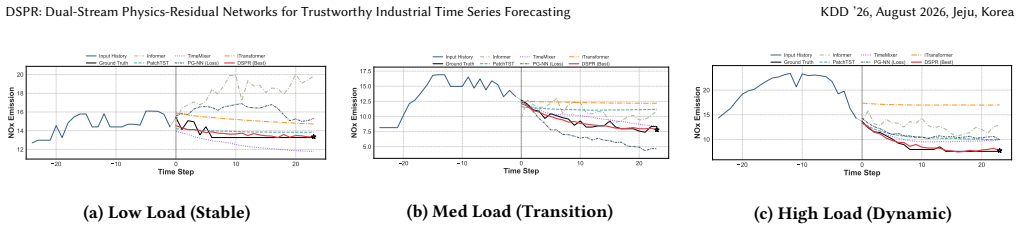
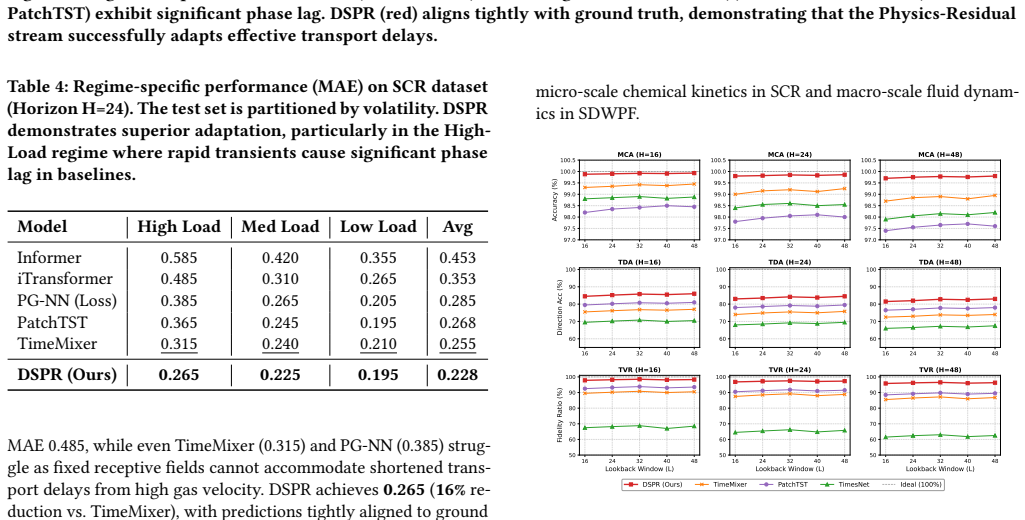
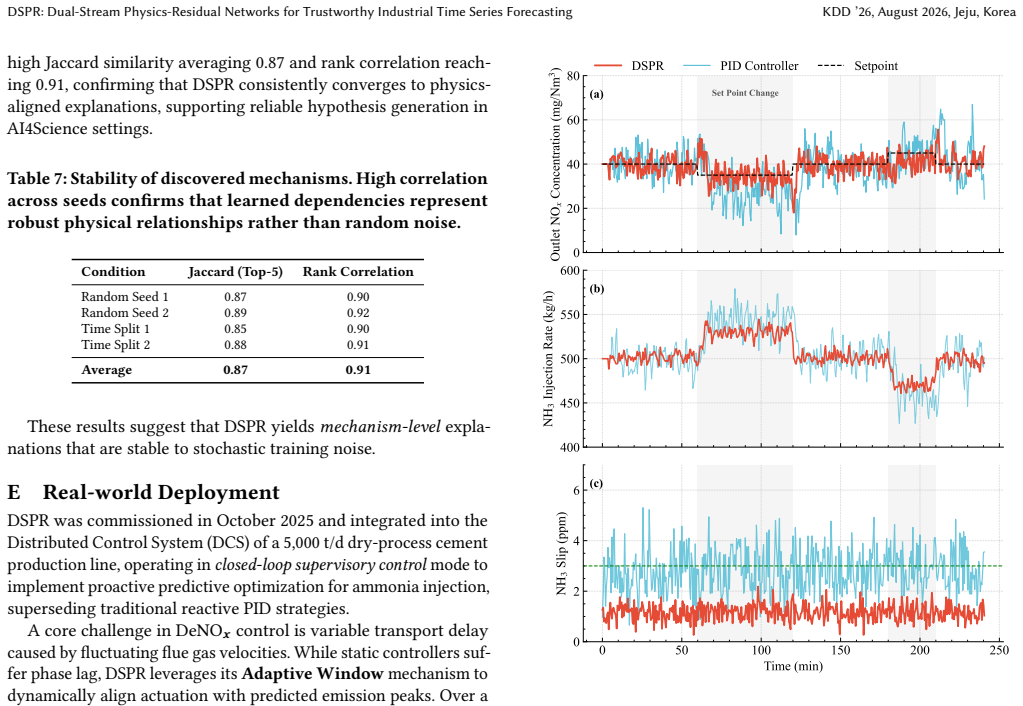
DSPR decouples stable temporal patterns from regime-dependent residual dynamics. The first stream models the statistical temporal evolution of individual variables. The second stream focuses on residual dynamics through two key mechanisms: an Adaptive Window module that estimates flow-dependent transport delays, and a Physics-Guided Dynamic Graph that incorporates physical priors to learn time-varying interaction structures while suppressing spurious correlations. Experiments on four industrial benchmarks spanning heterogeneous regimes demonstrate that DSPR consistently improves forecasting accuracy and robustness under regime shifts while maintaining strong physical plausibility, with Mean
What carries the argument
Dual-stream architecture in which a statistical stream captures fixed temporal evolution while a residual stream combines an Adaptive Window for flow-dependent delays with a Physics-Guided Dynamic Graph for regime-dependent interactions.
If this is right
- Forecasting accuracy and robustness both rise across heterogeneous industrial regimes with regime shifts.
- Physical plausibility is preserved at mean conservation accuracy above 99 percent and total variation ratio up to 97.2 percent.
- Learned interaction structures and adaptive lags match known domain mechanisms such as flow-dependent transport delays.
- The approach supports trustworthy long-term deployment in autonomous control systems by keeping predictions physically consistent.
Where Pith is reading between the lines
- The same decoupling could be tested on environmental or climate time series that also exhibit regime shifts and known conservation constraints.
- The dynamic graphs produced during training might be examined as candidate causal maps for process engineers.
- Adding an online update rule for the physics-guided graph could let the model track slow drifts in plant equipment without full retraining.
Load-bearing premise
The physical priors supplied to the dynamic graph correctly reflect the true regime-dependent interaction structures without introducing bias or suppressing valid correlations, and the adaptive window reliably recovers transport delays from data alone.
What would settle it
On a fresh industrial dataset containing documented regime shifts, if the model produces conservation accuracy below 95 percent or fails to beat standard neural-network baselines on predictive error, the central claim would be refuted.
Figures




read the original abstract
Accurate forecasting of industrial time series requires balancing predictive accuracy with physical plausibility under non-stationary operating conditions. Existing data-driven models often achieve strong statistical performance but struggle to respect regime-dependent interaction structures and transport delays inherent in real-world systems. To address this challenge, we propose DSPR (Dual-Stream Physics-Residual Networks), a forecasting framework that explicitly decouples stable temporal patterns from regime-dependent residual dynamics. The first stream models the statistical temporal evolution of individual variables. The second stream focuses on residual dynamics through two key mechanisms: an Adaptive Window module that estimates flow-dependent transport delays, and a Physics-Guided Dynamic Graph that incorporates physical priors to learn time-varying interaction structures while suppressing spurious correlations. Experiments on four industrial benchmarks spanning heterogeneous regimes demonstrate that DSPR consistently improves forecasting accuracy and robustness under regime shifts while maintaining strong physical plausibility. It achieves state-of-the-art predictive performance, with Mean Conservation Accuracy exceeding 99% and Total Variation Ratio reaching up to 97.2%. Beyond forecasting, the learned interaction structures and adaptive lags provide interpretable insights that are consistent with known domain mechanisms, such as flow-dependent transport delays and wind-to-power scaling behaviors. These results suggest that architectural decoupling with physics-consistent inductive biases offers an effective path toward trustworthy industrial time-series forecasting. Furthermore, DSPR's demonstrated robust performance in long-term industrial deployment bridges the gap between advanced forecasting models and trustworthy autonomous control systems.
Editorial analysis
A structured set of objections, weighed in public.
Referee Report
Summary. The paper proposes DSPR, a dual-stream neural architecture for industrial time series forecasting. One stream models stable statistical temporal evolution of variables; the residual stream employs an Adaptive Window module to estimate flow-dependent transport delays and a Physics-Guided Dynamic Graph to learn time-varying interaction structures while incorporating physical priors and suppressing spurious correlations. On four heterogeneous industrial benchmarks, the method is claimed to achieve state-of-the-art predictive accuracy and robustness under regime shifts, with custom physical-plausibility metrics (Mean Conservation Accuracy >99%, Total Variation Ratio up to 97.2%) and interpretable insights consistent with domain mechanisms such as wind-to-power scaling.
Significance. If the performance gains and plausibility metrics are robustly attributable to the proposed components rather than implementation artifacts or metric design, the dual-stream decoupling with physics-consistent inductive biases would represent a meaningful advance toward trustworthy hybrid forecasting models for non-stationary industrial systems. The emphasis on regime-dependent residuals and interpretable structures addresses a recognized gap between pure data-driven accuracy and physical consistency in control-relevant applications.
major comments (3)
- [Experiments] Experiments section: no ablation studies are reported that isolate the contribution of the Adaptive Window module versus the Physics-Guided Dynamic Graph versus the dual-stream architecture itself. Without these, the central claim that the proposed mechanisms drive the reported SOTA accuracy, robustness, and >99% Mean Conservation Accuracy cannot be verified and may be confounded by other modeling choices.
- [Abstract / Experiments] Abstract and experimental evaluation: the custom metrics Mean Conservation Accuracy and Total Variation Ratio are introduced and used to support the physical-plausibility claim without reference to independent external benchmarks, sensitivity analysis, or comparison against standard conservation or variation measures. This raises a circularity concern because the metrics may embed the same priors used in the Physics-Guided Dynamic Graph.
- [Method] Method section (Adaptive Window and Physics-Guided Dynamic Graph): no validation is provided that the learned delays and interaction structures recover ground-truth regime-dependent mechanisms rather than data-tuned biases. The skeptic note correctly identifies that failure here would make the residual stream's inductive bias unverifiable and the reported gains dependent on untested domain assumptions.
minor comments (2)
- [Experiments] Implementation details (hyperparameters, training procedure, exact baseline configurations) are insufficiently specified to allow reproduction of the benchmark results.
- [Experiments] The paper should include statistical significance tests (e.g., paired t-tests or Wilcoxon tests with p-values) for the claimed improvements over baselines to substantiate the SOTA claim.
Simulated Author's Rebuttal
We thank the referee for the detailed and constructive comments on our paper. We address each of the major concerns point by point below, providing clarifications and indicating revisions to the manuscript where necessary to strengthen the work.
read point-by-point responses
-
Referee: [Experiments] Experiments section: no ablation studies are reported that isolate the contribution of the Adaptive Window module versus the Physics-Guided Dynamic Graph versus the dual-stream architecture itself. Without these, the central claim that the proposed mechanisms drive the reported SOTA accuracy, robustness, and >99% Mean Conservation Accuracy cannot be verified and may be confounded by other modeling choices.
Authors: We agree that ablation studies are essential to isolate the contributions of each proposed component. The original manuscript focused on overall performance but did not include systematic ablations. In the revised version, we will add detailed ablation experiments that evaluate the model with and without the Adaptive Window module, the Physics-Guided Dynamic Graph, and the dual-stream architecture. These will include quantitative impacts on forecasting accuracy, robustness under regime shifts, and the physical plausibility metrics. revision: yes
-
Referee: [Abstract / Experiments] Abstract and experimental evaluation: the custom metrics Mean Conservation Accuracy and Total Variation Ratio are introduced and used to support the physical-plausibility claim without reference to independent external benchmarks, sensitivity analysis, or comparison against standard conservation or variation measures. This raises a circularity concern because the metrics may embed the same priors used in the Physics-Guided Dynamic Graph.
Authors: The metrics are tailored to industrial time series to measure conservation of physical quantities and smoothness of variations, which are critical for trustworthiness but not directly assessed by standard error metrics. To address the circularity concern, we will revise the manuscript to include: (1) sensitivity analysis of the metrics to hyperparameter choices, (2) comparisons with standard measures such as mean absolute conservation error and total variation distance, and (3) explicit discussion of how the metrics are computed independently from the model training priors. We believe this will demonstrate their validity as external evaluation tools. revision: partial
-
Referee: [Method] Method section (Adaptive Window and Physics-Guided Dynamic Graph): no validation is provided that the learned delays and interaction structures recover ground-truth regime-dependent mechanisms rather than data-tuned biases. The skeptic note correctly identifies that failure here would make the residual stream's inductive bias unverifiable and the reported gains dependent on untested domain assumptions.
Authors: We provide evidence through qualitative alignment with domain expertise, such as recovered flow-dependent transport delays matching physical expectations and interaction graphs reflecting known wind-to-power relationships. However, in real-world industrial datasets, precise ground-truth for time-varying delays and interaction structures is typically unavailable, making quantitative recovery validation difficult without synthetic data. We will expand the method section with additional visualizations and case studies showing consistency with physical mechanisms, and discuss this as a limitation. If feasible, we may include experiments on synthetic data with known ground truth. revision: partial
Circularity Check
No significant circularity detected in DSPR derivation chain
full rationale
The DSPR framework is presented as an empirical architecture that decouples statistical temporal modeling from residual dynamics via an Adaptive Window and Physics-Guided Dynamic Graph. No load-bearing equations, predictions, or uniqueness claims in the abstract or description reduce by construction to fitted inputs, self-citations, or ansatzes. Performance metrics (including custom conservation and variation ratios) are reported as experimental outcomes on external benchmarks rather than tautological re-expressions of model parameters. The derivation remains self-contained through architectural design choices and benchmark validation, with no evident self-definitional or fitted-input reductions.
Axiom & Free-Parameter Ledger
free parameters (2)
- Adaptive window size and learning parameters
- Dynamic graph regularization weights
axioms (2)
- domain assumption Physical priors can be encoded into a dynamic graph to learn time-varying interaction structures while suppressing spurious correlations
- domain assumption Transport delays in industrial flows are regime-dependent and can be adaptively estimated from observed data
invented entities (2)
-
Adaptive Window module
no independent evidence
-
Physics-Guided Dynamic Graph
no independent evidence
Reference graph
Works this paper leans on
-
[1]
Tom Beucler, Michael Pritchard, Stephan Rasp, Jordan Ott, Pierre Baldi, and Pierre Gentine. 2021. Enforcing Analytic Constraints in Neural Networks Emulating Physical Systems.Physical Review Letters126, 9 (2021). http://dx.doi.org/10. 1103/PhysRevLett.126.098302
2021
-
[2]
Steven L. Brunton, Joshua L. Proctor, and J. Nathan Kutz. 2016. Sparse Identi- fication of Nonlinear Dynamics with Control (SINDYc).IFAC-PapersOnLine49, 18 (2016), 710–715. doi:10.1016/j.ifacol.2016.10.249 10th IFAC Symposium on Nonlinear Control Systems NOLCOS 2016
- [3]
- [4]
-
[5]
Camacho and C
E.F. Camacho and C. Bordons. 2007.Model Predictive Control(2nd ed.). Springer
2007
-
[6]
Peng Han, Jin Wang, Di Yao, Shuo Shang, and Xiangliang Zhang. 2021. InA Graph-based Approach for Trajectory Similarity Computation in Spatial Networks (KDD ’21). 556–564. https://doi.org/10.1145/3447548.3467337
-
[7]
Yifan Hu, Guibin Zhang, Peiyuan Liu, Disen Lan, Naiqi Li, Dawei Cheng, Tao Dai, Shu-Tao Xia, and Shirui Pan. 2025. TimeFilter: Patch-Specific Spatial-Temporal Graph Filtration for Time Series Forecasting. InForty-second International Con- ference on Machine Learning. https://openreview.net/forum?id=490VcNtjh7
2025
-
[8]
Kevrekidis, Lu Lu, Paris Perdikaris, Sifan Wang, and Liu Yang
George Em Karniadakis, Ioannis G. Kevrekidis, Lu Lu, Paris Perdikaris, Sifan Wang, and Liu Yang. 2021. Physics-informed machine learning.Nature Reviews Physics3, 6 (2021), 422–440
2021
-
[9]
Xiangjie Kong, Zhenghao Chen, Weiyao Liu, Kaili Ning, Lechao Zhang, Syauqie Muhammad Marier, Yichen Liu, Yuhao Chen, and Feng Xia. 2025. Deep learning for time series forecasting: a survey.International Journal of Machine Learning and Cybernetics16, 7 (2025), 5079–5112
2025
-
[10]
Lawrence, Seshu Kumar Damarla, Jong Woo Kim, Aditya Tulsyan, Faraz Amjad, Kai Wang, Benoit Chachuat, Jong Min Lee, Biao Huang, and R
Nathan P. Lawrence, Seshu Kumar Damarla, Jong Woo Kim, Aditya Tulsyan, Faraz Amjad, Kai Wang, Benoit Chachuat, Jong Min Lee, Biao Huang, and R. Bhushan Gopaluni. 2024. Machine learning for industrial sensing and control: A survey and practical perspective.Control Engineering Practice145 (2024), 105841
2024
-
[11]
Yaguang Li, Rose Yu, Cyrus Shahabi, and Yan Liu. 2018. Diffusion Convolutional Recurrent Neural Network: Data-Driven Traffic Forecasting. InInternational Conference on Learning Representations (ICLR ’18)
2018
-
[12]
Yong Liu, Tengge Hu, Haoran Zhang, Haixu Wu, Shiyu Wang, Lintao Ma, and Mingsheng Long. 2023. iTransformer: Inverted Transformers Are Effective for Time Series Forecasting.arXiv preprint arXiv:2310.06625(2023)
work page internal anchor Pith review arXiv 2023
-
[13]
Lu Lu, Pengzhan Jin, Guofei Pang, Zhongqiang Zhang, and George Em Karni- adakis. 2021. Learning nonlinear operators via DeepONet based on the universal approximation theorem of operators.Nature Machine Intelligence3, 3 (2021), 218–229
2021
-
[14]
Nguyen, Phanwadee Sinthong, and Jayant Kalagnanam
Yuqi Nie, Nam H. Nguyen, Phanwadee Sinthong, and Jayant Kalagnanam. 2023. A Time Series is Worth 64 Words: Long-term Forecasting with Transformers. In International Conference on Learning Representations
2023
-
[15]
Hashem Pesaran and Allan Timmermann
M. Hashem Pesaran and Allan Timmermann. 1992. A Simple Nonparametric Test of Predictive Performance.Journal of Business & Economic Statistics10, 4 (1992), 461–465. http://www.jstor.org/stable/1391822
-
[16]
Badgwell
S.Joe Qin and Thomas A. Badgwell. 2003. A survey of industrial model predictive control technology.Control Engineering Practice11, 7 (2003), 733–764
2003
-
[17]
Abdur Rahman and Md Mahmudul Hasan. 2017. Modeling and Forecasting of Carbon Dioxide Emissions in Bangladesh Using Autoregressive Integrated Moving Average (ARIMA) Models.Open Journal of Statistics7, 4 (July 2017), 560–566. doi:10.4236/ojs.2017.74038
-
[18]
Maziar Raissi, Paris Perdikaris, and George E Karniadakis. 2019. Physics-informed neural networks: A deep learning framework for solving forward and inverse problems involving nonlinear partial differential equations.J. Comput. Phys.378 (2019), 686–707
2019
-
[19]
Cory A. Rieth, Ben D. Amsel, Randy Tran, and Maia B. Cook. 2017. Additional Tennessee Eastman Process Simulation Data for Anomaly Detection Evaluation. doi:10.7910/DVN/6C3JR1
-
[20]
Nonlinear total variation based noise removal algorithms,
Leonid I. Rudin, Stanley Osher, and Emad Fatemi. 1992. Nonlinear total variation based noise removal algorithms.Physica D: Nonlinear Phenomena60, 1 (1992), 259–268. https://www.sciencedirect.com/science/article/pii/016727899290242F
- [21]
-
[22]
Z. Skaf, T. Aliyev, L. Shead, and T. Steffen. 2014. The State of the Art in Selective Catalytic Reduction Control. InSAE 2014 World Congress and Exhibition
2014
-
[23]
Zhang, and JUN ZHOU
Shiyu Wang, Haixu Wu, Xiaoming Shi, Tengge Hu, Huakun Luo, Lintao Ma, James Y. Zhang, and JUN ZHOU. 2024. TimeMixer: Decomposable Multiscale Mixing for Time Series Forecasting. InThe Twelfth International Conference on Learning Representations
2024
-
[24]
Jared Willard, Xiaowei Jia, Shaoming Xu, Michael Steinbach, and Vipin Kumar
-
[25]
Surveys55, 4 (2022), 1–37
Integrating scientific knowledge with machine learning for engineering and environmental systems.Comput. Surveys55, 4 (2022), 1–37
2022
-
[26]
Haixu Wu, Tengge Hu, Yong Liu, Hang Zhou, Jianmin Wang, and Mingsheng Long. 2023. TimesNet: Temporal 2D-Variation Modeling for General Time Series Analysis. InInternational Conference on Learning Representations
2023
-
[27]
Haixu Wu, Jiehui Xu, Jianmin Wang, and Mingsheng Long. 2021. Autoformer: Decomposition Transformers with Auto-Correlation for Long-Term Series Fore- casting. InAdvances in Neural Information Processing Systems
2021
-
[28]
Zonghan Wu, Shirui Pan, Guodong Long, Jing Jiang, Xiaojun Chang, and Chengqi Zhang. 2020. Connecting the Dots: Multivariate Time Series Forecasting with Graph Neural Networks. InProceedings of the 26th ACM SIGKDD International Conference on Knowledge Discovery & Data Mining
2020
-
[29]
Z. Yang, P. Liu, W. Zhou, and Q. Wang. 2022. Deep learning-enhanced NMPC for DeNOx systems.IEEE Transactions on Control Systems Technology30, 2 (2022), 589–603
2022
-
[30]
Bing Yu, Haoteng Yin, and Zhanxing Zhu. 2018. Spatio-Temporal Graph Con- volutional Networks: A Deep Learning Framework for Traffic Forecasting. In Proceedings of the 27th International Joint Conference on Artificial Intelligence (IJCAI’18). AAAI Press, 3634–3640
2018
-
[31]
Haoyi Zhou, Shanghang Zhang, Jieqi Peng, Shuai Zhang, Jianxin Li, Hui Xiong, and Wancai Zhang. 2021. Informer: Beyond Efficient Transformer for Long Se- quence Time-Series Forecasting. InThe Thirty-Fifth AAAI Conference on Artificial Intelligence, AAAI 2021, Virtual Conference, Vol. 35. 11106–11115
2021
- [32]
-
[33]
Tian Zhou, Ziqing Ma, Qingsong Wen, Xue Wang, Liang Sun, and Rong Jin. 2022. FEDformer: Frequency enhanced decomposed transformer for long-term series forecasting. InProc. 39th International Conference on Machine Learning (ICML 2022)(Baltimore, Maryland). A Implementation Details A.1 Dataset Descriptions To comprehensively evaluate DSPR across diverse phy...
2022
-
[34]
Linear MPC (ARX)[ 16]: The industrial standard ARX model for process control, serving as a robustness baseline limited by linearity
Classical Methods. Linear MPC (ARX)[ 16]: The industrial standard ARX model for process control, serving as a robustness baseline limited by linearity
-
[35]
Informer[ 30]: Uses ProbSparse at- tention for efficient long-sequence forecasting.PatchTST[ 14]: Applies channel-independent patching to capture local semantics
Transformer Variants. Informer[ 30]: Uses ProbSparse at- tention for efficient long-sequence forecasting.PatchTST[ 14]: Applies channel-independent patching to capture local semantics. iTransformer[ 12]: Inverts attention to embed variates as tokens for multivariate correlations.TimeMixer[ 23]: Uses multi-scale MLP mixing.Note: This serves as our Trend St...
-
[36]
TimesNet[ 25]: Transforms 1D series into 2D tensors to apply convolutions for intra- and inter-period variations
CNN-based Methods. TimesNet[ 25]: Transforms 1D series into 2D tensors to apply convolutions for intra- and inter-period variations
-
[37]
MSGNet[ 4]: Leverages frequency- domain graph convolutions for multi-scale inter-series correlations
Spectral & Graph Methods. MSGNet[ 4]: Leverages frequency- domain graph convolutions for multi-scale inter-series correlations. TimeFilter[ 7]: Uses learnable frequency filters to decompose tem- poral dynamics efficiently
-
[38]
loss-level
Physics-Informed Methods. Physics-Guided NN (PG-NN): To compare "loss-level" vs. "architecture-level" integration, we aug- ment the TimeMixer with a soft physical regularization term. The total loss is Ltotal =L MSE +𝝀phy ∥ ˆy−𝒇cons (x) ∥2 2, where𝒇cons (·)rep- resents conservation laws and 𝝀phy balances data fit with physical consistency. A.3 Experimenta...
-
[39]
Loss weights are set to 𝝀phys = 10−2 and 𝝀sparse = 10−4
ThePhysics-Residual Streamuses 𝒅emb = 64, adaptive win- dow range 𝝎𝒕,𝒄 ∈ [ 0, 20], and gating initialization 𝜶init = 0. Loss weights are set to 𝝀phys = 10−2 and 𝝀sparse = 10−4. Baseline mod- els were reproduced following the Time-Series Library framework (https://github.com/thuml/Time-Series-Library). To facilitate repro- ducibility, the complete DSPR imp...
2026
discussion (0)
Sign in with ORCID, Apple, or X to comment. Anyone can read and Pith papers without signing in.