REVIEW 2 major objections 2 minor 13 references
Physics-informed neural operators for the in situ characterization of locally reacting sound absorbers
T0 review · 2 major / 2 minor · reviewed 2026-05-10 · grok-4.3
Pith's one-line read A physics-informed neural operator infers frequency-dependent surface admittance directly from near-field pressure and velocity measurements by embedding acoustic governing equations.
desk verdict The paper uses a physics-informed deep operator network to infer a globally consistent frequency-dependent admittance from near-field pressure and velocity data on synthetic cases, but all validation stays inside data generated from the exact same equations used for regularization. read the letter →
The pith
A machine-rendered reading of the paper's core claim, the machinery that carries it, and where it could break.
The reading
What carries the argument
Deep operator network that maps measurement data, coordinates, and frequency to field quantities while using embedded acoustic equations as regularization to infer a consistent admittance spectrum without an explicit forward model.
What would settle it
An experiment that applies the inferred admittance spectrum to predict the acoustic field in an independent real-world measurement setup and checks whether the predictions match the observed pressure and velocity data within measurement uncertainty.
Extended reading notes
Core claim
The paper claims that a deep operator network, trained with physics-based regularization from the Helmholtz equation, linearized momentum equation, and Robin boundary conditions, learns the mapping from near-field measurements of pressure and particle velocity to acoustic field quantities while simultaneously inferring a globally consistent frequency-dependent surface admittance spectrum for locally reacting sound absorbers. Validation on synthetically generated data under semi free-field conditions shows accurate reconstruction of both real and imaginary admittance parts together with reliable field predictions. Parameter studies further indicate greater robustness to noise and sparse data,
Load-bearing premise
The governing acoustic equations plus synthetic semi free-field data are assumed to be sufficient to enforce physical consistency in the inferred admittance spectrum.
Editorial extensions
If this is right
- Accurate admittance spectra become available from in situ near-field measurements without frequency-by-frequency inversion.
- Predictions of acoustic field quantities remain reliable even when input data include noise or limited spatial sampling.
- The same trained operator can be applied across a broad frequency range while maintaining global consistency in the admittance values.
- Conventional data-driven methods are outperformed in robustness when the same measurement conditions are used.
- Material characterization for wave-based simulations becomes feasible under conditions closer to real installations.
Reading between the lines
- The method could be applied to experimental data collected in actual rooms or ducts to test transfer from synthetic training.
- Extensions to three-dimensional geometries or non-locally reacting surfaces would require only changes in the boundary-condition regularization term.
- The operator could be retrained incrementally as new measurement points arrive, supporting online monitoring of absorber performance.
- Coupling the inferred admittance directly into larger finite-element or boundary-element solvers would close the loop between characterization and simulation.
Signed reviews
Editorial analysis
A structured set of objections, weighed in public.
Referee Report
Summary. The paper proposes a physics-informed neural operator (PINO) framework to infer frequency-dependent surface admittance of locally reacting absorbers directly from near-field pressure and particle velocity measurements. A deep operator network learns the mapping from data, coordinates, and frequency to acoustic field quantities while simultaneously optimizing a globally consistent admittance spectrum; the Helmholtz equation, linearized momentum equation, and Robin boundary conditions are embedded as soft constraints during training, avoiding an explicit forward model. Validation uses synthetically generated data for two planar porous absorbers under semi-free-field conditions, with parameter studies showing improved noise and sparsity robustness relative to purely data-driven baselines.
Significance. If the central claims hold, the work offers a promising route to in situ admittance characterization that is less sensitive to measurement noise and incomplete sampling than conventional or data-only methods. The avoidance of an explicit forward model while still enforcing governing relations is a technical strength that could extend to other inverse acoustic problems; the synthetic results demonstrate that the physics regularization can stabilize the inferred spectrum across frequencies.
major comments (2)
- [Validation and Results sections] The validation strategy (synthetic data generated under the identical Helmholtz, momentum, and Robin assumptions used as regularization) tests robustness only within the model class. It does not examine whether the inferred admittance remains physically consistent when real measurements contain unmodeled effects such as weak non-local reaction, sensor positioning errors, or scattering. This is load-bearing for the claim of reliable in situ characterization, as any mismatch must be absorbed by the learned operator without an explicit forward model to diagnose the discrepancy.
- [Method description] The abstract and method description state that a globally consistent admittance spectrum is inferred without frequency-wise inversion, yet no explicit mechanism (e.g., a shared latent representation across frequencies or a smoothness penalty on the spectrum) is detailed to enforce inter-frequency consistency beyond the physics residuals. If this consistency is achieved only implicitly through the operator network, the claim requires a clearer demonstration that the optimization does not permit unphysical frequency-to-frequency jumps.
minor comments (2)
- The network architecture (depth, width, activation functions, and how the operator is conditioned on frequency) is described at a high level; providing the precise configuration and any ablation on these choices would improve reproducibility.
- Error metrics for the reconstructed admittance (e.g., L2 or relative error on real/imaginary parts) and acoustic field predictions are summarized qualitatively; quantitative tables or plots with confidence intervals across the frequency range would strengthen the results section.
Simulated Author's Rebuttal
We thank the referee for the constructive and insightful comments. We address each major comment point by point below, indicating the revisions we will make to the manuscript.
read point-by-point responses
-
Referee: [Validation and Results sections] The validation strategy (synthetic data generated under the identical Helmholtz, momentum, and Robin assumptions used as regularization) tests robustness only within the model class. It does not examine whether the inferred admittance remains physically consistent when real measurements contain unmodeled effects such as weak non-local reaction, sensor positioning errors, or scattering. This is load-bearing for the claim of reliable in situ characterization, as any mismatch must be absorbed by the learned operator without an explicit forward model to diagnose the discrepancy.
Authors: We agree that the validation relies on synthetic data generated under the same physical assumptions (Helmholtz equation, momentum equation, and Robin boundary conditions) that are enforced as soft constraints in the PINO training. This setup demonstrates the framework's ability to recover accurate, globally consistent admittance spectra and field predictions within the assumed model class, as well as its improved robustness to noise and sparse sampling compared to data-driven baselines. However, we acknowledge that this does not directly test performance under real-world mismatches such as non-local reaction, sensor positioning errors, or scattering. In the revised manuscript, we will expand the Validation and Results sections (and add a dedicated Limitations paragraph) to explicitly discuss this scope, clarify that the current claims pertain to the model-consistent regime, and outline how the learned operator could absorb or flag discrepancies in future experimental validations. This revision will provide a more balanced presentation without overstating the current results. revision: yes
-
Referee: [Method description] The abstract and method description state that a globally consistent admittance spectrum is inferred without frequency-wise inversion, yet no explicit mechanism (e.g., a shared latent representation across frequencies or a smoothness penalty on the spectrum) is detailed to enforce inter-frequency consistency beyond the physics residuals. If this consistency is achieved only implicitly through the operator network, the claim requires a clearer demonstration that the optimization does not permit unphysical frequency-to-frequency jumps.
Authors: The global consistency is realized implicitly through the deep operator network architecture: a single set of trainable parameters defines the operator that maps (measurement data, coordinates, frequency) to the acoustic field quantities for all frequencies simultaneously. The physics residuals are evaluated and minimized jointly across the frequency range during training, which couples predictions at different frequencies via the shared representation and continuous functional form of the network. This joint optimization, rather than independent per-frequency solves, discourages unphysical jumps. We recognize that the original method description did not sufficiently articulate this mechanism. In the revision, we will expand the Method section with a clearer explanation of the shared-parameter operator and joint loss formulation, and we will include an additional analysis (e.g., a plot of the inferred admittance spectra) demonstrating the smoothness and absence of discontinuities across frequencies. revision: yes
Circularity Check
No significant circularity; physics regularization and data-driven inference remain independent
full rationale
The paper's core derivation embeds standard acoustic governing relations (Helmholtz equation, linearized momentum equation, Robin boundary conditions) as regularization terms within the neural operator loss to infer a frequency-dependent admittance spectrum from pressure/velocity measurements. This does not reduce to self-definition or fitted-input-as-prediction because the PDE residuals and boundary conditions are drawn from first-principles acoustics and are not constructed from the target admittance values themselves. Validation occurs on synthetic data generated by a separate simulation model; while this tests recovery within the assumed model class, it does not make the inferred admittance equivalent to the training inputs by construction. No load-bearing self-citations, uniqueness theorems imported from prior author work, or ansatz smuggling are present in the described chain. The method therefore retains independent content from the embedded physics and measurement data.
Assumptions & free parameters
free parameters (1)
- neural network weights and hyperparameters
assumptions (2)
- standard math The acoustic field satisfies the Helmholtz equation in the fluid domain.
- domain assumption The linearized momentum equation and Robin boundary conditions hold at the surface.
Cite this review
Pith. "Pith review of Physics-informed neural operators for the in situ characterization of locally reacting sound absorbers." pith.science (2026). https://pith.science/paper/2604.07412
@misc{pith2026260407412,
  author       = {Pith},
  title        = {Pith review of: Physics-informed neural operators for the in situ characterization of locally reacting sound absorbers},
  year         = {2026},
  howpublished = {\url{https://pith.science/paper/2604.07412}},
  note         = {Machine review of arXiv:2604.07412}
}
read the original abstract
Accurate knowledge of acoustic surface admittance or impedance is essential for reliable wave-based simulations, yet its in situ estimation remains challenging due to noise, model inaccuracies, and restrictive assumptions of conventional methods. This work presents a physics-informed neural operator approach for estimating frequency-dependent surface admittance directly from near-field measurements of sound pressure and particle velocity. A deep operator network is employed to learn the mapping from measurement data, spatial coordinates, and frequency to acoustic field quantities, while simultaneously inferring a globally consistent surface admittance spectrum without requiring an explicit forward model. The governing acoustic relations, including the Helmholtz equation, the linearized momentum equation, and Robin boundary conditions, are embedded into the training process as physics-based regularization, enabling physically consistent and noise-robust predictions while avoiding frequency-wise inversion. The method is validated using synthetically generated data from a simulation model for two planar porous absorbers under semi free-field conditions across a broad frequency range. Results demonstrate accurate reconstruction of both real and imaginary admittance components and reliable prediction of acoustic field quantities. Parameter studies confirm improved robustness to noise and sparse sampling compared to purely data-driven approaches, highlighting the potential of physics-informed neural operators for in situ acoustic material characterization.
Figures


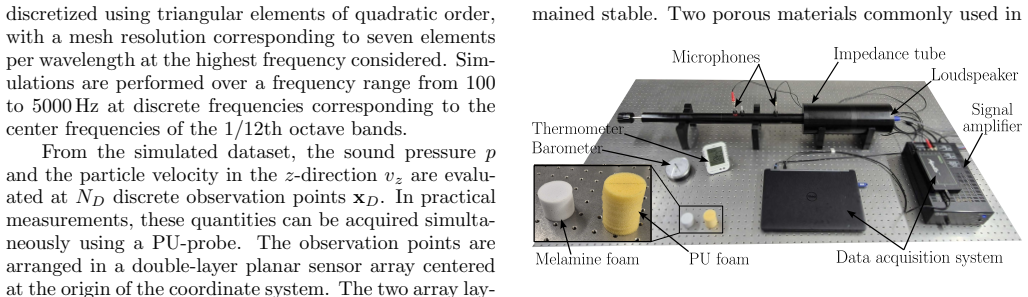
Figures from the paper (7 more)


Reference graph
Works this paper leans on
-
[1]
Most approaches are formu- lated as inverse problems, where sound pressure and/or particle velocity measurements in the near field of the sample are used to infer boundary properties based on ArXiv preprint / 10 April 2026 1 arXiv:2604.07412v1 [cs.LG] 8 Apr 2026 physical wave propagation models
work page Pith review arXiv 2026
-
[2]
In this work, a physics-informed deep operator net- work (DeepONet) is proposed to estimate frequency- dependent acoustic surface admittance directly from near-field measurements of sound pressure and normal particle velocity. By explicitly incorporating frequency as an input variable, the method estimates the full sur- face admittance spectrum within a s...
work page 2026
-
[3]
work, the surface admittance is expressed in dimension- less form asY= eY Z0
Acoustic data are recorded at dis- crete measurement positions (red dots) arranged in two mi- crophone arrays, which are separated by a distancedalong thez-direction. work, the surface admittance is expressed in dimension- less form asY= eY Z0. To ensure physically realistic boundary conditions, the frequency-dependent reference admittance valuesY ref are...
work page 2026
-
[4]
III. PHYSICS-INFORMED NEURAL OPERATORS Neural operators constitute a class of machine learn- ing methods that aim to approximate mappings between infinite-dimensional function spaces. Such mappings fre- quently appear in the mathematical description of phys- ical systems, for instance when relating boundary con- ditions, spatially varying coefficients, or...
work page 2026
-
[5]
By leveraging this disentanglement of spatial and fre- quency dependencies, the DeepONet architecture decom- poses the overall operator learning task into two coupled but simpler subproblems. This separation of roles re- duces the complexity of the learning problem and enables the model to generalize to arbitrary spatial evaluation points54. The DeepONet ...
work page 2026
-
[6]
Schematic overview of the physics-informed DeepONet architecture and training procedure. The neural operator consists of a branch network and a trunk network that together map the input frequency and spatial coordinates to the predicted acoustic field quantities (left). The resulting network outputs (center) are used to evaluate the different loss compone...
work page 2026
-
[7]
ArXiv preprint / 10 April 2026 7 Their outputs are combined through an element-wise product and subsequently mapped by a linear output layer to the predicted acoustic quantities. Specifically, the network predicts the real and imaginary parts of the acoustic pressurep θ and the normal-direction particle ve- locityv z,θ, as illustrated in Fig
work page 2026
-
[8]
Evolution of the effective training and validation losses (λ· L) during DeepONet training. The supervised data losses for pressure and particle velocity decrease rapidly and converge smoothly, while the physics-informed residual losses appear progressively as their weighting is activated during training. The curves demonstrate stable joint optimization of...
work page 2026
Show all 13 references
-
[9]
The DeepONet predictions are shown alongside the corresponding reference spectrum over the frequency range from 100 to 5000 Hz
Comparison of the frequency-dependent real and imaginary parts of the acoustic surface admittanceYfor two porous materials: melamine foam (top) and PU foam (bot- tom). The DeepONet predictions are shown alongside the corresponding reference spectrum over the frequency range fr...
2026
-
[10]
The mean error valuesµare reported in the legends
RelativeL 2-norm error of the DeepONet predictions for the surface admittanceY(left), the sound pressurep(middle), and the normal particle velocityv z (right) for melamine foam and PU foam as a function of frequency from 100 to 5000 Hz. The mean error valuesµare reported in th...
2026
-
[11]
The shaded region indicates the standard deviationσover the considered frequency range
Mean relativeL 2-norm error of the estimated surface admittanceYas a function of the number of measurement pointsN D, comparing the physics-informed DeepONet with a data-only DeepONet variant. The shaded region indicates the standard deviationσover the considered frequency ran...
2026
-
[12]
Computer simulations in room acoustics: con- cepts and uncertainties,
Mean relativeL 2-norm error of the estimated sur- face admittanceYas a function of the SNR level of the added noise, comparing the physics-informed DeepONet with a data- only variant. The shaded regions indicate the standard devi- ationσover the considered frequency range. Fig...
2026 doi
-
[13]
ArXiv preprint / 10 April 2026 15
2026
Reviewed May 10, 2026 · model on record in the stance chip above.
Discussion (0). Continue with ORCID to comment.