Recognition: 2 theorem links
· Lean TheoremHow Robust is the Cosmic Distance with Tip of Red Giant Branch against Stellar Population Variations?
Pith reviewed 2026-05-10 18:15 UTC · model grok-4.3
The pith
The tip of the red giant branch varies by no more than 0.028 magnitudes due to typical differences in stellar age, helium, and alpha enhancement.
A machine-rendered reading of the paper's core claim, the machinery that carries it, and where it could break.
Core claim
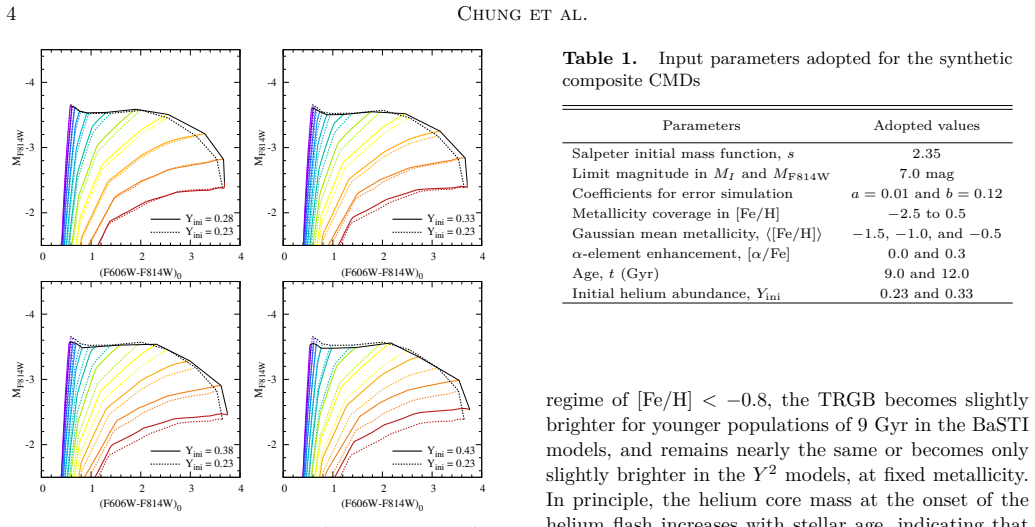
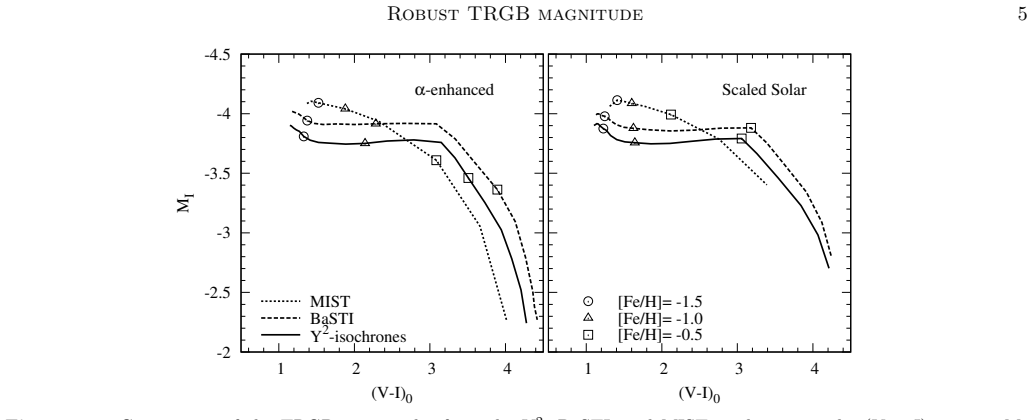
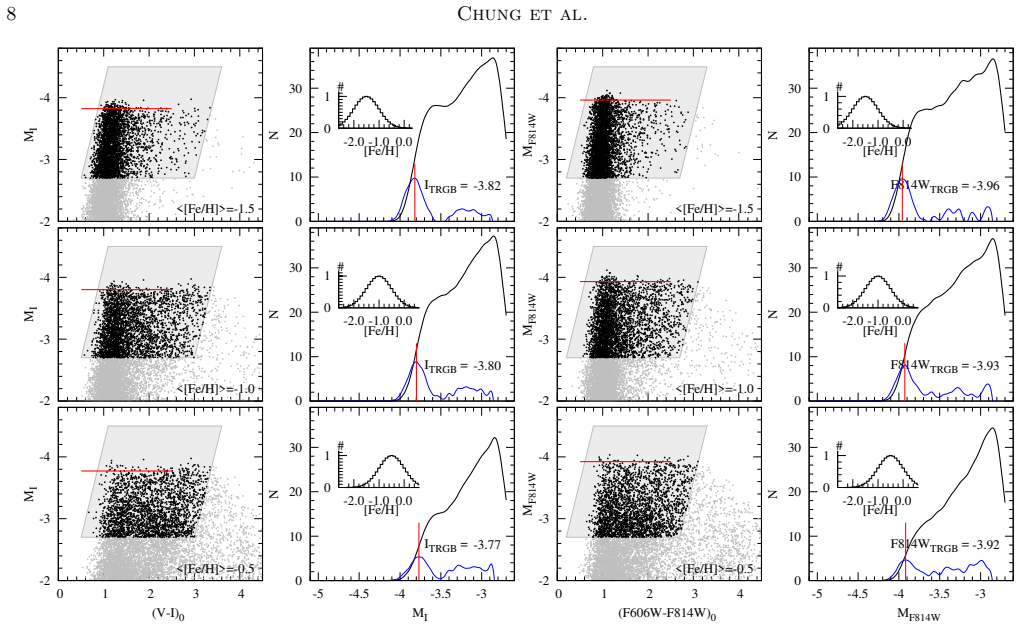
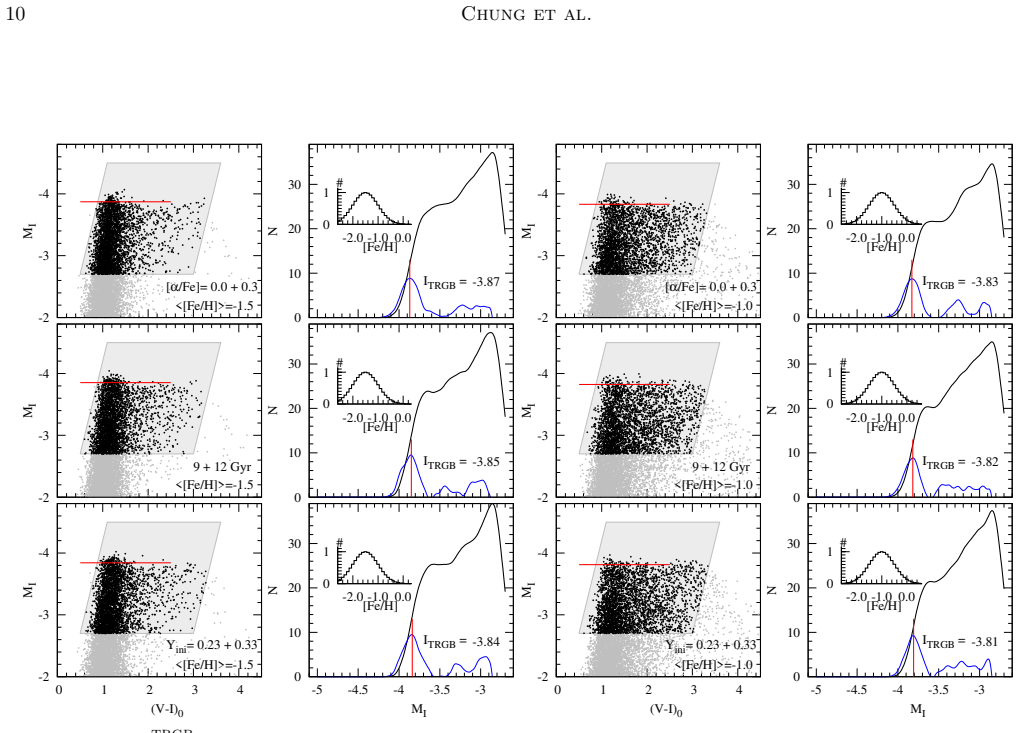
Using synthetic composite color-magnitude diagrams in the I and F814W bands, the analysis finds that at fixed age and helium, a 0.5 dex increase in metallicity dims M_I^TRGB by 0.046 mag and M_F814W^TRGB by 0.093 mag, while a 0.3 dex increase in alpha-element enhancement dims them by 0.050 and 0.044 mag respectively. Changes in age by 3 Gyr and helium by 0.10 produce smaller average shifts of 0.031 and 0.009 mag in M_I^TRGB. For mixed populations, the net variation from alpha, age, and helium combinations remains below 0.028 mag in M_I^TRGB, confirming the TRGB's reliability as a standard candle.
What carries the argument
Synthetic composite color-magnitude diagrams from stellar evolution models that quantify the luminosity of the tip of the red giant branch under varying population parameters.
If this is right
- Increasing metallicity by 0.5 dex at fixed age and helium dims the I-band TRGB by 0.046 mag.
- Increasing alpha-element enhancement by 0.3 dex dims it by 0.050 mag in I-band.
- Age variations of 3 Gyr cause average shifts of 0.031 mag in M_I^TRGB.
- Helium abundance variations of 0.10 cause only 0.009 mag shifts.
- These small net effects in mixed populations keep the TRGB within reported systematic uncertainties for distance measurements.
Where Pith is reading between the lines
- This robustness implies that TRGB distances can be applied confidently to galaxies with varied star formation histories without major population corrections.
- Such stability could help cross-check other distance methods in resolving the current tension in Hubble constant values.
- Direct comparisons of TRGB brightness in galaxies with measured differences in alpha enhancement or metallicity could further validate the modeled effects.
Load-bearing premise
Synthetic composite color-magnitude diagrams from stellar evolution models accurately represent the actual luminosity of TRGB stars across mixed populations in real galaxies.
What would settle it
Direct measurement of TRGB magnitudes in galaxies with known differences in metallicity, alpha enhancement, age, and helium abundance showing variations exceeding 0.028 magnitudes would contradict the claim.
Figures






read the original abstract
The tip of the red giant branch (TRGB) provides a key standard candle for extragalactic distance measurements and for refining the Hubble constant. We test its robustness by quantifying how metallicity, $\alpha$-element enhancement, age, and initial helium abundance modulate the TRGB luminosity, using synthetic composite color--magnitude diagrams in the $I$ and $F814W$ bands. We find that metallicity and $\alpha$-element enhancement are the primary drivers of TRGB variation, while age introduces only a modest effect and helium abundance is negligible. At fixed age and helium content, increasing the mean metallicity by 0.5 dex or the $\alpha$-element enhancement by 0.3 dex produces the well-known systematic dimming of 0.046 and 0.050 mag, respectively, in $M_I^{\rm TRGB}$, and of 0.093 and 0.044 mag, respectively, in $M_{F814W}^{\rm TRGB}$. By comparison, changes in age of 3~Gyr and in initial helium abundance of 0.10 yield minor luminosity shifts, with average changes of 0.031 and 0.009~mag, respectively, in $M_I^{\rm TRGB}$, and of 0.035 and 0.027 mag, respectively, in $M_{F814W}^{\rm TRGB}$, substantially smaller than those caused by variations in metallicity or $\alpha$-element enhancement. For mixed stellar populations under typical stellar-halo metallicity conditions, the net variation in $M_I^{\rm TRGB}$ arising from each combination of the $\alpha$-element enhancement, age, and initial helium abundance remains below 0.028~mag, well within reported systematic uncertainties. Together, these results reaffirm the TRGB as a highly robust distance indicator and support its continued use as an independent anchor for precision cosmology in the era of the Hubble-tension debate.
Editorial analysis
A structured set of objections, weighed in public.
Referee Report
Summary. The manuscript uses synthetic composite color-magnitude diagrams generated from stellar evolution models to quantify the dependence of TRGB luminosity (in I and F814W) on metallicity, α-element enhancement, age, and initial helium abundance. It reports that metallicity and α-enhancement drive the largest shifts (0.046 mag and 0.050 mag dimming in M_I^TRGB for +0.5 dex and +0.3 dex changes), while 3 Gyr age and 0.10 helium changes produce smaller average shifts (0.031 mag and 0.009 mag). For mixed populations at typical halo metallicities, the net variation from combinations of α, age, and He remains below 0.028 mag, supporting TRGB robustness as a distance indicator.
Significance. If the synthetic CMDs faithfully reproduce real TRGB behavior, the work provides quantitative bounds showing that population variations contribute negligibly to TRGB systematics compared with current uncertainties, reinforcing its value as an independent rung in the distance ladder for Hubble-constant studies. The controlled forward-modeling approach is a clear strength, allowing isolation of individual parameter effects without observational selection biases.
major comments (2)
- [Methods (synthetic CMD construction) and Results (mixed-population section)] The headline result (net |ΔM_I^TRGB| < 0.028 mag for mixed populations) is obtained exclusively from one family of isochrones. Because the TRGB luminosity is fixed by the core mass at helium flash, which depends on the specific treatment of convection, overshooting, diffusion, and mass loss, the small net variation may be an artifact of the chosen grid rather than a general property of stellar populations. This directly affects the central robustness claim and requires explicit comparison with at least one independent set of tracks (e.g., MESA or PARSEC) to test sensitivity to model physics.
- [Results (quantitative variation paragraphs)] No quantitative error analysis or uncertainty on the measured tip magnitudes is presented. The quoted shifts (0.046 mag, 0.050 mag, 0.028 mag) are given without reported dispersions from the edge-detection procedure or from finite sampling in the synthetic CMDs, making it impossible to judge whether the “below 0.028 mag” threshold is statistically meaningful or merely an upper limit set by the method.
minor comments (2)
- [Abstract and throughout] Notation for the TRGB magnitude is inconsistent (M_I^TRGB vs. M_I^{rm TRGB}); adopt a single LaTeX form throughout.
- [Abstract] The abstract states that helium abundance is “negligible,” yet reports a 0.027 mag shift in M_F814W^TRGB for ΔY = 0.10; clarify whether this is considered negligible relative to the 0.044–0.093 mag metallicity/α shifts or simply smaller in absolute terms.
Simulated Author's Rebuttal
We thank the referee for their constructive and insightful comments, which have helped us identify areas where the manuscript can be strengthened. We address each major comment below and will incorporate revisions to improve the clarity and robustness of our analysis.
read point-by-point responses
-
Referee: [Methods (synthetic CMD construction) and Results (mixed-population section)] The headline result (net |ΔM_I^TRGB| < 0.028 mag for mixed populations) is obtained exclusively from one family of isochrones. Because the TRGB luminosity is fixed by the core mass at helium flash, which depends on the specific treatment of convection, overshooting, diffusion, and mass loss, the small net variation may be an artifact of the chosen grid rather than a general property of stellar populations. This directly affects the central robustness claim and requires explicit comparison with at least one independent set of tracks (e.g., MESA or PARSEC) to test sensitivity to model physics.
Authors: We appreciate the referee pointing out the potential dependence on the specific stellar evolution grid. Our analysis is designed to isolate the effects of population parameters (metallicity, α-enhancement, age, and helium) by varying them within a single, self-consistent set of models, which minimizes confounding differences in input physics. The differential shifts we report arise primarily from changes in the hydrogen-shell burning and core-mass growth along the RGB, which are governed by well-established principles that are common across modern grids. Nevertheless, we acknowledge that an explicit cross-check would strengthen the generality of the <0.028 mag bound. In the revised manuscript we will add a dedicated subsection discussing the sensitivity of TRGB variations to model physics and will perform a limited comparison using an independent grid (PARSEC) for the key mixed-population cases at halo-like metallicities. This will test whether the net variation remains comparably small. revision: yes
-
Referee: [Results (quantitative variation paragraphs)] No quantitative error analysis or uncertainty on the measured tip magnitudes is presented. The quoted shifts (0.046 mag, 0.050 mag, 0.028 mag) are given without reported dispersions from the edge-detection procedure or from finite sampling in the synthetic CMDs, making it impossible to judge whether the “below 0.028 mag” threshold is statistically meaningful or merely an upper limit set by the method.
Authors: We agree that the absence of reported uncertainties on the measured TRGB magnitudes limits the ability to assess the statistical significance of the quoted shifts. In the revised version we will quantify the uncertainties arising from two sources: (1) the edge-detection algorithm itself (by reporting the width of the peak in the Sobel-filter response or equivalent metric) and (2) finite sampling in the synthetic CMDs (via bootstrap resampling of the stellar populations or repeated realizations with different random seeds). These uncertainties will be tabulated alongside the mean shifts, allowing readers to evaluate whether the 0.028 mag threshold for mixed populations is robust relative to the measurement precision. revision: yes
Circularity Check
No circularity: forward simulation from input parameters to measured TRGB shifts
full rationale
The paper generates synthetic CMDs by varying input stellar population parameters (metallicity, alpha enhancement, age, helium) within a fixed set of stellar evolution tracks, then directly measures the TRGB luminosity in the resulting diagrams. This produces the reported net variation bounds (e.g., <0.028 mag) as a straightforward numerical output of those inputs. No step equates a derived quantity to a fitted parameter by construction, renames a known result, or relies on a load-bearing self-citation whose content reduces to the present work. The derivation chain is self-contained as a parameter-sweep experiment; external validity of the isochrones is a separate modeling assumption, not a circularity issue.
Axiom & Free-Parameter Ledger
axioms (2)
- domain assumption Stellar evolution models accurately predict TRGB luminosity for given metallicity, alpha enhancement, age, and helium values
- domain assumption The composite populations with typical halo metallicities are representative of real extragalactic stellar systems
Lean theorems connected to this paper
-
IndisputableMonolith/Cost/FunctionalEquation.leanwashburn_uniqueness_aczel unclearWe test its robustness by quantifying how metallicity, α-element enhancement, age, and initial helium abundance modulate the TRGB luminosity, using synthetic composite color–magnitude diagrams
-
IndisputableMonolith/Foundation/RealityFromDistinction.leanreality_from_one_distinction unclearthe net variation in M_I^TRGB arising from each combination of the α-element enhancement, age, and initial helium abundance remains below 0.028 mag
Reference graph
Works this paper leans on
-
[1]
Anand, G. S., Tully, R. B., Cohen, Y., et al. 2024, ApJ, 973, 83, doi: 10.3847/1538-4357/ad64c7
-
[2]
Baumgardt, H., & Vasiliev, E. 2021, MNRAS, 505, 5957, doi: 10.1093/mnras/stab1474
-
[3]
Beers, T. C., Preston, G. W., & Shectman, S. A. 1985, AJ, 90, 2089, doi: 10.1086/113917
-
[4]
Bellazzini, M. 2008, Mem. Soc. Astron. Italiana, 79, 440, doi: 10.48550/arXiv.0711.2016
-
[5]
2004, A&A, 424, 199, doi: 10.1051/0004-6361:20035910
Origlia, L. 2004, A&A, 424, 199, doi: 10.1051/0004-6361:20035910
-
[6]
Belokurov, V., Zucker, D. B., Evans, N. W., et al. 2006, ApJL, 642, L137, doi: 10.1086/504797
-
[7]
Bressan, A., Marigo, P., Girardi, L., et al. 2012, MNRAS, 427, 127, doi: 10.1111/j.1365-2966.2012.21948.x
-
[8]
Y., Salaris, M., & Pietrinferni, A
Cassisi, S., Potekhin, A. Y., Salaris, M., & Pietrinferni, A. 2021, A&A, 654, A149, doi: 10.1051/0004-6361/202141425 14 Chung et al
-
[9]
2010, A&A, 522, A10, doi: 10.1051/0004-6361/201014432
Charbonnel, C., & Lagarde, N. 2010, A&A, 522, A10, doi: 10.1051/0004-6361/201014432
-
[10]
2016, The Astrophysical Journal, 823, 102, doi:10.3847/0004-637X/823/2/102
Choi, J., Dotter, A., Conroy, C., et al. 2016, ApJ, 823, 102, doi: 10.3847/0004-637X/823/2/102
work page internal anchor Pith review doi:10.3847/0004-637x/823/2/102 2016
-
[11]
2016, MNRAS, 456, L1, doi: 10.1093/mnrasl/slv161
Chung, C., Lee, Y.-W., & Pasquato, M. 2016, MNRAS, 456, L1, doi: 10.1093/mnrasl/slv161
-
[12]
Robust and ubiquitous evidence from a larger sample of host galaxies in a broader redshift range
Chung, C., Park, S., Son, J., Cho, H., & Lee, Y.-W. 2025, MNRAS, 538, 3340, doi: 10.1093/mnras/staf497
-
[13]
2019, ApJL, 883, L31, doi: 10.3847/2041-8213/ab40cf
Chung, C., Pasquato, M., Lee, S.-Y., et al. 2019, ApJL, 883, L31, doi: 10.3847/2041-8213/ab40cf
-
[14]
2020, ApJS, 250, 33, doi: 10.3847/1538-4365/abb4e6
Chung, C., Yoon, S.-J., Cho, H., Lee, S.-Y., & Lee, Y.-W. 2020, ApJS, 250, 33, doi: 10.3847/1538-4365/abb4e6
-
[15]
2013, ApJS, 204, 3, doi: 10.1088/0067-0049/204/1/3
Chung, C., Yoon, S.-J., Lee, S.-Y., & Lee, Y.-W. 2013, ApJS, 204, 3, doi: 10.1088/0067-0049/204/1/3
-
[16]
2011, ApJL, 740, L45, doi: 10.1088/2041-8205/740/2/L45
Chung, C., Yoon, S.-J., & Lee, Y.-W. 2011, ApJL, 740, L45, doi: 10.1088/2041-8205/740/2/L45
-
[17]
2017, ApJ, 842, 91, doi: 10.3847/1538-4357/aa6f19
Chung, C., Yoon, S.-J., & Lee, Y.-W. 2017, ApJ, 842, 91, doi: 10.3847/1538-4357/aa6f19
-
[18]
Chung, C., Yoon, S.-J., Park, S., et al. 2023, ApJ, 959, 94, doi: 10.3847/1538-4357/ad0121
-
[19]
2011, MNRAS, 410, 166, doi: 10.1111/j.1365-2966.2010.17432.x
Cooper, A. P., Cole, S., Frenk, C. S., et al. 2010, MNRAS, 406, 744, doi: 10.1111/j.1365-2966.2010.16740.x Di Valentino, E., Mena, O., Pan, S., et al. 2021, Classical and Quantum Gravity, 38, 153001, doi: 10.1088/1361-6382/ac086d
-
[20]
Dupree, A. K., Strader, J., & Smith, G. H. 2011, ApJ, 728, 155, doi: 10.1088/0004-637X/728/2/155 Ekström, S., Georgy, C., Eggenberger, P., et al. 2012, A&A, 537, A146, doi: 10.1051/0004-6361/201117751
-
[21]
Freedman, W. L. 2021, ApJ, 919, 16, doi: 10.3847/1538-4357/ac0e95
-
[22]
Freedman, W. L., Madore, B. F., Hatt, D., et al. 2019, ApJ, 882, 34, doi: 10.3847/1538-4357/ab2f73
-
[23]
Freedman, W. L., Madore, B. F., Hatt, D., et al. 2020, ApJ, 891, 57, doi: 10.3847/1538-4357/ab7339
-
[24]
2017, A&A, 597, A14, doi: 10.1051/0004-6361/201629034
Gallet, F., Charbonnel, C., Amard, L., et al. 2017, A&A, 597, A14, doi: 10.1051/0004-6361/201629034
-
[25]
Hatt, D., Beaton, R. L., Freedman, W. L., et al. 2017, ApJ, 845, 146, doi: 10.3847/1538-4357/aa7f73
-
[26]
Helmi, A., Babusiaux, C., Koppelman, H. H., et al. 2018, Nature, 563, 85, doi: 10.1038/s41586-018-0625-x
-
[27]
Jang, I. S., & Lee, M. G. 2017a, ApJ, 835, 28, doi: 10.3847/1538-4357/835/1/28
-
[28]
Jang, I. S., & Lee, M. G. 2017b, ApJ, 836, 74, doi: 10.3847/1538-4357/836/1/74
-
[29]
Jang, I. S., Hoyt, T. J., Beaton, R. L., et al. 2021, ApJ, 906, 125, doi: 10.3847/1538-4357/abc8e9
-
[30]
Johnston, K. V., Bullock, J. S., Sharma, S., et al. 2008, ApJ, 689, 936, doi: 10.1086/592228
-
[31]
Kim, Y.-C., Demarque, P., Yi, S. K., & Alexander, D. R. 2002, ApJS, 143, 499, doi: 10.1086/343041
-
[32]
2012, A&A, 543, A108, doi: 10.1051/0004-6361/201118331
Lagarde, N., Decressin, T., Charbonnel, C., et al. 2012, A&A, 543, A108, doi: 10.1051/0004-6361/201118331
-
[33]
Lee, M. G., Freedman, W. L., & Madore, B. F. 1993, ApJ, 417, 553, doi: 10.1086/173340
-
[34]
Lee, Y.-W., Chung, C., Demarque, P., et al. 2022, MNRAS, 517, 2697, doi: 10.1093/mnras/stac2840
-
[35]
Lee, Y.-W., Chung, C., Kang, Y., & Jee, M. J. 2020, ApJ, 903, 22, doi: 10.3847/1538-4357/abb3c6
-
[36]
1994, ApJ, 423, 248, doi: 10.1086/173803
Lee, Y.-W., Demarque, P., & Zinn, R. 1994, ApJ, 423, 248, doi: 10.1086/173803
-
[37]
2005, ApJL, 621, L57, doi: 10.1086/428944
Lee, Y.-W., Joo, S.-J., Han, S.-I., et al. 2005, ApJL, 621, L57, doi: 10.1086/428944
-
[38]
Li, S., Casertano, S., & Riess, A. G. 2023, ApJ, 950, 83, doi: 10.3847/1538-4357/accd69
-
[39]
Madore, B. F., Freedman, W. L., & Owens, K. 2023a, AJ, 166, 224, doi: 10.3847/1538-3881/ad022c
-
[40]
Madore, B. F., Freedman, W. L., Owens, K. A., & Jang, I. S. 2023b, AJ, 166, 2, doi: 10.3847/1538-3881/acd3f3
-
[41]
Madore, B. F., Mager, V., & Freedman, W. L. 2009, ApJ, 690, 389, doi: 10.1088/0004-637X/690/1/389
-
[42]
2006, AJ, 132, 2729, doi: 10.1086/508925
Makarov, D., Makarova, L., Rizzi, L., et al. 2006, AJ, 132, 2729, doi: 10.1086/508925
-
[43]
McQuinn, K. B. W., Boyer, M., Skillman, E. D., & Dolphin, A. E. 2019, ApJ, 880, 63, doi: 10.3847/1538-4357/ab2627
-
[44]
Milone, A. P., Marino, A. F., Renzini, A., et al. 2018, MNRAS, 481, 5098, doi: 10.1093/mnras/sty2573
-
[45]
Pasquini, L., Mauas, P., Käufl, H. U., & Cacciari, C. 2011, A&A, 531, A35, doi: 10.1051/0004-6361/201116592
-
[46]
2006, ApJ, 642, 797, doi: 10.1086/501344
Pietrinferni, A., Cassisi, S., Salaris, M., & Castelli, F. 2006, ApJ, 642, 797, doi: 10.1086/501344
-
[47]
Piotto, G., Bedin, L. R., Anderson, J., et al. 2007, ApJL, 661, L53, doi: 10.1086/518503
-
[48]
Riess, A. G., Yuan, W., Macri, L. M., et al. 2022, ApJL, 934, L7, doi: 10.3847/2041-8213/ac5c5b
-
[49]
Sakai, S., Madore, B. F., & Freedman, W. L. 1996, ApJ, 461, 713, doi: 10.1086/177096
-
[50]
Sakai, S., Madore, B. F., & Freedman, W. L. 1997, ApJ, 480, 589, doi: 10.1086/304000
-
[51]
1997, MNRAS, 289, 406, doi: 10.1093/mnras/289.3.406
Salaris, M., & Cassisi, S. 1997, MNRAS, 289, 406, doi: 10.1093/mnras/289.3.406
-
[52]
Scolnic, D., Riess, A. G., Wu, J., et al. 2023, ApJL, 954, L31, doi: 10.3847/2041-8213/ace978
-
[53]
1978, ApJ, 225, 357, doi: 10.1086/156499
Searle, L., & Zinn, R. 1978, ApJ, 225, 357, doi: 10.1086/156499
-
[54]
2017, A&A, 606, A33, doi: 10.1051/0004-6361/201731004 Robust TRGB magnitude 15
Pietrinferni, A. 2017, A&A, 606, A33, doi: 10.1051/0004-6361/201731004 Robust TRGB magnitude 15
-
[55]
2025, ApJ, 980, 218, doi: 10.3847/1538-4357/adae8e
Shao, Z., Wang, S., Jiang, B., et al. 2025, ApJ, 980, 218, doi: 10.3847/1538-4357/adae8e
-
[56]
Alignment with DESI BAO and signs of a non-accelerating universe
Son, J., Lee, Y.-W., Chung, C., Park, S., & Cho, H. 2025, MNRAS, 544, 975, doi: 10.1093/mnras/staf1685
-
[57]
2010, ApJ, 708, 1168, doi: 10.1088/0004-637X/708/2/1168
Tanaka, M., Chiba, M., Komiyama, Y., et al. 2010, ApJ, 708, 1168, doi: 10.1088/0004-637X/708/2/1168
-
[58]
Thomas, D., Maraston, C., & Bender, R. 2003, MNRAS, 339, 897, doi: 10.1046/j.1365-8711.2003.06248.x
-
[59]
Valcarce, A. A. R., Catelan, M., & Sweigart, A. V. 2012, A&A, 547, A5, doi: 10.1051/0004-6361/201219510
-
[60]
Valle, G., Dell’Omodarme, M., Prada Moroni, P. G., & Degl’Innocenti, S. 2013, A&A, 549, A50, doi: 10.1051/0004-6361/201220069
-
[61]
Viaux, N., Catelan, M., Stetson, P. B., et al. 2013, A&A, 558, A12, doi: 10.1051/0004-6361/201322004
-
[62]
Yoon, S.-J., Joo, S.-J., Ree, C. H., et al. 2008, ApJ, 677, 1080, doi: 10.1086/533510
discussion (0)
Sign in with ORCID, Apple, or X to comment. Anyone can read and Pith papers without signing in.