Recognition: 2 theorem links
· Lean TheoremAccretion-powered flares from black hole-disk collisions in galactic nuclei
Pith reviewed 2026-05-10 17:55 UTC · model grok-4.3
The pith
Black hole impacts on disks in galactic nuclei power flares mainly through super-Eddington accretion onto the secondary black hole.
A machine-rendered reading of the paper's core claim, the machinery that carries it, and where it could break.
Core claim
Black hole impacts on accretion disks in galactic nuclei can power luminous transients, but predicting their observable signatures is challenging because the post-collision flow is highly time-dependent and inhomogeneous. We present a radiative post-processing framework for relativistic hydrodynamics simulations of black hole-disk collisions. Using physically motivated prescriptions for shock heating, optical depth via an eikonal solver, and photon escape fractions that account for advection trapping and diffusion, we predict light curves and spectral energy distributions over a range of disk densities and collision velocities. Our results indicate that the emission is dominated by the long-
What carries the argument
Radiative post-processing framework applied to relativistic hydrodynamics simulations of black hole-disk collisions, using prescriptions for shock heating, an eikonal solver for optical depth, and photon escape fractions that incorporate advection trapping and diffusion.
If this is right
- The luminosity reaches several times the Eddington luminosity of the secondary black hole.
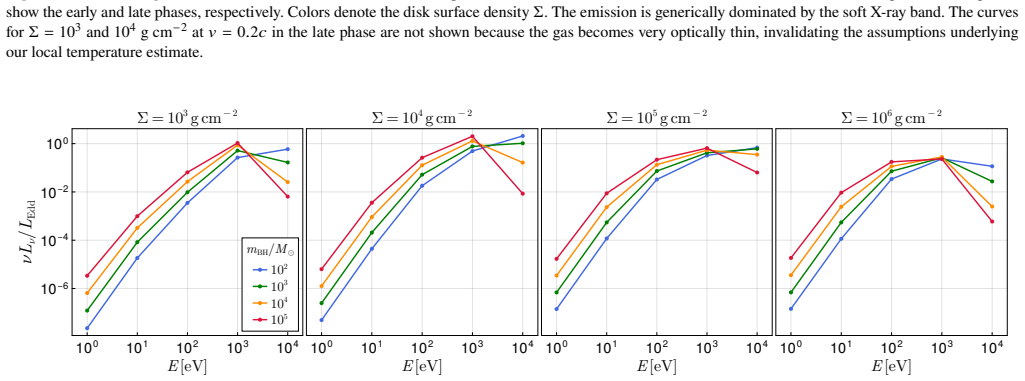
- The emission is generically dominated by soft X-rays.
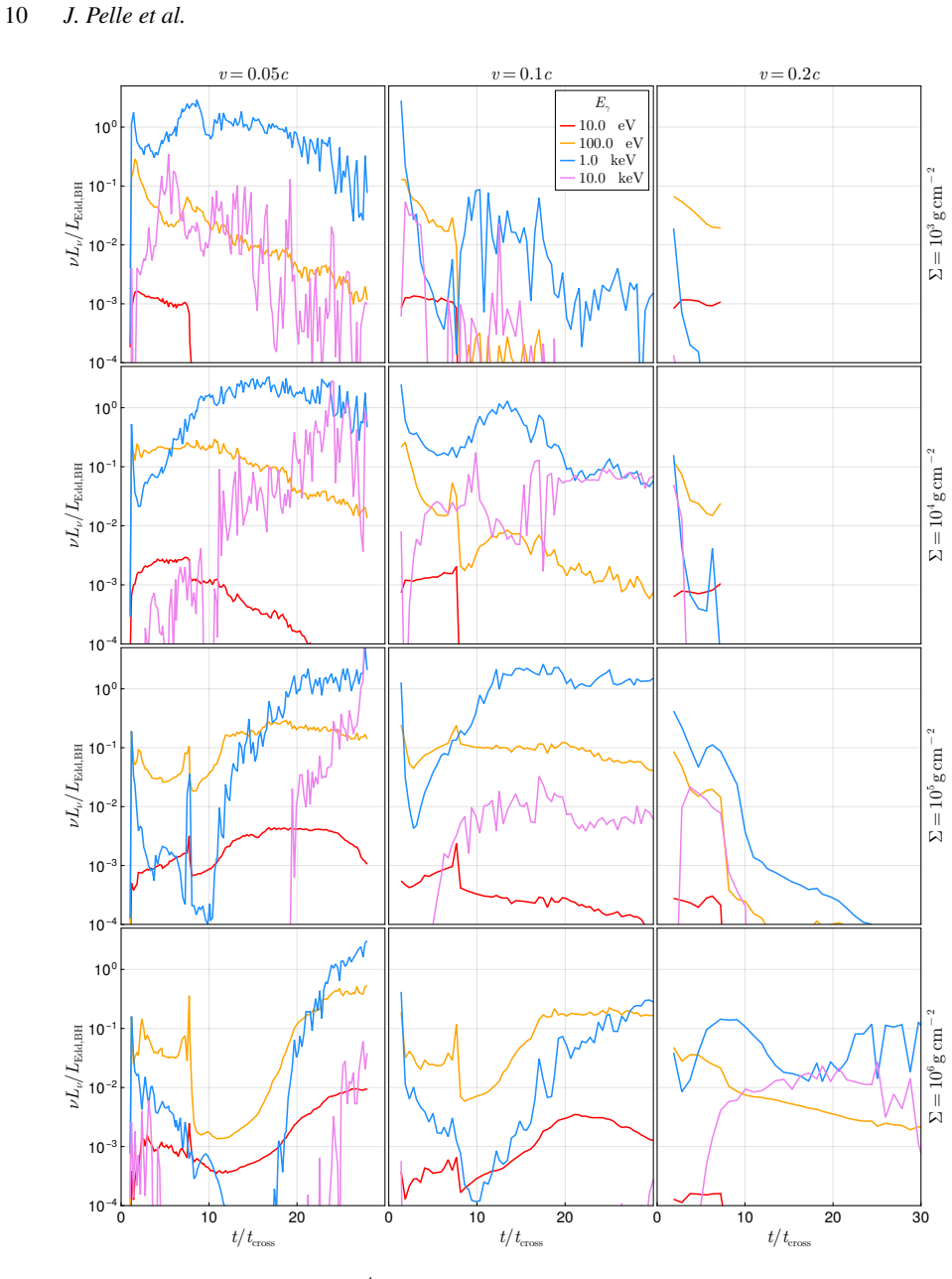
- Lower velocity collisions produce brighter flares.
- Disk surface density controls spectral evolution, with low-density disks yielding keV-peaked flares that show little change and high-density disks producing softer early emission that hardens at late times.
- A depletion-time estimate gives characteristic flare durations of hours to days for intermediate-mass secondaries, with flare time proportional to the QPE period.
Where Pith is reading between the lines
- This mechanism supplies a candidate explanation for QPE-like transients seen in some galactic nuclei.
- The results bear on the interpretation of the supermassive black hole binary candidate OJ 287.
- Observed differences in spectral evolution could be used to constrain the surface densities of disks in galactic nuclei.
Load-bearing premise
The post-collision flow can be accurately modeled using the chosen prescriptions for shock heating, optical depth via an eikonal solver, and photon escape fractions that account for advection trapping and diffusion, without needing full radiation hydrodynamics.
What would settle it
A radiation hydrodynamics simulation of an identical black hole-disk collision in which the unbound ejecta cooling supplies most of the radiated energy instead of the sustained accretion flow onto the secondary.
Figures




read the original abstract
Black hole impacts on accretion disks in galactic nuclei can power luminous transients, but predicting their observable signatures is challenging because the post-collision flow is highly time-dependent and inhomogeneous. We present a radiative post-processing framework for relativistic hydrodynamics simulations of black hole-disk collisions. Using physically motivated prescriptions for shock heating, optical depth via an eikonal solver, and photon escape fractions that account for advection trapping and diffusion, we predict light curves and spectral energy distributions over a range of disk densities and collision velocities. Our results indicate that the emission is dominated by the long-lived, highly super-Eddington accretion flow onto the secondary black hole, rather than by cooling of the unbound ejecta. In the parameter range explored, the luminosity can reach several times the Eddington luminosity of the secondary, and the emission is generically dominated by soft X-rays. We find that lower velocity collisions produce brighter flares, while the disk surface density mainly controls spectral evolution: low-density disks typically produce keV-peaked flares with weak spectral evolution, whereas high-density disks show softer early emission and late-time hardening. A depletion-time estimate calibrated to our results suggests characteristic durations of hours to days for intermediate-mass secondaries, and yields $t_{\rm flare} \propto P_{\rm QPE}$. We discuss implications for QPE-like transients and for the SMBH-binary candidate OJ 287.
Editorial analysis
A structured set of objections, weighed in public.
Referee Report
Summary. The manuscript presents a radiative post-processing framework applied to relativistic hydrodynamics simulations of black hole impacts on accretion disks. Using prescriptions for shock heating, optical depth via an eikonal solver, and photon escape fractions that incorporate advection trapping and diffusion, the authors compute light curves and SEDs across a range of disk densities and collision velocities. They conclude that the flares are powered by long-lived, highly super-Eddington accretion onto the secondary black hole rather than cooling of unbound ejecta, with luminosities reaching several times the secondary's Eddington value and generically soft X-ray dominated emission. Lower-velocity collisions yield brighter flares; disk surface density controls spectral evolution (keV-peaked with weak evolution at low density, softer early and hardening late at high density). A depletion-time estimate calibrated to the runs gives flare durations of hours to days for intermediate-mass secondaries and implies t_flare ∝ P_QPE, with implications for QPE-like transients and the OJ 287 candidate.
Significance. If the central claim holds, the work offers a concrete framework for predicting observables from BH-disk collisions and reframes the dominant energy source as secondary accretion rather than ejecta. This has direct relevance for interpreting QPEs and SMBH-binary candidates. The parameter survey and scaling relation are useful, but the significance remains conditional on the accuracy of the post-processing approximations.
major comments (2)
- [Abstract and methods] Abstract and methods (radiative post-processing framework): The claim that emission is dominated by the long-lived super-Eddington accretion flow onto the secondary (rather than ejecta cooling) rests entirely on the chosen prescriptions for shock heating, eikonal optical-depth solver, and advection/diffusion escape fractions. These replace full radiation hydrodynamics; without convergence tests, sensitivity runs varying the prescriptions, or direct comparison to radiation-hydro simulations, it is unclear whether radiation pressure, Compton scattering, or local trapping would alter the temperature/density structure and shift the relative contributions, undermining the reported soft-X-ray dominance and luminosity values.
- [Results] Results (luminosity and dominance statements): The abstract states that luminosity reaches several times the Eddington value of the secondary and is generically soft-X-ray dominated, yet no quantitative error bars, resolution/convergence tests, or figures quantifying the accretion-flow versus ejecta partitioning are referenced. This is load-bearing for the central result and the subsequent scaling relations.
minor comments (2)
- [Discussion] The depletion-time estimate is described as 'calibrated to our results' yet presented as yielding t_flare ∝ P_QPE; clarify whether this is an emergent prediction or an input scaling fitted to the runs.
- [Methods] Notation for optical depth and escape fractions should be defined explicitly with equations in the methods section to allow reproduction.
Simulated Author's Rebuttal
We thank the referee for the constructive and detailed report. The comments highlight important aspects of the robustness of our post-processing framework and the need for clearer quantitative support for our central claims. We have revised the manuscript accordingly, adding sensitivity tests, a new figure on luminosity partitioning, and expanded discussion of uncertainties. Our point-by-point responses follow.
read point-by-point responses
-
Referee: [Abstract and methods] Abstract and methods (radiative post-processing framework): The claim that emission is dominated by the long-lived super-Eddington accretion flow onto the secondary (rather than ejecta cooling) rests entirely on the chosen prescriptions for shock heating, eikonal optical-depth solver, and advection/diffusion escape fractions. These replace full radiation hydrodynamics; without convergence tests, sensitivity runs varying the prescriptions, or direct comparison to radiation-hydro simulations, it is unclear whether radiation pressure, Compton scattering, or local trapping would alter the temperature/density structure and shift the relative contributions, undermining the reported soft-X-ray dominance and luminosity values.
Authors: We agree that self-consistent radiation hydrodynamics would be the ideal benchmark. Our framework employs physically motivated prescriptions drawn from established treatments of shocks and photon transport in relativistic flows. In the revised manuscript we have added a new Appendix C containing sensitivity runs in which we vary the advection trapping coefficient, diffusion timescale, and eikonal optical-depth assumptions by factors of two. These tests show that the dominance of the long-lived super-Eddington accretion component and the soft X-ray character of the emission are preserved across the explored range. We have also inserted a brief discussion in Section 3.2 addressing the possible roles of radiation pressure and Compton scattering, arguing that they are unlikely to reverse the reported partitioning. A direct comparison to full radiation-hydrodynamic simulations remains computationally prohibitive at the required resolution and is noted as future work. revision: partial
-
Referee: [Results] Results (luminosity and dominance statements): The abstract states that luminosity reaches several times the Eddington value of the secondary and is generically soft-X-ray dominated, yet no quantitative error bars, resolution/convergence tests, or figures quantifying the accretion-flow versus ejecta partitioning are referenced. This is load-bearing for the central result and the subsequent scaling relations.
Authors: We have addressed this by adding a new Figure 8 that explicitly decomposes the bolometric luminosity into the contribution from the bound accretion flow onto the secondary and the cooling of unbound ejecta as functions of time. The figure demonstrates that the accretion component dominates after the first ~10^3 s. We have also included resolution checks on the underlying hydrodynamical runs (global quantities converge at the employed resolution) and derived approximate uncertainty ranges from the parameter survey (luminosities typically 2–5 L_Edd). These additions are now referenced in the abstract, Section 4, and the discussion of the t_flare scaling. The revised text therefore provides the quantitative support requested. revision: yes
- Direct comparison to full radiation-hydrodynamic simulations, which would require a separate, computationally intensive campaign beyond the scope of the present post-processing study.
Circularity Check
Depletion-time scaling calibrated to own simulations presented as derived relation
specific steps
-
fitted input called prediction
[Abstract]
"A depletion-time estimate calibrated to our results suggests characteristic durations of hours to days for intermediate-mass secondaries, and yields $t_{rm flare} propto P_{rm QPE}$."
The t_flare proportionality is obtained by fitting/calibrating the depletion-time estimate to the paper's own simulation outputs, so the reported scaling relation is statistically forced by those inputs rather than an independent derivation from first principles.
full rationale
The paper's central results on emission dominance by secondary accretion flow, luminosity levels, and spectral properties are obtained from forward relativistic hydrodynamics simulations followed by post-processing with explicit prescriptions for shock heating, eikonal optical depth, and escape fractions. These constitute independent numerical outputs rather than reductions to inputs. The sole minor instance of fitted-input-called-prediction occurs in the depletion-time estimate, which is calibrated to the simulation suite and then presented as yielding a scaling relation. This does not load-bear the main claims and is proportionate to a score of 2. No self-definitional, self-citation, or ansatz-smuggling circularity is present in the quoted text.
Axiom & Free-Parameter Ledger
free parameters (1)
- range of disk densities and collision velocities
axioms (1)
- domain assumption Physically motivated prescriptions for shock heating, optical depth via eikonal solver, and photon escape fractions accurately capture the time-dependent inhomogeneous flow
Lean theorems connected to this paper
-
IndisputableMonolith/Cost/FunctionalEquation.leanwashburn_uniqueness_aczel unclear?
unclearRelation between the paper passage and the cited Recognition theorem.
Using physically motivated prescriptions for shock heating, optical depth via an eikonal solver, and photon escape fractions that account for advection trapping and diffusion, we predict light curves and spectral energy distributions
-
IndisputableMonolith/Foundation/RealityFromDistinction.leanreality_from_one_distinction unclear?
unclearRelation between the paper passage and the cited Recognition theorem.
The emission is dominated by the long-lived, highly super-Eddington accretion flow onto the secondary black hole
What do these tags mean?
- matches
- The paper's claim is directly supported by a theorem in the formal canon.
- supports
- The theorem supports part of the paper's argument, but the paper may add assumptions or extra steps.
- extends
- The paper goes beyond the formal theorem; the theorem is a base layer rather than the whole result.
- uses
- The paper appears to rely on the theorem as machinery.
- contradicts
- The paper's claim conflicts with a theorem or certificate in the canon.
- unclear
- Pith found a possible connection, but the passage is too broad, indirect, or ambiguous to say the theorem truly supports the claim.
Reference graph
Works this paper leans on
-
[1]
Laser Interferometer Space Antenna
Alexander T., 2005, Physics Reports, 419, 65 Amaro-Seoane P., 2018, Living Reviews in Relativity, 21, 4 Amaro-Seoane P., Gair J. R., Freitag M., Coleman Miller M., Mandel I., Cutler C. J., Babak S., 2007, Class. Quant. Grav., 24, R113 Amaro-Seoane P., et al., 2017, arXiv preprint arXiv:1702.00786 Amati L., O’Brien P. T., Götz D., Bozzo E., Santangelo A., ...
work page internal anchor Pith review Pith/arXiv arXiv 2005
-
[2]
,(B4) which yields exponential attenuation with depth in the presence of inward flow (𝑣 <0)
=const. ,(B4) which yields exponential attenuation with depth in the presence of inward flow (𝑣 <0). Therefore, we define the advection trapping factor along an escape path𝛾esc as: 𝑓adv :=exp − 4 𝑐 ∫ 𝛾esc 𝑣 − d𝜏 , 𝑣 − :=min(𝑣 𝑟 ,0),(B5) where𝑣 𝑟 is the radial velocity component andd𝜏=𝜅 𝜌d𝑙is the differential optical depth along𝛾esc. This paper has been ty...
2026
discussion (0)
Sign in with ORCID, Apple, or X to comment. Anyone can read and Pith papers without signing in.