Recognition: 2 theorem links
· Lean TheoremOperational criteria for quantum advantage in latency-constrained nonlocal games
Pith reviewed 2026-05-10 17:41 UTC · model grok-4.3
The pith
Cavity-assisted trapped-atom nodes provide continuous entangled pairs for quantum advantage in microsecond-latency coordination over metropolitan networks.
A machine-rendered reading of the paper's core claim, the machinery that carries it, and where it could break.
Core claim
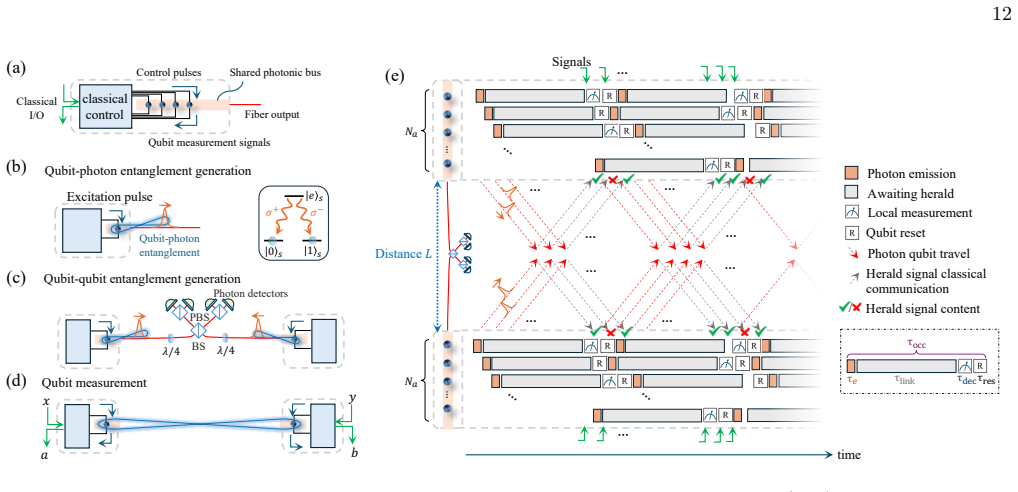
Adapting statistical certification methods for nonlocal games to latency-constrained decision-making scenarios with limited stationary windows identifies the operational criteria that must be satisfied by hardware to realize quantum advantage. These criteria are met by time-multiplexed, event-ready operations of cavity-assisted trapped-atom quantum network nodes that provide a continuous stream of entangled qubit pairs with decision latencies of a microsecond and decision rates of 8×10^3 s^{-1} per channel for a 50-km fiber network.
What carries the argument
Time-multiplexed event-ready operations of cavity-assisted trapped-atom nodes generating continuous entangled qubit pairs while respecting finite stationary window and rate constraints in LCTC.
If this is right
- Quantum advantage can be achieved in practical time-critical distributed decision-making without classical communication.
- Hardware must achieve specific combinations of low latency and high entanglement generation rates to satisfy statistical significance.
- Applications such as financial market coordination and electric grid management can utilize these quantum correlations.
- The framework allows quantitative evaluation of quantum advantage beyond idealized models that ignore real operation times.
Where Pith is reading between the lines
- The criteria could guide the development of other quantum hardware platforms for low-latency tasks.
- Achieving these parameters might enable extensions to multi-party coordination games or larger scale networks.
- This work suggests that event-ready entanglement generation is key to bridging theoretical nonlocal game advantages with operational constraints.
Load-bearing premise
That the cavity-assisted trapped-atom nodes can achieve microsecond decision latencies, 8×10^3 s^{-1} rates, and sufficient fidelity simultaneously in a 50 km metropolitan network setup.
What would settle it
A demonstration that the proposed trapped-atom nodes cannot simultaneously reach the required latency, rate, and fidelity thresholds over 50 km would falsify the feasibility of meeting the operational criteria.
Figures





read the original abstract
Remote entanglement enables coordinated decision making without communication and produces correlations beyond those achievable by any classical strategy, representing a practical quantum advantage in time-critical distributed decision-making problems. However, existing analyses of quantum-classical gaps in such latency-constrained tacit coordination (LCTC) have focused on idealized models that neglect the finite stationary window of the LCTC, finite operation times, and limited entanglement generation rates, leaving fundamental constraints unaccounted for. In this work, we develop a comprehensive framework to quantitatively analyze quantum advantage in LCTC that explicitly incorporates finite-duration and finite-rate operations, as well as generalized utility structures with a limited stationary window. These advances are made possible by adapting statistical certification methods for nonlocal games to the decision-making scenarios of LCTC, identifying operational criteria that must be satisfied by the hardware implementations to realize quantum advantage with sufficient statistical significance. To meet the stringent criteria, we propose time-multiplexed, event-ready operations of cavity-assisted trapped-atom quantum network nodes that provide a continuous stream of entangled qubit pairs, with decision latencies of a microsecond and decision rates of $8\times 10^3~\text{s}^{-1}$ per channel for a representative metropolitan-scale $50$-km fiber network to keep up with the fast-changing environment, such as financial markets and electric grid networks. These results bridge the gap between the theoretical notions of the quantum-classical gap in nonlocal games and concrete implementations that meet the stringent operational criteria for achieving robust quantum advantage in realistic coordination tasks.
Editorial analysis
A structured set of objections, weighed in public.
Referee Report
Summary. The paper develops a framework for quantifying quantum advantage in latency-constrained tacit coordination (LCTC) nonlocal games by adapting statistical certification methods to account for finite operation times, limited entanglement generation rates, and a bounded stationary window. It derives operational criteria that hardware must satisfy for statistically significant quantum advantage and proposes a concrete implementation: time-multiplexed, event-ready cavity-assisted trapped-atom nodes delivering 1 μs decision latency and 8×10^3 s^{-1} rates per channel over a representative 50 km metropolitan fiber link with 0.2 dB/km loss.
Significance. If the adapted certification criteria are correctly formulated and the proposed hardware parameters can be shown to simultaneously meet latency, rate, and fidelity thresholds, the work would supply concrete, falsifiable targets that link abstract quantum-classical gaps in nonlocal games to realizable quantum-network hardware for time-critical coordination tasks such as market or grid control.
major comments (3)
- [§5] §5 (hardware proposal): the claim that cavity-assisted trapped-atom nodes achieve simultaneous 1 μs latency, 8×10^3 s^{-1} per-channel rate, and certification-grade Bell violation over 50 km fiber is asserted without an explicit timing budget, rate equation, or fidelity model that balances cavity QED parameters, multiplexing overhead, and fiber loss while remaining above the statistical-significance threshold inside the stationary window.
- [Section 4] Section 4 (adapted certification criteria): the operational criteria for LCTC are presented as derived from statistical methods, yet no derivation, error-propagation analysis, or numerical example is supplied showing how the finite rates and latencies affect the sample size needed to certify a quantum-classical gap under realistic noise; this leaves the central claim that the proposed rates suffice unverified.
- [§4.1–4.2] §4.1–4.2 (finite-duration and finite-rate extensions): the framework incorporates a limited stationary window and finite operation times, but the manuscript provides no quantitative bound or simulation demonstrating that the 8×10^3 s^{-1} rate is high enough to accumulate sufficient statistics before the environment changes, undermining the assertion that quantum advantage is realized with the stated parameters.
minor comments (2)
- [Abstract and §5] The abstract and §5 use “decision rates of 8×10^3 s^{-1} per channel” without defining whether this is the entanglement-generation rate, the successful Bell-test rate, or the final decision rate; a single consistent definition and symbol would improve clarity.
- Figure captions and text references to utility structures and generalized payoff matrices are not cross-referenced to the relevant equations; adding equation numbers in the text would aid readability.
Simulated Author's Rebuttal
We thank the referee for the careful and constructive review. The comments identify places where additional explicit derivations, budgets, and quantitative demonstrations will strengthen the manuscript. We address each major comment below and will revise the manuscript accordingly.
read point-by-point responses
-
Referee: [§5] §5 (hardware proposal): the claim that cavity-assisted trapped-atom nodes achieve simultaneous 1 μs latency, 8×10^3 s^{-1} per-channel rate, and certification-grade Bell violation over 50 km fiber is asserted without an explicit timing budget, rate equation, or fidelity model that balances cavity QED parameters, multiplexing overhead, and fiber loss while remaining above the statistical-significance threshold inside the stationary window.
Authors: We agree that the hardware proposal requires an explicit timing budget, rate equation, and fidelity model. In the revised manuscript we will add a dedicated subsection that derives the timing budget from cavity QED parameters and multiplexing overhead, presents the rate equation accounting for fiber loss over 50 km, and supplies a fidelity model that keeps the Bell violation above the statistical-significance threshold throughout the stationary window. revision: yes
-
Referee: [Section 4] Section 4 (adapted certification criteria): the operational criteria for LCTC are presented as derived from statistical methods, yet no derivation, error-propagation analysis, or numerical example is supplied showing how the finite rates and latencies affect the sample size needed to certify a quantum-classical gap under realistic noise; this leaves the central claim that the proposed rates suffice unverified.
Authors: We will expand Section 4 to include the full derivation of the adapted certification criteria from standard statistical methods, together with an error-propagation analysis that incorporates finite rates and latencies. A numerical example will also be added that computes the required sample size under realistic noise levels and confirms that the stated 8×10^3 s^{-1} rate suffices for certification. revision: yes
-
Referee: [§4.1–4.2] §4.1–4.2 (finite-duration and finite-rate extensions): the framework incorporates a limited stationary window and finite operation times, but the manuscript provides no quantitative bound or simulation demonstrating that the 8×10^3 s^{-1} rate is high enough to accumulate sufficient statistics before the environment changes, undermining the assertion that quantum advantage is realized with the stated parameters.
Authors: We will add to §§4.1–4.2 a quantitative bound on the number of samples that can be collected within the stationary window at the given rate, together with a brief simulation (or analytic estimate) showing that the accumulated statistics remain sufficient to certify the quantum-classical gap before the environment changes appreciably. revision: yes
Circularity Check
No significant circularity in derivation chain
full rationale
The paper adapts existing statistical certification methods for nonlocal games to LCTC scenarios, derives operational criteria from that adaptation, and then proposes hardware parameters (microsecond latency, 8e3 s^{-1} rate per channel over 50 km) claimed to satisfy those criteria. No equations, fitted parameters, or self-citations are shown that reduce the claimed quantum advantage or criteria to a definition or input by construction. The central claims rest on the adaptation step and hardware feasibility assertions rather than any self-referential loop or renamed known result. This is the expected non-finding for a framework paper that does not exhibit the enumerated circular patterns.
Axiom & Free-Parameter Ledger
free parameters (2)
- decision latency target
- entanglement rate target
axioms (2)
- standard math Quantum mechanics permits stronger-than-classical correlations in nonlocal games
- domain assumption Statistical certification methods for nonlocal games can be adapted to finite-duration decision windows
Lean theorems connected to this paper
-
IndisputableMonolith/Foundation/RealityFromDistinction.leanreality_from_one_distinction unclear?
unclearRelation between the paper passage and the cited Recognition theorem.
We develop a comprehensive framework... adapting statistical certification methods for nonlocal games to the decision-making scenarios of LCTC... time-multiplexed, event-ready operations of cavity-assisted trapped-atom quantum network nodes... decision latencies of a microsecond and decision rates of 8×10^3 s^{-1} per channel for a 50-km fiber network
-
IndisputableMonolith/Cost/FunctionalEquation.leanwashburn_uniqueness_aczel unclear?
unclearRelation between the paper passage and the cited Recognition theorem.
The quantum-classical gap Δω(ϵ,M)=(1−ϵ)Q(M)−C(M)/2... fidelity criterion ϵ<ϵ_th(M)... rate criterion R_HEG>R_req(ϵ,M,α)
What do these tags mean?
- matches
- The paper's claim is directly supported by a theorem in the formal canon.
- supports
- The theorem supports part of the paper's argument, but the paper may add assumptions or extra steps.
- extends
- The paper goes beyond the formal theorem; the theorem is a base layer rather than the whole result.
- uses
- The paper appears to rely on the theorem as machinery.
- contradicts
- The paper's claim conflicts with a theorem or certificate in the canon.
- unclear
- Pith found a possible connection, but the passage is too broad, indirect, or ambiguous to say the theorem truly supports the claim.
Reference graph
Works this paper leans on
-
[1]
early” photon with a pulse widthτ p, (iii) performing a coherent internal-state population swap, and (iv) applying a second excitation pulse to generate a “late
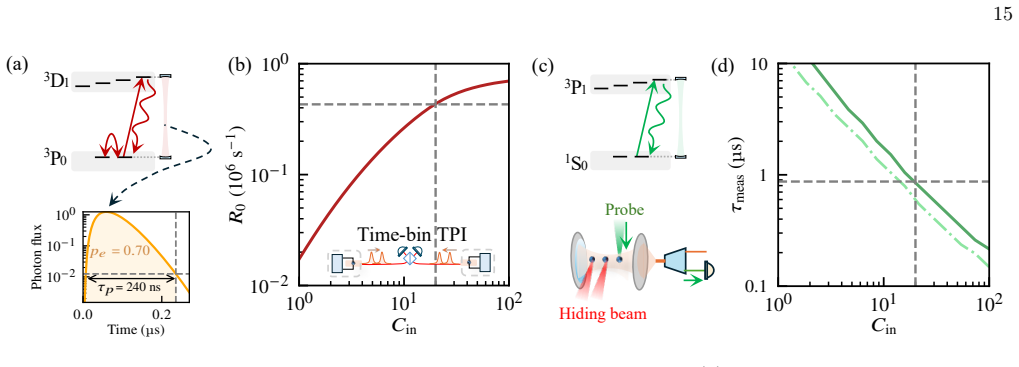
Remote entanglement generation Here, we analyze the performance of remote entan- glement generation assisted by the networking cavity, as summarized in Fig. 6(a). Here, we employ time-bin encoding for telecom-band photon [69, 70, 91], which is well suited for long-distance fiber communication owing to its robustness against polarization and phase fluctua-...
-
[2]
6(c)], which dominantly sets the lo- cal decision latencyτ dec
Fast qubit measurement and reset We next characterize fast qubit measurement enabled by the 556 nm cavity coupled to the cycling transition 1S0 ↔ 3P1 [see Fig. 6(c)], which dominantly sets the lo- cal decision latencyτ dec. The primary figure of merit is the tradeoff between measurement fidelity and probe duration. Since the state discrimination is perfor...
-
[3]
J. S. Bell, On the einstein podolsky rosen paradox, Physics Physique Fizika1, 195 (1964)
1964
-
[4]
Horodecki, P
R. Horodecki, P. Horodecki, M. Horodecki, and K. Horodecki, Quantum entanglement, Rev. Mod. Phys. 81, 865 (2009)
2009
-
[5]
Brunner, D
N. Brunner, D. Cavalcanti, S. Pironio, V. Scarani, and S. Wehner, Bell nonlocality, Reviews of Modern Physics 86, 419–478 (2014)
2014
-
[6]
Aspect, P
A. Aspect, P. Grangier, and G. Roger, Experimental tests of realistic local theories via bell’s theorem, Phys. Rev. Lett.47, 460 (1981)
1981
-
[7]
M. A. Rowe, D. Kielpinski, V. Meyer, C. A. Sackett, W. M. Itano, C. Monroe, and D. J. Wineland, Experi- mental violation of a bell’s inequality with efficient de- tection, Nature409, 791 (2001)
2001
-
[8]
Hensen, H
B. Hensen, H. Bernien, A. E. Dr´ eau, A. Reiserer, N. Kalb, M. S. Blok, J. Ruitenberg, R. F. L. Vermeulen, R. N. Schouten, C. Abell´ an, W. Amaya, V. Pruneri, M. W. Mitchell, M. Markham, D. J. Twitchen, D. Elk- ouss, S. Wehner, T. H. Taminiau, and R. Hanson, Loophole-free bell inequality violation using electron spins separated by 1.3 kilometres, Nature52...
2015
-
[9]
Rauch, J
D. Rauch, J. Handsteiner, A. Hochrainer, J. Gallicchio, A. S. Friedman, C. Leung, B. Liu, L. Bulla, S. Ecker, F. Steinlechner, R. Ursin, B. Hu, D. Leon, C. Benn, A. Ghedina, M. Cecconi, A. H. Guth, D. I. Kaiser, T. Scheidl, and A. Zeilinger, Cosmic bell test using ran- dom measurement settings from high-redshift quasars, Phys. Rev. Lett.121, 080403 (2018)
2018
-
[10]
D. P. Nadlinger, P. Drmota, B. C. Nichol, G. Araneda, D. Main, R. Srinivas, D. M. Lucas, C. J. Ballance, K. Ivanov, E.-Z. Tan,et al., Experimental quantum key distribution certified by bell’s theorem, Nature607, 682 (2022)
2022
-
[11]
Storz, J
S. Storz, J. Sch¨ ar, A. Kulikov, P. Magnard, P. Kurpiers, J. L¨ utolf, T. Walter, A. Copetudo, K. Reuer, A. Akin, et al., Loophole-free bell inequality violation with su- perconducting circuits, Nature617, 265 (2023)
2023
-
[12]
Buhrman, R
H. Buhrman, R. Cleve, S. Massar, and R. de Wolf, Nonlocality and communication complexity, Reviews of Modern Physics82, 665–698 (2010)
2010
-
[13]
Cleve, P
R. Cleve, P. Hoyer, B. Toner, and J. Watrous, Conse- quences and limits of nonlocal strategies, inProceedings. 19th IEEE Annual Conference on Computational Com- plexity, 2004.(IEEE) p. 236–249
2004
-
[14]
Brassard, A
G. Brassard, A. Broadbent, and A. Tapp, Quantum pseudo-telepathy, Foundations of Physics35, 1877–1907 (2005)
1907
-
[15]
J. F. Clauser, M. A. Horne, A. Shimony, and R. A. Holt, Proposed experiment to test local hidden-variable theories, Phys. Rev. Lett.23, 880 (1969)
1969
-
[16]
Aspect, J
A. Aspect, J. Dalibard, and G. Roger, Experimental test of bell’s inequalities using time-varying analyzers, Phys. Rev. Lett.49, 1804 (1982)
1982
-
[17]
J.-W. Pan, D. Bouwmeester, M. Daniell, H. Weinfurter, and A. Zeilinger, Experimental test of quantum nonlo- cality in three-photon Greenberger–Horne–Zeilinger en- tanglement, Nature403, 515 (2000)
2000
-
[18]
Xu, Y.-Z
J.-M. Xu, Y.-Z. Zhen, Y.-X. Yang, Z.-M. Cheng, Z.- C. Ren, K. Chen, X.-L. Wang, and H.-T. Wang, Ex- perimental demonstration of quantum pseudotelepathy, Phys. Rev. Lett.129, 050402 (2022)
2022
-
[19]
Drmota, D
P. Drmota, D. Main, E. M. Ainley, A. Agrawal, G. Araneda, D. P. Nadlinger, B. C. Nichol, R. Srinivas, A. Cabello, and D. M. Lucas, Experimental quantum advantage in the odd-cycle game, Phys. Rev. Lett.134, 070201 (2025)
2025
-
[20]
How to factor 2048 bit RSA integers with less than a million noisy qubits
C. Gidney, How to factor 2048 bit rsa integers with less than a million noisy qubits (2025), arXiv:2505.15917 [quant-ph]
work page internal anchor Pith review arXiv 2048
-
[21]
H. Zhou, C. Duckering, C. Zhao, D. Bluvstein, M. Cain, A. Kubica, S.-T. Wang, and M. D. Lukin, Resource analysis of low-overhead transversal architectures for re- configurable atom arrays, inProceedings of the 52nd An- nual International Symposium on Computer Architec- ture, ISCA ’25 (Association for Computing Machinery, New York, NY, USA, 2025) p. 1432–1448
2025
-
[22]
Zapatero, T
V. Zapatero, T. van Leent, R. Arnon-Friedman, W.- Z. Liu, Q. Zhang, H. Weinfurter, and M. Curty, Ad- vances in device-independent quantum key distribution, npj Quantum Information9, 10 (2023)
2023
-
[23]
Pironio, A
S. Pironio, A. Ac´ ın, S. Massar, A. B. de La Giroday, D. N. Matsukevich, P. Maunz, S. Olmschenk, D. Hayes, L. Luo, T. A. Manning,et al., Random numbers certi- fied by bell’s theorem, Nature464, 1021 (2010)
2010
-
[24]
ˇSupi´ c and J
I. ˇSupi´ c and J. Bowles, Self-testing of quantum systems: a review, Quantum4, 337 (2020)
2020
-
[25]
D. Ding and L. Jiang, Coordinating decisions via quan- tum telepathy (2025), arXiv:2407.21723 [quant-ph]
-
[26]
V. Arun, V. Chidambaram, and S. Aaronson, Faster- than-light coordination for networked systems with quantum non-local games, inProceedings of the 24th ACM Workshop on Hot Topics in Networks, HotNets ’25 (ACM, 2025) p. 10–18
2025
-
[27]
F. F. da Silva and S. Wehner, Entanglement improves coordination in distributed systems, inProceedings of the 2nd Workshop on Quantum Networks and Dis- 22 tributed Quantum Computing, SIGCOMM ’25 (ACM,
-
[28]
Zhang, S
Y. Zhang, S. Glancy, and E. Knill, Asymptotically opti- mal data analysis for rejecting local realism, Phys. Rev. A84, 062118 (2011)
2011
-
[29]
Elkouss and S
D. Elkouss and S. Wehner, (nearly) optimal p values for all bell inequalities, npj Quantum Information2, 16026 (2016)
2016
-
[30]
Ara´ ujo, F
M. Ara´ ujo, F. Hirsch, and M. T. Quintino, Bell nonlo- cality with a single shot, Quantum4, 353 (2020)
2020
-
[31]
Reiserer and G
A. Reiserer and G. Rempe, Cavity-based quantum net- works with single atoms and optical photons, Reviews of Modern Physics87, 1379–1418 (2015)
2015
-
[32]
Bluvstein, S
D. Bluvstein, S. J. Evered, A. A. Geim, S. H. Li, H. Zhou, T. Manovitz, S. Ebadi, M. Cain, M. Kalinowski, D. Hangleiter, J. P. Bonilla Ataides, N. Maskara, I. Cong, X. Gao, P. Sales Ro- driguez, T. Karolyshyn, G. Semeghini, M. J. Gullans, M. Greiner, V. Vuleti´ c, and M. D. Lukin, Logical quan- tum processor based on reconfigurable atom arrays, Na- ture62...
2024
-
[33]
H. J. Manetsch, G. Nomura, E. Bataille, X. Lv, K. H. Leung, and M. Endres, A tweezer array with 6,100 highly coherent atomic qubits, Nature647, 60 (2025)
2025
-
[34]
Henriet, L
L. Henriet, L. Beguin, A. Signoles, T. Lahaye, A. Browaeys, G.-O. Reymond, and C. Jurczak, Quan- tum computing with neutral atoms, Quantum4, 327 (2020)
2020
-
[35]
J. P. Covey, A. Sipahigil, S. Szoke, N. Sinclair, M. En- dres, and O. Painter, Telecom-band quantum optics with ytterbium atoms and silicon nanophotonics, Phys. Rev. Appl.11, 034044 (2019)
2019
-
[36]
Li and J
Y. Li and J. D. Thompson, High-rate and high-fidelity modular interconnects between neutral atom quantum processors, PRX Quantum5, 020363 (2024)
2024
-
[37]
Sunami, S
S. Sunami, S. Tamiya, R. Inoue, H. Yamasaki, and A. Goban, Scalable networking of neutral-atom qubits: Nanofiber-based approach for multiprocessor fault- tolerant quantum computers, PRX Quantum6, 010101 (2025)
2025
-
[38]
Sinclair, J
J. Sinclair, J. Ramette, B. Grinkemeyer, D. Bluvstein, M. D. Lukin, and V. Vuleti´ c, Fault-tolerant optical in- terconnects for neutral-atom arrays, Phys. Rev. Res.7, 013313 (2025)
2025
-
[39]
Deist, Y.-H
E. Deist, Y.-H. Lu, J. Ho, M. K. Pasha, J. Zeiher, Z. Yan, and D. M. Stamper-Kurn, Mid-circuit cavity measurement in a neutral atom array, Phys. Rev. Lett. 129, 203602 (2022)
2022
-
[40]
Wang, D.-Y
J. Wang, D.-Y. Huang, X.-L. Zhou, Z.-M. Shen, S.-J. He, Q.-Y. Huang, Y.-J. Liu, C.-F. Li, and G.-C. Guo, Ultrafast high-fidelity state readout of single neutral atom, Phys. Rev. Lett.134, 240802 (2025)
2025
-
[41]
Grinkemeyer, E
B. Grinkemeyer, E. Guardado-Sanchez, I. Dimitrova, D. Shchepanovich, G. E. Mandopoulou, J. Borregaard, V. Vuleti´ c, and M. D. Lukin, Error-detected quantum operations with neutral atoms mediated by an optical cavity, Science387, 1301 (2025)
2025
-
[42]
Horodecki and M
K. Horodecki and M. Stankiewicz, Semi-device- independent quantum money, New Journal of Physics 22, 023007 (2020)
2020
-
[43]
Bozzio, C
M. Bozzio, C. Cr´ epeau, P. Wallden, and P. Walther, Quantum cryptography beyond key distribution: The- ory and experiment, Rev. Mod. Phys.97, 045006 (2025)
2025
-
[44]
Meier and H
F. Meier and H. Yamasaki, Energy-consumption advan- tage of quantum computation, PRX Energy4, 023008 (2025)
2025
- [45]
-
[46]
H. Tang, B. Li, G. Wang, H. Xu, C. Li, A. Barr, P. Cap- pellaro, and J. Li, Communication-efficient quantum al- gorithm for distributed machine learning, Phys. Rev. Lett.130, 150602 (2023)
2023
-
[47]
Ac´ ın, N
A. Ac´ ın, N. Gisin, and B. Toner, Grothendieck’s con- stant and local models for noisy entangled quantum states, Phys. Rev. A73, 062105 (2006)
2006
-
[48]
V´ ertesi, More efficient bell inequalities for werner states, Phys
T. V´ ertesi, More efficient bell inequalities for werner states, Phys. Rev. A78, 032112 (2008)
2008
-
[49]
Rosenfeld, D
W. Rosenfeld, D. Burchardt, R. Garthoff, K. Redeker, N. Ortegel, M. Rau, and H. Weinfurter, Event-ready bell test using entangled atoms simultaneously closing detection and locality loopholes, Phys. Rev. Lett.119, 010402 (2017)
2017
-
[50]
arms race
M. Aquilina, E. Budish, and P. O’Neill, Quantifying the high-frequency trading “arms race”, The Quarterly Journal of Economics137, 493–564 (2021)
2021
-
[51]
A¨ ıt-Sahalia, J
Y. A¨ ıt-Sahalia, J. Fan, L. Xue, and Y. Zhou, How and when are high-frequency stock returns predictable?, Na- tional Bureau of Economic Research Working Paper , 30366 (2022)
2022
-
[52]
Huth and F
N. Huth and F. Abergel, High frequency lead/lag re- lationships — empirical facts, Journal of Empirical Fi- nance26, 41–58 (2014)
2014
-
[53]
Brogaard, T
J. Brogaard, T. Hendershott, and R. Riordan, High- frequency trading and price discovery, Review of Finan- cial Studies27, 2267–2306 (2014)
2014
-
[54]
North American Electric Reliability Corporation, Reli- ability guideline: Forced oscillation monitoring & miti- gation (2017)
2017
-
[55]
North American Electric Reliability Corporation, Relia- bility guideline: Pmu placement and installation (2017)
2017
-
[56]
Anderson, J
B. Anderson, J. Reilly, , and V. Krishnan, Load control for frequency response – a literature review, NREL/TP- 5000-77780 (2022)
2022
-
[57]
J. Hu, C. Zeng, Z. Wang, H. Xu, J. Huang, and K. Chen, Load balancing in pfc-enabled datacenter networks, in Proceedings of the 6th Asia-Pacific Workshop on Net- working, APNet 2022 (ACM, 2022) p. 21–28
2022
-
[58]
Alizadeh, T
M. Alizadeh, T. Edsall, S. Dharmapurikar, R. Vaidyanathan, K. Chu, A. Fingerhut, V. T. Lam, F. Matus, R. Pan, N. Yadav, and G. Varghese, Conga: distributed congestion-aware load balancing for datacenters, inProceedings of the 2014 ACM confer- ence on SIGCOMM, SIGCOMM’14 (ACM, 2014) p. 503–514
2014
-
[59]
L. Yu, J. Sonchack, and V. Liu, OrbWeaver: Using IDLE cycles in programmable networks for opportunis- tic coordination, in19th USENIX Symposium on Net- worked Systems Design and Implementation (NSDI 22) (USENIX Association, Renton, WA, 2022) pp. 1195– 1212
2022
-
[60]
Vasudevan, A
V. Vasudevan, A. Phanishayee, H. Shah, E. Krevat, D. G. Andersen, G. R. Ganger, G. A. Gibson, and B. Mueller, Safe and effective fine-grained tcp retrans- missions for datacenter communication, ACM SIG- COMM Computer Communication Review39, 303–314 23 (2009)
2009
-
[61]
M. L. Almeida, S. Pironio, J. Barrett, G. T´ oth, and A. Ac´ ın, Noise robustness of the nonlocality of entangled quantum states, Phys. Rev. Lett.99, 040403 (2007)
2007
-
[62]
R. F. Werner, Quantum states with einstein-podolsky- rosen correlations admitting a hidden-variable model, Physical Review A40, 4277–4281 (1989)
1989
-
[63]
C. H. Bennett, D. P. DiVincenzo, J. A. Smolin, and W. K. Wootters, Mixed-state entanglement and quan- tum error correction, Phys. Rev. A54, 3824 (1996)
1996
-
[64]
Epping, H
M. Epping, H. Kampermann, and D. Bruß, Designing bell inequalities from a tsirelson bound, Phys. Rev. Lett. 111, 240404 (2013)
2013
-
[65]
Acharya, D
R. Acharya, D. A. Abanin, L. Aghababaie-Beni, I. Aleiner, T. I. Andersen, M. Ansmann, F. Arute, K. Arya, A. Asfaw, N. Astrakhantsev, J. Atalaya, R. Babbush, D. Bacon, B. Ballard, J. C. Bardin, et al., Quantum error correction below the surface code threshold, Nature638, 920 (2024)
2024
-
[66]
Muzi Falconi, R
A. Muzi Falconi, R. Panza, S. Sbernardori, R. Forti, R. Klemt, O. Abdel Karim, M. Marinelli, and F. Scazza, Microsecond-scale high-survival and number-resolved detection of ytterbium atom arrays, Phys. Rev. Lett. 135, 203402 (2025)
2025
-
[67]
S. Ma, G. Liu, P. Peng, B. Zhang, S. Jandura, J. Claes, A. P. Burgers, G. Pupillo, S. Puri, and J. D. Thompson, High-fidelity gates and mid-circuit erasure conversion in an atomic qubit, Nature622, 279 (2023)
2023
-
[68]
Alexander, A
K. Alexander, A. Benyamini, D. Black, D. Bonneau, S. Burgos, B. Burridge, H. Cable, G. Campbell,et al., A manufacturable platform for photonic quantum com- puting, Nature641, 876 (2025)
2025
-
[69]
H. K. Beukers, M. Pasini, H. Choi, D. Englund, R. Han- son, and J. Borregaard, Remote-entanglement proto- cols for stationary qubits with photonic interfaces, PRX Quantum5, 010202 (2024)
2024
-
[70]
Krutyanskiy, M
V. Krutyanskiy, M. Canteri, M. Meraner, J. Bate, V. Krcmarsky, J. Schupp, N. Sangouard, and B. P. Lanyon, Telecom-wavelength quantum repeater node based on a trapped-ion processor, Phys. Rev. Lett.130, 213601 (2023)
2023
-
[71]
S. Saha, M. Shalaev, J. O’Reilly, I. Goetting, G. Toh, A. Kalakuntla, Y. Yu, and C. Monroe, High-fidelity re- mote entanglement of trapped atoms mediated by time- bin photons, Nature Communications16, 2533 (2025)
2025
-
[72]
L. Li, X. Hu, Z. Jia, W. Huie, W. K. C. Sun, Aakash, Y. Dong, N. Hiri-O-Tuppa, and J. P. Covey, Paral- lelized telecom quantum networking with an ytterbium- 171 atom array, Nature Physics21, 1826 (2025)
2025
-
[73]
Hartung, M
L. Hartung, M. Seubert, S. Welte, E. Distante, and G. Rempe, A quantum-network register assembled with optical tweezers in an optical cavity, Science385, 179 (2024)
2024
-
[74]
Simon and W
C. Simon and W. T. M. Irvine, Robust long-distance entanglement and a loophole-free bell test with ions and photons, Phys. Rev. Lett.91, 110405 (2003)
2003
-
[75]
W. Huie, S. G. Menon, H. Bernien, and J. P. Covey, Multiplexed telecommunication-band quantum networking with atom arrays in optical cavities, Phys. Rev. Res.3, 043154 (2021)
2021
-
[76]
K. R. Brown, J. Kim, and C. Monroe, Co-designing a scalable quantum computer with trapped atomic ions, npj Quantum Information2, 16034 (2016)
2016
-
[77]
A. M. Kaufman and K.-K. Ni, Quantum science with optical tweezer arrays of ultracold atoms and molecules, Nature Physics17, 1324 (2021)
2021
-
[78]
Ransfordet al., Helios: A 98-qubit trapped-ion quantum computer (2025), arXiv:2511.05465 [quant-ph]
A. Ransford et al., Helios: A 98-qubit trapped-ion quan- tum computer (2025), arXiv:2511.05465 [quant-ph]
-
[79]
van Leent, M
T. van Leent, M. Bock, F. Fertig, R. Garthoff, S. Eppelt, Y. Zhou, P. Malik, M. Seubert, T. Bauer, W. Rosen- feld, W. Zhang, C. Becher, and H. Weinfurter, Entan- gling single atoms over 33 km telecom fibre, Nature607, 69–73 (2022)
2022
-
[80]
Long-lived remote ion-ion entangle- ment for scalable quantum repeaters
W.-Z. Liu, Y.-B. Zhou, J.-P. Chen, B. Wang, A. Teng, X.-W. Han, G.-C. Liu, Z.-J. Zhang, Y. Yang, F.-G. Liu, C.-H. Xue, B.-W. Yang, J. Yang, C. Zeng, D.-R. Pan, M.-Y. Zheng, X. Zhang, S. Cao, Y.-Z. Zhen, Y. Xiao, H. Li, L. You, X. Ma, Q. Zhao, F. Xu, Y. Wang, Y. Wan, Q. Zhang, and J.-W. Pan, Long-lived remote ion–ion entanglement for scalable quantum repea...
discussion (0)
Sign in with ORCID, Apple, or X to comment. Anyone can read and Pith papers without signing in.