Recognition: unknown
Axion-like Particles and Lepton Flavor Violation in Muonic Atoms
Pith reviewed 2026-05-10 17:23 UTC · model grok-4.3
The pith
Laboratory constraints from muon decays and the electron magnetic moment cap the ALP-mediated branching ratio for muon-electron conversion in muonic atoms at O(10^{-20}) in aluminum.
A machine-rendered reading of the paper's core claim, the machinery that carries it, and where it could break.
Core claim
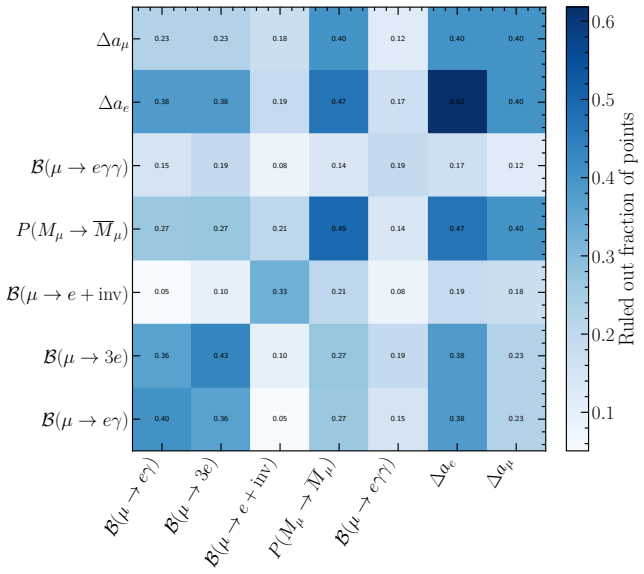
In the simplified ALP framework with flavor-violating e-μ couplings and a flavor-diagonal pseudoscalar electron coupling, the ALP-mediated contribution to the μ⁻ e⁻ → e⁻ e⁻ transition rate in a muonic atom, after all laboratory constraints are applied, yields a branching ratio at most O(10^{-20}) for aluminum; the resonant region 2m_e < m_a < m_μ - m_e is far more suppressed, and Δa_e excludes the largest fraction of the scanned parameter space.
What carries the argument
The ALP-exchange amplitude for the μ⁻ e⁻ → e⁻ e⁻ transition inside the muonic atom, computed at fixed couplings and then subjected to global constraints from muon decays, magnetic moments, and muonium oscillations.
If this is right
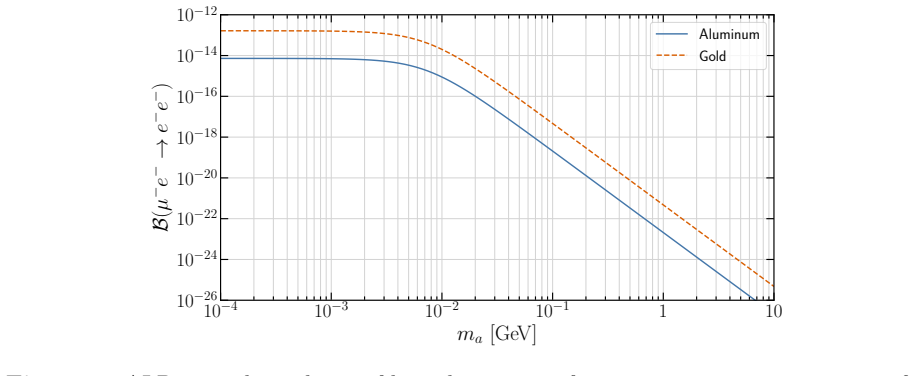
- The branching ratio scales as (Z-1)^3, so searches in heavier nuclei such as lead or gold would be more sensitive at fixed ALP couplings.
- The largest viable rates remain tied to values of B(μ→3e) near its present experimental limit, placing the most relevant parameter space within reach of the Mu3e experiment.
- Invisible ALP decays to a dark sector are permitted but do not open new viable regions for the muonic-atom signal once laboratory bounds are imposed.
- Light mediators enhance the rate at fixed couplings but are already excluded over most of the space by Δa_e and other processes.
Where Pith is reading between the lines
- If the simplified model is correct, precision measurements of the electron magnetic moment will remain the dominant constraint on this class of ALP explanations for lepton flavor violation.
- Extending the framework to include additional scalar or vector mediators could alter the relative importance of Δa_e versus μ→3e and potentially reopen higher-rate windows.
- The (Z-1)^3 scaling suggests that dedicated searches in high-Z muonic atoms could be prioritized even if Mu2e on aluminum yields a null result.
- The suppression of the resonant window implies that off-shell ALP exchange dominates any observable signal, favoring broad searches over narrow mass windows.
Load-bearing premise
The analysis rests on a simplified ALP model that assumes only the stated flavor-violating e-μ and diagonal electron couplings without extra new physics that could change the rates or relax the existing bounds.
What would settle it
An observation of the μ⁻ e⁻ → e⁻ e⁻ branching ratio in aluminum above O(10^{-20}) while remaining consistent with current limits on Δa_e and B(μ→3e) would falsify the claim that laboratory constraints restrict the rate to this level.
Figures


read the original abstract
We explore the potential of the Mu2e experiment to probe the lepton-flavor-violating process $\mu^- e^- \to e^- e^-$ in a muonic atom within a simplified axion-like particle (ALP) framework featuring flavor-violating $e$-$\mu$ couplings and a flavor-diagonal pseudoscalar coupling to electrons, which also allows for possible invisible ALP decays into a dark sector. We compute the ALP-mediated contribution to the transition rate and show that, at fixed couplings, the branching ratio increases for lighter mediators and scales as $(Z-1)^3$, favoring heavier nuclei. We compare the model against constraints from $\mu\to e\gamma$, $\mu\to 3e$, $\mu\to e\gamma\gamma$, $\mu\to e+\mathrm{inv}$, and muonium-antimuonium conversion, as well as from the anomalous magnetic moments of the electron and muon. Additional astrophysical and beam-dump limits on the electron coupling are also discussed. A key result is that $\Delta a_e$ provides one of the most stringent probes of the parameter space and, in the global scan, excludes the largest fraction of sampled points. After applying the laboratory constraints used in the scan, the viable branching ratio for $\mu^- e^- \to e^- e^-$ in aluminum drops to at most $\mathcal{O}(10^{-20})$, while the resonant region $2m_e<m_a<m_\mu-m_e$ is much more heavily suppressed. The highest achievable values are closely tied to $\mathcal{B}(\mu\to 3e)$ near its current limit, indicating that the upcoming Mu3e experiment will explore the most promising region relevant for this muonic-atom signal. Our analysis shows that, although a light ALP can parametrically enhance $\mu^- e^- \to e^- e^-$ at fixed couplings, existing bounds -- especially $\Delta a_e$, $\mu\to 3e$, $\mu\to e\gamma$, and muonium oscillations -- severely limit the observable rate.
Editorial analysis
A structured set of objections, weighed in public.
Referee Report
Summary. The manuscript claims that within a simplified ALP model with flavor-violating e-μ couplings and a flavor-diagonal pseudoscalar electron coupling (allowing invisible decays), the ALP-mediated branching ratio for μ⁻e⁻ → e⁻e⁻ in muonic atoms scales with mediator mass and nuclear charge as (Z-1)³ at fixed couplings. After a global parameter scan subject to laboratory constraints from μ→eγ, μ→3e, μ→eγγ, μ→e+inv, muonium conversion, Δa_e, Δa_μ, and astrophysical/beam-dump limits, the viable branching ratio in aluminum is at most O(10^{-20}), with the resonant window 2m_e < m_a < m_μ - m_e more suppressed. Δa_e excludes the largest fraction of points and is among the strongest probes; the highest rates remain tied to the current μ→3e limit, so Mu3e will probe the most relevant region for this signal.
Significance. If the central results hold, the work provides a concrete benchmark showing that existing constraints render this particular ALP-mediated LFV signal in muonic atoms unobservably small for Mu2e, while underscoring the complementary power of Mu3e. The parametric study of mass and Z dependence, together with the comprehensive multi-constraint scan that quantifies exclusion fractions, offers a useful reference for ALP model building with LFV. Credit is due for the explicit inclusion of invisible ALP decays and the direct linkage of the muonic-atom rate to near-term experimental sensitivities.
major comments (2)
- [Section 4] Section 4 (anomalous magnetic moments): The bound from Δa_e on |g_aee| is applied directly to restrict the flavor-violating coupling g_aeμ in the scan, and this drives the O(10^{-20}) upper limit on the branching ratio. The manuscript does not vary the net Δa_e by allowing additional new-physics contributions that could offset the ALP loop term. This assumption is load-bearing for the suppression claim; a concrete test is to augment the scan with a free offset parameter δ(Δa_e) and recompute the post-constraint distribution of branching ratios.
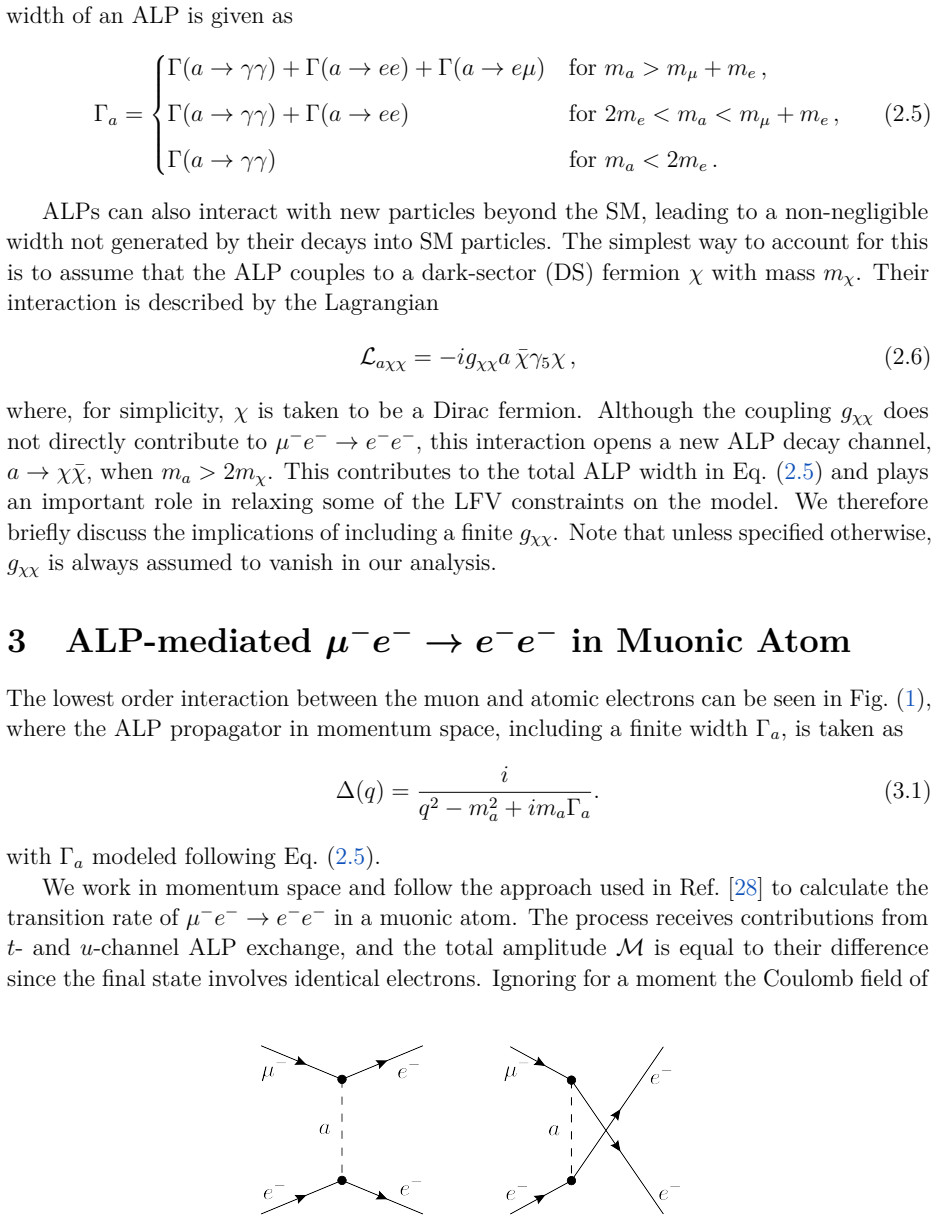
- [Section 3] Section 3 (transition rate): The statement that the branching ratio increases for lighter mediators and scales as (Z-1)³ at fixed couplings is central to identifying heavier nuclei as favorable. The derivation of this Z dependence from the overlap integrals or effective operators should be shown explicitly (including any mass-dependent form factors) to confirm it remains valid through the resonant region 2m_e < m_a < m_μ - m_e.
minor comments (3)
- [Section 2] The notation for the three couplings (g_aee, g_aeμ, and any invisible width parameter) should be introduced with a single equation or table in Section 2 to avoid later ambiguity when quoting numerical bounds.
- Figure 5 (or equivalent scan plot) would benefit from an additional panel or inset showing the distribution of branching ratios before versus after the Δa_e cut, to make the exclusion power visually quantitative.
- [Section 4] A reference to the standard treatment of ALP contributions to (g-2)_e (e.g., the loop integral in the literature) should be added when the Δa_e formula is first written.
Simulated Author's Rebuttal
We thank the referee for the thorough review and insightful comments on our manuscript. We address each major comment below and indicate the revisions we plan to make.
read point-by-point responses
-
Referee: [Section 4] Section 4 (anomalous magnetic moments): The bound from Δa_e on |g_aee| is applied directly to restrict the flavor-violating coupling g_aeμ in the scan, and this drives the O(10^{-20}) upper limit on the branching ratio. The manuscript does not vary the net Δa_e by allowing additional new-physics contributions that could offset the ALP loop term. This assumption is load-bearing for the suppression claim; a concrete test is to augment the scan with a free offset parameter δ(Δa_e) and recompute the post-constraint distribution of branching ratios.
Authors: We appreciate the referee highlighting this important assumption. Our analysis is performed within a simplified ALP model in which the ALP is responsible for both the LFV couplings and the contributions to the anomalous magnetic moments. In this minimal framework, there are no additional new physics contributions to offset the ALP term in Δa_e. Introducing a free offset parameter would necessitate specifying the nature of the additional contributions, which lies beyond the scope of the present work. We will revise the manuscript to explicitly discuss this modeling assumption in Section 4 and note that cancellations from unspecified sources could in principle relax the bounds, though such scenarios would require a more complete model. revision: partial
-
Referee: [Section 3] Section 3 (transition rate): The statement that the branching ratio increases for lighter mediators and scales as (Z-1)³ at fixed couplings is central to identifying heavier nuclei as favorable. The derivation of this Z dependence from the overlap integrals or effective operators should be shown explicitly (including any mass-dependent form factors) to confirm it remains valid through the resonant region 2m_e < m_a < m_μ - m_e.
Authors: We agree that providing the explicit derivation will improve the clarity of the paper. The scaling with (Z-1)^3 originates from the normalization factors in the muon and electron wave functions for a nucleus with charge Z, combined with the overlap integrals of the effective operators generated by ALP exchange. We will add this derivation to Section 3, including the relevant mass-dependent form factors from the ALP propagator. Furthermore, we confirm that this Z dependence remains valid in the resonant region, as the resonance condition affects the propagator but preserves the nuclear overlap structure at fixed couplings. revision: yes
Circularity Check
No significant circularity; derivation uses external constraints and standard formulas
full rationale
The paper derives the ALP-mediated branching ratio for μ⁻e⁻ → e⁻e⁻ from the specified flavor-violating and diagonal couplings using explicit rate formulas, then applies independent laboratory bounds (Δa_e, μ→3e, μ→eγ, muonium conversion, etc.) obtained from external experiments. No quoted step reduces a prediction to a fitted parameter from the same dataset, nor does any central claim rest on a self-citation chain or ansatz imported from the authors' prior work. The suppression to O(10^{-20}) follows directly from intersecting the model with those external limits; the analysis remains self-contained against benchmarks outside the present scan.
Axiom & Free-Parameter Ledger
free parameters (3)
- ALP mass m_a
- Flavor-violating coupling g_{a e μ}
- Electron pseudoscalar coupling g_{a e e}
axioms (2)
- domain assumption ALP is a light pseudoscalar with the specified flavor structure and possible invisible decays
- standard math Standard model background processes and nuclear effects are negligible or correctly subtracted in the rate calculation
invented entities (1)
-
Axion-like particle with flavor-violating e-μ couplings
no independent evidence
Reference graph
Works this paper leans on
-
[1]
Neutrino Masses and Mixing: Evidence and Implications,
M. C. Gonzalez-Garcia and Y. Nir, “Neutrino Masses and Mixing: Evidence and Implications,”Rev. Mod. Phys.75(2003) 345–402,arXiv:hep-ph/0202058
-
[2]
Precision Physics with Muons : A Decade of Theoretical and Experimental Advances,
B. Echenard and A. A. Petrov, “Precision Physics with Muons : A Decade of Theoretical and Experimental Advances,”arXiv:2602.12442 [hep-ph]
-
[3]
Weak Interactions with Lepton-Hadron Symmetry,
S. L. Glashow, J. Iliopoulos, and L. Maiani, “Weak Interactions with Lepton-Hadron Symmetry,”Phys. Rev. D2(1970) 1285–1292
1970
-
[4]
The Processesµ→e+γ,µ→e+e,ν′→ν+γin the Weinberg-Salam Model with Neutrino Mixing,
S. T. Petcov, “The Processesµ→e+γ,µ→e+e,ν′→ν+γin the Weinberg-Salam Model with Neutrino Mixing,”Sov. J. Nucl. Phys.25(1977) 340. [Erratum: Sov.J.Nucl.Phys. 25, 698 (1977), Erratum: Yad.Fiz. 25, 1336 (1977)]
1977
-
[5]
Exotic Decays of the Muon and Heavy Leptons in Gauge Theories,
W. J. Marciano and A. I. Sanda, “Exotic Decays of the Muon and Heavy Leptons in Gauge Theories,”Phys. Lett. B67(1977) 303–305
1977
-
[6]
Charged Lepton-Flavour Violation,
G. Frau and C. Langenbruch, “Charged Lepton-Flavour Violation,”Symmetry16 no. 3, (2024) 359
2024
-
[7]
MEG IICollaboration, K. Afanacievet al., “New limit on theµ+→e+γdecay with the MEG II experiment,”Eur. Phys. J. C85no. 10, (2025) 1177, arXiv:2504.15711 [hep-ex]. [Erratum: Eur.Phys.J.C 85, 1317 (2025)]. [8]MEG IICollaboration, K. Afanacievet al., “A search forµ+→e+γwith the first dataset of the MEG II experiment,”Eur. Phys. J. C84no. 3, (2024) 216, arXiv...
-
[8]
Search for the Decayµ+→e+e+e−,
SINDRUMCollaboration, U. Bellgardtet al., “Search for the Decayµ+→e+e+e−,” Nucl. Phys. B299(1988) 1–6. [11]SINDRUM IICollaboration, W. H. Bertlet al., “A Search for muon to electron conversion in muonic gold,”Eur. Phys. J. C47(2006) 337–346
1988
-
[9]
J. Heeck and M. Sokhashvili, “Lepton flavor violation by two units,”Phys. Lett. B 852(2024) 138621,arXiv:2401.09580 [hep-ph]
- [10]
-
[11]
Willmann et al.,New bounds from searching for muonium to anti-muonium conversion, Phys
L. Willmannet al., “New bounds from searching for muonium to anti-muonium conversion,”Phys. Rev. Lett.82(1999) 49–52,arXiv:hep-ex/9807011. 18
-
[12]
Search for Right-Handed Currents in Muon Decay,
A. Jodidioet al., “Search for Right-Handed Currents in Muon Decay,”Phys. Rev. D 34(1986) 1967. [Erratum: Phys.Rev.D 37, 237 (1988)]. [16]TWISTCollaboration, R. Bayeset al., “Search for two body muon decay signals,” Phys. Rev. D91no. 5, (2015) 052020,arXiv:1409.0638 [hep-ex]
-
[13]
Research Proposal for an Experiment to Search for the Decay µ→eee,
A. Blondelet al., “Research Proposal for an Experiment to Search for the Decay µ→eee,”arXiv:1301.6113 [physics.ins-det]. [18]Mu2eCollaboration, L. Bartoszeket al., “Mu2e Technical Design Report,” arXiv:1501.05241 [physics.ins-det]. [19]COMETCollaboration, R. Abramishviliet al., “COMET Phase-I Technical Design Report,”PTEP2020no. 3, (2020) 033C01, arXiv:18...
-
[14]
Status of the DeeMe Experiment, an Experimental Search forµ-e Conversion at J-PARC MLF,
N. Teshima, “Status of the DeeMe Experiment, an Experimental Search forµ-e Conversion at J-PARC MLF,”PoSNuFact2019(2020) 082,arXiv:1911.07143 [physics.ins-det]
-
[15]
L. Calibbi, D. Redigolo, R. Ziegler, and J. Zupan, “Looking forward to lepton-flavor-violating ALPs,”JHEP09(2021) 173,arXiv:2006.04795 [hep-ph]
-
[16]
Perrevoort,Sensitivity Studies on New Physics in the Mu3e Experiment and Development of Firmware for the Front-End of the Mu3e Pixel Detector
A.-K. Perrevoort,Sensitivity Studies on New Physics in the Mu3e Experiment and Development of Firmware for the Front-End of the Mu3e Pixel Detector. PhD thesis, U. Heidelberg (main), 2018
2018
-
[17]
Search for Rare Muon Decays with the Crystal Box Detector,
R. D. Boltonet al., “Search for Rare Muon Decays with the Crystal Box Detector,” Phys. Rev. D38(1988) 2077
1988
-
[18]
Bai et al.,Conceptual design of the muonium-to-antimuonium conversion experiment (MACE),Nucl
A.-Y. Baiet al., “Conceptual Design of the Muonium-to-Antimuonium Conversion Experiment (MACE),”arXiv:2410.18817 [hep-ex]
-
[19]
Muonium-antimuonium oscillations in effective field theory,
R. Conlin and A. A. Petrov, “Muonium-antimuonium oscillations in effective field theory,”Phys. Rev. D102no. 9, (2020) 095001,arXiv:2005.10276 [hep-ph]
-
[20]
Conlin,Lepton Flavor Violation And Effective Field Theories
R. Conlin,Lepton Flavor Violation And Effective Field Theories. PhD thesis, Wayne State U., Detroit, Wayne State U., Detroit, 2022
2022
-
[21]
Studying∆L= 2Lepton Flavor Violation with Muons,
A. A. Petrov, R. Conlin, and C. Grant, “Studying∆L= 2Lepton Flavor Violation with Muons,”Universe8no. 3, (2022) 169,arXiv:2203.04161 [hep-ph]
-
[22]
A new idea to search for charged lepton flavor violation using a muonic atom,
M. Koike, Y. Kuno, J. Sato, and M. Yamanaka, “A new idea to search for charged lepton flavor violation using a muonic atom,”Phys. Rev. Lett.105(2010) 121601, arXiv:1003.1578 [hep-ph]
-
[23]
Improved analyses for µ−e−→e−e−in muonic atoms by contact interactions,
Y. Uesaka, Y. Kuno, J. Sato, T. Sato, and M. Yamanaka, “Improved analyses for µ−e−→e−e−in muonic atoms by contact interactions,”Phys. Rev. D93no. 7, (2016) 076006,arXiv:1603.01522 [hep-ph]. 19
-
[24]
Improved analysis for µ−e−→e−e−in muonic atoms by photonic interaction,
Y. Uesaka, Y. Kuno, J. Sato, T. Sato, and M. Yamanaka, “Improved analysis for µ−e−→e−e−in muonic atoms by photonic interaction,”Phys. Rev. D97no. 1, (2018) 015017,arXiv:1711.08979 [hep-ph]
-
[25]
Uesaka,Charged Lepton Flavor Violation Processµ−e−→e−e+ in Muonic Atoms
Y. Uesaka,Charged Lepton Flavor Violation Processµ−e−→e−e+ in Muonic Atoms. PhD thesis, Osaka U., 2018
2018
-
[26]
Y. Kuno, J. Sato, T. Sato, Y. Uesaka, and M. Yamanaka, “Momentum distribution of the electron pair from the charged lepton flavor violating processµ−e−→e−e−in muonic atoms with a polarized muon,”Phys. Rev. D100no. 7, (2019) 075012, arXiv:1908.11653 [hep-ph]
-
[27]
Impact of sterile neutrinos on nuclear-assisted cLFV processes,
A. Abada, V. De Romeri, and A. M. Teixeira, “Impact of sterile neutrinos on nuclear-assisted cLFV processes,”JHEP02(2016) 083,arXiv:1510.06657 [hep-ph]
-
[28]
T. Nomura, H. Okada, and Y. Uesaka, “A radiatively induced neutrino mass model with hidden localU(1)and LFV processesℓi→ℓjγ,µ→eZ′andµe→ee,”JHEP01 (2021) 016,arXiv:2005.05527 [hep-ph]
-
[29]
T. Nomura, H. Okada, and Y. Uesaka, “A two-loop induced neutrino mass model, dark matter, and LFV processesℓi→ℓjγ, andµe→eein a hidden localU(1) symmetry,”Nucl. Phys. B962(2021) 115236,arXiv:2008.02673 [hep-ph]
-
[30]
J. Heeck and W. Rodejohann, “Lepton flavor violation with displaced vertices,”Phys. Lett. B776(2018) 385–390,arXiv:1710.02062 [hep-ph]
-
[31]
Axionlike Particles, Lepton-Flavor Violation, and a New Explanation ofaµand ae,
M. Bauer, M. Neubert, S. Renner, M. Schnubel, and A. Thamm, “Axionlike Particles, Lepton-Flavor Violation, and a New Explanation ofaµand ae,”Phys. Rev. Lett.124 no. 21, (2020) 211803,arXiv:1908.00008 [hep-ph]
-
[32]
C. Cornella, P. Paradisi, and O. Sumensari, “Hunting for ALPs with Lepton Flavor Violation,”JHEP01(2020) 158,arXiv:1911.06279 [hep-ph]
-
[33]
Probingeµflavor-violating ALP at Belle II,
M. Endo, S. Iguro, and T. Kitahara, “Probingeµflavor-violating ALP at Belle II,” JHEP06(2020) 040,arXiv:2002.05948 [hep-ph]
- [34]
- [35]
-
[36]
Probing an intrinsically flavorful ALP via tau-lepton flavor physics,
C.-X. Cui, H. Ishida, S. Matsuzaki, and Y. Shigekami, “Probing an intrinsically flavorful ALP via tau-lepton flavor physics,”Phys. Rev. D105no. 9, (2022) 095033, arXiv:2110.11640 [hep-ph]. 20
-
[37]
G. Haghighat and M. Mohammadi Najafabadi, “Search for lepton-flavor-violating ALPs at a future muon collider and utilization of polarization-induced effects,”Nucl. Phys. B980(2022) 115827,arXiv:2106.00505 [hep-ph]
-
[38]
Searching for flavor-violating ALPs in Higgs boson decays,
H. Davoudiasl, R. Marcarelli, N. Miesch, and E. T. Neil, “Searching for flavor-violating ALPs in Higgs boson decays,”Phys. Rev. D104no. 5, (2021) 055022, arXiv:2105.05866 [hep-ph]
- [39]
- [40]
-
[41]
Lepton-flavor-violating ALP signals with TeV-scale muon beams,
B. Batell, H. Davoudiasl, R. Marcarelli, E. T. Neil, and S. Trojanowski, “Lepton-flavor-violating ALP signals with TeV-scale muon beams,”Phys. Rev. D110 no. 7, (2024) 075039,arXiv:2407.15942 [hep-ph]
-
[42]
L. Calibbi, T. Li, L. Mukherjee, and Y. Yang, “Probing ALP lepton flavor violation at µTRISTAN,”Phys. Rev. D110no. 11, (2024) 115009,arXiv:2406.13234 [hep-ph]
-
[43]
H. Davoudiasl, R. Marcarelli, and E. T. Neil, “Flavor-violating ALPs, electron g-2, and the Electron-Ion Collider,”Phys. Rev. D109no. 11, (2024) 115013, arXiv:2402.17821 [hep-ph]
-
[44]
Axionlike-particle contributions to theµ→e conversion,
K. Fuyuto and E. Mereghetti, “Axionlike-particle contributions to theµ→e conversion,”Phys. Rev. D109no. 7, (2024) 075014
2024
-
[45]
Long-lived axionlike particles from tau decays,
Y. Ema, P. J. Fox, M. Hostert, T. Menzo, M. Pospelov, A. Ray, and J. Zupan, “Long-lived axionlike particles from tau decays,”Phys. Rev. D112no. 11, (2025) 115028,arXiv:2507.15271 [hep-ph]
-
[46]
Manifesting the Invisible Axion at Low-energies,
H. Georgi, D. B. Kaplan, and L. Randall, “Manifesting the Invisible Axion at Low-energies,”Phys. Lett. B169(1986) 73–78
1986
- [47]
-
[48]
FeynCalc 10: Do multiloop integrals dream of computer codes?,
V. Shtabovenko, R. Mertig, and F. Orellana, “FeynCalc 10: Do multiloop integrals dream of computer codes?,”Comput. Phys. Commun.306(2025) 109357, arXiv:2312.14089 [hep-ph]
-
[49]
Total Nuclear Capture Rates for Negative Muons,
T. Suzuki, D. F. Measday, and J. P. Roalsvig, “Total Nuclear Capture Rates for Negative Muons,”Phys. Rev. C35(1987) 2212. 21
1987
-
[50]
Y. Kuno and Y. Okada, “Muon decay and physics beyond the standard model,”Rev. Mod. Phys.73(2001) 151–202,arXiv:hep-ph/9909265
-
[51]
Measurement of the fine-structure constant as a test of the Standard Model
R. H. Parker, C. Yu, W. Zhong, B. Estey, and H. Müller, “Measurement of the fine-structure constant as a test of the Standard Model,”Science360(2018) 191, arXiv:1812.04130 [physics.atom-ph]
work page Pith review arXiv 2018
-
[52]
Determination of the fine-structure constant with an accuracy of 81 parts per trillion,
L. Morel, Z. Yao, P. Cladé, and S. Guellati-Khélifa, “Determination of the fine-structure constant with an accuracy of 81 parts per trillion,”Nature588 no. 7836, (2020) 61–65
2020
-
[53]
The anomalous magnetic moment of the muon in the Standard Model: an update
R. Alibertiet al., “The anomalous magnetic moment of the muon in the Standard Model: an update,”Phys. Rept.1143(2025) 1–158,arXiv:2505.21476 [hep-ph]. [60]Muon g-2Collaboration, G. W. Bennettet al., “Final Report of the Muon E821 Anomalous Magnetic Moment Measurement at BNL,”Phys. Rev. D73(2006) 072003,arXiv:hep-ex/0602035. [61]Muon g-2Collaboration, B. A...
work page internal anchor Pith review arXiv 2025
-
[54]
Measurement of the Positive Muon Anomalous Magnetic Moment to0.20ppm,
Muon g-2Collaboration, D. P. Aguillardet al., “Measurement of the Positive Muon Anomalous Magnetic Moment to0.20ppm,”Phys. Rev. Lett.131no. 16, (2023) 161802,arXiv:2308.06230 [hep-ex]
-
[55]
Measurement of the Positive Muon Anomalous Magnetic Moment to127ppb,
Muon g-2Collaboration, D. P. Aguillardet al., “Measurement of the Positive Muon Anomalous Magnetic Moment to127ppb,”Phys. Rev. Lett.135no. 10, (2025) 101802,arXiv:2506.03069 [hep-ex]. [64]Muon g-2Collaboration, D. P. Aguillardet al., “Detailed report on the measurement of the positive muon anomalous magnetic moment to0.20ppm,”Phys. Rev. D110no. 3, (2024) ...
-
[56]
Muon g-2Collaboration, T. Albahriet al., “Beam dynamics corrections to the Run-1 measurement of the muon anomalous magnetic moment at Fermilab,”Phys. Rev. Accel. Beams24no. 4, (2021) 044002,arXiv:2104.03240 [physics.acc-ph]. 22
-
[57]
T. Aoyamaet al., “The anomalous magnetic moment of the muon in the Standard Model,”Phys. Rept.887(2020) 1–166,arXiv:2006.04822 [hep-ph]
-
[58]
Astrophysical methods to constrain axions and other novel particle phenomena,
G. G. Raffelt, “Astrophysical methods to constrain axions and other novel particle phenomena,”Phys. Rept.198(1990) 1–113
1990
-
[59]
Red giant bound on the axion - electron coupling revisited,
G. Raffelt and A. Weiss, “Red giant bound on the axion - electron coupling revisited,” Phys. Rev. D51(1995) 1495–1498,arXiv:hep-ph/9410205
-
[60]
G. G. Raffelt,Stars as laboratories for fundamental physics: The astrophysics of neutrinos, axions, and other weakly interacting particles. University of Chicago Press, 5, 1996
1996
-
[61]
Neutrino and axion bounds from the globular cluster M5 (NGC 5904),
N. Viaux, M. Catelan, P. B. Stetson, G. Raffelt, J. Redondo, A. A. R. Valcarce, and A. Weiss, “Neutrino and axion bounds from the globular cluster M5 (NGC 5904),” Phys. Rev. Lett.111(2013) 231301,arXiv:1311.1669 [astro-ph.SR]
-
[62]
Revisiting the axion bounds from the Galactic white dwarf luminosity function,
M. M. Miller Bertolami, B. E. Melendez, L. G. Althaus, and J. Isern, “Revisiting the axion bounds from the Galactic white dwarf luminosity function,”JCAP10(2014) 069,arXiv:1406.7712 [hep-ph]. [74]EDEL WEISSCollaboration, E. Armengaudet al., “Searches for electron interactions induced by new physics in the EDELWEISS-III Germanium bolometers,” Phys. Rev. D9...
-
[63]
P. Carenza and G. Lucente, “Supernova bound on axionlike particles coupled with electrons,”Phys. Rev. D104no. 10, (2021) 103007,arXiv:2107.12393 [hep-ph]. [Erratum: Phys.Rev.D 110, 049901 (2024)]
-
[64]
N. Bar, K. Blum, and G. D’Amico, “Is there a supernova bound on axions?,”Phys. Rev. D101no. 12, (2020) 123025,arXiv:1907.05020 [hep-ph]
-
[65]
Search for Axion Production in Low-energy Electron Bremsstrahlung,
D. J. Bechis, T. W. Dombeck, R. W. Ellsworth, E. V. Sager, P. H. Steinberg, L. J. Teig, J. K. Yoh, and R. L. Weitz, “Search for Axion Production in Low-energy Electron Bremsstrahlung,”Phys. Rev. Lett.42(1979) 1511. [Erratum: Phys.Rev.Lett. 43, 90 (1979)]
1979
-
[66]
Search for Neutral Particles in Electron Beam Dump Experiment,
A. Konakaet al., “Search for Neutral Particles in Electron Beam Dump Experiment,” Phys. Rev. Lett.57(1986) 659
1986
-
[67]
A Search for Short Lived Axions in an Electron Beam Dump Experiment,
E. M. Riordanet al., “A Search for Short Lived Axions in an Electron Beam Dump Experiment,”Phys. Rev. Lett.59(1987) 755. 23
1987
-
[68]
Search for Neutral Metastable Penetrating Particles Produced in the SLAC Beam Dump,
J. D. Bjorken, S. Ecklund, W. R. Nelson, A. Abashian, C. Church, B. Lu, L. W. Mo, T. A. Nunamaker, and P. Rassmann, “Search for Neutral Metastable Penetrating Particles Produced in the SLAC Beam Dump,”Phys. Rev. D38(1988) 3375
1988
-
[69]
A Search for Shortlived Particles Produced in an Electron Beam Dump,
A. Bross, M. Crisler, S. H. Pordes, J. Volk, S. Errede, and J. Wrbanek, “A Search for Shortlived Particles Produced in an Electron Beam Dump,”Phys. Rev. Lett.67 (1991) 2942–2945
1991
-
[70]
Low-energy e+ e- scattering,
A. Scherdin, J. Reinhardt, W. Greiner, and B. Muller, “Low-energy e+ e- scattering,” Rept. Prog. Phys.54(1991) 1–52
1991
-
[71]
Search for light neutral objects photoproduced in a crystal strong field and decaying into e+ e- pairs,
G. Bassompierreet al., “Search for light neutral objects photoproduced in a crystal strong field and decaying into e+ e- pairs,”Phys. Lett. B355(1995) 584–594
1995
-
[72]
A viable QCD axion in the MeV mass range,
D. S. M. Alves and N. Weiner, “A viable QCD axion in the MeV mass range,”JHEP 07(2018) 092,arXiv:1710.03764 [hep-ph]
-
[73]
Invisible decays of axion-like particles: constraints and prospects,
L. Darmé, F. Giacchino, E. Nardi, and M. Raggi, “Invisible decays of axion-like particles: constraints and prospects,”JHEP06(2021) 009,arXiv:2012.07894 [hep-ph]
-
[74]
L. Bündgen, R. V. Harlander, S. Y. Klein, and M. C. Schaaf, “FeynGame 3.0” Comput. Phys. Commun.314(2025) 109662,arXiv:2501.04651 [hep-ph]
-
[75]
Matplotlib: A 2d graphics environment,
J. D. Hunter, “Matplotlib: A 2d graphics environment,”Computing in Science & Engineering9no. 3, (2007) 90–95. 24
2007
discussion (0)
Sign in with ORCID, Apple, or X to comment. Anyone can read and Pith papers without signing in.