Recognition: unknown
Tracing Active Galactic Nuclei Properties Through a Changing-look Event
Pith reviewed 2026-05-10 17:37 UTC · model grok-4.3
The pith
Single-epoch black hole mass estimates remain consistent across epochs in a changing-look AGN even as broad lines vary, while the first Boltzmann plot application to its Balmer series yields broad-line-region electron temperatures near 12,
A machine-rendered reading of the paper's core claim, the machinery that carries it, and where it could break.
Core claim
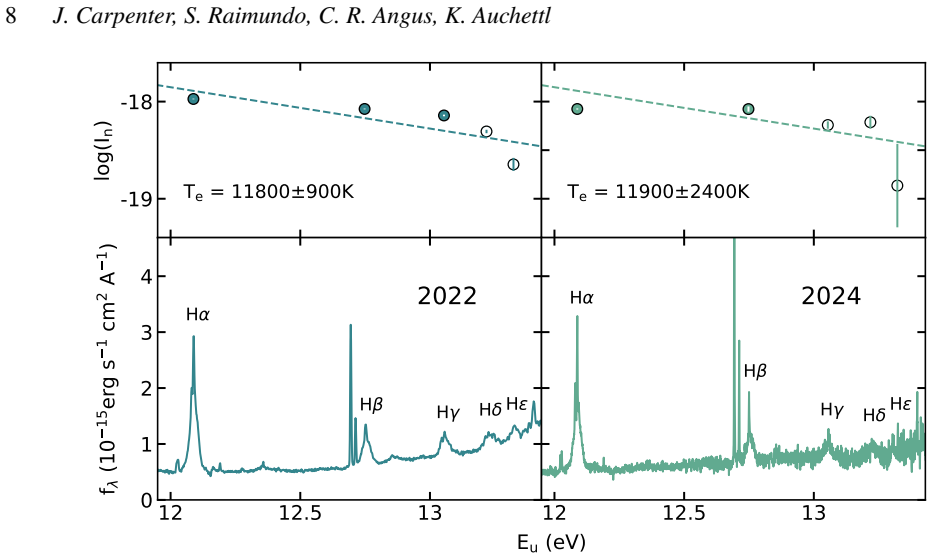
In the changing-look AGN ZTF18abuamgo, multi-epoch spectroscopy spanning twenty years shows a Type 1.5 to Type 1.2 transition driven by a rapid increase in accretion rate, with the Eddington ratio rising from 0.032 ± 0.005 to 0.08 ± 0.01. For the first time in a changing-look AGN the Boltzmann plot method is applied to the visible Balmer series, giving broad-line-region electron temperatures of 11,800 ± 900 K in 2022 and 11,900 ± 2,400 K in 2024. Single-epoch black-hole mass estimation applied to the brightening Hα emission returns a mass of (5.0 ± 0.4) × 10^7 M⊙ that is unchanged across all epochs, indicating that highly variable broad lines do not bias results obtained with this method.
What carries the argument
The Boltzmann plot method applied to the relative intensities of the visible Balmer series lines, which extracts the electron temperature in the broad line region from the slope of the population distribution versus excitation energy.
If this is right
- The transition can occur on timescales as short as four years.
- Broad-line-region electron temperatures can now be measured directly in other changing-look AGNs with the same technique.
- Single-epoch virial mass estimates remain reliable even when broad lines change by large factors.
- Objects like ZTF18abuamgo can serve as laboratories for testing how accretion-rate changes affect broad-line-region conditions.
Where Pith is reading between the lines
- The near-identical temperatures in the dim and bright states imply that broad-line-region thermal conditions may be largely insensitive to moderate changes in accretion rate.
- The method could be applied to a statistical sample of changing-look AGNs to test whether 12,000 K is a typical broad-line-region temperature.
- If reverberation-mapping masses become available for this object, they would provide an independent check on whether the single-epoch value is accurate.
- Multi-wavelength monitoring during future transitions could separate accretion-driven variability from geometric or obscuration effects more cleanly.
Load-bearing premise
The observed changes in continuum flux and broad-line strengths are caused solely by an increase in the central accretion rate and are not produced by variable obscuration or changes in the geometry of the emitting gas.
What would settle it
X-ray or infrared observations that detect a significant increase in absorbing column density or dust emission exactly coinciding with the optical brightening would indicate that obscuration rather than accretion-rate change drives the transition.
Figures



read the original abstract
Changing-look transitions challenge our understanding of active galactic nuclei (AGN), exhibiting dramatic changes in broad-line emission and continuum flux on timescales of months to years. We present a detailed study of the spectroscopically confirmed changing-look AGN ZTF18abuamgo. Combining photometric survey data with spectroscopy spanning three epochs over 20 years, we identify a turn-on transition from a Type 1.5 to Type 1.2 AGN and estimate the timescale of this change to be as short as four years. Spectral analysis indicates that this transformation is driven by a rapid increase in accretion rate, with the Eddington ratio rising from $0.032 \pm 0.005$ in the dim state to $0.08 \pm 0.01$ in the bright state. For the first time in a changing-look AGN, we apply the Boltzmann plot method to the visible Balmer series emission, deriving broad line region electron temperatures of $11,800 \pm 900$ K and $11,900 \pm 2,400$ K in 2022 and 2024, respectively. Applying single-epoch black hole mass estimation to the brightening H$\alpha$ emission, we find a mass of $(5.0 \pm 0.4) \times 10^7 M_\odot$. The consistency in this estimate across all spectroscopic epochs suggest that even highly variable broad lines in CL-AGN do not bias the results derived using this method. Our results demonstrate that objects like ZTF18abuamgo provide a unique laboratory to study extreme AGN variability, probe the physical conditions in the broad line region, and assess the limitations of widely used black hole mass estimation methods.
Editorial analysis
A structured set of objections, weighed in public.
Referee Report
Summary. The manuscript presents multi-epoch photometric and spectroscopic observations of the changing-look AGN ZTF18abuamgo spanning ~20 years. It documents a Type 1.5 to Type 1.2 transition on a timescale as short as four years, attributes the change to an Eddington ratio increase from 0.032±0.005 to 0.08±0.01, applies the Boltzmann plot method to the Balmer series for the first time in a CL-AGN to derive BLR electron temperatures of 11,800±900 K (2022) and 11,900±2,400 K (2024), and reports a consistent single-epoch Hα-based black hole mass of (5.0±0.4)×10^7 M_⊙ across epochs.
Significance. If the physical attribution and temperature derivations hold, the work supplies a rare, well-sampled laboratory for BLR conditions during extreme variability and provides direct evidence that single-epoch virial mass estimates remain stable even when broad lines vary strongly. The first application of the Boltzmann plot in this context and the reported temperature consistency are concrete strengths that could be cited by future studies of CL-AGN.
major comments (2)
- [Abstract] Abstract and spectral-analysis section: the assertion that the Type 1.5→1.2 transition and Eddington-ratio rise are driven solely by an accretion-rate increase is load-bearing for the subsequent claims about unbiased mass estimates and BLR temperatures, yet the manuscript provides no multi-epoch X-ray hardness ratios, UV continuum slopes, or photoionization modeling to exclude variable obscuration or BLR covering-factor changes as viable alternatives.
- [Abstract] Abstract: the Boltzmann-plot temperatures (11,800±900 K and 11,900±2,400 K) and Eddington ratios are presented without the underlying line-flux measurements, continuum-subtraction details, or the explicit linear-fit parameters used to extract T_e; these omissions prevent independent verification of the reported uncertainties and the claim of consistency across epochs.
minor comments (2)
- [Abstract] The phrase 'as short as four years' for the transition timescale should be tied explicitly to the specific photometric or spectroscopic epochs used in the calculation.
- Ensure that all quoted uncertainties (e.g., on mass, Eddington ratio, and temperature) are accompanied by a brief statement of their origin (photometric, spectroscopic, or fitting) in the main text.
Simulated Author's Rebuttal
We thank the referee for their constructive and detailed review of our manuscript. We have addressed each major comment point by point below, providing clarifications and making revisions to the manuscript where appropriate to strengthen the presentation and address concerns about verifiability and alternative interpretations.
read point-by-point responses
-
Referee: [Abstract] Abstract and spectral-analysis section: the assertion that the Type 1.5→1.2 transition and Eddington-ratio rise are driven solely by an accretion-rate increase is load-bearing for the subsequent claims about unbiased mass estimates and BLR temperatures, yet the manuscript provides no multi-epoch X-ray hardness ratios, UV continuum slopes, or photoionization modeling to exclude variable obscuration or BLR covering-factor changes as viable alternatives.
Authors: We thank the referee for this important observation. Our attribution of the transition to an accretion-rate increase is grounded in the multi-epoch photometric brightening of the continuum and the corresponding strengthening of the broad Balmer lines, which directly inform the Eddington ratio estimates. While the current dataset does not include X-ray hardness ratios, UV slopes, or photoionization models, the short observed timescale (as short as four years) and the lack of significant color evolution in the photometry are inconsistent with variable obscuration. To address the concern, we have added an expanded discussion paragraph in the spectral-analysis section that explicitly evaluates variable obscuration and BLR covering-factor changes as alternatives, explaining why the available observations favor an intrinsic accretion-driven change. This revision clarifies the evidential basis without requiring new observations. revision: partial
-
Referee: [Abstract] Abstract: the Boltzmann-plot temperatures (11,800±900 K and 11,900±2,400 K) and Eddington ratios are presented without the underlying line-flux measurements, continuum-subtraction details, or the explicit linear-fit parameters used to extract T_e; these omissions prevent independent verification of the reported uncertainties and the claim of consistency across epochs.
Authors: We agree that the abstract's brevity precludes inclusion of all supporting details. The full manuscript reports the Balmer-series line fluxes in Table 2, describes the continuum-subtraction procedure in Section 3.2, and provides the explicit linear-fit parameters (slopes, intercepts, and uncertainties) for the Boltzmann plots in Section 4.3, from which the electron temperatures are derived via the standard relation. The reported uncertainties incorporate both fit errors and flux measurement uncertainties, and the temperatures are consistent within errors across epochs. To improve accessibility, we have revised the abstract to direct readers to these tables and sections for verification and have added a summary of the fit parameters to the main text. revision: yes
Circularity Check
No circularity in observational derivations or mass/temperature estimates
full rationale
The paper reports direct measurements from multi-epoch photometry and spectroscopy of ZTF18abuamgo. Electron temperatures are obtained by applying the standard Boltzmann plot (linear fit of ln(I/gA) versus upper-level energy) to the observed Balmer line fluxes in the 2022 and 2024 spectra, yielding 11,800 ± 900 K and 11,900 ± 2,400 K. Black-hole mass is computed via the standard single-epoch virial estimator applied to the bright-state Hα luminosity and line width, giving (5.0 ± 0.4) × 10^7 M_⊙; the same estimator applied to all epochs returns statistically consistent values. Eddington ratios are then formed from the observed bolometric luminosity (inferred from continuum flux) divided by the Eddington luminosity for that mass. None of these steps involve fitting a parameter to a subset of the data and then “predicting” a closely related quantity, nor do any equations reduce by algebraic identity to the input measurements. No load-bearing self-citations, uniqueness theorems, or ansatzes imported from prior work by the same authors appear in the provided text. The attribution of the Type 1.5 → 1.2 transition to an accretion-rate increase is an interpretive inference from the observed luminosity rise, not a tautological derivation.
Axiom & Free-Parameter Ledger
free parameters (1)
- Eddington ratio =
0.032 and 0.08
axioms (2)
- domain assumption Broad line region gas is in local thermodynamic equilibrium suitable for Boltzmann plot application to Balmer lines
- domain assumption Single-epoch virial black hole mass estimator remains valid for highly variable broad emission lines
Reference graph
Works this paper leans on
-
[1]
write newline
" write newline "" before.all 'output.state := FUNCTION fin.entry write newline FUNCTION new.block output.state before.all = 'skip after.block 'output.state := if FUNCTION new.sentence output.state after.block = 'skip output.state before.all = 'skip after.sentence 'output.state := if if FUNCTION not #0 #1 if FUNCTION and 'skip pop #0 if FUNCTION or pop #1...
- [2]
-
[3]
Antonucci R., 1993, @doi [Annual Review of Astronomy and Astrophysics] 10.1146/annurev.aa.31.090193.002353 , 31, 473
-
[4]
Baldwin J. A., Phillips M. M., Terlevich R., 1981, @doi [Publications of the Astronomical Society of the Pacific] 10.1086/130766 , 93, 5
-
[5]
Belli S., et al., 2024, @doi [Nature] 10.1038/s41586-024-07412-1 , 630, 54
-
[6]
Bellm E. C., et al., 2019, @doi [Publications of the Astronomical Society of the Pacific] 10.1088/1538-3873/aaecbe , 131, 018002
-
[7]
Bentz M. C., et al., 2013, @doi [The Astrophysical Journal] 10.1088/0004-637X/767/2/149 , 767, 149
-
[8]
Berk D. E. V., et al., 2004, @doi [The Astrophysical Journal] 10.1086/380563 , 601, 692
-
[9]
Blanchard P. K., et al., 2017, @doi [The Astrophysical Journal] 10.3847/1538-4357/aa77f7 , 843, 106
-
[10]
Bont \`a E. D., et al., 2024, Estimating Masses of Supermassive Black Holes in Active Galactic Nuclei from the Halpha Emission Line , http://arxiv.org/abs/2410.21387
-
[11]
M., Camilleri R., Lidman C., Freeman K
Carr A., Davis T. M., Camilleri R., Lidman C., Freeman K. C., Scolnic D., 2024, @doi [Publications of the Astronomical Society of Australia] 10.1017/pasa.2024.74 , 41, e068
-
[12]
Childress M. J., Vogt F. P. A., Nielsen J., Sharp R. G., 2014, @doi [Astrophysics and Space Science] 10.1007/s10509-013-1682-0 , 349, 617
-
[13]
Czerny B., 2006. p. 265, https://ui.adsabs.harvard.edu/abs/2006ASPC..360..265C
2006
-
[14]
Denney K. D., et al., 2014, @doi [The Astrophysical Journal] 10.1088/0004-637X/796/2/134 , 796, 134
-
[15]
A., 1977, Soviet Astronomy Letters, 3, 1
Dibai E. A., 1977, Soviet Astronomy Letters, 3, 1
1977
-
[16]
Dong Q., Zhang Z.-X., Gu W.-M., Sun M., Zheng Y.-G., 2025, @doi [The Astrophysical Journal] 10.3847/1538-4357/add331 , 986, 160
-
[17]
Dopita M., Hart J., McGregor P., Oates P., Bloxham G., Jones D., 2007, @doi [Astrophysics and Space Science] 10.1007/s10509-007-9510-z , 310, 255
-
[18]
Dopita M., et al., 2010, @doi [Astrophysics and Space Science] 10.1007/s10509-010-0335-9 , 327, 245
-
[19]
Drake A. J., et al., 2009, @doi [The Astrophysical Journal] 10.1088/0004-637X/696/1/870 , 696, 870
-
[20]
Elitzur M., Ho L. C., 2009, @doi [The Astrophysical Journal] 10.1088/0004-637X/701/2/L91 , 701, L91
-
[21]
Elitzur M., Shlosman I., 2006, @doi [The Astrophysical Journal] 10.1086/508158 , 648, L101
-
[22]
Eracleous M., Livio M., Halpern J. P., Storchi-Bergmann T., 1995, @doi [The Astrophysical Journal] 10.1086/175104 , 438, 610
-
[23]
Ferrarese L., Merritt D., 2000, @doi [The Astrophysical Journal] 10.1086/312838 , 539, L9
-
[24]
B., et al., 2024, @doi [The Astrophysical Journal] 10.3847/1538-4357/ad7c42 , 975, 239
Fries L. B., et al., 2024, @doi [The Astrophysical Journal] 10.3847/1538-4357/ad7c42 , 975, 239
-
[25]
Gebhardt K., et al., 2000, @doi [The Astrophysical Journal] 10.1086/312840 , 539, L13
-
[26]
Geller M. J., Hwang H. S., Diaferio A., Kurtz M. J., Coe D., Rines K. J., 2014, @doi [The Astrophysical Journal] 10.1088/0004-637X/783/1/52 , 783, 52
-
[27]
Gezari S., 2021, @doi [Annual Review of Astronomy and Astrophysics] 10.1146/annurev-astro-111720-030029 , 59, 21
-
[28]
Green P. J., et al., 2022, @doi [The Astrophysical Journal] 10.3847/1538-4357/ac743f , 933, 180
-
[29]
Estimating Black Hole Masses in Active Galaxies Using the Halpha Emission Line
Greene J. E., Ho L. C., 2005, @doi [The Astrophysical Journal] 10.1086/431897 , 630, 122
-
[30]
ascl:1809.008
Guo H., Shen Y., Wang S., 2018, Astrophysics Source Code Library, p. ascl:1809.008
2018
-
[31]
Hon W. J., Webster R., Wolf C., 2024, Broad-line Active Galactic Nuclei in the 6dF Galaxy Survey , http://arxiv.org/abs/2410.08536
-
[32]
Ilic D., Popovic L. C., La Mura G., Ciroi S., Rafanelli P., 2012, @doi [Astronomy and Astrophysics] 10.1051/0004-6361/201219299 , 543, A142
- [33]
-
[34]
Jin J.-J., Wu X.-B., Feng X.-T., 2022, @doi [The Astrophysical Journal] 10.3847/1538-4357/ac410c , 926, 184
-
[35]
Jones D. H., et al., 2004, @doi [Monthly Notices of the Royal Astronomical Society] 10.1111/j.1365-2966.2004.08353.x , 355, 747
-
[36]
Jones D. H., et al., 2009, @doi [Monthly Notices of the Royal Astronomical Society] 10.1111/j.1365-2966.2009.15338.x , 399, 683
-
[37]
Kaspi S., Smith P. S., Netzer H., Maoz D., Jannuzi B. T., Giveon U., 2000, @doi [The Astrophysical Journal] 10.1086/308704 , 533, 631
-
[38]
Kewley L. J., Groves B., Kauffmann G., Heckman T., 2006, @doi [Monthly Notices of the Royal Astronomical Society] 10.1111/j.1365-2966.2006.10859.x , 372, 961
-
[39]
Kochanek C. S., et al., 2017, @doi [Publications of the Astronomical Society of the Pacific] 10.1088/1538-3873/aa80d9 , 129, 104502
-
[40]
T., 1992, @doi [The Astrophysical Journal Supplement Series] 10.1086/191654 , 79, 285
Korista K. T., 1992, @doi [The Astrophysical Journal Supplement Series] 10.1086/191654 , 79, 285
-
[41]
Korista K. T., Goad M. R., 2004, @doi [The Astrophysical Journal] 10.1086/383193 , 606, 749
-
[42]
Coevolution (Or Not) of Supermassive Black Holes and Host Galaxies
Kormendy J., Ho L. C., 2013, @doi [Annual Review of Astronomy and Astrophysics] 10.1146/annurev-astro-082708-101811 , 51, 511
work page internal anchor Pith review doi:10.1146/annurev-astro-082708-101811 2013
-
[43]
Koss M., et al., 2017, @doi [The Astrophysical Journal] 10.3847/1538-4357/aa8ec9 , 850, 74
-
[44]
Koz owski S., et al., 2010, @doi [The Astrophysical Journal] 10.1088/0004-637X/708/2/927 , 708, 927
-
[45]
LaMassa S. M., et al., 2015, @doi [The Astrophysical Journal] 10.1088/0004-637X/800/2/144 , 800, 144
-
[46]
LaMassa S. M., et al., 2024, Stripe 82X Data Release 3: Multiwavelength Catalog with New Spectroscopic Redshifts and Black Hole Masses , http://arxiv.org/abs/2403.20160
-
[47]
Lopez-Rodriguez E., et al., 2018, @doi [Monthly Notices of the Royal Astronomical Society] 10.1093/mnras/sty1197 , 478, 2350
-
[48]
Lyu J., Rieke G. H., Smith P. S., 2019, @doi [The Astrophysical Journal] 10.3847/1538-4357/ab481d , 886, 33
-
[49]
Lyu B., Wu Q., Yan Z., Yu W., Liu H., 2022, @doi [The Astrophysical Journal] 10.3847/1538-4357/ac5256 , 927, 227
-
[50]
MacLeod C. L., et al., 2016, @doi [Monthly Notices of the Royal Astronomical Society] 10.1093/mnras/stv2997 , 457, 389
-
[51]
MacLeod C. L., et al., 2019, @doi [The Astrophysical Journal] 10.3847/1538-4357/ab05e2 , 874, 8
-
[52]
Magorrian J., et al., 1998, @doi [The Astronomical Journal] 10.1086/300353 , 115, 2285
-
[53]
Mainzer A., et al., 2014, @doi [The Astrophysical Journal] 10.1088/0004-637X/792/1/30 , 792, 30
-
[54]
Merloni A., et al., 2015, @doi [Monthly Notices of the Royal Astronomical Society] 10.1093/mnras/stv1095 , 452, 69
-
[55]
Mura G. L., Popovic L. C., Ciroi S., Rafanelli P., Ilic D., 2007, @doi [The Astrophysical Journal] 10.1086/522821 , 671, 104
-
[56]
L., Ciroi S., Cracco V., Ilic D., Popovic L
Mura G. L., Ciroi S., Cracco V., Ilic D., Popovic L. C., Rafanelli P., 2011, Optical Emission Lines and the X - Ray Properties of Type 1 Seyfert Galaxies , @doi 10.1515/astro-2017-0316 , http://arxiv.org/abs/1108.5335
-
[57]
Netzer H., 1990, in Swiss Society for Astrophysics and Astronomy Courvoisier T. J.-L., Mayor M., eds, , Vol. 20, Active Galactic Nuclei . Springer-Verlag, Berlin/Heidelberg, pp 57--158, @doi 10.1007/3-540-31625-6_2 , http://link.springer.com/10.1007/3-540-31625-6_2
-
[58]
Netzer H., 2019, @doi [Monthly Notices of the Royal Astronomical Society] 10.1093/mnras/stz2016 , 488, 5185
-
[59]
Nicastro F., 2000, @doi [The Astrophysical Journal] 10.1086/312491 , 530, L65
-
[60]
Noda H., Done C., 2018, @doi [Monthly Notices of the Royal Astronomical Society] 10.1093/mnras/sty2032 , 480, 3898
-
[61]
Osterbrock D. E., 1977, @doi [The Astrophysical Journal] 10.1086/155407 , 215, 733
-
[62]
Osterbrock D. E., 1981, @doi [The Astrophysical Journal] 10.1086/159306 , 249, 462
-
[63]
E., Ferland G
Osterbrock D. E., Ferland G. J., 2006, Astrophysics of gaseous nebulae and active galactic nuclei
2006
-
[64]
M., 1997, An Introduction to Active Galactic Nuclei
Peterson B. M., 1997, An Introduction to Active Galactic Nuclei . Cambridge University Press, Cambridge, @doi 10.1017/CBO9781139170901 , https://www.cambridge.org/core/books/an-introduction-to-active-galactic-nuclei/B40D3A6D4D20C0102CB9F1A867B164D0
-
[65]
M., Wandel A., 1999, @doi [The Astrophysical Journal] 10.1086/312190 , 521, L95
Peterson B. M., Wandel A., 1999, @doi [The Astrophysical Journal] 10.1086/312190 , 521, L95
-
[66]
Peterson B. M., et al., 2004, @doi [The Astrophysical Journal] 10.1086/423269 , 613, 682
-
[67]
C., 2003, @doi [The Astrophysical Journal] 10.1086/376401 , 599, 140
Popovic L. C., 2003, @doi [The Astrophysical Journal] 10.1086/376401 , 599, 140
-
[68]
C., 2006, @doi [Serbian Astronomical Journal] 10.2298/SAJ0673001P , 173, 1
Popovic L. C., 2006, @doi [Serbian Astronomical Journal] 10.2298/SAJ0673001P , 173, 1
-
[69]
Popovic L. C., Shapovalova A. I., Chavushyan V. H., Ilic D., Burenkov A. N., Mercado A., Bochkarev N. G., 2008, @doi [Publications of the Astronomical Society of Japan] 10.1093/pasj/60.1.1 , 60, 1
-
[70]
Price I., Nielsen J., Lidman C., Soon J., Travouillon T., Sharp R., 2024, @doi [Publications of the Astronomical Society of Australia] 10.1017/pasa.2024.75 , 41, e057
-
[71]
Raimundo S. I., Vestergaard M., Koay J. Y., Lawther D., Casasola V., Peterson B. M., 2019, @doi [Monthly Notices of the Royal Astronomical Society] 10.1093/mnras/stz852 , 486, 123
-
[72]
Ren W., Guo H., Shen Y., Silverman J. D., Burke C. J., Wang S., Wang J., 2024, @doi [The Astrophysical Journal] 10.3847/1538-4357/ad6e76 , 974, 153
-
[73]
Ricci C., Trakhtenbrot B., 2023, @doi [Nature Astronomy] 10.1038/s41550-023-02108-4 , 7, 1282
-
[74]
Rodrigo C., Solano E., 2020, XIV.0 Scientific Meeting (virtual) of the Spanish Astronomical Society, p. 182
2020
-
[75]
Rodrigo C., Solano E., Bayo A., 2012, @doi [IVOA Working Draft 15 October 2012] 10.5479/ADS/bib/2012ivoa.rept.1015R , p. 1015
-
[76]
Rodrigo C., et al., 2024, @doi [Astronomy and Astrophysics] 10.1051/0004-6361/202449998 , 689, A93
-
[77]
Rumbaugh N., et al., 2018, @doi [The Astrophysical Journal] 10.3847/1538-4357/aaa9b6 , 854, 160
-
[78]
Runnoe J. C., Brotherton M. S., Shang Z., 2012, @doi [Monthly Notices of the Royal Astronomical Society] 10.1111/j.1365-2966.2012.20620.x , 422, 478
-
[79]
Runnoe J. C., et al., 2016, @doi [Monthly Notices of the Royal Astronomical Society] 10.1093/mnras/stv2385 , 455, 1691
-
[80]
Schawinski K., Koss M., Berney S., Sartori L. F., 2015, @doi [Monthly Notices of the Royal Astronomical Society] 10.1093/mnras/stv1136 , 451, 2517
discussion (0)
Sign in with ORCID, Apple, or X to comment. Anyone can read and Pith papers without signing in.