Recognition: unknown
The ZTF-ULTRASAT experiment: Characterizing the non-transients in ULTRASAT's high cadence survey
Pith reviewed 2026-05-10 17:02 UTC · model grok-4.3
The pith
Short-timescale, high-amplitude variable stars can mimic transient alerts in high-cadence ultraviolet surveys.
A machine-rendered reading of the paper's core claim, the machinery that carries it, and where it could break.
Core claim
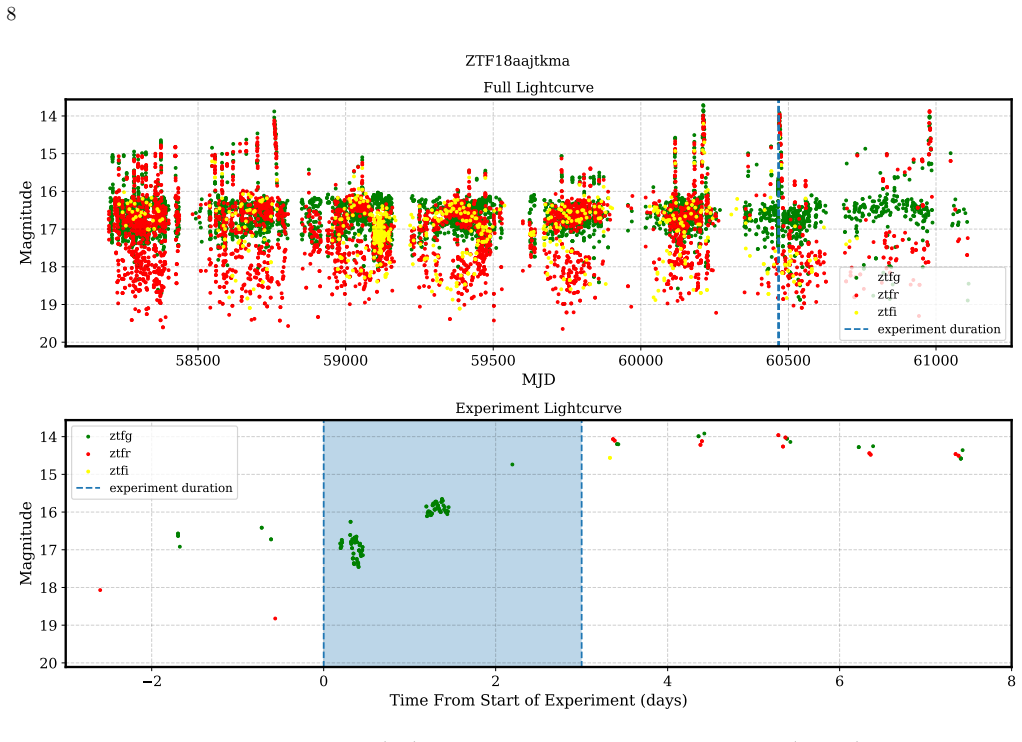
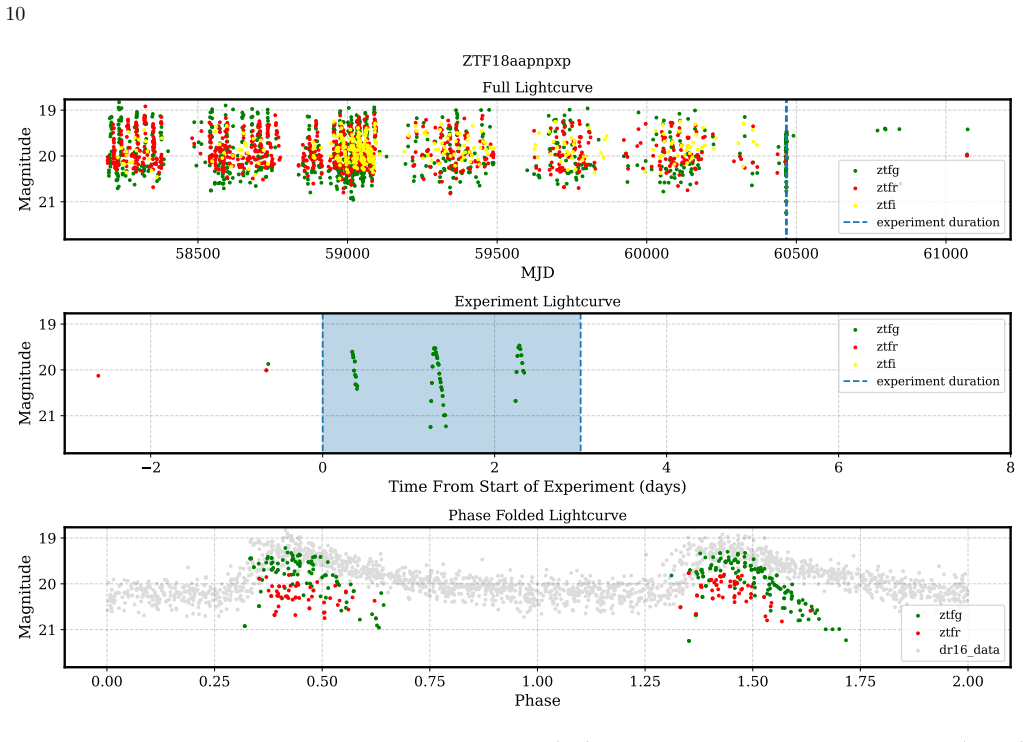
The experiment observed five fields at high cadence over three nights with ZTF, applying a real-time filter that flagged seven transient candidates. Analysis using periods and amplitudes from the Source Classification Project revealed that three were RR Lyrae stars with short periods and high amplitudes, two showed flaring behavior, and two were spurious. This establishes that short-timescale, high-amplitude variables can systematically mimic transient alerts in high-cadence UV surveys, with pre-existing machine learning catalogs offering a concrete mitigation strategy.
What carries the argument
The Source Classification Project machine learning catalogs that supply periods and amplitudes to identify and remove variable star contaminants from transient candidate lists.
Load-bearing premise
Optical variability and contamination rates from ZTF observations are representative of the ultraviolet behavior ULTRASAT will encounter in its high-cadence fields.
What would settle it
Simultaneous or follow-up ultraviolet observations of the same fields revealing substantially different variable contamination rates or types than predicted from the optical ZTF data.
Figures





read the original abstract
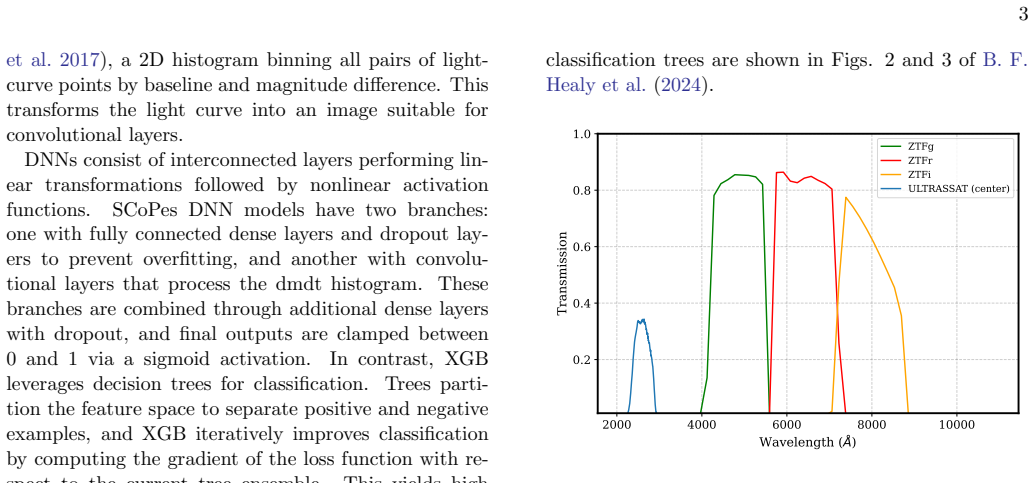
The forthcoming launch of the Ultraviolet Transient Astronomy Satellite (ULTRASAT) will transform our understanding of the transient ultraviolet sky by increasing our ability to identify transients due to its unprecedented 204 deg2 field of view. While rapid (extragalactic) transients are a priority science area for the mission, flaring stars and AGN can often contaminate searches for such objects. To prepare for these challenges, the Zwicky Transient Facility (ZTF)-ULTRASAT experiment observed five fields at high cadence over three nights, in close proximity to ULTRASAT's three northern high-cadence fields. A real-time filter identified seven transient candidates, of which five were persistent variable sources and two were spurious. Periods and amplitudes derived from the ZTF Source Classification Project (SCoPe) showed that three candidates were RR Lyrae stars with short periods and high amplitudes, while the remaining two displayed flaring behavior. We demonstrate that short-timescale, high-amplitude variables can systematically mimic transient alerts in high-cadence UV surveys, and we provide a concrete strategy to this contamination using pre-existing machine learning catalogs.
Editorial analysis
A structured set of objections, weighed in public.
Referee Report
Summary. The paper reports results from the ZTF-ULTRASAT experiment, consisting of high-cadence ZTF observations of five fields near ULTRASAT's northern high-cadence regions over three nights. A real-time transient filter flagged seven candidates, of which five were persistent variables (three short-period, high-amplitude RR Lyrae stars and two flaring sources) identified via the SCoPe machine-learning catalog, while two were spurious. The authors conclude that such variables can systematically mimic transient alerts in high-cadence UV surveys and propose mitigation via pre-existing optical ML catalogs.
Significance. If the optical results translate to the UV regime, the work supplies a low-cost, immediately applicable strategy for reducing stellar contamination in ULTRASAT transient searches by cross-matching against existing catalogs, thereby increasing the purity of the mission's extragalactic transient sample.
major comments (2)
- [Abstract] Abstract: The claim that the identified variables 'can systematically mimic transient alerts in high-cadence UV surveys' rests on ZTF optical data alone. No scaling relations, amplitude corrections, or simulated light curves accounting for the larger UV amplitudes of RR Lyrae pulsations and flares (typically 2-3x optical) are provided to establish equivalent false-positive rates under ULTRASAT's 200-260 nm bandpass, cadence, and depth.
- [Observations] The five observed fields are stated to be 'in close proximity' to ULTRASAT's targets, yet no quantitative comparison of stellar densities, variable-star fractions, or sky coverage statistics is given to demonstrate that these fields adequately sample the target high-cadence regions.
minor comments (2)
- [Results] No data table or light-curve parameters (coordinates, exact periods, amplitudes, SCoPe probabilities) are supplied for the seven candidates, preventing independent verification of the classifications and measurements.
- [Methods] The manuscript lacks any description of the real-time filter thresholds, photometric precision achieved, or error analysis on the derived periods and amplitudes.
Simulated Author's Rebuttal
We thank the referee for their constructive comments, which have helped clarify the scope and limitations of our ZTF-ULTRASAT experiment. We respond to each major comment below.
read point-by-point responses
-
Referee: [Abstract] Abstract: The claim that the identified variables 'can systematically mimic transient alerts in high-cadence UV surveys' rests on ZTF optical data alone. No scaling relations, amplitude corrections, or simulated light curves accounting for the larger UV amplitudes of RR Lyrae pulsations and flares (typically 2-3x optical) are provided to establish equivalent false-positive rates under ULTRASAT's 200-260 nm bandpass, cadence, and depth.
Authors: We agree that the demonstration relies on optical ZTF data as a proxy for ULTRASAT's UV observations. The experiment's goal was to identify real contaminants that trigger high-cadence transient filters and to show that pre-existing ML catalogs (SCoPe) provide an immediate mitigation route. Because ULTRASAT has not yet launched, we lack UV light curves; however, the larger UV amplitudes noted by the referee would increase, rather than decrease, the likelihood of these sources producing alerts. We will revise the abstract and add a short discussion paragraph clarifying the proxy nature of the ZTF data and noting that UV amplitudes are expected to be 2-3 times larger, thereby reinforcing the need for catalog-based filtering. No new simulations are added, as they fall outside the paper's scope of characterizing observed contaminants. revision: partial
-
Referee: [Observations] The five observed fields are stated to be 'in close proximity' to ULTRASAT's targets, yet no quantitative comparison of stellar densities, variable-star fractions, or sky coverage statistics is given to demonstrate that these fields adequately sample the target high-cadence regions.
Authors: The fields were selected to overlap with the planned ULTRASAT northern high-cadence footprint using available mission planning information. While the manuscript states 'close proximity,' we did not include explicit statistics. We will add a short paragraph in the Observations section providing quantitative context, such as the stellar density and known variable fraction (from ZTF and Gaia) in the observed fields compared with the broader ULTRASAT target regions, to demonstrate representativeness. revision: yes
Circularity Check
No significant circularity; empirical characterization from new observations and independent catalog
full rationale
The paper reports new ZTF high-cadence observations of five fields, real-time transient filtering yielding seven candidates, and classification of five as persistent variables (RR Lyrae and flares) using periods/amplitudes from the pre-existing independent SCoPe ML catalog. The central claim and mitigation strategy rest on this direct data cross-check rather than any derivation, fit, or self-referential equation. No load-bearing self-citations, ansatzes, or renamings reduce the result to its inputs; the work is self-contained against external benchmarks.
Axiom & Free-Parameter Ledger
axioms (1)
- domain assumption Optical variability observed by ZTF accurately predicts contamination behavior in ULTRASAT's ultraviolet bands.
Reference graph
Works this paper leans on
-
[1]
, " * write output.state after.block = add.period write newline
ENTRY address archivePrefix author booktitle chapter doi edition editor eprint howpublished institution journal key month number organization pages publisher school series title misctitle type volume year version url label extra.label sort.label short.list INTEGERS output.state before.all mid.sentence after.sentence after.block FUNCTION init.state.consts ...
-
[2]
write newline
" write newline "" before.all 'output.state := FUNCTION format.url url empty "" new.block "" url * "" * if FUNCTION format.eprint eprint empty "" archivePrefix empty "" archivePrefix "arXiv" = new.block " " eprint * " " * new.block " " eprint * " " * if if if FUNCTION format.doi doi empty "" " " doi * " " * if FUNCTION format.pid doi empty eprint empty ur...
-
[3]
, " * write output.state after.block = add.period write newline
ENTRY address archivePrefix author booktitle chapter doi edition editor eprint howpublished institution journal key month number organization pages publisher school series title misctitle type volume year version url label extra.label sort.label short.list INTEGERS output.state before.all mid.sentence after.sentence after.block FUNCTION init.state.consts ...
-
[4]
write newline
" write newline "" before.all 'output.state := FUNCTION format.url url empty "" new.block "" url * "" * if FUNCTION format.eprint eprint empty "" archivePrefix empty "" archivePrefix "arXiv" = new.block " " eprint * " " * new.block " " eprint * " " * if if if FUNCTION format.doi doi empty "" " " doi * " " * if FUNCTION format.pid doi empty eprint empty ur...
-
[5]
P j*j U 3˶ ysWsv zxm?߮ m8L_|e ŶR<mY=IJz7y< 0' ۳ x1枖ONk Kϯ|^ f <q? @ zGn |mg A
thebibliography [1] 20pt to REFERENCES 6pt =0pt \@twocolumntrue 12pt -12pt 10pt plus 3pt =0pt =0pt =1pt plus 1pt =0pt =0pt -12pt =13pt plus 1pt =20pt =13pt plus 1pt \@M =10000 =-1.0em =0pt =0pt 0pt =0pt =1.0em @enumiv\@empty 10000 10000 `\.\@m \@noitemerr \@latex@warning Empty `thebibliography' environment \@ifnextchar \@reference \@latexerr Missing key o...
-
[6]
Barna, T., Reed, B., Andreoni, I., et al. 2024, title An online framework for fitting fast transient light curves, Monthly Notices of the Royal Astronomical Society, 531, 1084, 10.1093/mnras/stae1164
-
[7]
Bellm , E. C., Kulkarni , S. R., Graham , M. J., et al. 2019, title The Zwicky Transient Facility: System Overview, Performance, and First Results , , 131, 018002, 10.1088/1538-3873/aaecbe
-
[8]
Chambers, K. C., Magnier, E. A., Metcalfe, N., et al. 2019, The Pan-STARRS1 Surveys, 1612.05560
work page internal anchor Pith review Pith/arXiv arXiv 2019
-
[9]
Chen, T., & Guestrin, C. 2016, title XGBoost: A Scalable Tree Boosting System, in Proceedings of the 22nd ACM SIGKDD International Conference on Knowledge Discovery and Data Mining, KDD ’16 (ACM), 785–794, 10.1145/2939672.2939785
-
[10]
Chen, X., Wang, S., Deng, L., et al. 2020, title The Zwicky Transient Facility Catalog of Periodic Variable Stars, The Astrophysical Journal Supplement Series, 249, 18, 10.3847/1538-4365/ab9cae
-
[11]
Coughlin, M. W., Burdge, K., Duev, D. A., et al. 2021, title The ZTF Source Classification Project – II. Periodicity and variability processing metrics, Monthly Notices of the Royal Astronomical Society, 505, 2954, 10.1093/mnras/stab1502
-
[12]
Coughlin, M. W., Bloom, J. S., Nir, G., et al. 2023, title A Data Science Platform to Enable Time-domain Astronomy, The Astrophysical Journal Supplement Series, 267, 31, 10.3847/1538-4365/acdee1
-
[13]
Dekany , R., Smith , R. M., Riddle , R., et al. 2020, title The Zwicky Transient Facility: Observing System , , 132, 038001, 10.1088/1538-3873/ab4ca2
-
[14]
BOOM and Babamul: a real-time, multi-survey, optical alert broker system operating at scale
du Laz, T. J., Coughlin, M. W., Bachant, P., et al. 2025, BOOM and Babamul: a real-time, multi-survey, optical alert broker system operating at scale, 2511.00164
work page internal anchor Pith review Pith/arXiv arXiv 2025
-
[15]
Duev, D. A., Mahabal, A., Masci, F. J., et al. 2019, title Real-bogus classification for the Zwicky Transient Facility using deep learning, Monthly Notices of the Royal Astronomical Society, 489, 3582, 10.1093/mnras/stz2357
-
[16]
Flewelling, H. A., Magnier, E. A., Chambers, K. C., et al. 2020, title The Pan-STARRS1 Database and Data Products, The Astrophysical Journal Supplement Series, 251, 7, 10.3847/1538-4365/abb82d
-
[18]
Gaia Collaboration , Vallenari , A., Brown , A. G. A., et al. 2023 b , title Gaia Data Release 3. Summary of the content and survey properties , , 674, A1, 10.1051/0004-6361/202243940
-
[19]
Ganot , N., Gal-Yam , A., Ofek , E. O., et al. 2016, title The Detection Rate of Early UV Emission from Supernovae: A Dedicated Galex/PTF Survey and Calibrated Theoretical Estimates , , 820, 57, 10.3847/0004-637X/820/1/57
-
[20]
Ganot , N., Ofek , E. O., Gal-Yam , A., et al. 2022, title The GALEX-PTF Experiment. II. Supernova Progenitor Radius and Energetics via Shock-cooling Modeling , , 931, 71, 10.3847/1538-4357/ac67ef
-
[21]
Graham, M. J., Drake, A. J., Djorgovski, S. G., Mahabal, A. A., & Donalek, C. 2013, title Using conditional entropy to identify periodicity, Monthly Notices of the Royal Astronomical Society, 434, 2629, 10.1093/mnras/stt1206
-
[22]
Graham, M. J., Kulkarni, S. R., Bellm, E. C., et al. 2019, title The Zwicky Transient Facility: Science Objectives, Publications of the Astronomical Society of the Pacific, 131, 078001, 10.1088/1538-3873/ab006c
-
[23]
Healy, B. F., Coughlin, M. W., Mahabal, A. A., et al. 2024, The ZTF Source Classification Project: III. A Catalog of Variable Sources, 2312.00143
-
[24]
Junell, A., Sasli, A., Nunes, F. F., et al. 2025, Applying multimodal learning to Classify transient Detections Early (AppleCiDEr) I: Data set, methods, and infrastructure, 2507.16088
-
[25]
Lomb, N. R. 1976, title Least-squares frequency analysis of unequally spaced data, Astrophys Space Sci, 39, 447, https://doi.org/10.1007/BF00648343
-
[26]
Mahabal, A., Sheth, K., Gieseke, F., et al. 2017, title Deep-learnt classification of light curves, in 2017 IEEE Symposium Series on Computational Intelligence (SSCI) (IEEE), 1–8, 10.1109/ssci.2017.8280984
-
[27]
, archivePrefix = "arXiv", eprint =
Mainzer , A., Bauer , J., Grav , T., et al. 2011, title Preliminary Results from NEOWISE: An Enhancement to the Wide-field Infrared Survey Explorer for Solar System Science , , 731, 53, 10.1088/0004-637X/731/1/53
-
[28]
Marocco, F., Eisenhardt, P. R. M., Fowler, J. W., et al. 2021, title The CatWISE2020 Catalog, The Astrophysical Journal Supplement Series, 253, 8, 10.3847/1538-4365/abd805
-
[29]
Publications of the Astronomical Society of the Pacific , author =
Masci , F. J., Laher , R. R., Rusholme , B., et al. 2019, title The Zwicky Transient Facility: Data Processing, Products, and Archive , , 131, 018003, 10.1088/1538-3873/aae8ac
work page internal anchor Pith review doi:10.1088/1538-3873/aae8ac 2019
-
[30]
M., Wehlau , A., & Mendes de Oliveira , C
Nemec , J. M., Wehlau , A., & Mendes de Oliveira , C. 1988, title Variable Stars in the Ursa Minor Dwarf Galaxy , , 96, 528, 10.1086/114830
-
[31]
Patterson , M. T., Bellm , E. C., Rusholme , B., et al. 2019, title The Zwicky Transient Facility Alert Distribution System , , 131, 018001, 10.1088/1538-3873/aae904
-
[32]
Rehemtulla , N., Miller , A. A., Coughlin , M. W., & Jegou du Laz , T. 2023, title BTSbot : A Multi-input Convolutional Neural Network to Automate and Expedite Bright Transient Identification for the Zwicky Transient Facility , arXiv e-prints, arXiv:2307.07618, 10.48550/arXiv.2307.07618
-
[33]
Rehemtulla, N., Miller, A. A., Laz, T. J. D., et al. 2024, The Zwicky Transient Facility Bright Transient Survey. III. BTSbot : Automated Identification and Follow-up of Bright Transients with Deep Learning, 2401.15167
-
[34]
2025, A Census of NUV M-Dwarf Flares Using Archival GALEX Data and the gPhoton2 Pipeline, 2306.17045
Rekhi, P., Ben-Ami, S., Perdelwitz, V., & Shvartzvald, Y. 2025, A Census of NUV M-Dwarf Flares Using Archival GALEX Data and the gPhoton2 Pipeline, 2306.17045
-
[35]
Scargle, J. D. 1982, title STUDIES IN ASTRONOMICAL TIME SERIES ANALYSIS. II. STATISTICAL ASPECTS OF SPECTRAL ANALYSIS OF UNEVENLY SPACED DATA, The Astrophysical Journal, 263, 835, 10.1086/160554
-
[36]
1998, title Period search in large datasets, Open Astronomy, 7, 43, doi:10.1515/astro-1998-0109
Schwarzenberg-Czerny, A. 1998, title Period search in large datasets, Open Astronomy, 7, 43, doi:10.1515/astro-1998-0109
-
[37]
Sesar, B., Ivezić, ., Stuart, J. S., et al. 2013, title EXPLORING THE VARIABLE SKY WITH LINEAR. II. HALO STRUCTURE AND SUBSTRUCTURE TRACED BY RR LYRAE STARS TO 30 kpc, The Astronomical Journal, 146, 21, 10.1088/0004-6256/146/2/21
-
[38]
Sesar, B., Hernitschek, N., Mitrović, S., et al. 2017, title Machine-learned Identification of RR Lyrae Stars from Sparse, Multi-band Data: The PS1 Sample, The Astronomical Journal, 153, 204, 10.3847/1538-3881/aa661b
-
[39]
Shvartzvald , Y., Waxman , E., Gal-Yam , A., et al. 2024, title ULTRASAT: A Wide-field Time-domain UV Space Telescope , , 964, 74, 10.3847/1538-4357/ad2704
-
[40]
Szkody , P., Anderson , S. F., Ag \"u eros , M., et al. 2002, title Cataclysmic Variables from The Sloan Digital Sky Survey. I. The First Results , , 123, 430, 10.1086/324734
-
[42]
van der Walt, S. J., Crellin-Quick, A., & Bloom, J. S. 2019 b , title SkyPortal: An Astronomical Data Platform, Journal of Open Source Software, 4, 1247, 10.21105/joss.01247
-
[43]
van Roestel , J., Duev , D. A., Mahabal , A. A., et al. 2021, title The ZTF Source Classification Project. I. Methods and Infrastructure , , 161, 267, 10.3847/1538-3881/abe853
-
[44]
Wright , E. L., Eisenhardt , P. R. M., Mainzer , A. K., et al. 2010, title The Wide-field Infrared Survey Explorer (WISE): Mission Description and Initial On-orbit Performance , , 140, 1868, 10.1088/0004-6256/140/6/1868
work page internal anchor Pith review doi:10.1088/0004-6256/140/6/1868 2010
-
[45]
Yann LeCun, Yoshua Bengio, G. H. 2015, title Deep learning, Nature, 512, 436, 10.1038/nature14539
-
[46]
Zackay , B., Ofek , E. O., & Gal-Yam , A. 2016, title Proper Image Subtraction Optimal Transient Detection, Photometry, and Hypothesis Testing , , 830, 27, 10.3847/0004-637X/830/1/27
discussion (0)
Sign in with ORCID, Apple, or X to comment. Anyone can read and Pith papers without signing in.