Recognition: unknown
Accretion Disks in Schwarzschild-MOG and Kerr-MOG Backgrounds: MOG Parameter in terms of Observational Quantities
Pith reviewed 2026-05-10 16:59 UTC · model grok-4.3
The pith
The paper derives closed-form expressions for the mass M, MOG parameter α, distance D, and spin a of black holes in modified gravity using directly measurable accretion disk quantities such as frequency shift and redshift rapidity.
A machine-rendered reading of the paper's core claim, the machinery that carries it, and where it could break.
Core claim
We apply a general relativistic framework to static and rotating black hole solutions in Scalar-Tensor-Vector Gravity or modified gravity (MOG). Our results yield exact analytic, closed-form relations expressing the mass M, the MOG coupling parameter α, and the distance D of a Schwarzschild-MOG black hole in terms of a minimal set of directly measurable elements of the accretion disk: the total frequency shift, the telescope aperture angle, and the redshift rapidity. We further extend the formalism to the rotating Kerr-MOG geometry and obtain corresponding relations that determine the rotation parameter a jointly with M, α, and D on the midline. In the rotating background, we introduced the
What carries the argument
The redshift rapidity, a relativistic invariant encoding the evolution of the frequency shift with respect to the emitter's proper time, which allows expressing M, α, and D in closed form for particles near the midline and line of sight.
If this is right
- Direct empirical estimation of the MOG parameter α from accretion disk observations becomes possible.
- The formulas recover the standard Schwarzschild and Kerr results in the limit α → 0.
- Redshift acceleration is introduced to disentangle parameters in rotating Kerr-MOG geometries.
- The expressions are concise and suitable for incorporation into black hole parameter-estimation pipelines.
Where Pith is reading between the lines
- This approach could be tested on systems with independently measured masses, such as stellar-mass black holes in X-ray binaries, to see if derived α values are consistent.
- If α is found to be non-zero, it would suggest modifications to gravity that could be cross-checked with other observational tests like gravitational waves or cosmology.
- The method might extend to other modified gravity theories by adapting the redshift rapidity definitions.
Load-bearing premise
The derivations assume particles close to the midline and line of sight so that the redshift rapidity can be treated as a relativistic invariant encoding the evolution of the frequency shift with respect to the emitter's proper time.
What would settle it
Observing a black hole with known mass and distance via its accretion disk and finding that the formulas yield an α value inconsistent with zero or with other independent constraints on MOG.
Figures

read the original abstract
We apply a general relativistic framework to static and rotating black hole solutions in Scalar-Tensor-Vector Gravity or modified gravity (MOG). Our results yield exact analytic, closed-form relations expressing the mass $M$, the MOG coupling parameter $\alpha$, and the distance $D$ of a Schwarzschild-MOG black hole in terms of a minimal set of directly measurable elements of the accretion disk: the total frequency shift, the telescope aperture angle, and the redshift rapidity. The resulting expressions are derived for particles close to the midline and line of sight, where the redshift rapidity is treated as a relativistic invariant encoding the evolution of the frequency shift with respect to the emitter's proper time in MOG spacetime. We further extend the formalism to the rotating Kerr-MOG geometry and obtain corresponding relations that determine the rotation parameter $a$ jointly with $M$, $\alpha$, and $D$ on the midline. In the rotating background, we introduced the redshift acceleration (general-relativistic version of jerk) to disentangle the spacetime parameters. Crucially, the explicit appearance of $\alpha$ in these formulas enables direct empirical estimation of this parameter, thereby providing a means to test for departures from standard general relativity. The previous results obtained in the standard Schwarzschild/Kerr backgrounds are recovered in the limit $\alpha \to 0$. The derived expressions are concise and suitable for incorporation into black hole parameter-estimation pipelines.
Editorial analysis
A structured set of objections, weighed in public.
Referee Report
Summary. The manuscript derives exact analytic closed-form expressions for the mass M, MOG parameter α, and distance D of a Schwarzschild-MOG black hole (and jointly the spin a for Kerr-MOG) in terms of a minimal set of accretion-disk observables: total frequency shift, telescope aperture angle, and redshift rapidity (with redshift acceleration added for the rotating case). The relations are obtained under the assumption that particles lie close to the midline and line of sight, allowing redshift rapidity to be treated as a relativistic invariant encoding the proper-time evolution of the frequency shift. The explicit dependence on α permits its direct empirical estimation to test departures from GR; the standard Schwarzschild/Kerr results are recovered for α → 0. The expressions are presented as concise and suitable for parameter-estimation pipelines.
Significance. If the derivations hold and the geometric assumptions are validated, the work supplies a direct analytic route to extract the MOG coupling α from observations, offering a concrete, falsifiable test of modified gravity without post-hoc fitting. The closed-form character and explicit recovery of the GR limit are genuine strengths that could facilitate incorporation into existing pipelines. The significance for empirical tests is nevertheless limited by the lack of any quantitative check on how violations of the midline/line-of-sight restriction propagate into the inferred α.
major comments (2)
- [Abstract] Abstract: the claim that the formulas enable 'direct empirical estimation of this parameter' without further modeling rests on the midline/line-of-sight restriction (explicitly stated in the abstract). No quantitative assessment or error propagation is supplied showing how much the extracted α changes when particles are distributed through a disk of finite thickness or when the line of sight is imperfectly aligned. Because α enters the metric and therefore the redshift expressions directly, even modest violations can bias the inferred value, undermining the central claim of a model-independent test.
- [Kerr-MOG section] Kerr-MOG derivation (the section introducing redshift acceleration): the manuscript states that redshift acceleration is introduced 'to disentangle the spacetime parameters' and obtain joint expressions for a, M, α, D. No explicit check is given that this quantity is independent of the others under the MOG line element or that the resulting algebraic system remains solvable and closed once the midline assumption is imposed; without that verification the joint-estimation claim is not yet load-bearing.
minor comments (2)
- [Abstract] The abstract refers to 'redshift rapidity' and 'redshift acceleration' without an inline definition or reference to the defining equation; adding a brief parenthetical definition (e.g., d(ln ν)/dτ) would improve immediate readability.
- The statement that 'the previous results obtained in the standard Schwarzschild/Kerr backgrounds are recovered in the limit α → 0' is correct in principle but would benefit from an explicit side-by-side comparison of the MOG and GR expressions in an appendix or table.
Simulated Author's Rebuttal
We thank the referee for the careful and constructive review of our manuscript. The comments raise important points regarding the scope of our assumptions and the need for additional verifications. We respond point by point below and outline the revisions we will implement.
read point-by-point responses
-
Referee: [Abstract] Abstract: the claim that the formulas enable 'direct empirical estimation of this parameter' without further modeling rests on the midline/line-of-sight restriction (explicitly stated in the abstract). No quantitative assessment or error propagation is supplied showing how much the extracted α changes when particles are distributed through a disk of finite thickness or when the line of sight is imperfectly aligned. Because α enters the metric and therefore the redshift expressions directly, even modest violations can bias the inferred value, undermining the central claim of a model-independent test.
Authors: We acknowledge that our expressions for direct estimation of α are derived under the explicit midline and line-of-sight assumptions stated in the abstract. These assumptions allow the redshift rapidity to be treated as an invariant, yielding closed-form relations. We agree that assessing the sensitivity to violations of these assumptions is important for practical application. In the revised version, we will add a discussion paragraph estimating the leading-order effects of small deviations from the midline (e.g., using a perturbative approach for small height-to-radius ratios in the disk). A full quantitative error propagation analysis would require numerical modeling of ray tracing in MOG spacetimes, which lies outside the analytic focus of the present work but will be flagged as future research. revision: partial
-
Referee: [Kerr-MOG section] Kerr-MOG derivation (the section introducing redshift acceleration): the manuscript states that redshift acceleration is introduced 'to disentangle the spacetime parameters' and obtain joint expressions for a, M, α, D. No explicit check is given that this quantity is independent of the others under the MOG line element or that the resulting algebraic system remains solvable and closed once the midline assumption is imposed; without that verification the joint-estimation claim is not yet load-bearing.
Authors: We thank the referee for this precise comment. The redshift acceleration is introduced as the second proper-time derivative of the frequency shift to provide the additional equation needed to solve for the four unknowns (a, M, α, D). In the revised manuscript, we will explicitly demonstrate the independence by deriving the expression for redshift acceleration from the MOG metric and showing that it introduces a new functional dependence not reducible to the lower-order quantities. We will also confirm that the resulting system of four equations in four unknowns remains algebraically closed and solvable under the midline approximation, with the explicit solutions already provided in the text. revision: yes
- Full numerical error propagation and bias quantification for non-ideal disk geometries and alignments, as this would necessitate extensive simulations beyond the analytic derivations of the current manuscript.
Circularity Check
Derivation chain self-contained; no circular reductions identified
full rationale
The paper derives closed-form expressions for M, α, D (and a) directly from the MOG line element by applying the definitions of total frequency shift, redshift rapidity, and aperture angle under the stated midline/line-of-sight geometric restriction. α enters explicitly as a free parameter of the input metric and is algebraically solved for in terms of observables; the resulting formulas are not fitted post hoc nor defined in terms of the target quantities. No self-citation load-bearing steps, self-definitional loops, or ansatz smuggling appear in the derivation. The α → 0 limit simply recovers the prior Schwarzschild/Kerr results without circularity. The central claim that the explicit α dependence enables empirical estimation follows from the algebraic inversion of the metric-derived redshift expressions and does not reduce to a tautology.
Axiom & Free-Parameter Ledger
axioms (2)
- domain assumption The Schwarzschild-MOG and Kerr-MOG line elements are the correct background metrics for the accretion flow.
- domain assumption Redshift rapidity is a relativistic invariant that directly encodes the evolution of frequency shift with emitter proper time.
Reference graph
Works this paper leans on
-
[1]
The right panels of Fig
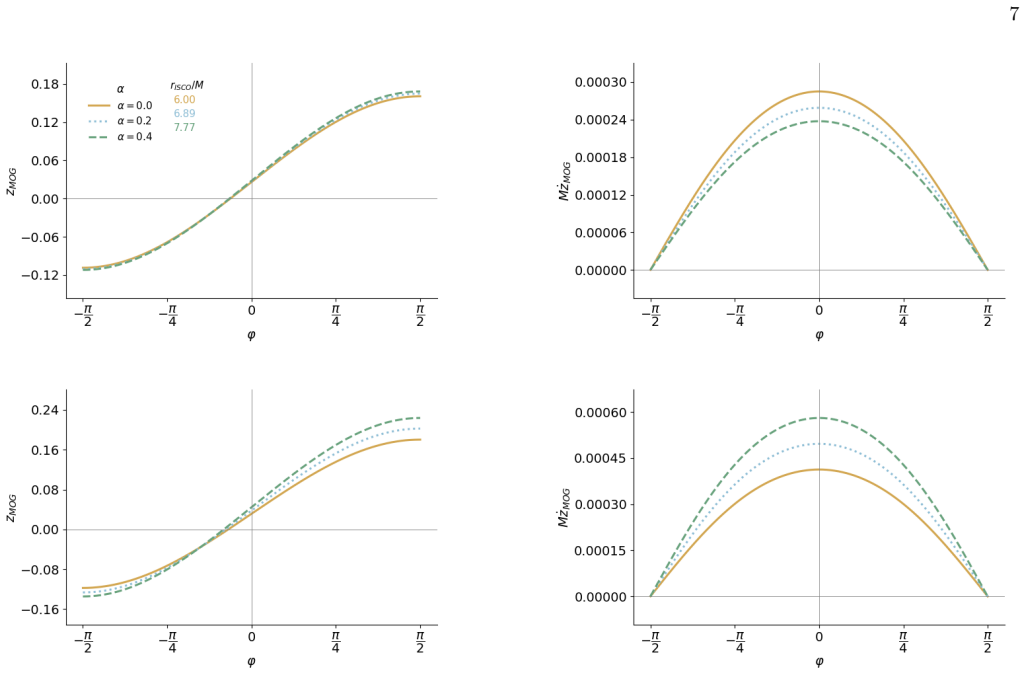
whenα= 0. The right panels of Fig. 1 display ˙z M OG as a function of the azimuthal angleφfor several values of the MOG parameterα. Unlike the case of the total frequency shift, the rapidity either increases or decreases withα, depending on the emitter radius. In the upper-right panel we setr e = 10r ISCO (α) andD= 10 5rISCO (α); these plots show how the ...
2023
-
[2]
1 + p ˜P− ˜N 1−2 ˜P+ ˜N ˜a+ ˜∆3/2 cosδ mq ˜∆2 cos2 δm + (1−2 ˜P+ ˜N) sin2 δm # , (A1b) 1 +z (m) KM OG2 = 1q 1−3 ˜P+ 2 ˜N+ 2˜a p ˜P− ˜N
The starting5×5system At the midline, the system to be solved is given by (93)-(97) re =Dtanδ m, (A1a) 1 +z (m) KM OG1 = 1q 1−3 ˜P+ 2 ˜N+ 2˜a p ˜P− ˜N " 1 + p ˜P− ˜N 1−2 ˜P+ ˜N ˜a+ ˜∆3/2 cosδ mq ˜∆2 cos2 δm + (1−2 ˜P+ ˜N) sin2 δm # , (A1b) 1 +z (m) KM OG2 = 1q 1−3 ˜P+ 2 ˜N+ 2˜a p ˜P− ˜N " 1 + p ˜P− ˜N 1−2 ˜P+ ˜N ˜a− ˜∆3/2 cosδ mq ˜∆2 cos2 δm + (1−2 ˜P+ ˜N...
-
[3]
Next, usingr e =Dtanδ m, one has D re D D2 +r 2e sinδ m = 1 tanδ m 1 D(1 + tan2 δm) sinδ m = c3 m D .(A7) Hence Eq
Compact midline form For the elimination, it is convenient to introduce the temporary combinations X:= 1−2 ˜P+ ˜N , Y:= ˜P− ˜N , Z:= 1 + ˜a 2 −2 ˜P+ ˜N=X+ ˜a 2,(A4) E:= q 1−3 ˜P+ 2 ˜N+ 2˜a √ Y ,Σ := p Z 2c2m +Xs 2m.(A5) 19 In terms of these blocks, the red/blue-shift equations yield immediately the half-sum and half-difference formulas pm = 1 + z(m) KM OG...
-
[4]
First elimination The first useful observation is that the product of (A6b) and (A9) is free ofE, Σ,Y, andZ 3/2. Multiplying the two relations gives dmηm = √ Y Z 3/2cm XEΣ ! EΣ√ Y Z 3/2s2mc3m h Z 2c4 m + (Z2 −2X)s 2 mc2 m +Xs 4 m i = Z 2c4 m + (Z2 −2X)s 2 mc2 m +Xs 4 m Xs 2mc2m .(A10) Splitting the fraction term by term, dmηm = Z 2c4 m Xs 2mc2m + (Z 2 −2X...
-
[5]
Solving for the reduced system To solve the system explicitly, we introduce one temporary parameter, Φm := Z Km .(A17) Then (A15) implies X=K mΦ2 m, Z=K mΦm.(A18) Inserting these into the definition of Σ gives Σ2 =Z 2c2 m +Xs 2 m = (KmΦm)2c2 m + (KmΦ2 m)s2 m =K mΦ2 m Kmc2 m +s 2 m .(A19) Using Km = tan2 δm(c2 mHm −1) =⇒K mc2 m +s 2 m =s 2 mc2 mHm,(A20) we...
-
[6]
Distance, source radius, spin, MOG coupling, and mass Starting from (A8), we substituteY=q 2 m,Z=K mΦm, Σ = √KmΦmsmcm √Hm, andE m = 1/(pm −d mRm), and after a short simplification, it gives ˙zm = d2 mEmΦ3/2 m D(1 + ˜amqm)sm √Hm .(A42) Now, we note that ˜amqm =A m(pmEm −1) =A mdmEmRm,(A43) where the second equality follows from (A28). Hence Em 1 + ˜amqm = ...
-
[7]
pm −d msm s (3 +d mηm)(1−Λ −1/2 m ) t2m c2m(3 +d mηm)−1 #2 × 1− s2 m c2 m(3 +d mηm)−1 c2mΛm − d2 ms2 m(3 +d mηm)Λ−3/2 m
Explicit formulas Now, by substituting the reduced variables appearing in the decoupled solutions directly in terms of the initially defined parametersp m, dm, sm, cm,˙zm, ηm, we found that it was also convenient to introduce the additional parameter due to its recurrent appearance in the expanded solutions Λm :=K mp2 m −d 2 ms2 mHm.(A47) By considering (...
-
[8]
R. Penrose,Gravitational Collapse and Space- Time Singularities, Phys. Rev. Lett.14, 57 (1965). doi:10.1103/PhysRevLett.14.57
-
[9]
B. P. Abbott et al. [LIGO Scientific Collaboration and Virgo Collaboration],Observation of Gravitational Waves from a Binary Black Hole Merger, Phys. Rev. Lett.116, 061102 (2016). doi:10.1103/PhysRevLett.116.061102
-
[10]
K. Akiyama et al. [Event Horizon Telescope Collaboration],First M87 Event Horizon Telescope Results. I. The Shadow of the Supermassive Black Hole, Astrophys. J. Lett.875, L1 (2019). doi:10.3847/2041- 8213/ab0ec7
-
[11]
Axisymmetric black hole has only two degrees of freedom,
B. Carter,Axisymmetric Black Hole Has Only Two Degrees of Freedom, Phys. Rev. Lett.26, 331 (1971). doi:10.1103/PhysRevLett.26.331 25
-
[12]
D. C. Robinson,Uniqueness of the Kerr Black Hole, Phys. Rev. Lett.34, 905 (1975). doi:10.1103/PhysRevLett.34.905
-
[13]
J. W. Moffat,Scalar–tensor–vector gravity theory, JCAP 03, 004 (2006). doi:10.1088/1475-7516/2006/03/004
-
[14]
J. W. Moffat,Black holes in modified gravity (MOG), Eur. Phys. J. C75, 175 (2015). doi:10.1140/epjc/s10052- 015-3405-x
-
[15]
J. W. Moffat,Modified gravity black holes and their observable shadows, Eur. Phys. J. C75, 130 (2015). doi:10.1140/epjc/s10052-015-3352-6
-
[16]
J. R. Brownstein and J. W. Moffat,Galaxy Rotation Curves Without Nonbaryonic Dark Matter, Astrophys. J.636, 721 (2006). doi:10.1086/498208
-
[17]
J. W. Moffat and S. Rahvar,The MOG weak field approximation and observational test of galaxy rotation curves, Mon. Not. R. Astron. Soc.436, 1439 (2013). doi:10.1093/mnras/stt1670
-
[18]
J. W. Moffat and V. T. Toth,The bending of light and lensing in modified gravity, Mon. Not. R. Astron. Soc. 397, 1885 (2009). doi:10.1111/j.1365-2966.2009.14876.x
-
[19]
U. Nucamendi, A. Herrera-Aguilar, R. Lizardo-Castro, and O. Lopez-Cruz,Toward the gravitational redshift detection in NGC 4258 and the estimation of its black hole mass-to-distance ratio, Astrophys. J. Lett.917, L14 (2021). doi:10.3847/2041-8213/ac151b
-
[20]
A. Villalobos-Ramirez, O. Gallardo-Rivera, A. Herrera- Aguilar, and U. Nucamendi,A general relativistic estimation of the black hole mass-to-distance ratio at the core of TXS 2226-184, Astron. Astrophys.662, L9 (2022). doi:10.1051/0004-6361/202243653
-
[21]
D. Villaraos, A. Herrera-Aguilar, U. Nucamendi, G. Gonzalez-Juarez, and R. Lizardo-Castro,A general relativistic mass-to-distance ratio for a set of megamaser AGN black holes, MNRAS517, 4213 (2022). doi:10.1093/mnras/stac2973
-
[22]
A. Gonzalez-Juarez, M. Momennia, A. Villalobos- Ramirez, and A. Herrera-Aguilar,Estimating the mass-to-distance ratio for a set of megamaser AGN black holes by employing a general relativistic method, Astron. Astrophys.689, A205 (2024). doi:10.1051/0004- 6361/202450098
-
[23]
D. Villaraos, A. Herrera-Aguilar, M. Momennia, and U. Nucamendi,Cosmological redshift of a Schwarzschild-de Sitter black hole: Towards estimating the Hubble constant, arXiv:2601.00989 [gr-qc] (2025). doi:10.48550/arXiv.2601.00989
-
[24]
J. A. Braatz, M. J. Reid, E. M. L. Humphreys, C. Henkel, J. J. Condon, and K. Y. Lo,The megamaser cosmology project. II. The angular-diameter distance to UGC 3789, Astrophys. J.718, 657 (2010). doi:10.1088/0004- 637X/718/2/657
-
[25]
D. W. Pesce, J. A. Braatz, M. J. Reid, J. J. Condon, F. Gao, C. Henkel, C. Y. Kuo, K. Y. Lo, and W. Zhao, The Megamaser Cosmology Project. XI. A Geometric Distance to CGCG 074-064, Astrophys. J.890, 118 (2020). doi:10.3847/1538-4357/ab6bcd
-
[26]
A. Herrera-Aguilar and U. Nucamendi,Kerr black hole parameters in terms of the redshift/blueshift of photons emitted by geodesic particles, Phys. Rev. D92, 045024 (2015). doi:10.1103/PhysRevD.92.045024
-
[27]
P. Banerjee, A. Herrera-Aguilar, M. Momennia and U. Nucamendi,Mass and spin of Kerr black holes in terms of observational quantities: The dragging effect on the redshift, Phys. Rev. D105, 124037 (2022). doi:10.1103/PhysRevD.105.124037
-
[28]
M. Momennia, A. Herrera-Aguilar and U. Nucamendi, Kerr black hole in de Sitter spacetime and observational redshift: Toward a new method to measure the Hubble constant, Phys. Rev. D107, 104041 (2023). doi:10.1103/PhysRevD.107.104041
-
[29]
D. A. Martinez-Valera, M. Momennia, and A. Herrera- Aguilar,Observational redshift from general spherically symmetric black holes, Eur. Phys. J. C84, 288 (2024). doi:10.1140/epjc/s10052-024-12649-1; Eur. Phys. J. C 85, 404 (2025). doi:10.1140/epjc/s10052-025-14114-z
-
[30]
M. Momennia, P. Banerjee, A. Herrera-Aguilar, and U. Nucamendi,Schwarzschild black hole and redshift rapidity: a new approach towards measuring cosmic distances, Eur. Phys. J. C84, 583 (2024). doi:10.1140/epjc/s10052-024-12933-0
-
[31]
G. Morales-Herrera, P. Ortega-Ruiz, M. Momennia, and A. Herrera-Aguilar,Mass, charge, and distance to Reissner–Nordstr¨ om black hole in terms of directly measurable quantities, Eur. Phys. J. C84, 525 (2024). doi:10.1140/epjc/s10052-024-12880-w
-
[32]
M. Momennia,Mass and spin of Kerr black hole in terms of directly measurable quantities of accretion disk, arXiv:2501.04677 [gr-qc] (2025). doi:10.48550/arXiv.2501.04677
-
[33]
Hohenegger,Probing effective black hole deformations, Eur
S. Hohenegger,Probing effective black hole deformations, Eur. Phys. J. C85, 1413 (2025). doi:10.1140/epjc/s10052-025-15126-5
-
[34]
Q. Fu and X. Zhang,Probing a polymerized black hole with the frequency shifts of photons, Phys. Rev. D107, 064019 (2023). doi:10.1103/PhysRevD.107.064019
-
[35]
R. Becerril, S. Valdez-Alvarado, J. Davila, and R. E. Ortega-Miranda,On the relation of the mass, spin and charge parameters with the red and blue shifts of photons emitted by particles orbiting a Kerr–Newman black hole, Class. Quantum Grav.42, 205011 (2025). doi:10.1088/1361-6382/ae0ddb
-
[36]
N. B. A. Kharbithai and A. K. Sen,Gravitational Redshift Observed from a Kerr Body with Spatial Resolution on the Surface, Gravit. Cosmol.32, 135 (2026). doi:10.1134/S0202289325700604
-
[37]
B. Nelson, A. Powell, and J. Traschen,Phase Space of SdS Geodesics and using the Cosmological Horizon to Observe a Black Hole, [arXiv:2511.13995]. doi:10.48550/arXiv.2511.13995
-
[38]
H. E. Trad and L. Khodja,Frequency Shift of Photons in Reissner–Nordstr¨ om Black Hole Immersed in Perfect Fluid Dark Matter, Int. J. Theor. Phys.64, 160 (2025). doi:10.1007/s10773-025-06028-z
-
[39]
J. G. Russo and P. K. Townsend,Relativistic kinematics and stationary motions, J. Phys. A: Math. Theor.42, 445402 (2009). doi:10.1088/1751-8113/42/44/445402
-
[40]
E. B. Ford, A. V. Moorhead, and D. Veras,A Bayesian surrogate model for rapid time series analysis and application to exoplanet observations, Bayesian Anal.6, 475 (2011). doi:10.1214/11-BA619
-
[41]
A. Dutta, P. C. C. Freire, T. Gautam, N. Wex, A. Ridolfi, D. J. Champion, V. Venkatraman Krishnan, C.-H. Rosie Chen, M. Cadelano, M. Kramer, F. Abbate, M. Bailes, V. Balakrishnan, A. Corongiu, Y. Gupta, P. V. Padmanabh, A. Possenti, S. M. Ransom, and L. Zhang,NGC 1851A: Revealing an ongoing three-body encounter in a dense globular cluster, Astron. Astroph...
-
[42]
C. J. A. P. Martins, M. Martinelli, E. Calabrese, and M. P. L. P. Ramos,Real-time cosmography with redshift derivatives, Phys. Rev. D94, 043001 (2016). doi:10.1103/PhysRevD.94.043001
-
[43]
P. Sheoran, A. Herrera-Aguilar, and U. Nucamendi,Mass and spin of a Kerr black hole in modified gravity and a test of the Kerr black hole hypothesis, Phys. Rev. D97, 124049 (2018). doi:10.1103/PhysRevD.97.124049
discussion (0)
Sign in with ORCID, Apple, or X to comment. Anyone can read and Pith papers without signing in.