Recognition: no theorem link
LitXBench: A Benchmark for Extracting Experiments from Scientific Literature
Pith reviewed 2026-05-13 00:58 UTC · model grok-4.3
The pith
Frontier language models extract full experiments from papers 0.37 F1 better than multi-turn pipelines by tying measurements to processing steps.
A machine-rendered reading of the paper's core claim, the machinery that carries it, and where it could break.
Core claim
LitXBench is a benchmarking framework for methods that extract complete experimental measurements from literature. On the LitXAlloy dataset of 1426 measurements from 19 alloy papers, frontier language models outperform multi-turn extraction pipelines by as much as 0.37 F1. The advantage stems from models associating measurements with the processing steps that define a material, whereas pipelines primarily associate them with compositions.
What carries the argument
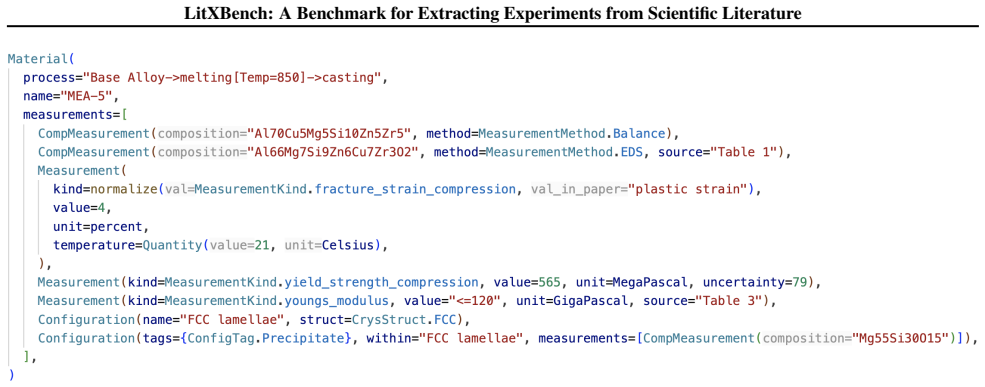
LitXAlloy benchmark of 1426 alloy measurements stored as Python objects, which supports programmatic validation and tests whether extraction methods capture processing steps together with the measurements.
If this is right
- Accurate full-experiment extraction supports construction of larger property-prediction models from literature.
- Material identity depends on processing history, so extraction systems must capture those steps to produce usable data.
- Direct frontier-model prompting can replace multi-turn pipelines for literature extraction.
- Benchmarking tools should test association with processing conditions to measure real-world utility.
Where Pith is reading between the lines
- The same benchmark approach could be applied to papers in chemistry or biology to check whether processing-step linkage remains the decisive factor.
- Widespread adoption of direct model extraction might enable faster meta-analyses across entire research fields.
- Future pipeline designs could close the performance gap by adding explicit rules for linking data to processing sequences.
Load-bearing premise
The 19 alloy papers and 1426 measurements form a representative sample of real extraction tasks, and the F1 difference arises specifically from how methods handle processing steps rather than from prompt wording or model scale.
What would settle it
Re-running the benchmark after adding explicit processing-step association rules to a multi-turn pipeline and checking whether its F1 score on LitXAlloy then equals or exceeds the frontier models.
Figures


read the original abstract
Aggregating experimental data from papers enables materials scientists to build better property prediction models and to facilitate scientific discovery. Recently, interest has grown in extracting not only single material properties but also entire experimental measurements. To support this shift, we introduce LitXBench, a framework for benchmarking methods that extract experiments from literature. We also present LitXAlloy, a dense benchmark comprising 1426 total measurements from 19 alloy papers. By storing the benchmark's entries as Python objects, rather than text-based formats such as CSV or JSON, we improve auditability and enable programmatic data validation. We find that frontier language models, such as Gemini 3.1 Pro Preview, outperform existing multi-turn extraction pipelines by up to 0.37 F1. Our results suggest that this performance gap arises because extraction pipelines associate measurements with compositions rather than the processing steps that define a material.
Editorial analysis
A structured set of objections, weighed in public.
Referee Report
Summary. The paper claims to introduce LitXBench as a framework for benchmarking extraction of experiments from literature and LitXAlloy as a benchmark with 1426 measurements from 19 alloy papers stored as Python objects. It reports that frontier LLMs like Gemini 3.1 Pro Preview outperform existing multi-turn extraction pipelines by up to 0.37 F1 and suggests this is because pipelines associate measurements with compositions rather than processing steps.
Significance. If substantiated, the introduction of LitXBench and LitXAlloy provides a useful resource for advancing information extraction techniques in materials science, supporting better aggregation of experimental data for property prediction models. The choice to store data as Python objects rather than text formats is a positive feature that promotes auditability and validation. The performance comparison offers insights into the relative strengths of LLM-based versus pipeline-based approaches.
major comments (2)
- [Abstract] The claim that the performance gap arises because extraction pipelines associate measurements with compositions rather than the processing steps that define a material lacks supporting quantitative evidence such as an error analysis or ablation study. This interpretation is central to explaining the results but without a breakdown of error types or a controlled experiment isolating the association mechanism, it remains speculative and could be confounded by other factors like model scale or design differences.
- [LitXAlloy] The representativeness of the 19 alloy papers and 1426 measurements as a sample of real-world extraction challenges is not clearly established. Given the small number of source papers, additional details on selection process, coverage of different experimental protocols, and potential biases would be needed to support broad claims about the superiority of LLMs on this task.
minor comments (2)
- Include a table or section detailing the specific multi-turn extraction pipelines used as baselines, along with their key characteristics and original publications.
- Provide more information on the exact protocol for computing the F1 score, including how matches are determined for complex experimental measurements involving multiple components.
Simulated Author's Rebuttal
We thank the referee for their detailed and constructive comments on our manuscript. We address each of the major comments below and describe the revisions we plan to make.
read point-by-point responses
-
Referee: [Abstract] The claim that the performance gap arises because extraction pipelines associate measurements with compositions rather than the processing steps that define a material lacks supporting quantitative evidence such as an error analysis or ablation study. This interpretation is central to explaining the results but without a breakdown of error types or a controlled experiment isolating the association mechanism, it remains speculative and could be confounded by other factors like model scale or design differences.
Authors: We agree that the current manuscript presents this interpretation as a suggestion without a formal error analysis. To address this, we will add a new subsection in the results that provides a qualitative and quantitative breakdown of error types for both the LLM and pipeline approaches. This will include examples where pipelines fail to correctly link measurements to specific processing steps, supported by counts of such errors across the benchmark. We will also note potential confounding factors such as differences in model scale. revision: yes
-
Referee: [LitXAlloy] The representativeness of the 19 alloy papers and 1426 measurements as a sample of real-world extraction challenges is not clearly established. Given the small number of source papers, additional details on selection process, coverage of different experimental protocols, and potential biases would be needed to support broad claims about the superiority of LLMs on this task.
Authors: We acknowledge the need for more transparency regarding the benchmark construction. In the revised manuscript, we will expand the description of LitXAlloy to include: (1) the paper selection criteria, such as focusing on papers that report detailed experimental procedures for alloy synthesis and characterization; (2) coverage of experimental protocols, including various processing techniques like annealing, quenching, and aging; and (3) a discussion of potential biases, such as the selection of papers with publicly available data and emphasis on common alloy systems. While we do not claim the benchmark represents all possible extraction challenges, it is designed to be a challenging and dense test set for the specific task of extracting linked experimental measurements. revision: yes
Circularity Check
No circularity: purely empirical benchmark comparison
full rationale
The paper introduces LitXBench and the LitXAlloy dataset (1426 measurements from 19 papers) and reports direct empirical F1 scores showing frontier LLMs outperforming multi-turn pipelines. No equations, fitted parameters, derivations, or self-citations are used to define or predict the results. The performance numbers are obtained by running the methods on the benchmark; the interpretive suggestion about composition-vs-processing association is presented as a post-hoc observation rather than a load-bearing derivation that reduces to the inputs by construction. The work is self-contained against external benchmarks.
Axiom & Free-Parameter Ledger
axioms (1)
- domain assumption The 1426 measurements from 19 papers accurately capture the structure of real experimental records in materials literature.
invented entities (2)
-
LitXBench
no independent evidence
-
LitXAlloy
no independent evidence
Reference graph
Works this paper leans on
-
[1]
Version 0.25.2. Haas, S., Manzoni, A. M., Krieg, F., and Glatzel, U. Mi- crostructure and mechanical properties of precipitate strengthened high entropy alloy al10co25cr8fe15ni36ti6 with additions of hafnium and molybdenum.Entropy, 21 (2):169, 2019. He, T., Sun, W., Huo, H., Kononova, O., Rong, Z., Tshi- toyan, V ., Botari, T., and Ceder, G. Similarity of...
-
[2]
‘raw_materials‘ (required): map each initial input name (for example ‘"elements"‘ or ‘"powders"‘) to ‘RawMaterial‘. - Populate ‘kind‘ with ‘RawMaterialKind‘ (usually ‘Ingot‘, ‘Powder‘, or ‘ Unspecified‘). - Populate ‘description‘ and ‘source‘ whenever the paper states purity, supplier, or precursor details
-
[3]
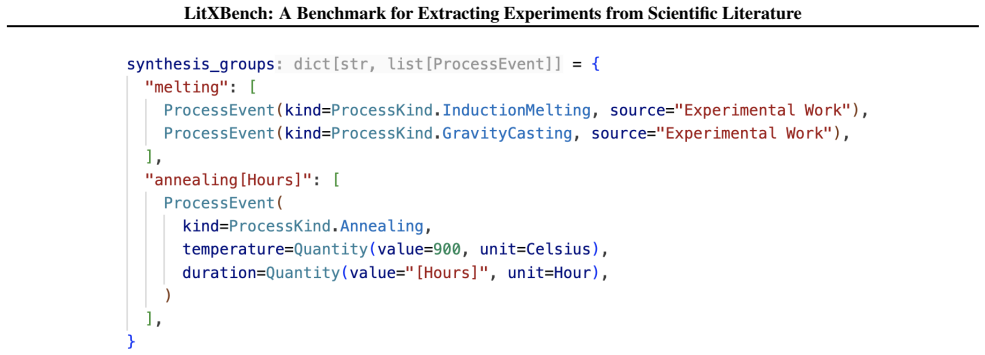
‘synthesis_groups‘ (required): a dict of named synthesis stages to lists of ‘ ProcessEvent‘. - Use reusable stages and process variables when appropriate (for example ‘" annealing[Temp]"‘). - Each ‘ProcessEvent‘ should include ‘kind‘ (a ‘ProcessKind‘ enum member), and include ‘temperature‘ (as ‘Quantity‘, e.g. ‘Quantity(value=1200, unit=Celsius)‘), ‘durat...
-
[4]
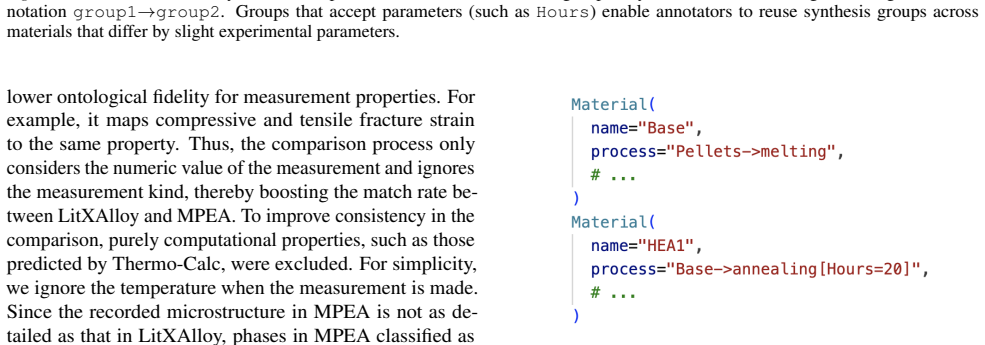
‘output_materials‘ (required): list of ‘Material‘. - Populate ‘Material.process‘ using dataset process notation such as ‘"elements->creation"‘ or ‘"base->annealing[Temp=700]->quenching"‘. - The first segment (before the first ‘->‘) is a comma-separated list of input raw materials or named materials. Use commas to combine multiple inputs: ‘"elements, reinf...
-
[5]
Measurements: - Use ‘Measurement(kind=AlloyMeasurementKind.<kind>, value=<number>, unit=<unit>)‘. - If uncertainty is reported (e.g. "450 +- 20"), set ‘value=450.0‘ and ‘uncertainty =20.0‘. - If temperature or pressure is tied to a measurement, set ‘temperature=Quantity (...)‘ or ‘pressure=Measurement(...)‘. - Assume room temperature is ˜23 C when the pap...
-
[6]
GlobalLatticeParam (for XRD lattice parameters and crystal structure): - Use ‘GlobalLatticeParam‘ when the paper reports lattice parameters from XRD for the overall material. - ‘lattice‘: wrap a pymatgen ‘Lattice‘ in ‘LatticeMeasurement(...)‘. Required parameters depend on type: - ‘Lattice.cubic(a)‘ - requires ‘a‘ - ‘Lattice.hexagonal(a, c)‘ - requires ‘a...
-
[7]
hardness at the center region was 210 HV
Configuration (for microstructural features): - Use ‘Configuration‘ to describe microstructural features like dendrites, precipitates, phases, lamellae, or regions of interest with distinct microstructure (e.g. a Cr-rich region, an interdendritic zone). - Do NOT use Configuration merely to record where on the bulk material a measurement was taken. If the ...
-
[8]
Microhardness measured with Vickers hardness tester at 500 gf load for 15 s
‘descriptions‘ (optional): list of ‘AlloyDescriptionGroup‘ for recording contextual information about measurement methods and equipment, or process-related descriptions that apply to all materials. - Use this field for information about HOW measurements were performed (instruments, testing conditions, specimen dimensions, strain rates) and general descrip...
-
[9]
‘balance_composition(main_element, additions)‘ - for "balance notation" compositions. Use when the paper writes compositions like Ti-6Al-4V, meaning the main element (Ti) makes up the balance (remainder to 100 wt%) after accounting for the other additions (6 wt% Al, 4 wt% V). - ‘main_element‘: string name of the balance element (e.g. ‘"Ti"‘). - ‘additions...
-
[10]
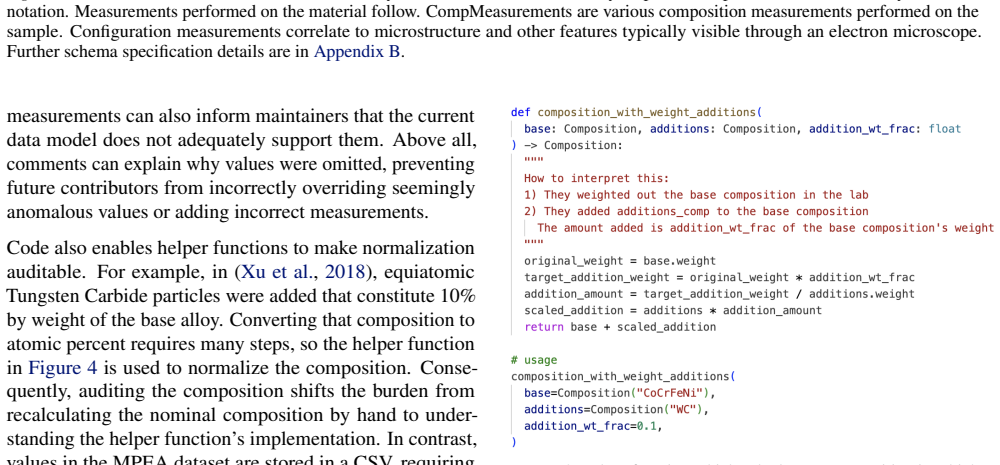
‘composition_with_weight_additions(base, additions, addition_wt_frac)‘ - for when the paper says "add X wt% of Y to base alloy". - ‘base‘: the original alloy composition before additions (usually atomic-fraction style). - ‘additions‘: the additive recipe expressed by weight ratio; use ‘Composition. from_weight_dict(...)‘ for this. - ‘addition_wt_frac‘: de...
-
[11]
"raw_materials" (required): map each initial input name (e.g. "elements" or " powders") to a raw material object. - "kind": one of the RawMaterialKind values (usually "Ingot", "Powder", or " Unspecified"). - Populate "description" and "source" whenever the paper states purity, supplier, or precursor details
-
[12]
"synthesis_groups" (required): an object mapping named synthesis stages to arrays of process event objects. - Use reusable stages and process variables when appropriate (e.g. "annealing[ Temp]"). - Each process event MUST include "kind" (a ProcessKind member name). Optionally include "temperature", "duration", "description", "source" when available. If yo...
-
[13]
"output_materials" (required): array of material objects. 29 LitXBench: A Benchmark for Extracting Experiments from Scientific Literature - "process": use process notation such as "elements->creation" or "base-> annealing[Temp=700]->quenching". - The first segment (before the first "->") is a comma-separated list of input raw materials or named materials....
-
[14]
Measurements - each item in the "measurements" array must have a "_type" field: - "_type": "composition" - for composition. Include "composition" (formula string or element dict) and optionally "method". - "_type": "measurement" - for a single measurement. REQUIRED: "kind", "value", " unit" (all three must be present). Optional: "uncertainty", "measuremen...
-
[15]
Lattice parameters (for XRD-determined crystal structure): - Use "_type": "lattice_param" with a "lattice" object. Required parameters depend on type: - "cubic": {"type": "cubic", "a": ...} (requires "a") - "hexagonal": {"type": "hexagonal", "a": ..., "c": ...} (requires "a" and "c") - "tetragonal": {"type": "tetragonal", "a": ..., "c": ...} (requires "a"...
-
[16]
Configuration (for microstructural features): - Use "_type": "configuration" to describe dendrites, precipitates, phases, lamellae, or regions with distinct microstructure. - Do NOT use configuration merely to record where on the bulk material a measurement was taken. - "name": identifies the feature (e.g. "dendrite", "FCC matrix", "B2 precipitates "). - ...
-
[17]
"descriptions" (optional): array of description group objects for recording contextual information about measurement methods and equipment, or process-related descriptions. - Use this for information about HOW measurements were performed (instruments, testing conditions). - "kinds": array of AlloyMeasurementKind, PhaseMeasurementKind, ProcessKind, or Meas...
-
[18]
Balance composition - for "balance notation" (e.g. Ti-6Al-4V): ‘‘‘json {"_helper": "balance_composition", "main_element": "Ti", "additions": {"Al": 6, " V": 4}} ‘‘‘ Ti is the balance element (90 wt%), Al is 6 wt%, V is 4 wt%
- [19]
-
[20]
Weight additions - add X wt% of a mix to a base alloy: ‘‘‘json {"_helper": "weight_additions", "base": "NbTaTiZr", "additions_weights": {"Mo": 50, "W": 50}, "fraction": 0.05} ‘‘‘ Adds 5 wt% of a 50/50 Mo/W mix to equiatomic NbTaTiZr. "fraction" is a decimal: 5 wt% = 0.05, 2.5 wt% = 0.025. Use these helpers inside the "composition" field of a composition m...
discussion (0)
Sign in with ORCID, Apple, or X to comment. Anyone can read and Pith papers without signing in.