Recognition: no theorem link
Efficient and Effective Internal Memory Retrieval for LLM-Based Healthcare Prediction
Pith reviewed 2026-05-10 17:07 UTC · model grok-4.3
The pith
K2K stores clinical information directly in LLM parameters to enable fast internal retrieval for healthcare predictions without external database searches.
A machine-rendered reading of the paper's core claim, the machinery that carries it, and where it could break.
Core claim
The paper establishes that encoding key clinical information into the LLM's parameter space creates an internal key-value memory from which the model can retrieve context rapidly and accurately, and that this internal route, when combined with activation-guided probe construction and cross-attention reranking, outperforms conventional external retrieval on healthcare outcome prediction tasks.
What carries the argument
Keys to Knowledge (K2K) internal key-value memory that encodes clinical information directly into model parameters, accessed via activation-guided probes and cross-attention reranking.
If this is right
- Healthcare predictions can be generated with substantially lower latency, fitting real-time clinical workflows.
- Systems become less dependent on maintaining and querying large external knowledge bases during inference.
- The same internal memory approach can be applied to the four evaluated outcome prediction tasks with improved results.
- Retrieval quality improves when probe selection uses activation patterns and reranking uses cross-attention scores.
Where Pith is reading between the lines
- The internal storage strategy could reduce the compute cost of repeated external searches in high-volume clinical deployments.
- Models trained this way might retain better factual consistency across multiple prediction rounds on the same patient data.
- The technique opens a path to selectively blending internal and external sources depending on query complexity.
Load-bearing premise
Embedding clinical information into the model's parameters plus the proposed probe and reranking steps will deliver reliable gains over external retrieval without adding new errors or needing impractical amounts of training.
What would settle it
Running K2K and a standard external RAG baseline on a new, previously unseen healthcare dataset and finding that K2K produces lower accuracy or higher error rates on outcome predictions.
Figures




read the original abstract
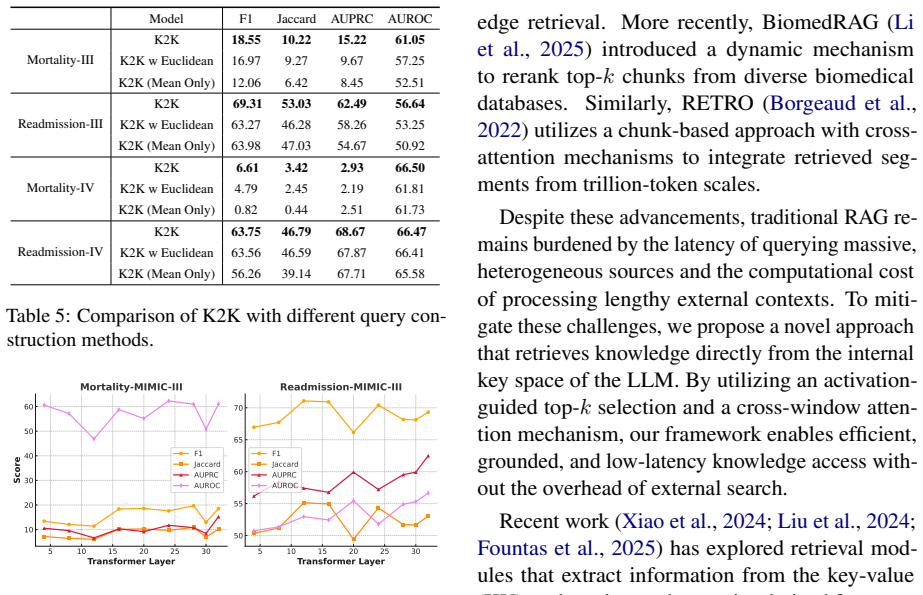
Large language models (LLMs) hold significant promise for healthcare, yet their reliability in high-stakes clinical settings is often compromised by hallucinations and a lack of granular medical context. While Retrieval Augmented Generation (RAG) can mitigate these issues, standard supervised pipelines require computationally intensive searches over massive external knowledge bases, leading to high latency that is impractical for time-sensitive care. To address this, we introduce Keys to Knowledge (K2K), a novel framework that replaces external retrieval with internal, key-based knowledge access. By encoding essential clinical information directly into the model's parameter space, K2K enables rapid retrieval from internal key-value memory without inference-time overhead. We further enhance retrieval quality through activation-guided probe construction and cross-attention reranking. Experimental results demonstrate that K2K achieves state-of-the-art performance across four benchmark healthcare outcome prediction datasets.
Editorial analysis
A structured set of objections, weighed in public.
Referee Report
Summary. The paper introduces Keys to Knowledge (K2K), a framework that encodes essential clinical information directly into LLM parameter space for internal key-based retrieval, augmented by activation-guided probe construction and cross-attention reranking. It replaces external RAG to reduce latency in healthcare outcome prediction and claims state-of-the-art results across four benchmark datasets.
Significance. If the internal retrieval mechanisms can be shown to deliver gains beyond standard fine-tuning, the work would address a practical bottleneck in deploying LLMs for time-sensitive clinical tasks by eliminating external search overhead while maintaining or improving prediction quality.
major comments (2)
- [Abstract / Experiments] Abstract and Experiments section: The central claim that K2K achieves SOTA performance via the proposed internal retrieval mechanisms is unsupported because no ablations, baselines (including plain supervised fine-tuning on the same datasets), metrics, error bars, or controls are described. This directly undermines attribution of gains to activation-guided probes and cross-attention reranking rather than parameter encoding alone.
- [Method] Method section (K2K framework description): The risk that encoding clinical information into parameters overwrites pre-trained medical knowledge is not quantified or tested with controls for forgetting or introduced errors on out-of-distribution cases, which is load-bearing for the high-stakes healthcare reliability claim.
minor comments (2)
- [Method] Clarify notation for 'key-value memory' and 'probe construction' to distinguish them from standard attention mechanisms.
- [Experiments] Add explicit comparison table against external RAG baselines with latency and accuracy metrics.
Simulated Author's Rebuttal
We thank the referee for the constructive comments on our manuscript. We address each major point below and commit to revisions that will strengthen the experimental support and reliability analysis.
read point-by-point responses
-
Referee: [Abstract / Experiments] Abstract and Experiments section: The central claim that K2K achieves SOTA performance via the proposed internal retrieval mechanisms is unsupported because no ablations, baselines (including plain supervised fine-tuning on the same datasets), metrics, error bars, or controls are described. This directly undermines attribution of gains to activation-guided probes and cross-attention reranking rather than parameter encoding alone.
Authors: We agree that the current manuscript does not provide sufficient ablations, baseline comparisons to plain supervised fine-tuning, error bars, or controls to fully attribute gains to the activation-guided probes and cross-attention reranking. In the revised version we will expand the Experiments section with these elements: direct comparisons against standard fine-tuning on the identical datasets, component-wise ablations, all metrics reported with standard deviations across multiple runs, and controls that isolate the contribution of each mechanism. These additions will allow proper evaluation of whether the internal retrieval components deliver gains beyond parameter encoding alone. revision: yes
-
Referee: [Method] Method section (K2K framework description): The risk that encoding clinical information into parameters overwrites pre-trained medical knowledge is not quantified or tested with controls for forgetting or introduced errors on out-of-distribution cases, which is load-bearing for the high-stakes healthcare reliability claim.
Authors: We concur that quantifying potential overwriting of pre-trained medical knowledge is essential for healthcare claims. The present manuscript does not include such controls. We will add targeted experiments in the revision that measure performance on out-of-distribution medical tasks and general clinical knowledge benchmarks both before and after K2K encoding, reporting any degradation or introduced errors. This will provide concrete evidence on retention and reliability. revision: yes
Circularity Check
No significant circularity detected
full rationale
The paper proposes the K2K framework as a novel method for internal key-based retrieval in LLMs, achieved by encoding clinical information into parameter space and augmenting it with activation-guided probe construction plus cross-attention reranking. All central claims rest on empirical performance measurements across four external benchmark datasets rather than any derivation, equation, or self-referential definition. No load-bearing step reduces by construction to a fitted input, self-citation, or renamed known result; the abstract and description frame results as experimental outcomes independent of the method's internal definitions. The work is therefore self-contained against external benchmarks.
Axiom & Free-Parameter Ledger
axioms (1)
- domain assumption Clinical knowledge can be effectively encoded into LLM parameter space for retrieval
Reference graph
Works this paper leans on
-
[1]
InInternational conference on machine learning, pages 2206–2240
Improving language models by retrieving from trillions of tokens. InInternational conference on machine learning, pages 2206–2240. PMLR. Edward Choi, Mohammad Taha Bahadori, Jimeng Sun, Joshua Kulas, Andy Schuetz, and Walter Stewart
-
[2]
Empirical Evaluation of Gated Recurrent Neural Networks on Sequence Modeling
Retain: An interpretable predictive model for healthcare using reverse time attention mechanism. Advances in neural information processing systems, 29. Junyoung Chung, Caglar Gulcehre, KyungHyun Cho, and Yoshua Bengio. 2014. Empirical evaluation of gated recurrent neural networks on sequence model- ing.arXiv preprint arXiv:1412.3555. Zafeirios Fountas, Ma...
work page internal anchor Pith review arXiv 2014
-
[3]
arXiv preprint arXiv:2305.12788 , year=
Reasoning-enhanced healthcare predictions with knowledge graph community retrieval. InPro- ceedings of the International Conference on Learning Representations (ICLR). Pengcheng Jiang, Cao Xiao, Adam Cross, and Jimeng Sun. 2023. Graphcare: Enhancing healthcare pre- dictions with personalized knowledge graphs.arXiv preprint arXiv:2305.12788. Pengcheng Jian...
-
[4]
Reasoning-enhanced healthcare predictions with knowledge graph community retrieval.arXiv preprint arXiv:2410.04585. Bowen Jin, Hansi Zeng, Zhenrui Yue, Jinsung Yoon, Sercan Arik, Dong Wang, Hamed Zamani, and Jiawei Han. 2025. Search-r1: Training llms to reason and leverage search engines with reinforcement learning. arXiv preprint arXiv:2503.09516. Alista...
-
[5]
Available online at: https://physionet
Mimic-iv.PhysioNet. Available online at: https://physionet. org/content/mimiciv/1.0/(accessed August 23, 2021), pages 49–55. Alistair EW Johnson, Tom J Pollard, Lu Shen, Li-wei H Lehman, Mengling Feng, Mohammad Ghassemi, Benjamin Moody, Peter Szolovits, Leo Anthony Celi, and Roger G Mark. 2016. Mimic-iii, a freely accessi- ble critical care database.Scien...
-
[6]
Mingchen Li, Chen Ling, Rui Zhang, and Liang Zhao
Biomedrag: A retrieval augmented large lan- guage model for biomedicine.Journal of Biomedical Informatics, 162:104769. Mingchen Li, Chen Ling, Rui Zhang, and Liang Zhao. 2024b. Zero-shot link prediction in knowledge graphs with large language models. In2024 IEEE International Conference on Data Mining (ICDM), pages 753–760. IEEE. Mingchen Li, Zaifu Zhan, ...
-
[7]
Retrievalattention: Accelerating long-context llm inference via vector retrieval.arXiv preprint arXiv:2409.10516. Liantao Ma, Junyi Gao, Yasha Wang, Chaohe Zhang, Jiangtao Wang, Wenjie Ruan, Wen Tang, Xin Gao, and Xinyu Ma. 2020. Adacare: Explainable clin- ical health status representation learning via scale- adaptive feature extraction and recalibration....
discussion (0)
Sign in with ORCID, Apple, or X to comment. Anyone can read and Pith papers without signing in.