Recognition: 1 theorem link
· Lean TheoremOn the role of higher-order interactions towards first synchronization time
Pith reviewed 2026-05-10 18:20 UTC · model grok-4.3
The pith
Higher-order interactions in Kuramoto oscillator networks produce non-monotonic changes in the time to first synchronization.
A machine-rendered reading of the paper's core claim, the machinery that carries it, and where it could break.
Core claim
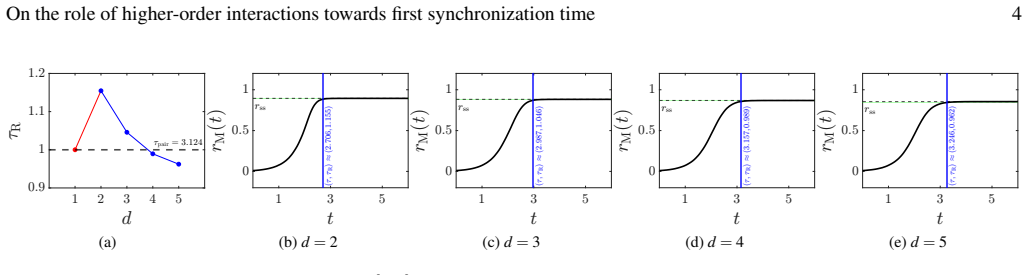
The paper establishes an analytical formula for the first synchronization time in a Kuramoto model extended with higher-order interactions by reducing it via the Ott-Antonsen ansatz. It further demonstrates through simulations that the time decreases with increasing coupling strength but exhibits non-monotonic dependence on the interaction order, with triadic terms accelerating synchronization relative to pairwise and higher terms delaying it, sometimes beyond the pairwise baseline.
What carries the argument
The Ott-Antonsen ansatz applied to the higher-order Kuramoto model, which allows reduction of the oscillator population dynamics to a low-dimensional equation from which the first synchronization time can be extracted analytically.
If this is right
- Increasing the strength of pairwise couplings shortens the first synchronization time.
- Adding triadic interactions further reduces the synchronization time.
- Incorporating interactions of order four and higher increases the synchronization time, in some cases making it longer than in the pairwise-only network.
- The non-monotonic effect arises because different orders contribute differently to the effective coupling in the reduced dynamics.
Where Pith is reading between the lines
- This framework could be used to optimize synchronization speed in engineered networks by tuning the balance of interaction orders.
- The non-monotonic behavior may appear in other models of collective behavior, such as opinion dynamics or ecological networks.
- Finite-size effects or heterogeneity in oscillator frequencies might alter the predicted times, suggesting tests on small networks.
Load-bearing premise
The Ott-Antonsen ansatz continues to provide an accurate low-dimensional description of the system even after higher-order interactions are added, without requiring extra terms or restrictions on the network.
What would settle it
Direct numerical integration of the full higher-order Kuramoto equations on a large network that shows the first synchronization time deviating significantly from the analytical prediction derived via the Ott-Antonsen ansatz.
Figures





read the original abstract
Understanding how large complex networks achieve synchronization is a problem of fundamental interest, and is typically studied in the asymptotic steady-state regime. In contrast, this study investigates how higher-order interactions affect the time required to reach steady-state synchronization in a complex dynamical system. To this end, an analytical expression for the first synchronization time is derived using the Ott-Antonsen ansatz on a Kuramoto oscillator network with higher-order interactions. Subsequent numerics reveal that increasing coupling strengths accelerates the transition to synchronization, whereas increasing the interaction order produces non-monotonic behavior. In particular, the inclusion of triadic interactions accelerates synchronization, whereas further incorporating higher-order interactions progressively delays convergence to the steady state, in some regimes even falling below the pairwise case.
Editorial analysis
A structured set of objections, weighed in public.
Referee Report
Summary. The manuscript derives an analytical expression for the first synchronization time in a Kuramoto oscillator network incorporating higher-order (triadic and beyond) interactions by applying the Ott-Antonsen ansatz to obtain a reduced low-dimensional ODE. Numerical simulations are then used to show that increasing pairwise or higher-order coupling strengths accelerates the transition to synchronization, while increasing the interaction order produces non-monotonic behavior: triadic interactions speed up synchronization relative to pairwise, but further higher-order terms can delay convergence, sometimes below the pairwise baseline.
Significance. If the central derivation holds, the work provides a rare analytical window into transient synchronization dynamics rather than only steady-state behavior, which is the dominant focus in the literature. The reported non-monotonic dependence on interaction order is a concrete, testable observation that could guide modeling of multi-body effects in applications such as neural circuits or power grids. The combination of an explicit formula with supporting numerics is a methodological strength.
major comments (2)
- [§3] §3 (Analytical derivation of the reduced dynamics): The Ott-Antonsen ansatz is invoked to close the system, but the manuscript does not verify that the OA manifold remains invariant under the higher-order coupling terms. Pairwise sinusoidal interactions preserve the form (1 + Re{z e^{-iθ}}), yet triadic or higher products generally excite higher harmonics outside the manifold unless the network is all-to-all, oscillators are identical, or extra averaging is imposed. This invariance is load-bearing for the claimed closed-form expression for first synchronization time and must be shown explicitly or the limitations stated.
- [§4] §4 (Numerical results and first-synchronization-time definition): The non-monotonic effect of interaction order is presented without a precise operational definition of the metric (e.g., the order-parameter threshold, averaging protocol over initial conditions or realizations, or finite-size scaling). This makes it difficult to assess whether the reported acceleration by triadic terms and subsequent delay are robust or sensitive to numerical choices.
minor comments (2)
- The abstract and introduction should explicitly state the network topology (all-to-all or sparse) and degree of oscillator heterogeneity assumed in both the derivation and simulations.
- Figure captions and legends would benefit from listing the exact parameter values (coupling strengths, orders, N) used in each panel to facilitate reproducibility.
Simulated Author's Rebuttal
We thank the referee for the detailed and constructive report. The comments highlight important points for rigor and reproducibility. We address each major comment below and will revise the manuscript to incorporate the necessary clarifications and verifications.
read point-by-point responses
-
Referee: [§3] §3 (Analytical derivation of the reduced dynamics): The Ott-Antonsen ansatz is invoked to close the system, but the manuscript does not verify that the OA manifold remains invariant under the higher-order coupling terms. Pairwise sinusoidal interactions preserve the form (1 + Re{z e^{-iθ}}), yet triadic or higher products generally excite higher harmonics outside the manifold unless the network is all-to-all, oscillators are identical, or extra averaging is imposed. This invariance is load-bearing for the claimed closed-form expression for first synchronization time and must be shown explicitly or the limitations stated.
Authors: We agree that explicit verification of OA manifold invariance is essential. Our derivation assumes an all-to-all network of identical oscillators, for which the higher-order (triadic and beyond) sinusoidal couplings preserve the manifold because the mean-field reduction closes without exciting higher harmonics. In the revised manuscript we will add a dedicated subsection in §3 that explicitly demonstrates this invariance: starting from the continuity equation with the higher-order interaction terms, we substitute the OA ansatz and show that the resulting equation for the order parameter z remains closed within the manifold. This will be done by direct substitution and averaging over the phase distribution, confirming no additional Fourier modes are generated under the all-to-all identical-oscillator assumption. revision: yes
-
Referee: [§4] §4 (Numerical results and first-synchronization-time definition): The non-monotonic effect of interaction order is presented without a precise operational definition of the metric (e.g., the order-parameter threshold, averaging protocol over initial conditions or realizations, or finite-size scaling). This makes it difficult to assess whether the reported acceleration by triadic terms and subsequent delay are robust or sensitive to numerical choices.
Authors: We acknowledge that the current presentation lacks sufficient detail on the numerical protocol. In the revised §4 we will supply an explicit operational definition: the first synchronization time is defined as the earliest time t* at which the Kuramoto order parameter r(t) first exceeds the threshold 0.95 and remains above it for a subsequent interval of length 10 (in dimensionless time units). We will describe the averaging procedure (ensemble average over 100 independent realizations with uniformly random initial phases drawn from [0,2π)), the numerical integrator (fourth-order Runge-Kutta with fixed step 0.01), and the system sizes used (N=500 and N=1000 to illustrate finite-size effects). These additions will allow readers to reproduce and assess the robustness of the reported non-monotonic dependence on interaction order. revision: yes
Circularity Check
No circularity: derivation applies external Ott-Antonsen reduction to extended model
full rationale
The paper derives an explicit analytical expression for first synchronization time by reducing the higher-order Kuramoto system via the standard Ott-Antonsen ansatz, then solves the resulting low-dimensional ODE. This step relies on an external, well-known closure technique rather than any self-definition, fitted parameter renamed as prediction, or load-bearing self-citation. No equation in the provided abstract or description reduces the target quantity to its own inputs by construction. Numerical explorations of coupling strength and interaction order are independent of the analytic expression and serve as validation rather than circular confirmation. The derivation chain is therefore self-contained against external benchmarks.
Axiom & Free-Parameter Ledger
axioms (1)
- domain assumption Ott-Antonsen ansatz applies without modification to Kuramoto oscillators with higher-order interactions
Lean theorems connected to this paper
-
IndisputableMonolith/Cost/FunctionalEquation.lean (washburn_uniqueness_aczel, Jcost definition)J-uniqueness via Aczél and Translation Theorem uncleardr(t)/dt = -rΔ + r(1-r²)[ε₁/2 + ε_d/2 r^{2(d-1)}] and τ = ∫ du / [-2uΔ + u(1-u)(ε₁ + ε_d u^{d-1})]
Reference graph
Works this paper leans on
-
[1]
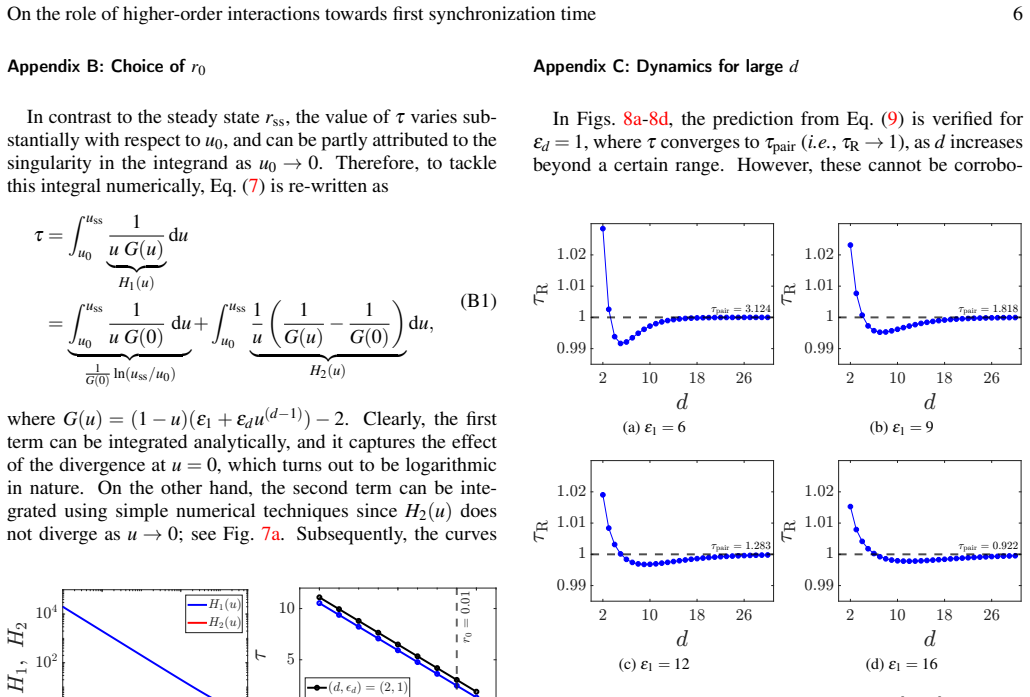
(7), can be approximated as τ≈ Z uss u0 du −2u∆+ε 1u(1−u) ,(9) which is independent ofdand is identical to that ofε d =0
Thus, the expression ofτ, from the integral in Eq. (7), can be approximated as τ≈ Z uss u0 du −2u∆+ε 1u(1−u) ,(9) which is independent ofdand is identical to that ofε d =0. On the role of higher-order interactions towards first synchronization time 3 III. NUMERICAL RESULTS For the rest of the paper,∆=1 (which impliesε c 1 =2), andδ=10 −2. Previous literat...
2018
-
[2]
(2), with the blue and red colors indicating the forward and backward variation, respectively, ofε 1
In contrast, the circular markers denote the value ofr ss obtained by simulating Eq. (2), with the blue and red colors indicating the forward and backward variation, respectively, ofε 1. and explosive transitions, depending on the value ofdand εd, characterized by either a smooth or sudden increase in the value ofr ss, respectively, as the value ofε1 is t...
2018
discussion (0)
Sign in with ORCID, Apple, or X to comment. Anyone can read and Pith papers without signing in.