Recognition: unknown
Resolving the 2024 Outburst of Magnetar 1E 1841-045 from its host Supernova Remnant with EP-FXT
Pith reviewed 2026-05-10 17:35 UTC · model grok-4.3
The pith
High-resolution imaging of the 2024 magnetar outburst isolates its emission from the supernova remnant, revealing a 20% flux increase and blackbody temperature correlations with pulse intensity.
A machine-rendered reading of the paper's core claim, the machinery that carries it, and where it could break.
Core claim
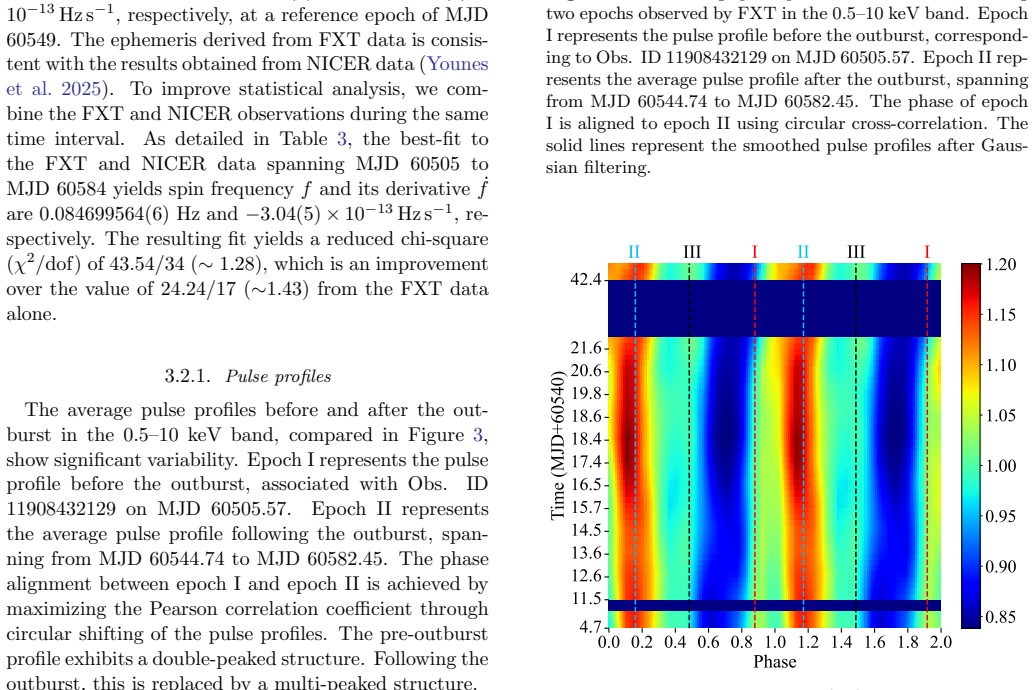
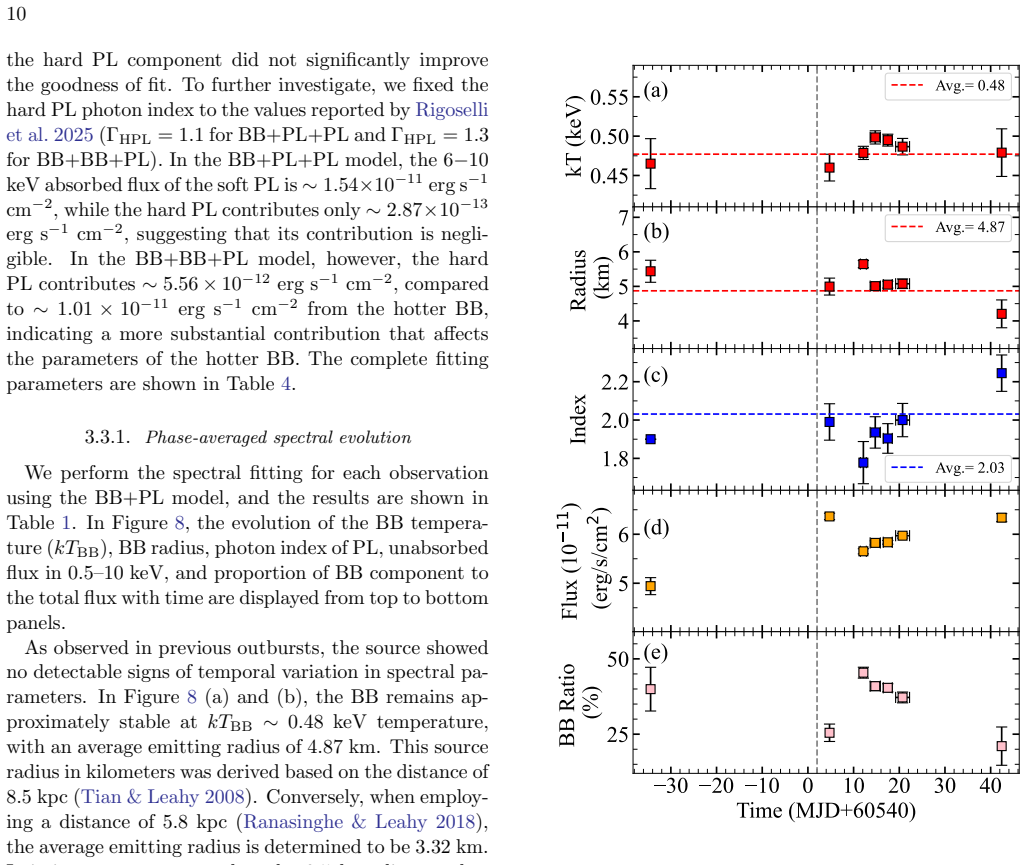
The magnetar 1E 1841-045 exhibited a new active episode starting on August 20, 2024, marked by X-ray bursts and enhanced persistent emission. Using data from the Einstein Probe, the pulse profile displays a multi-peaked structure, with notable phase shifts in the secondary peak. Energy-resolved pulse profile analysis indicates a transition in the dominant peak of the pulse profile above 5.8 keV. The 0.5-10 keV X-ray spectrum is well-modeled by a combined blackbody and power-law model, showing a ~20% flux increase following the outburst. Phase-resolved spectroscopy indicates a correlation between blackbody temperature and pulse profile intensity, along with spectral hardening at a specific脉冲相
What carries the argument
High spatial resolution of the Einstein Probe Follow-up X-ray Telescope combined with phase-resolved spectroscopy to separate the magnetar's pulsed emission from the host supernova remnant background.
If this is right
- The magnetar's 0.5-10 keV persistent flux rose by about 20% after the outburst onset.
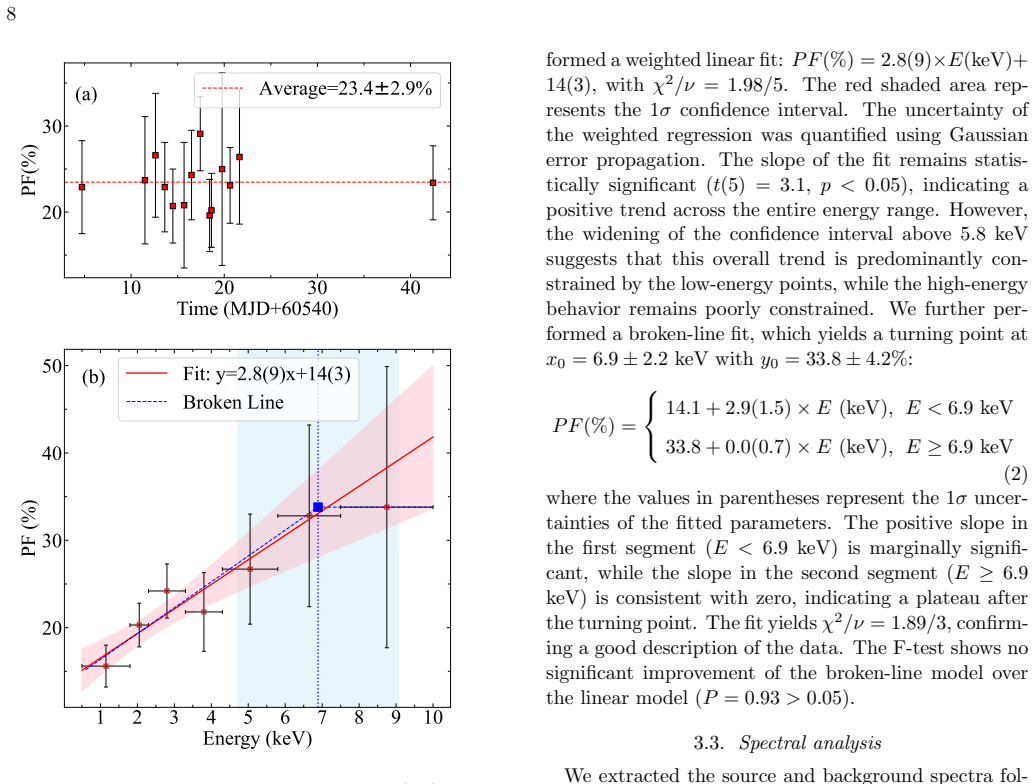
- Pulse profiles evolve with energy, showing a dominant-peak transition above 5.8 keV and secondary-peak phase shifts.
- Blackbody temperature correlates with pulse-profile intensity across phases.
- Spectral hardening appears at one specific phase in the rotation cycle.
- Subtracting the supernova remnant is required to recover the true intrinsic pulse properties.
Where Pith is reading between the lines
- The same high-resolution separation method could be applied to other magnetars still inside their remnants to improve outburst statistics.
- The temperature-intensity link points to outburst heating that varies across the neutron-star surface.
- Continued monitoring with similar instruments may reveal whether 20% flux jumps are common during magnetar activation episodes.
- The phase-specific hardening could connect to localized magnetic-field structures that future polarization measurements might test.
Load-bearing premise
The Einstein Probe's spatial resolution fully isolates the magnetar's pulsed X-ray emission from the supernova remnant without significant residual contamination that could change the reported 20% flux increase or the phase-resolved spectral correlations.
What would settle it
Independent observations with another high-resolution X-ray instrument that measure no 20% flux increase or different blackbody temperature versus intensity correlations after subtracting the remnant emission would contradict the central results.
Figures






read the original abstract
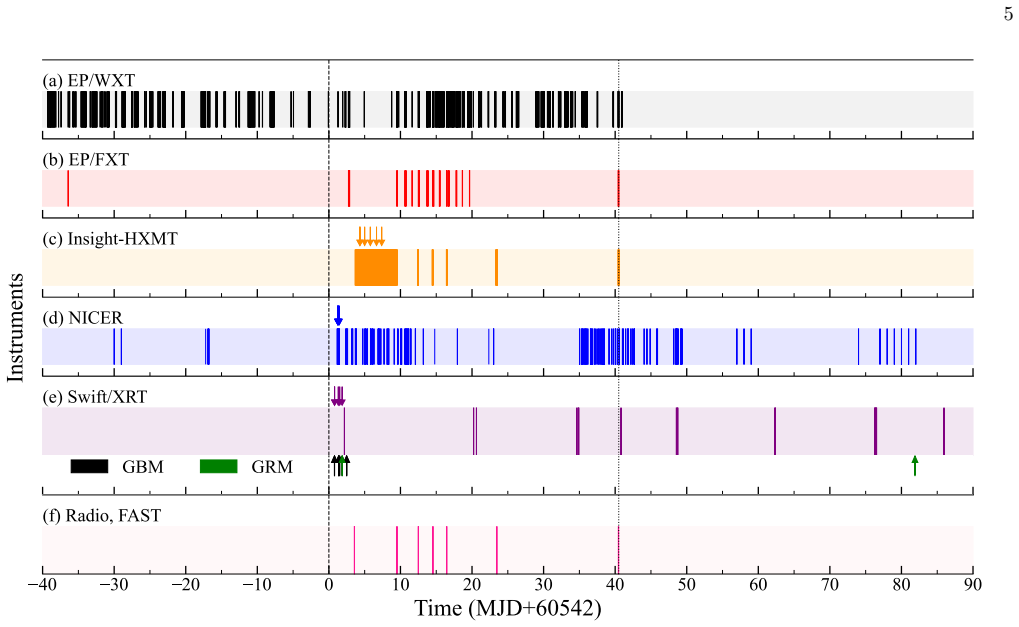
The magnetar 1E 1841-045 exhibited a new active episode starting on August 20, 2024, marked by X-ray bursts and enhanced persistent emission. Using data from the Einstein Probe (EP), we report on the timing and spectral results following the onset of this outburst. The pulse profile displays a multi-peaked structure, with notable phase shifts in the secondary peak. Energy-resolved pulse profile analysis indicates a transition in the dominant peak of the pulse profile above 5.8 keV. The 0.5-10 keV X-ray spectrum is well-modeled by a combined blackbody and power-law (BB+PL) model, showing a $\sim 20\%$ flux increase following the outburst. Phase-resolved spectroscopy indicates a correlation between BB temperature and pulse profile intensity, along with spectral hardening at a specific pulse phase. The high spatial resolution of EP enables effective separation of the supernova remnant emission, which is crucial for measuring the intrinsic pulse emission of the source. These findings underscore the intricate relationship between magnetar outbursts, pulse profile evolution, and spectral characteristics.
Editorial analysis
A structured set of objections, weighed in public.
Referee Report
Summary. The paper reports on the 2024 outburst of magnetar 1E 1841-045 observed with the Einstein Probe (EP), focusing on timing and spectral properties. It describes a multi-peaked pulse profile with phase shifts in the secondary peak, an energy-dependent transition where the dominant peak changes above 5.8 keV, and a ~20% increase in 0.5-10 keV flux. The spectrum is modeled with a blackbody plus power-law (BB+PL) component. Phase-resolved spectroscopy shows a correlation between blackbody temperature and pulse intensity, plus spectral hardening at one phase. The high spatial resolution of EP is credited with separating the magnetar's emission from its host supernova remnant.
Significance. If the results are robust, the work adds useful observational constraints on magnetar outburst evolution, including how pulse profiles and spectra change together. The phase-resolved temperature-intensity correlation could inform emission geometry models, and the EP resolution demonstration is relevant for future X-ray studies of sources embedded in SNRs. The observational nature means impact depends on reproducibility and statistical rigor.
major comments (2)
- Abstract: The ~20% flux increase and the BB temperature-pulse intensity correlation are presented without error bars, reduced chi-squared values, degrees of freedom, or details on background subtraction and data exclusion. These omissions directly affect assessment of whether the reported changes and correlations are statistically significant.
- Spectral and timing results sections: The claim that EP's spatial resolution fully isolates the pulsed emission from SNR contamination (central to the flux increase and phase-resolved findings) lacks quantitative limits on residual contamination or tests of background subtraction accuracy, leaving open the possibility that the 20% flux change and correlations are affected by incomplete separation.
minor comments (2)
- Abstract: The description of 'notable phase shifts in the secondary peak' would benefit from specifying the approximate phase offset or direction to make the timing results more immediately interpretable.
- Overall: Standard X-ray analysis details such as the exact energy bands used for pulse profiles, phase binning choices, and any cross-calibration with other instruments are not mentioned in the provided text and should be added for reproducibility.
Simulated Author's Rebuttal
We thank the referee for the careful review and constructive comments on our manuscript. We address each major comment below and have revised the manuscript accordingly to improve statistical transparency and quantitative support for our claims regarding source separation.
read point-by-point responses
-
Referee: Abstract: The ~20% flux increase and the BB temperature-pulse intensity correlation are presented without error bars, reduced chi-squared values, degrees of freedom, or details on background subtraction and data exclusion. These omissions directly affect assessment of whether the reported changes and correlations are statistically significant.
Authors: We agree that the abstract summary omits key statistical details due to length constraints. In the revised manuscript we will add approximate uncertainties to the reported ~20% flux increase and note the statistical significance of the BB temperature-pulse intensity correlation. The full details—including reduced chi-squared values, degrees of freedom, background subtraction procedures, and data exclusion criteria—are already present in the spectral fitting and phase-resolved spectroscopy sections; we will ensure explicit cross-references from the abstract and results summary to these sections. revision: yes
-
Referee: Spectral and timing results sections: The claim that EP's spatial resolution fully isolates the pulsed emission from SNR contamination (central to the flux increase and phase-resolved findings) lacks quantitative limits on residual contamination or tests of background subtraction accuracy, leaving open the possibility that the 20% flux change and correlations are affected by incomplete separation.
Authors: We acknowledge that the manuscript would benefit from explicit quantitative limits. In the revised version we will add estimates of residual SNR contamination derived from the EP-FXT point-spread function convolved with the known SNR extent, together with tests of background subtraction accuracy using multiple off-source regions and Monte Carlo simulations of possible leakage. These additions will place upper limits on any residual contribution to the pulsed flux and phase-resolved spectra. revision: yes
Circularity Check
No circularity: purely observational data reporting
full rationale
The manuscript presents timing and spectral measurements from EP-FXT observations of the 2024 magnetar outburst. Reported quantities include multi-peaked pulse profiles with phase shifts, energy-dependent peak transitions above 5.8 keV, a ~20% flux increase in the 0.5-10 keV band, and phase-resolved BB temperature correlations with intensity. All results are obtained via standard X-ray timing analysis and BB+PL spectral fitting applied directly to the data. The claim that EP's spatial resolution separates the magnetar from SNR emission is an instrumental justification, not a derivation that reduces to fitted inputs. No equations, theoretical models, predictions, or self-citations are load-bearing; the derivation chain is empty and self-contained against external data.
Axiom & Free-Parameter Ledger
free parameters (1)
- Blackbody temperature, power-law index, and normalization in BB+PL spectral model
axioms (2)
- domain assumption Magnetar persistent emission can be adequately described by a blackbody plus power-law component
- domain assumption EP-FXT spatial resolution is sufficient to separate point-source pulsed emission from extended supernova remnant emission
Reference graph
Works this paper leans on
-
[1]
An, H., Hasco¨ et, R., Kaspi, V. M., et al. 2013, ApJ, 779, 163, doi: 10.1088/0004-637X/779/2/163
-
[2]
An, H., Archibald, R. F., Hasco¨ et, R., et al. 2015, ApJ, 807, 93, doi: 10.1088/0004-637X/807/1/93
-
[3]
Archibald, R. F., Kaspi, V. M., Ng, C.-Y., et al. 2013, Nature, 497, 591, doi: 10.1038/nature12159
-
[4]
Arnaud, K. A. 1996, in Astronomical Society of the Pacific Conference Series, Vol. 101, Astronomical Data Analysis Software and Systems V, ed. G. H. Jacoby & J. Barnes, 17 Astropy Collaboration, Robitaille, T. P., Tollerud, E. J., et al. 2013, A&A, 558, A33, doi: 10.1051/0004-6361/201322068 Astropy Collaboration, Price-Whelan, A. M., Sip˝ ocz, B. M., et a...
-
[5]
2025, ApJ, 979, 122, doi: 10.3847/1538-4357/ada3c4
Bai, J., Wang, N., Dai, S., et al. 2025, ApJ, 979, 122, doi: 10.3847/1538-4357/ada3c4
-
[6]
Beloborodov, A. M. 2009, ApJ, 703, 1044, doi: 10.1088/0004-637X/703/1/1044 —. 2013, ApJ, 762, 13, doi: 10.1088/0004-637X/762/1/13
-
[7]
Beloborodov, A. M., & Li, X. 2016, ApJ, 833, 261, doi: 10.3847/1538-4357/833/2/261
-
[8]
2020, ApJL, 902, L2, doi: 10.3847/2041-8213/aba82a
Borghese, A., Coti Zelati, F., Rea, N., et al. 2020, ApJL, 902, L2, doi: 10.3847/2041-8213/aba82a
-
[9]
Ram Pressure Stripping of Disc Galaxies: The Role of the Inclination Angle , shorttitle =
Burgay, M., Rea, N., Israel, G. L., et al. 2006, MNRAS, 372, 410, doi: 10.1111/j.1365-2966.2006.10872.x
-
[10]
2024, GRB Coordinates Network, 37606, 1 16
Cai, C., Li, X.-B., Xiong, S.-L., et al. 2024, GRB Coordinates Network, 37606, 1 16
2024
-
[11]
2020, in Society of Photo-Optical Instrumentation Engineers (SPIE) Conference Series, Vol
Chen, Y., Cui, W., Han, D., et al. 2020, in Society of Photo-Optical Instrumentation Engineers (SPIE) Conference Series, Vol. 11444, Space Telescopes and Instrumentation 2020: Ultraviolet to Gamma Ray, ed. J.-W. A. den Herder, S. Nikzad, & K. Nakazawa, 114445B, doi: 10.1117/12.2562311 Coti Zelati, F., Rea, N., Pons, J. A., Campana, S., &
-
[12]
2018, MNRAS, 474, 961, doi: 10.1093/mnras/stx2679
Esposito, P. 2018, MNRAS, 474, 961, doi: 10.1093/mnras/stx2679
-
[13]
J., Dichiara, S., Lien, A
DeLaunay, J. J., Dichiara, S., Lien, A. Y., Parsotan, T. M., & Neil Gehrels Swift Observatory Team. 2024, GRB Coordinates Network, 37211, 1
2024
-
[14]
Dib, R., & Kaspi, V. M. 2014, ApJ, 784, 37, doi: 10.1088/0004-637X/784/1/37
-
[15]
M., & Neil Gehrels Swift Observatory Team
Dichiara, S., Palmer, D. M., & Neil Gehrels Swift Observatory Team. 2024, GRB Coordinates Network, 37222, 1
2024
-
[16]
Duncan, R. C., & Thompson, C. 1992, ApJL, 392, L9, doi: 10.1086/186413
-
[17]
Ram Pressure Stripping of Disc Galaxies: The Role of the Inclination Angle , shorttitle =
Edwards, R. T., Hobbs, G. B., & Manchester, R. N. 2006, MNRAS, 372, 1549, doi: 10.1111/j.1365-2966.2006.10870.x
-
[18]
2017, ApJS, 231, 8, doi: 10.3847/1538-4365/aa6f0a
Enoto, T., Shibata, S., Kitaguchi, T., et al. 2017, ApJS, 231, 8, doi: 10.3847/1538-4365/aa6f0a
-
[19]
2025, ApJ, 980, 99, doi: 10.3847/1538-4357/ada936
Fu, Y.-C., Lin, L., Ge, M.-Y., et al. 2025, ApJ, 980, 99, doi: 10.3847/1538-4357/ada936
-
[20]
Fu, Y.-C., Song, L. M., Ding, G. Q., et al. 2023, MNRAS, 521, 893, doi: 10.1093/mnras/stad614
-
[21]
Gavriil, F. P., Kaspi, V. M., & Woods, P. M. 2004, ApJ, 607, 959, doi: 10.1086/383564
-
[22]
Ge, M. Y., Lu, F. J., Qu, J. L., et al. 2012, ApJS, 199, 32, doi: 10.1088/0067-0049/199/2/32
-
[23]
Ge, M. Y., Lu, F. J., Yan, L. L., et al. 2019, Nature Astronomy, 3, 1122, doi: 10.1038/s41550-019-0853-5
-
[24]
2024, Research in Astronomy and Astrophysics, 24, 015016, doi: 10.1088/1674-4527/ad0f0c
Ge, M.-Y., Yang, Y.-P., Lu, F.-J., et al. 2024, Research in Astronomy and Astrophysics, 24, 015016, doi: 10.1088/1674-4527/ad0f0c
-
[25]
Gotthelf, E. V., Vasisht, G., & Dotani, T. 1999, ApJL, 522, L49, doi: 10.1086/312220
-
[26]
Huppenkothen, D., Bachetti, M., Stevens, A. L., et al. 2019, ApJ, 881, 39, doi: 10.3847/1538-4357/ab258d
-
[27]
2020, Research in Astronomy and Astrophysics, 20, 064, doi: 10.1088/1674-4527/20/5/64
Jiang, P., Tang, N.-Y., Hou, L.-G., et al. 2020, Research in Astronomy and Astrophysics, 20, 064, doi: 10.1088/1674-4527/20/5/64
-
[28]
1998, Nature, 393, 235, doi: 10.1038/30410
Kouveliotou, C., Dieters, S., Strohmayer, T., et al. 1998, Nature, 393, 235, doi: 10.1038/30410
-
[29]
Kriss, G. A., Becker, R. H., Helfand, D. J., & Canizares, C. R. 1985, ApJ, 288, 703, doi: 10.1086/162836
-
[30]
Kuiper, L., Hermsen, W., den Hartog, P. R., & Collmar, W. 2006, ApJ, 645, 556, doi: 10.1086/504317
-
[31]
2004, ApJ, 613, 1173, doi: 10.1086/423129
Kuiper, L., Hermsen, W., & Mendez, M. 2004, ApJ, 613, 1173, doi: 10.1086/423129
-
[32]
Lazarus, P., Kaspi, V. M., Champion, D. J., Hessels, J. W. T., & Dib, R. 2012, ApJ, 744, 97, doi: 10.1088/0004-637X/744/2/97
-
[33]
Leahy, D. A. 1987, A&A, 180, 275
1987
-
[34]
2011, ApJL, 740, L16, doi: 10.1088/2041-8205/740/1/L16
Lin, L., Kouveliotou, C., G¨ oˇ g¨ u¸ s, E., et al. 2011, ApJL, 740, L16, doi: 10.1088/2041-8205/740/1/L16
-
[35]
Lin, L., Zhang, C. F., Wang, P., et al. 2020, Nature, 587, 63, doi: 10.1038/s41586-020-2839-y
-
[36]
2025, Nature Astronomy, doi: 10.1038/s41550-024-02449-8
Liu, Y., Sun, H., Xu, D., et al. 2025, Nature Astronomy, doi: 10.1038/s41550-024-02449-8
-
[37]
2012, Pulsar Astronomy
Lyne, A., & Graham-Smith, F. 2012, Pulsar Astronomy
2012
-
[38]
Lyutikov, M., & Gavriil, F. P. 2006, MNRAS, 368, 690, doi: 10.1111/j.1365-2966.2006.10140.x
-
[39]
2024, GRB Coordinates Network, 38148, 1
Mereghetti, S., Gotz, D., Ferrigno, C., et al. 2024, GRB Coordinates Network, 38148, 1
2024
-
[40]
Mereghetti, S., Pons, J. A., & Melatos, A. 2015, SSRv, 191, 315, doi: 10.1007/s11214-015-0146-y
-
[41]
2010, PASJ, 62, 1249, doi: 10.1093/pasj/62.5.1249
Morii, M., Kitamoto, S., Shibazaki, N., et al. 2010, PASJ, 62, 1249, doi: 10.1093/pasj/62.5.1249
-
[42]
P., et al
Ng, M., Younes, G., Hu, C. P., et al. 2024, The Astronomer’s Telegram, 16789, 1
2024
-
[43]
The McGill Magnetar Catalog.ApJ Suppl
Olausen, S. A., & Kaspi, V. M. 2014, ApJS, 212, 6, doi: 10.1088/0067-0049/212/1/6
-
[44]
2026, ApJ, 999, 85, doi: 10.3847/1538-4357/ae4007
Peng, H.-L., Weng, S.-S., Ge, M.-Y., et al. 2026, ApJ, 999, 85, doi: 10.3847/1538-4357/ae4007
-
[45]
Ranasinghe, S., & Leahy, D. A. 2018, AJ, 155, 204, doi: 10.3847/1538-3881/aab9be
-
[46]
2026, in Encyclopedia of
Rea, N., & De Grandis, D. 2026, in Encyclopedia of
2026
-
[47]
3, 205–222, doi: 10.1016/B978-0-443-21439-4.00096-1
Astrophysics, Vol. 3, 205–222, doi: 10.1016/B978-0-443-21439-4.00096-1
-
[48]
2025, ApJL, 985, L34, doi: 10.3847/2041-8213/adbffb
Rigoselli, M., Taverna, R., Mereghetti, S., et al. 2025, ApJL, 985, L34, doi: 10.3847/2041-8213/adbffb
-
[49]
J., Veres, P., de Barra, C., et al
Roberts, O. J., Veres, P., de Barra, C., et al. 2024, GRB Coordinates Network, 37234, 1
2024
-
[50]
Stewart, R., Younes, G. A., Harding, A. K., et al. 2025, ApJL, 985, L35, doi: 10.3847/2041-8213/adbffa SVOM/GRM Team, Wang, C.-W., Dong, Y.-W., et al. 2024a, GRB Coordinates Network, 37297, 1 SVOM/GRM Team, Zhang, W.-L., Tan, W.-J., et al. 2024b, GRB Coordinates Network, 38192, 1
-
[51]
Thompson, C., & Duncan, R. C. 1993, ApJ, 408, 194, doi: 10.1086/172580
-
[52]
Thompson, C., Lyutikov, M., & Kulkarni, S. R. 2002, ApJ, 574, 332, doi: 10.1086/340586
-
[53]
Tian, W. W., & Leahy, D. A. 2008, ApJ, 677, 292, doi: 10.1086/529120 17
-
[54]
2010, Research in Astronomy and Astrophysics, 10, 553, doi: 10.1088/1674-4527/10/6/005
Tong, H., Xu, R.-X., Peng, Q.-H., & Song, L.-M. 2010, Research in Astronomy and Astrophysics, 10, 553, doi: 10.1088/1674-4527/10/6/005
-
[55]
Vasisht, G., & Gotthelf, E. V. 1997, ApJL, 486, L129, doi: 10.1086/310843
-
[56]
2015, ApJ, 815, 15, doi: 10.1088/0004-637X/815/1/15
Weng, S.-S., & G¨ o˘ g¨ u¸ s, E. 2015, ApJ, 815, 15, doi: 10.1088/0004-637X/815/1/15
-
[57]
Woods, P. M., Kaspi, V. M., Thompson, C., et al. 2004, ApJ, 605, 378, doi: 10.1086/382233
-
[58]
I., Zhang, B.-B., Yang, J., et al
Yin, Y.-H. I., Zhang, B.-B., Yang, J., et al. 2024, ApJL, 975, L27, doi: 10.3847/2041-8213/ad8652
-
[59]
Younes, G., Baring, M. G., Kouveliotou, C., et al. 2017a, ApJ, 851, 17, doi: 10.3847/1538-4357/aa96fd
-
[60]
P., Enoto, T., et al
Younes, G., Hu, C. P., Enoto, T., et al. 2024, The Astronomer’s Telegram, 16802, 1
2024
-
[61]
2017b, ApJ, 847, 85, doi: 10.3847/1538-4357/aa899a
Younes, G., Kouveliotou, C., Jaodand, A., et al. 2017b, ApJ, 847, 85, doi: 10.3847/1538-4357/aa899a
-
[62]
2020, ApJL, 904, L21, doi: 10.3847/2041-8213/abc94c
Younes, G., G¨ uver, T., Kouveliotou, C., et al. 2020, ApJL, 904, L21, doi: 10.3847/2041-8213/abc94c
-
[63]
Younes, G., Lander, S. K., Baring, M. G., et al. 2025, ApJ, 989, 89, doi: 10.3847/1538-4357/ade716
-
[64]
doi:10.1007/978-981-16-4544-0\_151-1
Yuan, W., Zhang, C., Chen, Y., & Ling, Z. 2022, in Handbook of X-ray and Gamma-ray Astrophysics, ed. C. Bambi & A. Sangangelo, 86, doi: 10.1007/978-981-16-4544-0 151-1
-
[65]
2025, Science China
Yuan, W., Dai, L., Feng, H., et al. 2025, Science China
2025
-
[66]
Physics, Mechanics, and Astronomy, 68, 239501, doi: 10.1007/s11433-024-2600-3
-
[67]
2025, Science China
Zhang, W., Yuan, W., Ling, Z., et al. 2025, Science China
2025
-
[68]
Physics, Mechanics, and Astronomy, 68, 219511, doi: 10.1007/s11433-024-2524-4
-
[69]
2024, GRB Coordinates Network, 37240, 1
Zhang, W.-L., Xiong, S.-L., Tan, W.-J., Huang, Y., & Gecam Team. 2024, GRB Coordinates Network, 37240, 1
2024
-
[70]
Zhu, W., & Kaspi, V. M. 2010, ApJ, 719, 351, doi: 10.1088/0004-637X/719/1/351
discussion (0)
Sign in with ORCID, Apple, or X to comment. Anyone can read and Pith papers without signing in.