Recognition: unknown
A study of periodic nulling in PSR B0751+32 with FAST
Pith reviewed 2026-05-10 17:10 UTC · model grok-4.3
The pith
Periodic nulling in PSR B0751+32 changes over time, challenging purely geometric models.
A machine-rendered reading of the paper's core claim, the machinery that carries it, and where it could break.
Core claim
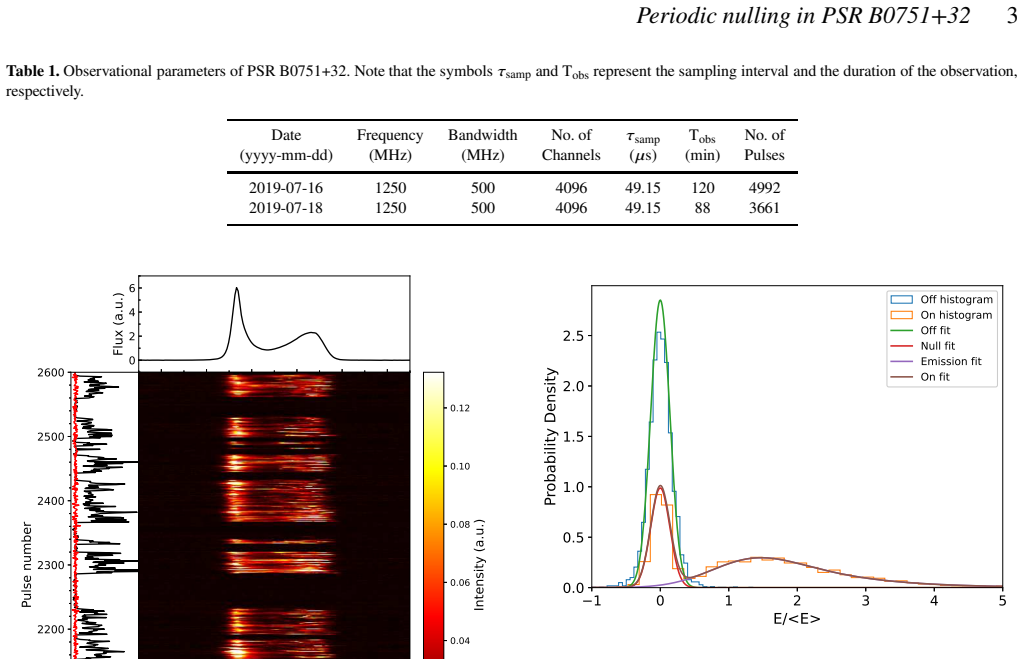
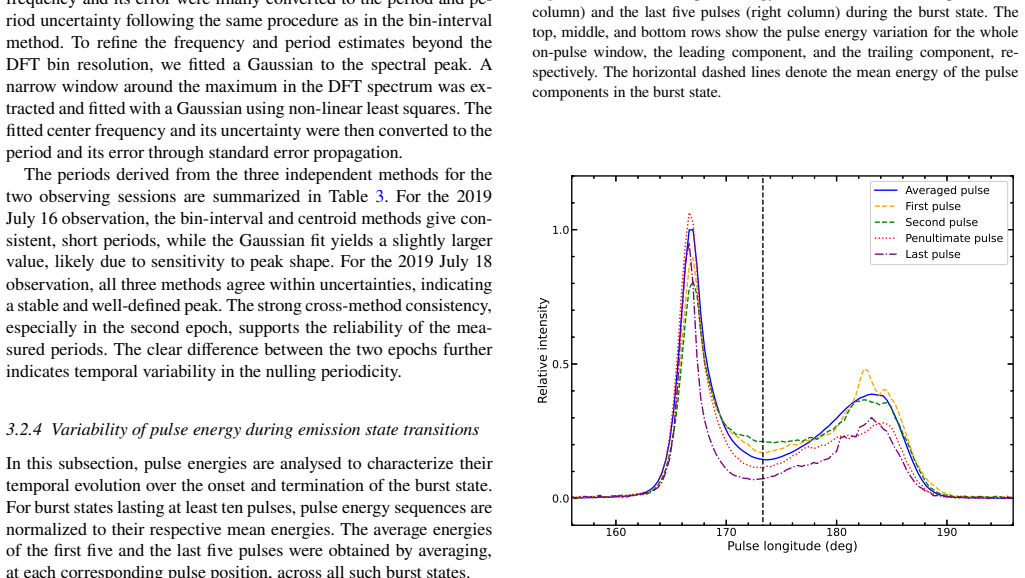
The authors report that PSR B0751+32 displays periodic nulling with a fraction of 35.1% ± 0.6%. Three methods to measure the periodicity all indicate significant temporal evolution in the modulation period within and across observing sessions. The pulse profile consists of a brighter, narrower leading component and a weaker trailing one. Pulse energies in both components are stable at the start of the burst state but then decline progressively, affecting the trailing component more before the burst ends. No evidence for the previously reported subpulse drifting is found in the data, leading to the conclusion that periodic nulling cannot be explained by purely geometric effects alone.
What carries the argument
The mixture model approach to separate null and burst pulses, along with multiple independent techniques for determining the nulling periodicity.
If this is right
- Nulling periodicity is not constant but shows temporal evolution.
- Pulse component energies decline during the burst state prior to termination.
- The trailing pulse component is more strongly affected by the energy decline.
- No subpulse drifting is present in the observations.
- Previous geometric models for periodic nulling are challenged by these observations.
Where Pith is reading between the lines
- The observed evolution suggests that nulling may be linked to time-varying physical conditions in the emission region.
- Similar analyses on other nulling pulsars could reveal whether temporal changes are a common feature.
- If confirmed, this would require updating models to include dynamic rather than static mechanisms for nulling.
- Additional multi-frequency observations might test if the energy decline and periodicity changes depend on observing frequency.
Load-bearing premise
The mixture model accurately classifies pulses as null or burst without misclassifying weak emission or noise, and the periodicity estimates are not biased by the temporal evolution.
What would settle it
A long observation campaign that finds a fixed, unchanging nulling periodicity or detects clear subpulse drifting in PSR B0751+32 would falsify the claim that geometric models are inadequate.
Figures




read the original abstract
We report new results from a nulling study of PSR~B0751+32 (PSR J0754+3231), observed at 1250~MHz with the Five hundred meter Aperture Spherical radio Telescope (FAST). Our analysis confirms the presence of periodic nulling in this pulsar. Using the recently developed mixture model method, we obtained a nulling fraction (NF) of $35.1\% \pm 0.6\%$. Three independent approaches were employed to estimate the nulling periodicity, and the results reveal significant temporal evolution of the modulation both within individual observations and across different \textbf{observing} essions. The pulsar exhibits an asymmetric two-component mean pulse profile, with the leading component brighter and narrower than the trailing one. Pulse energy analysis shows that both components remain stable immediately after the onset of the burst state, but subsequently undergo a progressive decline, with the trailing component most severely affected prior to burst termination. Notably, no evidence of the previously reported subpulse drifting was detected in our data. Our results challenge previous models that ascribed periodic nulling to purely geometric effects.
Editorial analysis
A structured set of objections, weighed in public.
Referee Report
Summary. The paper reports FAST observations at 1250 MHz of PSR B0751+32, confirming periodic nulling with a mixture-model nulling fraction of 35.1% ± 0.6%. Three independent methods are used to measure nulling periodicity, revealing significant temporal evolution both within individual observations and across sessions. The mean profile is asymmetric with a brighter, narrower leading component; pulse energies in both components are stable at burst onset but then decline progressively (trailing component most affected) before burst termination. No subpulse drifting is detected. These findings are presented as challenging prior models that attribute periodic nulling solely to geometric effects.
Significance. If the pulse classifications and periodicity estimates prove robust, the work supplies new high-sensitivity constraints on nulling variability, including intra-burst energy evolution and modulation changes on short timescales. The multi-method periodicity analysis and explicit reporting of temporal evolution add methodological value and could help discriminate between geometric and more dynamic magnetospheric interpretations of nulling.
major comments (3)
- [mixture-model section (data analysis)] Mixture-model section (data analysis): The reported progressive energy decline within burst states directly violates the stationarity assumption required for the two-component mixture model used to derive the NF = 35.1% ± 0.6%. Late-burst pulses whose energies fall into the null distribution would be misclassified, systematically lengthening apparent null runs and shifting the phase of the modulation signal; because the three periodicity estimates and the challenge to geometric models rest on these classifications, the central claim is load-bearing on this point.
- [periodicity results] Periodicity results: The manuscript states that the three independent periodicity methods reveal significant temporal evolution both within observations and across sessions, yet provides no quantitative robustness tests (e.g., re-fitting after excluding late-burst pulses or after injecting synthetic stationary sequences). Without such checks, it is unclear whether the reported evolution is intrinsic or an artifact of the classification bias noted above.
- [discussion of geometric models] Discussion of geometric models: The claim that the observations challenge purely geometric explanations relies on the combination of temporal evolution, energy decline, and absence of drifting. However, the text does not quantify how much evolution or decline would be incompatible with fixed-geometry models (e.g., via simulated pulse sequences), leaving the logical link between data and model rejection incompletely specified.
minor comments (3)
- [abstract] Abstract: typographical error 'essions' should read 'sessions'.
- [methods] Notation: the three periodicity methods are referred to only generically; explicit names, references, or brief algorithmic descriptions would improve reproducibility.
- [figures] Figures: if energy histograms or modulation curves are shown, error bars or confidence intervals on the mixture-model parameters should be added for clarity.
Simulated Author's Rebuttal
We thank the referee for their careful and constructive review of our manuscript. We address each major comment below and describe the revisions we will make to strengthen the analysis and discussion.
read point-by-point responses
-
Referee: Mixture-model section (data analysis): The reported progressive energy decline within burst states directly violates the stationarity assumption required for the two-component mixture model used to derive the NF = 35.1% ± 0.6%. Late-burst pulses whose energies fall into the null distribution would be misclassified, systematically lengthening apparent null runs and shifting the phase of the modulation signal; because the three periodicity estimates and the challenge to geometric models rest on these classifications, the central claim is load-bearing on this point.
Authors: We agree that the observed progressive decline in pulse energies within the burst state raises a legitimate question about the stationarity assumption underlying the mixture model. This could potentially affect classifications if late-burst energies overlap the null distribution. In the revised manuscript we will add an explicit discussion of this limitation in the data analysis section and include quantitative robustness checks, such as re-deriving the nulling fraction after excluding the final portion of each burst and comparing the resulting NF and periodicity values. revision: yes
-
Referee: Periodicity results: The manuscript states that the three independent periodicity methods reveal significant temporal evolution both within observations and across sessions, yet provides no quantitative robustness tests (e.g., re-fitting after excluding late-burst pulses or after injecting synthetic stationary sequences). Without such checks, it is unclear whether the reported evolution is intrinsic or an artifact of the classification bias noted above.
Authors: We accept the need for explicit robustness tests. The revised manuscript will incorporate quantitative checks, including re-computation of the three periodicity estimates after removal of late-burst pulses and comparison against synthetic stationary sequences. These additions will clarify whether the reported temporal evolution persists independently of possible classification bias. revision: yes
-
Referee: Discussion of geometric models: The claim that the observations challenge purely geometric explanations relies on the combination of temporal evolution, energy decline, and absence of drifting. However, the text does not quantify how much evolution or decline would be incompatible with fixed-geometry models (e.g., via simulated pulse sequences), leaving the logical link between data and model rejection incompletely specified.
Authors: We agree that a more quantitative bridge between the observations and model rejection would improve the discussion. In the revision we will expand this section to include references to specific predictions of fixed-geometry models and, where feasible, simple simulated sequences to illustrate the degree of stability expected under purely geometric scenarios versus the evolution and decline seen in the data. revision: yes
Circularity Check
No circularity: purely observational measurements from data
full rationale
The paper reports direct measurements of nulling fraction (35.1% via mixture model) and three independent periodicity estimates from FAST pulse sequences. These are extracted from observed pulse energies and classifications without any derivation that reduces a claimed prediction or result back to a fitted parameter or self-citation by construction. The challenge to geometric models rests on reported temporal evolution and absence of drifting, which are independent observational findings rather than tautological outputs of the paper's own equations.
Axiom & Free-Parameter Ledger
axioms (1)
- domain assumption Individual pulses can be reliably classified as null or burst using a mixture model without significant overlap or systematic bias from RFI or baseline variations.
Reference graph
Works this paper leans on
-
[1]
Anumarlapudi A., Swiggum J. K., Kaplan D. L., Fichtenbauer T. D. J., 2023, @doi [ApJ] 10.3847/1538-4357/acbb68 , https://ui.adsabs.harvard.edu/abs/2023ApJ...948...32A 948, 32
-
[2]
Backer D. C., 1970a, @doi [Nature] 10.1038/227692a0 , https://ui.adsabs.harvard.edu/abs/1970Natur.227..692B 227, 692
-
[3]
Backer D. C., 1970b, @doi [Nature] 10.1038/228042a0 , https://ui.adsabs.harvard.edu/abs/1970Natur.228...42B 228, 42
-
[4]
R., 1981, PhD thesis, University of Massachusetts System
Backus P. R., 1981, PhD thesis, University of Massachusetts System
1981
-
[5]
H., 1982, @doi [ApJ] 10.1086/160125 , https://ui.adsabs.harvard.edu/abs/1982ApJ...258..776B 258, 776
Bartel N., Morris D., Sieber W., Hankins T. H., 1982, @doi [ApJ] 10.1086/160125 , https://ui.adsabs.harvard.edu/abs/1982ApJ...258..776B 258, 776
-
[6]
Basu R., Mitra D., Melikidze G. I., Maciesiak K., Skrzypczak A., Szary A., 2016, @doi [ApJ] 10.3847/1538-4357/833/1/29 , http://adsabs.harvard.edu/abs/2016ApJ...833...29B 833, 29
-
[7]
Basu R., Mitra D., Melikidze G. I., 2017, @doi [ApJ] 10.3847/1538-4357/aa862d , http://adsabs.harvard.edu/abs/2017ApJ...846..109B 846, 109
-
[8]
Basu R., Mitra D., Melikidze G. I., Skrzypczak A., 2019, @doi [MNRAS] 10.1093/mnras/sty2846 , https://ui.adsabs.harvard.edu/abs/2019MNRAS.482.3757B 482, 3757
-
[9]
Basu R., Mitra D., Melikidze G. I., 2020a, @doi [MNRAS] 10.1093/mnras/staa1574 , https://ui.adsabs.harvard.edu/abs/2020MNRAS.496..465B 496, 465
-
[10]
Basu R., Lewandowski W., Kijak J., 2020b, @doi [MNRAS] 10.1093/mnras/staa2398 , https://ui.adsabs.harvard.edu/abs/2020MNRAS.499..906B 499, 906
-
[11]
Basu R., Mitra D., Melikidze G. I., 2020c, @doi [ApJ] 10.3847/1538-4357/ab63c9 , https://ui.adsabs.harvard.edu/abs/2020ApJ...889..133B 889, 133
-
[12]
H., Hulse R
Damashek M., Taylor J. H., Hulse R. A., 1978, ApJ, 225, L 31
1978
-
[13]
T., Stappers B
Edwards R. T., Stappers B. W., 2002, A&A, 393, 733
2002
-
[14]
Gajjar V., Joshi B. C., Kramer M., 2012, @doi [MNRAS] 10.1111/j.1365-2966.2012.21296.x , http://adsabs.harvard.edu/abs/2012MNRAS.424.1197G 424, 1197
-
[15]
Gajjar V., Yuan J. P., Yuen R., Wen Z. G., Liu Z. Y., Wang N., 2017, @doi [ApJ] 10.3847/1538-4357/aa96ac , http://adsabs.harvard.edu/abs/2017ApJ...850..173G 850, 173
-
[16]
Hankins T. H., Wright G. A. E., 1980, @doi [ ] 10.1038/288681a0 , https://ui.adsabs.harvard.edu/abs/1980Natur.288..681H 288, 681
-
[17]
Hankins T. H., Kern J. S., Weatherall J. C., Eilek J. A., 2003, @doi [ ] 10.1038/nature01477 , https://ui.adsabs.harvard.edu/abs/2003Natur.422..141H 422, 141
-
[18]
Herfindal J. L., Rankin J. M., 2007, @doi [MNRAS] 10.1111/j.1365-2966.2007.12089.x , http://adsabs.harvard.edu/abs/2007MNRAS.380..430H 380, 430
-
[19]
Herfindal J. L., Rankin J. M., 2009, @doi [MNRAS] 10.1111/j.1365-2966.2008.14119.x , http://adsabs.harvard.edu/abs/2009MNRAS.393.1391H 393, 1391
-
[20]
W., van Straten W., Manchester R
Hotan A. W., van Straten W., Manchester R. N., 2004, @doi [PASA] 10.1071/AS04022 , https://ui.adsabs.harvard.edu/abs/2004PASA...21..302H 21, 302
-
[21]
H., van Leeuwen J., 2004, @doi [A&A] 10.1051/0004-6361:20041062 , 425, 255
Janssen G. H., van Leeuwen J., 2004, @doi [A&A] 10.1051/0004-6361:20041062 , 425, 255
-
[22]
Jiang P., et al., 2020, @doi [RAA] 10.1088/1674-4527/20/5/64 , https://ui.adsabs.harvard.edu/abs/2020RAA....20...64J 20, 064
-
[23]
Kaplan D. L., Swiggum J. K., Fichtenbauer T. D. J., Vallisneri M., 2018, @doi [ApJ] 10.3847/1538-4357/aaab62 , https://ui.adsabs.harvard.edu/abs/2018ApJ...855...14K 855, 14
-
[24]
Kou F. F., et al., 2021, @doi [ApJ] 10.3847/1538-4357/abd545 , https://ui.adsabs.harvard.edu/abs/2021ApJ...909..170K 909, 170
-
[25]
Lyne A., Hobbs G., Kramer M., Stairs I., Stappers B., 2010, @doi [Science] 10.1126/science.1186683 , http://adsabs.harvard.edu/abs/2010Sci...329..408L 329, 408
-
[26]
Manchester R. N., Hobbs G. B., Teoh A., Hobbs M., 2005, @doi [AJ] 10.1086/428488 , https://ui.adsabs.harvard.edu/abs/2005AJ....129.1993M 129, 1993
-
[27]
McSweeney S. J., Bhat N. D. R., Tremblay S. E., Deshpande A. A., Ord S. M., 2017, @doi [ApJ] 10.3847/1538-4357/aa5c35 , https://ui.adsabs.harvard.edu/abs/2017ApJ...836..224M 836, 224
-
[28]
Mitra D., Rankin J., 2017, @doi [MNRAS] 10.1093/mnras/stx814 , http://adsabs.harvard.edu/abs/2017MNRAS.468.4601M 468, 4601
-
[29]
Olszanski T. E. E., Mitra D., Rankin J. M., 2019, @doi [MNRAS] 10.1093/mnras/stz2172 , https://ui.adsabs.harvard.edu/abs/2019MNRAS.489.1543O 489, 1543
-
[30]
J., 1969, Astrophys
Radhakrishnan V., Cooke D. J., 1969, Astrophys. Lett., https://ui.adsabs.harvard.edu/abs/1969ApL.....3..225R 3, 225
1969
-
[31]
Rankin J. M., 1993a, @doi [ApJS] 10.1086/191758 , https://ui.adsabs.harvard.edu/abs/1993ApJS...85..145R 85, 145
-
[32]
Rankin J. M., 1993b, @doi [ApJ] 10.1086/172361 , https://ui.adsabs.harvard.edu/abs/1993ApJ...405..285R 405, 285
-
[33]
Rankin J. M., Wright G. A. E., 2007, @doi [MNRAS] 10.1111/j.1365-2966.2007.11980.x , http://adsabs.harvard.edu/abs/2007MNRAS.379..507R 379, 507
-
[34]
Rankin J. M., Wright G. A. E., 2008, @doi [MNRAS] 10.1111/j.1365-2966.2008.13001.x , http://adsabs.harvard.edu/abs/2008MNRAS.385.1923R 385, 1923
-
[35]
Rankin J. M., Wright G. A. E., Brown A. M., 2013, @doi [MNRAS] 10.1093/mnras/stt739 , http://adsabs.harvard.edu/abs/2013MNRAS.433..445R 433, 445
-
[36]
Rankin J., Venkataraman A., Weisberg J. M., Curtin A. P., 2023, @doi [MNRAS] 10.1093/mnras/stad2182 , https://ui.adsabs.harvard.edu/abs/2023MNRAS.524.5042R 524, 5042
-
[37]
Rejep R., Wang N., Yan W. M., Wen Z. G., 2022, @doi [MNRAS] 10.1093/mnras/stab3063 , https://ui.adsabs.harvard.edu/abs/2022MNRAS.509.2507R 509, 2507
-
[38]
Ritchings R. T., 1976, @doi [MNRAS] 10.1093/mnras/176.2.249 , https://ui.adsabs.harvard.edu/abs/1976MNRAS.176..249R 176, 249
-
[39]
Smits J. M., Mitra D., Kuijpers J., 2005, @doi [A&A] 10.1051/0004-6361:20041626 , https://ui.adsabs.harvard.edu/abs/2005A&A...440..683S 440, 683
-
[40]
Tedila H. M., et al., 2025, @doi [ ] 10.3847/1538-4365/adb280 , https://ui.adsabs.harvard.edu/abs/2025ApJS..277...39T 277, 39
-
[41]
van Leeuwen A. G. J., Stappers B. W., Ramachandran R., Rankin J. M., 2003, @doi [A&A] 10.1051/0004-6361:20021630 , https://ui.adsabs.harvard.edu/abs/2003A&A...399..223V 399, 223
-
[42]
van Straten W., Bailes M., 2011, @doi [PASA] 10.1071/AS10021 , http://adsabs.harvard.edu/abs/2011PASA...28....1V 28, 1
-
[43]
Weisberg J. M., et al., 1999, @doi [ApJS] 10.1086/313189 , https://ui.adsabs.harvard.edu/abs/1999ApJS..121..171W 121, 171
-
[44]
Weltevrede P., 2016, @doi [A&A] 10.1051/0004-6361/201527950 , http://adsabs.harvard.edu/abs/2016A
-
[45]
Weltevrede P., Edwards R. T., Stappers B. W., 2006, @doi [A&A] 10.1051/0004-6361:20053088 , https://ui.adsabs.harvard.edu/abs/2006A&A...445..243W 445, 243
-
[46]
Weltevrede P., Stappers B. W., Edwards R. T., 2007, @doi [A&A] 10.1051/0004-6361:20066855 , https://ui.adsabs.harvard.edu/abs/2007A&A...469..607W 469, 607
-
[47]
Wen Z. G., Wang N., Yuan J. P., Yan W. M., Manchester R. N., Yuen R., Gajjar V., 2016, @doi [A&A] 10.1051/0004-6361/201628214 , https://ui.adsabs.harvard.edu/abs/2016A&A...592A.127W 592, A127
-
[48]
Wolszczan A., Bartel N., Sieber W., 1981, A&A, https://ui.adsabs.harvard.edu/abs/1981A&A...100...91W 100, 91
1981
-
[49]
2011, MNRAS, 415, 2101, doi: 10.1111/j.1365-2966.2011.18820.x
Yan W. M., et al., 2011, @doi [MNRAS] 10.1111/j.1365-2966.2011.18522.x , http://adsabs.harvard.edu/abs/2011MNRAS.414.2087Y 414, 2087
-
[50]
Yan W. M., Manchester R. N., Wang N., Yuan J. P., Wen Z. G., Lee K. J., 2019, @doi [MNRAS] 10.1093/mnras/stz650 , https://ui.adsabs.harvard.edu/abs/2019MNRAS.485.3241Y 485, 3241
-
[51]
Yan W. M., Manchester R. N., Wang N., Wen Z. G., Yuan J. P., Lee K. J., Chen J. L., 2020, @doi [MNRAS] 10.1093/mnras/stz3399 , https://ui.adsabs.harvard.edu/abs/2020MNRAS.491.4634Y 491, 4634
-
[52]
Zhao D., Yan W. M., Wang N., Yuan J. P., 2023, @doi [ ] 10.3847/1538-4357/ad0890 , https://ui.adsabs.harvard.edu/abs/2023ApJ...959...26Z 959, 26
discussion (0)
Sign in with ORCID, Apple, or X to comment. Anyone can read and Pith papers without signing in.