Recognition: unknown
Does the spectral break in the IceCube diffuse neutrino spectrum originate from AGN evolution?
Pith reviewed 2026-05-10 17:22 UTC · model grok-4.3
The pith
AGN evolution naturally produces the spectral break in IceCube's diffuse neutrino spectrum.
A machine-rendered reading of the paper's core claim, the machinery that carries it, and where it could break.
Core claim
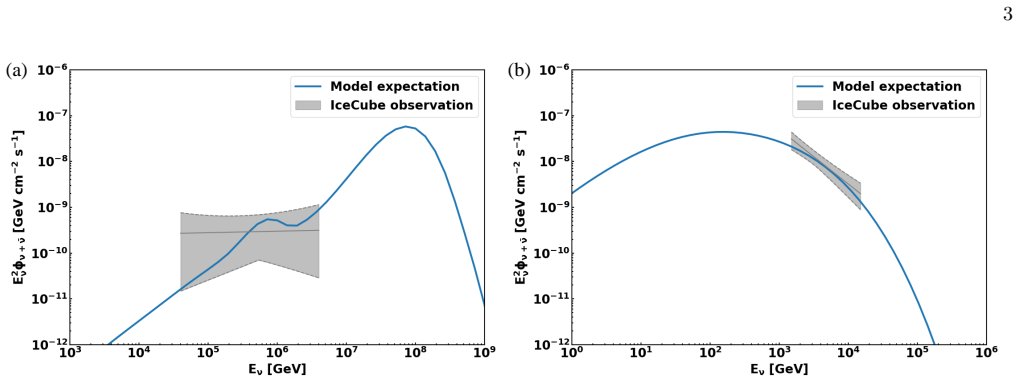
The spectral break is naturally predicted when AGN evolution is taken into account, and the diffuse flux can be interpreted as the superposition of contributions from AGNs at different evolutionary phases. We develop a unified framework that incorporates AGN evolution, where cosmic rays accelerated during the active phase subsequently diffuse and interact in the host galaxy after the central engine switches off, producing a long-lived hadronic afterglow. Adopting physically plausible parameters, our model successfully reproduces both the spectral features of the diffuse background and the observed neutrino emission from representative sources such as TXS 0506+056 and NGC 1068.
What carries the argument
The unified AGN-evolution framework in which cosmic rays accelerated in the active phase produce a long-lived hadronic afterglow through continued diffusion and interaction in the host galaxy after the central engine switches off.
If this is right
- The diffuse neutrino background is the summed afterglow contribution from AGNs across their full evolutionary sequence.
- AGN host galaxies function as more efficient cosmic-ray reservoirs than earlier models assumed.
- Most AGNs operate in a lepton-dominated regime, which accounts for the low number of point-like sources detected by IceCube.
- Next-generation neutrino telescopes must have substantially larger effective areas to increase the detection rate of individual sources.
Where Pith is reading between the lines
- Neutrino observations could serve as a clock for the AGN duty cycle in individual galaxies.
- Correlations between neutrino arrival directions and host-galaxy properties such as recent star-formation history or AGN remnant signatures would provide an independent test.
- The same evolutionary superposition approach might be applied to other transient high-energy populations to predict additional spectral features in the diffuse background.
Load-bearing premise
That physically plausible parameters for cosmic-ray acceleration, diffusion, and interaction in AGN host galaxies after the central engine switches off can be chosen to reproduce both the diffuse spectral break and the neutrino fluxes from TXS 0506+056 and NGC 1068.
What would settle it
A calculation demonstrating that no choice of physically allowed parameters for post-active cosmic-ray diffusion and interaction simultaneously fits the observed spectral break and the measured fluxes from TXS 0506+056 and NGC 1068.
Figures


read the original abstract
The enigmatic origin of the diffuse neutrino background detected by IceCube in the energy range from TeV to PeV remains one of the central open problems in high-energy astrophysics, and this puzzle is further deepened by the recent evidence for a spectral break. Could this convex-spectrum background arise predominantly from the evolution of active galactic nuclei (AGNs)? In this work, we claim that the spectral break is naturally predicted when AGN evolution is taken into account, and the diffuse flux can be interpreted as the superposition of contributions from AGNs at different evolutionary phases. We develop a unified framework that incorporates AGN evolution, where cosmic rays (CRs) accelerated during the active phase subsequently diffuse and interact in the host galaxy after the central engine switches off, producing a long-lived hadronic afterglow. Adopting physically plausible parameters, our model successfully reproduces both the spectral features of the diffuse background and the observed neutrino emission from representative sources such as TXS 0506$+$056 and NGC 1068. Our results suggest that AGN host galaxies are more efficient CR reservoirs than previously expected. Moreover, the model favors a lepton-dominated scenario for most AGNs. This conclusion accounts for the relatively low detection rate of point-like sources by IceCube and underscores the need for next-generation neutrino telescopes with larger effective areas and higher sensitivity.
Editorial analysis
A structured set of objections, weighed in public.
Referee Report
Summary. The paper claims that the convex spectral break in the IceCube diffuse neutrino background is a natural consequence of AGN evolution: cosmic rays accelerated during the active AGN phase diffuse and interact in the host galaxy after the central engine shuts down, producing a long-lived hadronic afterglow. The observed diffuse flux is interpreted as a superposition of contributions from AGNs at different evolutionary phases. With a unified framework and physically plausible parameters, the model is stated to reproduce both the diffuse spectrum (including the break) and the neutrino fluxes from TXS 0506+056 and NGC 1068, while favoring lepton-dominated AGN scenarios and implying AGN host galaxies are efficient CR reservoirs.
Significance. If the central claim holds after independent validation of the post-shutdown parameters, the result would supply an astrophysical origin for the IceCube spectral break without new physics, unify point-source and diffuse neutrino observations under AGN evolution, and explain the low IceCube point-source detection rate. The unified framework that couples AGN evolutionary phases to a long-lived hadronic afterglow is a constructive modeling step.
major comments (3)
- [Abstract and unified framework] Abstract and model description: the assertion that the spectral break is 'naturally predicted' by AGN evolution rests on adopting cosmic-ray diffusion coefficients, grammage, and interaction timescales after engine shutdown that are tuned to place the break near 100 TeV and normalize the flux; no external anchor (radio, gamma-ray, or multi-messenger constraints on the same host-galaxy diffusion) is shown to fix these parameters independently of the IceCube data.
- [Abstract] Abstract: the claim that the model 'successfully reproduces' the diffuse spectrum and source fluxes is presented without quantitative support (no chi-squared values, residual plots, error bars on the fit, or data exclusion criteria), so the validity of the reproduction cannot be assessed from the manuscript.
- [Unified framework] Model description: the relative contribution weights from different AGN evolutionary phases and the three free parameters (acceleration efficiency, post-shutdown diffusion/interaction timescales, phase weights) are adjusted until the superposition matches the observed break and fluxes; this makes the result at least partly a fit rather than an independent derivation from first principles.
minor comments (2)
- [Abstract] The term 'lepton-dominated scenario for most AGNs' is used without a precise definition or quantitative threshold in the provided text.
- [Model description] Notation for the evolutionary phases and the afterglow duration should be defined explicitly with symbols before use in equations.
Simulated Author's Rebuttal
We thank the referee for their constructive and detailed review of our manuscript. The comments raise important points about parameter justification, quantitative fit assessment, and the nature of the modeling approach. We address each major comment below and indicate the revisions we will incorporate.
read point-by-point responses
-
Referee: [Abstract and unified framework] Abstract and model description: the assertion that the spectral break is 'naturally predicted' by AGN evolution rests on adopting cosmic-ray diffusion coefficients, grammage, and interaction timescales after engine shutdown that are tuned to place the break near 100 TeV and normalize the flux; no external anchor (radio, gamma-ray, or multi-messenger constraints on the same host-galaxy diffusion) is shown to fix these parameters independently of the IceCube data.
Authors: We agree that stronger external anchoring would bolster the claim of a 'natural' prediction. The adopted post-shutdown diffusion coefficients and grammage are drawn from standard values in the literature for CR propagation in star-forming galaxies and AGN hosts (e.g., from gamma-ray and radio observations of similar systems). The break position itself follows from the ratio of AGN active-phase lifetime to post-active diffusion time, which is set by independent AGN population studies rather than IceCube data alone. The overall normalization is matched to the observed flux level, but the spectral shape emerges from the evolutionary superposition. To address the referee's concern, we will revise the manuscript to add explicit citations and a short discussion section linking the chosen parameters to multi-wavelength constraints on host-galaxy CR transport. revision: partial
-
Referee: [Abstract] Abstract: the claim that the model 'successfully reproduces' the diffuse spectrum and source fluxes is presented without quantitative support (no chi-squared values, residual plots, error bars on the fit, or data exclusion criteria), so the validity of the reproduction cannot be assessed from the manuscript.
Authors: We accept this criticism. The current manuscript relies on visual comparison rather than statistical metrics. In the revised version we will add chi-squared values (or equivalent goodness-of-fit measures) for the diffuse spectrum and the two example sources, include residual plots, and specify the exact IceCube data points and energy ranges used in the comparison. revision: yes
-
Referee: [Unified framework] Model description: the relative contribution weights from different AGN evolutionary phases and the three free parameters (acceleration efficiency, post-shutdown diffusion/interaction timescales, phase weights) are adjusted until the superposition matches the observed break and fluxes; this makes the result at least partly a fit rather than an independent derivation from first principles.
Authors: The model does contain adjustable parameters within physically allowed ranges, and we acknowledge that the result is not a pure first-principles derivation. However, the convex break is a structural prediction of the phase superposition once the evolutionary timescales are fixed by AGN demographics; it is not inserted by hand. Acceleration efficiency follows from standard diffusive shock acceleration expectations, diffusion timescales from galactic CR propagation models, and phase weights from the observed AGN luminosity function. The same parameter set is required to describe both the diffuse background and the two point sources, providing an internal consistency test. We will revise the text to clarify these motivations, reduce any implication of unconstrained fitting, and note the phenomenological character of the current implementation. revision: partial
Circularity Check
Reproduction of the observed spectral break relies on tuning post-shutdown diffusion and interaction parameters to match IceCube data
specific steps
-
fitted input called prediction
[Abstract]
"Adopting physically plausible parameters, our model successfully reproduces both the spectral features of the diffuse background and the observed neutrino emission from representative sources such as TXS 0506+056 and NGC 1068."
The parameters governing diffusion, grammage, and interaction timescales in the host-galaxy afterglow phase are selected to place the break near the observed energy and to normalize the flux. Once these inputs are tuned to the IceCube diffuse spectrum and the two point-source fluxes, the reproduction of the break is no longer an independent derivation but follows by construction from the chosen values.
full rationale
The paper's central claim is that AGN evolution plus a long-lived hadronic afterglow 'naturally predicts' the convex spectral break at ~100 TeV. However, the break location, shape, and normalization are achieved by selecting cosmic-ray diffusion coefficients, grammage, and interaction timescales after the central engine turns off. These parameters are stated to be 'physically plausible' yet are chosen specifically so the superposition of evolutionary phases reproduces both the diffuse spectrum (including the break) and the fluxes from TXS 0506+056 and NGC 1068. No independent external constraint (e.g., radio, gamma-ray, or multi-messenger limits on the same host-galaxy diffusion) is shown to fix the three parameters; they are adjusted until the model matches the target observations. This reduces the 'natural prediction' to a fitted-input-called-prediction step. The remainder of the framework (AGN evolution, superposition) is standard and non-circular, so the overall circularity is partial rather than total.
Axiom & Free-Parameter Ledger
free parameters (3)
- cosmic-ray acceleration efficiency during active AGN phase
- diffusion and interaction timescales in host galaxy after AGN shutdown
- relative contribution weights from different AGN evolutionary phases
axioms (2)
- domain assumption AGNs evolve through active and inactive phases with cosmic rays persisting after central engine shutdown
- domain assumption Host galaxies act as efficient cosmic-ray reservoirs
invented entities (1)
-
long-lived hadronic afterglow in AGN host galaxies
no independent evidence
Reference graph
Works this paper leans on
-
[1]
M. G. Aartsen, R. Abbasi, Y. Abdou, and et al. (Ice- Cube Collaboration), First Observation of PeV-Energy Neutrinos with IceCube, Phys. Rev. Lett.111, 021103 (2013)
2013
-
[2]
M. G. Aartsen, K. Abraham, M. Ackermann, and et al. (IceCube Collaboration), OBSERVATION AND CHAR- ACTERIZATION OF A COSMIC MUON NEUTRINO FLUX FROM THE NORTHERN HEMISPHERE US- ING SIX YEARS OF ICECUBE DATA, The Astrophys- ical Journal833, 3 (2016)
2016
-
[3]
M. G. Aartsen, M. Ackermann, J. Adams, and et al. (IceCube Collaboration), Characteristics of the Diffuse Astrophysical Electron and Tau Neutrino Flux with Six Years of IceCube High Energy Cascade Data, Phys. Rev. Lett.125, 121104 (2020)
2020
-
[4]
Abbasi, M
R. Abbasi, M. Ackermann, J. Adams, and et al. (IceCube Collaboration), IceCube high-energy starting event sam- ple: Description and flux characterization with 7.5 years of data, Phys. Rev. D104, 022002 (2021)
2021
-
[5]
Abbasi, M
R. Abbasi, M. Ackermann, J. Adams, and et al. (IceCube Collaboration), Improved Characterization of the Astro- physical Muon–neutrino Flux with 9.5 Years of IceCube Data, The Astrophysical Journal928, 50 (2022)
2022
-
[6]
Abbasi, M
R. Abbasi, M. Ackermann, J. Adams, and et al. (IceCube Collaboration), Characterization of the astrophysical dif- fuse neutrino flux using starting track events in IceCube, Phys. Rev. D110, 022001 (2024)
2024
-
[7]
Abbasi, M
R. Abbasi, M. Ackermann, J. Adams, and et al. (IceCube Collaboration), Evidence for a Spectral Break or Curva- ture in the Spectrum of Astrophysical Neutrinos from 5 TeV to 10 PeV, Phys. Rev. Lett.136, 121002 (2026)
2026
-
[8]
R. Abbasi, M. Ackermann, J. Adams, and et al., Im- proved measurements of the TeV–PeV extragalactic neu- trino spectrum from joint analyses of IceCube tracks and cascades, arXiv e-prints , arXiv:2507.22234 (2025)
work page internal anchor Pith review Pith/arXiv arXiv 2025
-
[9]
F. W. Stecker, C. Done, M. H. Salamon, and P. Sommers, High-energy neutrinos from active galactic nuclei, Phys. Rev. Lett.66, 2697 (1991)
1991
-
[10]
Szabo and R
A. Szabo and R. Protheroe, Implications of particle accel- eration in active galactic nuclei for cosmic rays and high energy neutrino astronomy, Astroparticle Physics2, 375 (1994)
1994
-
[11]
ESPRESSO
D. Caprioli, “ESPRESSO” ACCELERATION OF ULTRA-HIGH-ENERGY COSMIC RAYS, The Astro- physical Journal Letters811, L38 (2015)
2015
-
[12]
Ghisellini and F
G. Ghisellini and F. Tavecchio, Canonical high-power blazars, Monthly Notices of the Royal Astronomical So- ciety397, 985 (2009)
2009
-
[13]
Murase, Y
K. Murase, Y. Inoue, and C. D. Dermer, Diffuse neutrino intensity from the inner jets of active galactic nuclei: Im- pacts of external photon fields and the blazar sequence, Phys. Rev. D90, 023007 (2014)
2014
-
[14]
Miley and C
G. Miley and C. De Breuck, Distant radio galaxies and their environments, The Astronomy and Astrophysics Review15, 67 (2008)
2008
-
[15]
Quasar Era
N. P. H. Nesvadba, M. D. Lehnert, C. De Breuck, A. M. Gilbert, and W. van Breugel, Evidence for powerful AGN winds at high redshift: dynamics of galactic outflows in radio galaxies during the “Quasar Era”*, Astronomy & Astrophysics491, 407 (2008)
2008
-
[16]
Casasola, L
V. Casasola, L. Magrini, F. Combes, A. Mignano, E. Sani, R. Paladino, and F. Fontani, A gas-rich AGN near the centre of a galaxy cluster at z∼1.4, Astronomy & Astrophysics558, A60 (2013)
2013
-
[17]
G. C. Jones, R. Maiolino, C. Circosta, J. Scholtz, S. Car- niani, and Y. Fudamoto, Evidence for extended gaseous reservoirs around AGN at cosmic noon from ALMA CO(3-2) observations, Monthly Notices of the Royal As- tronomical Society518, 691 (2022)
2022
-
[18]
Murase, S
K. Murase, S. S. Kimura, and P. M´ esz´ aros, Hidden Cores of Active Galactic Nuclei as the Origin of Medium- Energy Neutrinos: Critical Tests with the MeV Gamma- Ray Connection, Phys. Rev. Lett.125, 011101 (2020)
2020
- [19]
-
[20]
S. S. Kimura, K. Murase, and K. Toma, NEUTRINO AND COSMIC-RAY EMISSION AND CUMULATIVE BACKGROUND FROM RADIATIVELY INEFFI- CIENT ACCRETION FLOWS IN LOW-LUMINOSITY ACTIVE GALACTIC NUCLEI, The Astrophysical Journal806, 159 (2015)
2015
-
[21]
S. S. Kimura, K. Murase, and P. M´ esz´ aros, Multimessen- ger tests of cosmic-ray acceleration in radiatively ineffi- cient accretion flows, Phys. Rev. D100, 083014 (2019)
2019
-
[22]
S. S. Kimura, K. Murase, and P. M´ esz´ aros, Soft gamma rays from low accreting supermassive black holes and connection to energetic neutrinos, Nature Communica- tions12, 5615 (2021)
2021
-
[23]
Kalashev, D
O. Kalashev, D. Semikoz, and I. Tkachev, Neutrinos in IceCube from active galactic nuclei, Soviet Journal of Ex- perimental and Theoretical Physics120, 541 (2015)
2015
-
[24]
Tamborra, S
I. Tamborra, S. Ando, and K. Murase, Star-forming galaxies as the origin of diffuse high-energy backgrounds: gamma-ray and neutrino connections, and implications for starburst history, Journal of Cosmology and As- troparticle Physics2014(09), 043
-
[25]
Hooper, A case for radio galaxies as the sources of Ice- Cube’s astrophysical neutrino flux, Journal of Cosmology and Astroparticle Physics2016(09), 002
D. Hooper, A case for radio galaxies as the sources of Ice- Cube’s astrophysical neutrino flux, Journal of Cosmology and Astroparticle Physics2016(09), 002. 7
-
[26]
Fang and K
K. Fang and K. Murase, Linking high-energy cosmic par- ticles by black-hole jets embedded in large-scale struc- tures, Nature Physics14, 396 (2018)
2018
-
[27]
Ackermann, M
M. Ackermann, M. Ajello, A. Albert, and et al., THE SPECTRUM OF ISOTROPIC DIFFUSE GAMMA- RAY EMISSION BETWEEN 100 MeV AND 820 GeV, The Astrophysical Journal799, 86 (2015)
2015
-
[28]
Aiello, A
S. Aiello, A. Albert, A. R. Alhebsi, and et al. (KM3NeT Collaboration), Observation of an ultra-high-energy cos- mic neutrino with KM3NeT, Nature (London)638, 376 (2025)
2025
-
[29]
KM3NeT Collaboration, MessMapp Group, Fermi-LAT Collaboration, OWENS VALLEY RADIO OBSERVA- TORY 40-M TELESCOPE Group, SVOM Collabora- tion, P. Baldini, J. Buchner, A. K. Erkenov, N. Globus, A. Merloni, A. Paggi, A. V. Popkov, D. Porquet, M. Sal- vato, Y. V. Sotnikova, and P. A. Voitsik, Characterizing Candidate Blazar Counterparts of the Ultra-High-Energy...
- [30]
-
[31]
M. G. Aartsen, M. Ackermann, J. Adams, and et al., Multimessenger observations of a flaring blazar coinci- dent with high-energy neutrino IceCube-170922A, Sci- ence361, eaat1378 (2018)
2018
-
[32]
Abbasi, M
R. Abbasi, M. Ackermann, J. Adams, and et al. (IceCube Collaboration), Evidence for neutrino emission from the nearby active galaxy NGC 1068, Science378, 538 (2022)
2022
-
[33]
Jogee, The Fueling and Evolution of AGN: Internal and External Triggers, inPhysics of Active Galactic Nu- clei at all Scales, edited by D
S. Jogee, The Fueling and Evolution of AGN: Internal and External Triggers, inPhysics of Active Galactic Nu- clei at all Scales, edited by D. Alloin, R. Johnson, and P. Lira (Springer Berlin Heidelberg, Berlin, Heidelberg,
-
[34]
E. C. D. Pope, J. T. Mendel, and S. S. Shabala, Investi- gating the properties of active galactic nucleus feedback in hot atmospheres triggered by cooling-induced gravita- tional collapse, Monthly Notices of the Royal Astronom- ical Society419, 50 (2011)
2011
-
[35]
S. S. Shabala, S. Ash, P. Alexander, and J. M. Riley, The duty cycle of local radio galaxies, Monthly Notices of the Royal Astronomical Society388, 625 (2008)
2008
-
[36]
R. J. Turner and S. S. Shabala, ENERGETICS AND LIFETIMES OF LOCAL RADIO ACTIVE GALACTIC NUCLEI, The Astrophysical Journal806, 59 (2015)
2015
-
[37]
M. G. Aartsen, M. Ackermann, J. Adams, and et al. (Ice- Cube Collaboration), Neutrino emission from the direc- tion of the blazar TXS 0506+056 prior to the IceCube- 170922A alert, Science361, 147 (2018)
2018
-
[38]
Lu, Y.-R
K.-X. Lu, Y.-R. Li, Q. Wu, L. C. Ho, Z.-X. Zhang, H.-C. Feng, S.-S. Li, Y.-J. Chen, M. Sun, X. Shu, W.-J. Guo, C. Cheng, J.-G. Wang, D. Kim, J.-M. Wang, and J.-M. Bai, A Short-lived Rejuvenation during the Decades-long Changing-look Transition in the Nucleus of Mrk 1018, The Astrophysical Journal Supplement Series276, 51 (2025)
2025
-
[39]
G. E. Romero, M. Boettcher, S. Markoff, and F. Tavec- chio, Relativistic Jets in Active Galactic Nuclei and Mi- croquasars, Space Science Reviews207, 5 (2017)
2017
-
[40]
Asano, F
K. Asano, F. Takahara, M. Kusunose, K. Toma, and J. Kakuwa, TIME-DEPENDENT MODELS FOR BLAZAR EMISSION WITH THE SECOND-ORDER FERMI ACCELERATION, The Astrophysical Journal 780, 64 (2013)
2013
-
[41]
R.-Y. Liu, F. M. Rieger, and F. A. Aharonian, Particle Acceleration in Mildly Relativistic Shearing Flows: The Interplay of Systematic and Stochastic Effects, and the Origin of the Extended High-energy Emission in AGN Jets, The Astrophysical Journal842, 39 (2017)
2017
-
[42]
X. Chen, M. Pohl, and M. B¨ ottcher, Particle diffusion and localized acceleration in inhomogeneous AGN jets – I. Steady-state spectra, Monthly Notices of the Royal Astronomical Society447, 530 (2014)
2014
-
[43]
X. Chen, M. Pohl, M. B¨ ottcher, and S. Gao, Particle dif- fusion and localized acceleration in inhomogeneous AGN jets – II. Stochastic variation, Monthly Notices of the Royal Astronomical Society458, 3260 (2016)
2016
-
[44]
P. F. Hopkins, G. T. Richards, and L. Hernquist, An Ob- servational Determination of the Bolometric Quasar Lu- minosity Function, The Astrophysical Journal654, 731 (2007)
2007
-
[45]
F. M. Rieger, V. Bosch-Ramon, and P. Duffy, Fermi ac- celeration in astrophysical jets, Astrophysics and Space Science309, 119 (2007)
2007
-
[46]
Fossati, L
G. Fossati, L. Maraschi, A. Celotti, A. Comastri, and G. Ghisellini, A unifying view of the spectral energy dis- tributions of blazars, Monthly Notices of the Royal As- tronomical Society299, 433 (1998)
1998
-
[47]
Donato, G
D. Donato, G. Ghisellini, G. Tagliaferri, and G. Fossati, Hard X-ray properties of blazars*, Astronomy & Astro- physics375, 739 (2001)
2001
-
[48]
Ghisellini, C
G. Ghisellini, C. Righi, L. Costamante, and F. Tavecchio, The Fermi blazar sequence, Monthly Notices of the Royal Astronomical Society469, 255 (2017)
2017
-
[49]
J. S. Chang and G. Cooper, A practical difference scheme for Fokker-Planck equations, Journal of Computational Physics6, 1 (1970)
1970
-
[50]
B. T. Park and V. Petrosian, Fokker-Planck equations of stochastic acceleration: A study of numerical methods, The Astrophysical Journal Supplement103, 255 (1996)
1996
-
[51]
Hahn, GAMERA - a new modeling package for non- thermal spectral modeling, in34th International Cosmic Ray Conference (ICRC2015), Vol
J. Hahn, GAMERA - a new modeling package for non- thermal spectral modeling, in34th International Cosmic Ray Conference (ICRC2015), Vol. 34 (2015) p. 917
2015
-
[52]
H¨ ummer, M
S. H¨ ummer, M. R¨ uger, F. Spanier, and W. Winter, SIM- PLIFIED MODELS FOR PHOTOHADRONIC INTER- ACTIONS IN COSMIC ACCELERATORS, The Astro- physical Journal721, 630 (2010)
2010
-
[53]
D. F. G. Fiorillo, F. Testagrossa, M. Petropoulou, and W. Winter, Can the Neutrinos from TXS 0506+056 Have a Coronal Origin?, The Astrophysical Journal986, 104 (2025)
2025
-
[54]
Putze, L
A. Putze, L. Derome, D. Maurin, L. Perotto, and R. Tail- let, A Markov Chain Monte Carlo technique to sample transport and source parameters of Galactic cosmic rays - I. Method and results for the Leaky-Box model, Astron- omy & Astrophysics497, 991 (2009)
2009
-
[55]
V. S. Ptuskin, O. N. Strelnikova, and L. G. Sveshnikova, On leaky-box approximation to GALPROP, Astroparti- cle Physics31, 284 (2009)
2009
-
[56]
Cowsik and D
R. Cowsik and D. Huth, The Correspondence between Leaky-box and Diffusion Models of Cosmic-Ray Propa- gation, The Astrophysical Journal987, 64 (2025)
2025
-
[57]
S. R. Kelner, F. A. Aharonian, and V. V. Bugayov, En- ergy spectra of gamma rays, electrons, and neutrinos pro- duced at proton-proton interactions in the very high en- ergy regime, Phys. Rev. D74, 034018 (2006)
2006
-
[58]
Padovani, E
P. Padovani, E. Resconi, M. Ajello, C. Bellenghi, 8 S. Bianchi, P. Blasi, K.-Y. Huang, S. Gabici, V. G´ amez Rosas, H. Niederhausen, E. Peretti, B. Eichmann, D. Guetta, A. Lamastra, and T. Shimizu, High-energy neutrinos from the vicinity of the supermassive black hole in NGC 1068, Nature Astronomy8, 1077 (2024)
2024
-
[59]
Abbasi, M
R. Abbasi, M. Ackermann, J. Adams, and et al., IceCube Search for Neutrino Emission from X-Ray Bright Seyfert Galaxies, The Astrophysical Journal988, 141 (2025)
2025
-
[60]
Y. Ueda, M. Akiyama, G. Hasinger, T. Miyaji, and M. G. Watson, TOWARD THE STANDARD POP- ULATION SYNTHESIS MODEL OF THE X-RAY BACKGROUND: EVOLUTION OF X-RAY LUMI- NOSITY AND ABSORPTION FUNCTIONS OF AC- TIVE GALACTIC NUCLEI INCLUDING COMPTON- THICK POPULATIONS, The Astrophysical Journal 786, 104 (2014)
2014
-
[61]
Y.-C. Ding, N. Li, C.-C. Wei, Y.-L. Wu, and Y.-F. Zhou, Implications of a possible TeV break in the cosmic-ray electron and positron flux, Phys. Rev. D103, 115010 (2021)
2021
-
[62]
W. G. Mathews and F. Brighenti, Creation of X-Ray Cavities in Galaxy Clusters with Cosmic Rays, The As- trophysical Journal660, 1137 (2007)
2007
-
[63]
Parma, M
P. Parma, M. Murgia, H. R. de Ruiter, R. Fanti, K.-H. Mack, and F. Govoni, In search of dying radio sources in the local universe*, Astronomy & Astrophysics470, 875 (2007)
2007
-
[64]
K. N. Sanderson, A. D. Kapi´ nska, M. K. M. Prescott, A. F. Dijeau, S. R. Gramze, J. Hernandez, and K. T. Kauma, Signatures of Active Galactic Nucleus Feed- back Modes: A Green Bean Galaxy with 150 kpc Jet- induced Radio Emission, The Astrophysical Journal971, 20 (2024)
2024
-
[65]
H. Xu, H. Li, D. C. Collins, S. Li, and M. L. Nor- man, EVOLUTION AND DISTRIBUTION OF MAG- NETIC FIELDS FROM ACTIVE GALACTIC NUCLEI IN GALAXY CLUSTERS. I. THE EFFECT OF INJEC- TION ENERGY AND REDSHIFT, The Astrophysical Journal725, 2152 (2010)
2010
-
[66]
H. Xu, H. Li, D. C. Collins, S. Li, and M. L. Nor- man, EVOLUTION AND DISTRIBUTION OF MAG- NETIC FIELDS FROM ACTIVE GALACTIC NU- CLEI IN GALAXY CLUSTERS. II. THE EFFECTS OF CLUSTER SIZE AND DYNAMICAL STATE, The As- trophysical Journal739, 77 (2011)
2011
-
[67]
U. P. Steinwandel, K. Dolag, H. Lesch, and A. Burkert, Driving Galactic Outflows with Magnetic Fields at Low and High Redshift, The Astrophysical Journal924, 26 (2022)
2022
-
[68]
R. J. H. Dunn, A. C. Fabian, and A. Celotti, Using radio bubbles to constrain the matter content of AGN jets, Monthly Notices of the Royal Astronomical Society372, 1741 (2006)
2006
-
[69]
B¨ ottcher, A
M. B¨ ottcher, A. Reimer, K. Sweeney, and A. Prakash, LEPTONIC AND HADRONIC MODELING OF FERMI-DETECTED BLAZARS, The Astrophysical Journal768, 54 (2013)
2013
-
[70]
M. G. Aartsen, M. Ackermann, J. Adams, and et al. (Ice- Cube Collaboration), Differential limit on the extremely- high-energy cosmic neutrino flux in the presence of as- trophysical background from nine years of IceCube data, Phys. Rev. D98, 062003 (2018)
2018
-
[71]
B. D. Oppenheimer and J. Schaye, AGN proximity zone fossils and the delayed recombination of metal lines, Monthly Notices of the Royal Astronomical Society434, 1063 (2013)
2013
-
[72]
Liu, J.-M
J.-R. Liu, J.-M. Wang, and Fermi-LAT Collaboration, Fermi detection of gamma-ray emission from the hot coronae of radio-quiet active galactic nuclei, Nature As- tronomy9, 1086 (2025)
2025
-
[73]
Zhang, Y
H. Zhang, Y. Cui, Y. Huang, S. Lin, Y. Liu, Z. Qiu, C. Shao, Y. Shi, C. Xie, and L. Yang, A proposed deep sea Neutrino Observatory in the Nanhai, Astroparticle Physics171, 103123 (2025)
2025
-
[74]
C. Xie, L. Yang, H. Zhang, Z. Qiu, S. Lin, Y. Shi, Y. Huang, and Y. Cui, NEON experiment: detectabil- ity for extragalactic sources and hardware status, inHigh Energy Astrophysics in Southern Africa 2025(2025) p. 3
2025
discussion (0)
Sign in with ORCID, Apple, or X to comment. Anyone can read and Pith papers without signing in.