Recognition: 3 theorem links
· Lean TheoremShear, Not Coherence, Organizes chaotic response under Higher-Order Coupling
Pith reviewed 2026-05-10 18:01 UTC · model grok-4.3
The pith
Higher-order coupling organizes chaos through frequency shear from amplitude heterogeneity rather than phase coherence.
A machine-rendered reading of the paper's core claim, the machinery that carries it, and where it could break.
Core claim
In a globally coupled quartet of nonisochronous Stuart-Landau oscillators, higher-order symmetric three-body interactions regulate amplitude heterogeneity, which nonisochronicity converts into effective-frequency shear; this shear, rather than phase coherence, controls the expression of chaos, causing the Lyapunov response to collapse onto a reduced shear-based description.
What carries the argument
effective-frequency shear generated from amplitude heterogeneity via nonisochronicity under higher-order coupling
If this is right
- The pairwise baseline already supports a connected chaotic branch; higher-order coupling only reconstructs rather than creates the irregularity.
- Chaos expression and instability measures depend on shear rather than on standard coherence or synchrony quantifiers.
- Higher-order coupling acts indirectly by regulating amplitude heterogeneity instead of directly on phase relations.
- The Lyapunov spectrum follows a reduced description controlled by the shear variable.
Where Pith is reading between the lines
- In larger networks the same amplitude-to-shear conversion could allow control of chaos by tuning heterogeneity without needing to adjust overall synchrony.
- Similar shear-based organization might appear in other nonisochronous oscillator systems once amplitude heterogeneity is measured explicitly.
- The indirect pathway suggests that experimental or numerical studies of higher-order effects should track amplitude spread and frequency shear as primary observables.
Load-bearing premise
The minimal globally coupled quartet of nonisochronous Stuart-Landau oscillators captures the essential dynamics of higher-order coupling in chaotic networks.
What would settle it
If the largest Lyapunov exponent fails to collapse onto the effective-frequency shear when the higher-order coupling strength is varied across the chaotic branch in the quartet model, the claim that shear organizes the response would be falsified.
Figures




read the original abstract
What dynamical quantity is actually controlled by higher-order interactions in chaotic oscillator networks remains unclear. In amplitude-active systems, chaos is often interpreted through coherence, yet coherence is not the quantity that governs instability. In this work, we study a minimal globally coupled quartet of nonisochronous Stuart-Landau oscillators with pairwise and symmetric three-body interactions. The pairwise baseline already supports a connected chaotic branch, and higher-order coupling reconstructs rather than creates this irregular dynamics. We show that chaos is organized not by phase coherence but by effective-frequency shear: higher-order coupling regulates amplitude heterogeneity, which nonisochronicity converts into shear, and shear controls how chaos is expressed under higher-order coupling. The Lyapunov response collapses onto a reduced shear-based description, revealing an indirect control pathway. These results establish that higher-order interactions control chaos only indirectly, by regulating an amplitude-shear mechanism rather than acting directly on synchrony.
Editorial analysis
A structured set of objections, weighed in public.
Referee Report
Summary. The paper studies a minimal globally coupled system of four nonisochronous Stuart-Landau oscillators that already exhibits a chaotic branch under pairwise coupling. It reports that symmetric three-body interactions do not create chaos but instead regulate amplitude heterogeneity; nonisochronicity then converts this heterogeneity into effective-frequency shear, which organizes the Lyapunov spectrum. Numerical results show that the Lyapunov response collapses onto a reduced description controlled by this shear rather than by phase coherence, establishing an indirect control pathway for higher-order coupling.
Significance. If the shear-collapse mechanism proves robust, the work would offer a useful reframing of how higher-order interactions act in amplitude-active chaotic networks, shifting emphasis from direct effects on synchrony to indirect regulation of amplitude-induced shear. The reported numerical collapse in the chosen quartet supplies a concrete, falsifiable observation that could guide further modeling in nonlinear dynamics.
major comments (2)
- [Abstract] Abstract and main results: the central claim that higher-order coupling 'controls chaos only indirectly' via shear (rather than directly on synchrony) rests on the observed collapse in a single 4-oscillator globally coupled Stuart-Landau quartet. No tests on other oscillator types, larger N, or non-global topologies are described, so the generality required for the broader assertion is not yet demonstrated.
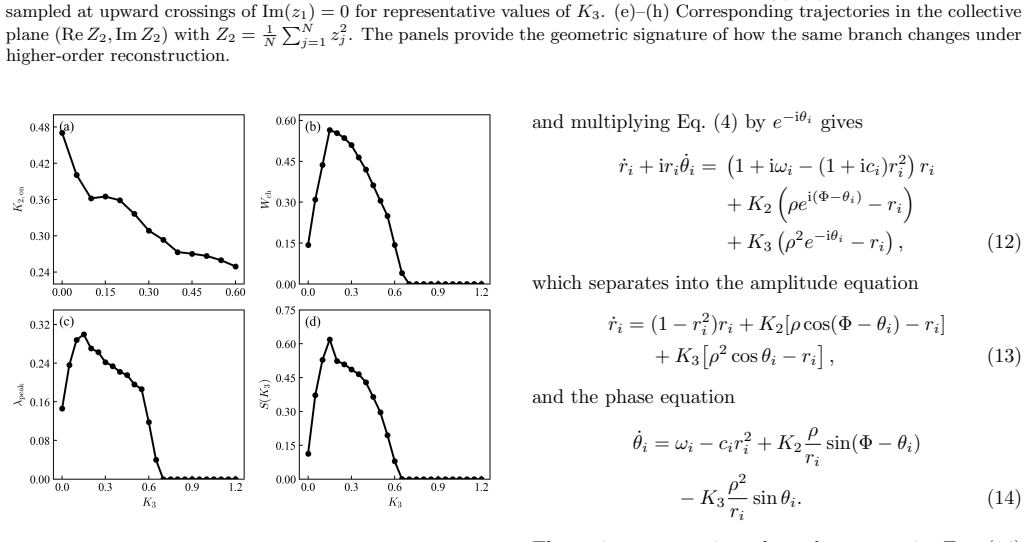
- [Results] Results on Lyapunov collapse: the manuscript states that the Lyapunov response 'collapses onto a reduced shear-based description' but provides no explicit definition or independent derivation of the shear measure; without this, it is unclear whether the collapse is a derived relation or an emergent numerical feature of the chosen nonisochronicity and coupling parameters.
minor comments (3)
- The abstract and introduction should state the precise definition of effective-frequency shear and how it is computed from the amplitude and frequency variables.
- Numerical methods (integration scheme, time-step, transient discard, and Lyapunov exponent algorithm) are not summarized; these details are needed to assess reproducibility of the reported collapse.
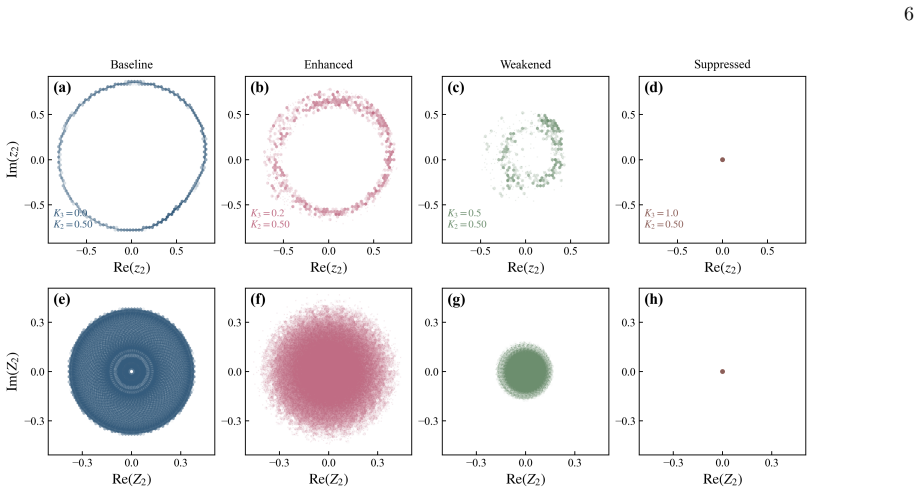
- Figure captions should explicitly label which panels show the shear collapse and which show coherence measures for direct comparison.
Simulated Author's Rebuttal
We thank the referee for the constructive comments on our manuscript. We address each major point below and will revise the manuscript to address the concerns raised.
read point-by-point responses
-
Referee: [Abstract] Abstract and main results: the central claim that higher-order coupling 'controls chaos only indirectly' via shear (rather than directly on synchrony) rests on the observed collapse in a single 4-oscillator globally coupled Stuart-Landau quartet. No tests on other oscillator types, larger N, or non-global topologies are described, so the generality required for the broader assertion is not yet demonstrated.
Authors: We agree that the study is limited to a minimal globally coupled system of four nonisochronous Stuart-Landau oscillators and that the abstract's reference to 'chaotic oscillator networks' in general may suggest broader applicability than the results demonstrate. We will revise the abstract, introduction, and conclusions to explicitly frame the work as a minimal-model demonstration of the shear mechanism in this specific setting. The revised text will state that the indirect control pathway is shown for the chosen quartet and that extension to other oscillator types, larger N, or different topologies remains an open question for future work. This revision will not alter the core numerical findings for the system studied. revision: yes
-
Referee: [Results] Results on Lyapunov collapse: the manuscript states that the Lyapunov response 'collapses onto a reduced shear-based description' but provides no explicit definition or independent derivation of the shear measure; without this, it is unclear whether the collapse is a derived relation or an emergent numerical feature of the chosen nonisochronicity and coupling parameters.
Authors: We thank the referee for highlighting this ambiguity. In the revised manuscript we will add an explicit definition of the effective-frequency shear, constructed from the amplitude heterogeneity induced by higher-order coupling and the nonisochronicity parameter. We will also include a short independent derivation (placed in the Results section) that relates the leading Lyapunov exponents to this shear quantity, showing analytically why the collapse is expected once the shear is fixed. This will make clear that the observed collapse follows from the derived relation rather than being an accidental numerical feature of the parameter choices. revision: yes
Circularity Check
No significant circularity; empirical collapse shown in specific model without reduction to inputs by construction
full rationale
The paper presents numerical results from a minimal globally-coupled quartet of nonisochronous Stuart-Landau oscillators, demonstrating that Lyapunov exponents collapse onto an effective-frequency shear measure constructed from amplitude heterogeneity and the nonisochronicity parameter. This is framed as an indirect control pathway via higher-order coupling regulating amplitudes. No equations or claims in the abstract or description reduce the shear measure or the collapse to a fitted parameter or self-definition by construction. No load-bearing self-citations, uniqueness theorems, or ansatzes are invoked. The derivation chain is self-contained as model-specific numerical evidence rather than a first-principles reduction equivalent to its inputs. This is the expected honest non-finding for a simulation-based study of mechanism.
Axiom & Free-Parameter Ledger
axioms (2)
- domain assumption Nonisochronicity of the Stuart-Landau oscillators
- domain assumption Symmetric three-body interactions in the globally coupled quartet
Lean theorems connected to this paper
-
IndisputableMonolith/Cost/FunctionalEquation.leanwashburn_uniqueness_aczel unclear?
unclearRelation between the paper passage and the cited Recognition theorem.
The Lyapunov response collapses onto a reduced shear-based description... K₃ → σ_r → σ_Ω → λ_max
-
IndisputableMonolith/Foundation/BranchSelection.leanbranch_selection unclear?
unclearRelation between the paper passage and the cited Recognition theorem.
higher-order coupling regulates amplitude heterogeneity, which nonisochronicity converts into shear
-
IndisputableMonolith/Foundation/AlexanderDuality.leanalexander_duality_circle_linking unclear?
unclearRelation between the paper passage and the cited Recognition theorem.
minimal globally coupled quartet of nonisochronous Stuart-Landau oscillators
What do these tags mean?
- matches
- The paper's claim is directly supported by a theorem in the formal canon.
- supports
- The theorem supports part of the paper's argument, but the paper may add assumptions or extra steps.
- extends
- The paper goes beyond the formal theorem; the theorem is a base layer rather than the whole result.
- uses
- The paper appears to rely on the theorem as machinery.
- contradicts
- The paper's claim conflicts with a theorem or certificate in the canon.
- unclear
- Pith found a possible connection, but the passage is too broad, indirect, or ambiguous to say the theorem truly supports the claim.
Reference graph
Works this paper leans on
-
[1]
Battiston, G
F. Battiston, G. Cencetti, I. Iacopini, V. Latora, M. Lu- cas, A. Patania, J.-G. Young, and G. Petri, Physics Re- ports874, 1 (2020)
2020
-
[2]
Battiston, E
F. Battiston, E. Amico, A. Barrat, G. Bianconi, G. Fer- raz de Arruda, B. Franceschiello, I. Iacopini, S. K´ efi, V. Latora, Y. Moreno, M. M. Murray, T. P. Peixoto, F. Vaccarino, and G. Petri, Nature Physics17, 1093 (2021)
2021
-
[3]
Zhang, M
Y. Zhang, M. Lucas, and F. Battiston, Nature Commu- nications14, 1605 (2023)
2023
-
[4]
D. G. Aronson, G. B. Ermentrout, and N. Kopell, Phys- ica D41, 403 (1990)
1990
-
[5]
P. C. Matthews, R. E. Mirollo, and S. H. Strogatz, Phys- ica D52, 293 (1991)
1991
-
[6]
I. S. Aranson and L. Kramer, Reviews of Modern Physics 74, 99 (2002)
2002
-
[7]
Brown, J
E. Brown, J. Moehlis, and P. Holmes, Neural Computa- tion16, 673 (2004)
2004
-
[8]
Nakao, Contemporary Physics57, 188 (2016)
H. Nakao, Contemporary Physics57, 188 (2016)
2016
-
[9]
Pietras and A
B. Pietras and A. Daffertshofer, Physics Reports819, 1 12 (2019)
2019
-
[10]
K. Luo, Z. Cai, Z. Liu, S. Guan, and Y. Zou, Chaos, Solitons & Fractals181, 114705 (2024)
2024
-
[11]
Hakim and W.-J
V. Hakim and W.-J. Rappel, Physical Review A46, R7347 (1992)
1992
-
[12]
Nakagawa and Y
N. Nakagawa and Y. Kuramoto, Physica D: Nonlinear Phenomena75, 74 (1994)
1994
-
[13]
Rosenblum and A
M. Rosenblum and A. Pikovsky, Physical Review Letters 98, 064101 (2007)
2007
-
[14]
A. A. Temirbayev, Z. Z. Zhanabaev, S. B. Tarasov, V. I. Ponomarenko, and M. Rosenblum, Physical Review E85, 10.1103/physreve.85.015204 (2012)
-
[15]
K. H¨ ohlein, F. P. Kemeth, and K. Krischer, Physical Re- view E100, 10.1103/physreve.100.022217 (2019)
-
[16]
F. P. Kemeth, S. W. Haugland, and K. Krischer, Chaos: An Interdisciplinary Journal of Nonlinear Science29, 10.1063/1.5055839 (2019)
-
[17]
B. Thakur and A. Sen, Chaos: An Interdisciplinary Jour- nal of Nonlinear Science29, 10.1063/1.5087188 (2019)
-
[18]
L. V. Gambuzza, F. Di Patti, L. Gallo, S. Lepri, M. Ro- mance, R. Criado, M. Frasca, V. Latora, and S. Boc- caletti, Nature Communications12, 10.1038/s41467-021- 21486-9 (2021)
-
[19]
Gallo, R
L. Gallo, R. Muolo, L. V. Gambuzza, V. Latora, M. Frasca, and T. Carletti, Communications Physics5, 263 (2022)
2022
-
[20]
C. Bick, T. B¨ ohle, and C. Kuehn, Nonlinear Differential Equations and Applications NoDEA29, 10.1007/s00030- 022-00796-x (2022)
-
[21]
C. Bick, T. B¨ ohle, and C. Kuehn, SIAM Journal on Ap- plied Dynamical Systems22, 1590 (2023)
2023
-
[22]
Dutta, U
S. Dutta, U. K. Verma, and S. Jalan, Physical Review E 108, L062201 (2023)
2023
-
[23]
U. K. Verma, S. Dutta, R. Ghosh, M. D. Shrimali, and S. Jalan, Physical Review E110, 044211 (2024)
2024
-
[24]
Benettin, L
G. Benettin, L. Galgani, A. Giorgilli, and J.-M. Strelcyn, Meccanica15, 9 (1980)
1980
-
[25]
Benettin, L
G. Benettin, L. Galgani, A. Giorgilli, and J.-M. Strelcyn, Meccanica15, 21 (1980)
1980
-
[26]
A. Wolf, J. B. Swift, H. L. Swinney, and J. A. Vastano, Physica D: Nonlinear Phenomena16, 285 (1985)
1985
-
[27]
K. K. Lin and L.-S. Young, Nonlinearity21, 899 (2008)
2008
-
[28]
Garc´ ıa-Morales and K
V. Garc´ ıa-Morales and K. Krischer, Contemporary Physics53, 79 (2012)
2012
-
[29]
Kuramoto, inInternational Symposium on Mathemat- ical Problems in Theoretical Physics, Lecture Notes in Physics, Vol
Y. Kuramoto, inInternational Symposium on Mathemat- ical Problems in Theoretical Physics, Lecture Notes in Physics, Vol. 39, edited by H. Araki (Springer, New York,
-
[30]
J. A. Acebr´ on, L. L. Bonilla, C. J. P´ erez Vicente, F. Ri- tort, and R. Spigler, Reviews of Modern Physics77, 137 (2005)
2005
-
[31]
F. A. Rodrigues, T. K. D. M. Peron, P. Ji, and J. Kurths, Physics Reports610, 1 (2016)
2016
discussion (0)
Sign in with ORCID, Apple, or X to comment. Anyone can read and Pith papers without signing in.