Recognition: unknown
Quasinormal modes of the thick braneworld in f(T) gravity
Pith reviewed 2026-05-10 17:31 UTC · model grok-4.3
The pith
In f(T) gravity the quadratic coefficient alpha induces a split in the thick brane and makes the damping of quasinormal modes depend on both alpha and overtone number.
A machine-rendered reading of the paper's core claim, the machinery that carries it, and where it could break.
Core claim
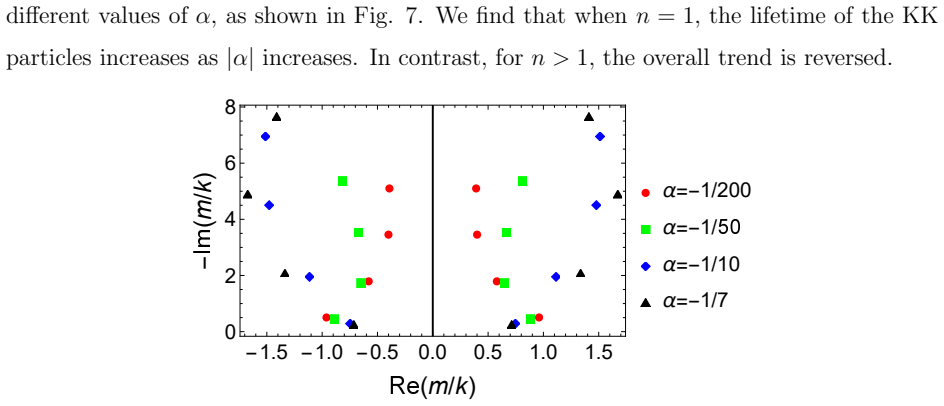
The central claim is that the parameter alpha in the f(T) equals T plus alpha T squared model can induce a brane-splitting structure within the allowed range of alpha between negative seven forty-eighths and positive one forty-eighth. The quasinormal frequencies are obtained using the asymptotic iteration method and the Bernstein spectral method, which agree for low overtones. For negative alpha the decay rate of the first quasinormal mode decreases with increasing absolute value of alpha, while higher overtones show the opposite behavior, and this is confirmed by time-domain evolution.
What carries the argument
The thick brane metric ansatz modified by the quadratic torsion correction alpha T squared, which generates the splitting in the warp factor and scalar field profile.
Load-bearing premise
The five-dimensional metric ansatz for the thick brane together with the conditions that the scalar field stays real and the energy density remains positive must be valid.
What would settle it
An independent numerical solution of the perturbation wave equation on the same background that produces quasinormal frequencies violating the reported trend of decreasing decay rate for the first mode when alpha is negative would falsify the central claim.
Figures




read the original abstract
We investigate the quasinormal modes (QNMs) of a thick brane model in $f(T)$ gravity with $f(T) = T + \alpha T^2$. Requiring the energy density to remain positive and the scalar field to be real constrains the parameter $\alpha$ to the range $[-\frac{7}{48},\frac{1}{48}]$. Within this allowed region, we find that the parameter $\alpha$ can induce a brane-splitting structure. The quasinormal frequencies of the system are computed using both the asymptotic iteration method and the Bernstein spectral method. The two approaches show good agreement in the low-overtone regime. For $\alpha<0$, the decay rate of the first QNM decreases as $|\alpha|$ increases, whereas higher overtones exhibit the opposite behavior. To further examine the influence of model parameters on the QNM spectrum, we also perform numerical time-domain evolution of perturbations, whose results are consistent with the frequency-domain analysis. Our results provide a concrete example of quasinormal spectra in thick brane models within $f(T)$ gravity and may offer useful insights for future observational tests of extra dimensions.
Editorial analysis
A structured set of objections, weighed in public.
Referee Report
Summary. The manuscript investigates quasinormal modes of a thick brane in f(T) gravity with the specific form f(T) = T + α T². It constrains the parameter α to the interval [-7/48, 1/48] by requiring positive energy density and a real scalar field, reports that α can induce a brane-splitting structure, computes the QNM spectrum using the asymptotic iteration method and the Bernstein spectral method (with agreement reported only in the low-overtone regime), finds that for α < 0 the decay rate of the fundamental mode decreases with increasing |α| while higher overtones exhibit the opposite trend, and cross-checks the results via time-domain evolution of perturbations.
Significance. If the numerical trends are robust, the work supplies a concrete example of how the quadratic correction in f(T) gravity modifies the QNM spectrum of a thick brane, including the possibility of brane splitting. The combination of two frequency-domain techniques plus a time-domain consistency check is a methodological strength that could inform future searches for extra-dimensional signatures in gravitational-wave data.
major comments (3)
- [Numerical results and method comparison] The central claim that higher overtones (n ≥ 2) exhibit the opposite decay-rate trend with |α| rests on the Bernstein or AIM results outside the regime where the two methods are stated to agree. No explicit convergence tests, error estimates, or cross-validation for n ≥ 2 are described, leaving the reported sign reversal vulnerable to truncation or asymptotic-matching artifacts rather than physical behavior.
- [Background and field equations] The thick-brane metric ansatz, the reduction of the five-dimensional f(T) field equations, and the explicit derivation of the background scalar-field and warp-factor profiles are not supplied in full; these steps are load-bearing for the subsequent perturbation equation and QNM calculation.
- [QNM tables and figures] No quantitative error bars, residual norms, or convergence tables are provided for the tabulated or plotted QNM frequencies, contrary to standard practice when reporting trends that change sign with overtone number.
minor comments (2)
- [Abstract] The abstract states that the two frequency-domain methods agree in the low-overtone regime but does not qualify the higher-overtone claim or mention the absence of error estimates.
- [Throughout] Notation for the overtone index n and the precise definition of the decay rate (Im(ω)) should be introduced once and used consistently in all figures and tables.
Simulated Author's Rebuttal
We thank the referee for the careful reading of our manuscript and the constructive comments. We address each major point below and will revise the paper accordingly to improve clarity and robustness.
read point-by-point responses
-
Referee: The central claim that higher overtones (n ≥ 2) exhibit the opposite decay-rate trend with |α| rests on the Bernstein or AIM results outside the regime where the two methods are stated to agree. No explicit convergence tests, error estimates, or cross-validation for n ≥ 2 are described, leaving the reported sign reversal vulnerable to truncation or asymptotic-matching artifacts rather than physical behavior.
Authors: We acknowledge that the two methods are shown to agree primarily in the low-overtone regime, as stated in the manuscript. The trends for n ≥ 2 are obtained from the Bernstein spectral method and are independently corroborated by the time-domain evolution of perturbations, which exhibits consistent qualitative behavior across the parameter range. To strengthen the presentation, we will add explicit convergence tests, residual norms, and error estimates for higher overtones in the revised version. revision: yes
-
Referee: The thick-brane metric ansatz, the reduction of the five-dimensional f(T) field equations, and the explicit derivation of the background scalar-field and warp-factor profiles are not supplied in full; these steps are load-bearing for the subsequent perturbation equation and QNM calculation.
Authors: We agree that including the full derivation of the background solution would enhance readability and self-containment. In the revised manuscript we will provide the metric ansatz, the reduction of the f(T) field equations, and the explicit steps leading to the warp factor and scalar-field profiles, either in the main text or in a dedicated appendix. revision: yes
-
Referee: No quantitative error bars, residual norms, or convergence tables are provided for the tabulated or plotted QNM frequencies, contrary to standard practice when reporting trends that change sign with overtone number.
Authors: We will include quantitative error estimates, residual norms, and convergence tables for the QNM frequencies (both low and higher overtones) in the revised manuscript. These additions will substantiate the reported trends and address the concern regarding possible numerical artifacts. revision: yes
Circularity Check
No circularity: model parameters constrained by physics, spectra computed numerically from equations
full rationale
The derivation begins with the standard f(T) = T + α T² ansatz and the thick-brane metric, then imposes positivity of energy density and reality of the scalar field to bound α ∈ [-7/48, 1/48]. Within this interval the brane-splitting structure and QNM frequencies are obtained by direct numerical solution of the perturbation equations via AIM and Bernstein methods; the time-domain evolution provides an independent cross-check. No parameter is fitted to the QNM data themselves, no self-citation supplies a uniqueness theorem or load-bearing ansatz, and the reported trends (decay-rate reversal with |α| for higher overtones) are outputs of the numerical integration rather than re-statements of the input constraints. The chain is therefore self-contained and externally falsifiable.
Axiom & Free-Parameter Ledger
free parameters (1)
- α
axioms (2)
- domain assumption Thick brane metric ansatz in 5D warped geometry
- ad hoc to paper f(T) = T + α T² form of the action
Reference graph
Works this paper leans on
-
[1]
The domain of φ(u) is compact and analytic over the entire domain, i.e., u ∈ [a,b ]
-
[2]
The boundary behavior of all eigenfunctions ψ i(u) satisfies lim u→ aψ i(u) → (u − a)q and lim u→ bψ i(u) → (b − u)r for some q,r ≥ 0
-
[3]
The eigenvalues of ω form a discrete spectrum. We then expand the solution in terms of Bernstein polynomials as φ(u) = Σ N k=0CkBN k (u), (68) whereBN k (u) = ( N k ) (u− a)k(b− u)N− k (b− a)N is the Bernstein polynomial, N denotes the order of Bern- stein basis adopted in the expansion. Substituting this expresstion into Eq. (67), we obtain a matrix equa...
-
[4]
Talent Scientific Fund of Lanzhou University
From the figure, we observe that the damping of the wave pack et becomes slower as |α | increases, which is consistent with the behavior shown in Fig. 7. A simila r tendency is also observed when s increases. Another noteworthy feature appears in Fig. 10(b): w hen s> 1, the decay rate is significantly reduced. This reflects the fact that the brane undergoes ...
2025
-
[5]
Nordstrom, On the possibility of unifying the electro magnetic and the gravitational fields, Phys
G. Nordstrom, On the possibility of unifying the electro magnetic and the gravitational fields, Phys. Z. 15, 504 (1914), arXiv:physics/0702221
-
[6]
Zum Unit¨ atsproblem der Physik,
T. Kaluza, Zum unit¨ atsproblem der physik, Sitzungsber . Preuss. Akad. Wiss. Berlin (Math. Phys. ) 1921, 966 (1921), arXiv:1803.08616 [physics.hist-ph]
-
[7]
Klein, Quantum Theory and Five-Dimensional Theory of Relativity
O. Klein, Quantum Theory and Five-Dimensional Theory of Relativity. (In German and En- glish), Z. Phys. 37, 895 (1926)
1926
-
[8]
K. Akama, An Early Proposal of “Brane World”, Lect. Notes Phys. 176, 267 (1982), arXiv:hep-th/0001113
-
[9]
The Hierarchy Problem and New Dimensions at a Millimeter
N. Arkani-Hamed, S. Dimopoulos, and G. R. Dvali, The Hier archy problem and new dimen- sions at a millimeter, Phys. Lett. B 429, 263 (1998), arXiv:hep-ph/9803315. 21
work page Pith review arXiv 1998
-
[10]
A Large Mass Hierarchy from a Small Extra Dimension
L. Randall and R. Sundrum, A Large mass hierarchy from a sm all extra dimension, Phys. Rev. Lett. 83, 3370 (1999), arXiv:hep-ph/9905221
work page internal anchor Pith review arXiv 1999
-
[11]
An Alternative to Compactification
L. Randall and R. Sundrum, An Alternative to compactifica tion, Phys. Rev. Lett. 83, 4690 (1999), arXiv:hep-th/9906064
work page Pith review arXiv 1999
-
[12]
The Einstein Equations on the 3-Brane World
T. Shiromizu, K.-i. Maeda, and M. Sasaki, The Einstein eq uation on the 3-brane world, Phys. Rev. D 62, 024012 (2000), arXiv:gr-qc/9910076
work page Pith review arXiv 2000
-
[13]
Tanaka, Classical black hole evaporation in Randall- Sundrum infinite brane world, Prog
T. Tanaka, Classical black hole evaporation in Randall- Sundrum infinite brane world, Prog. Theor. Phys. Suppl. 148, 307 (2003), arXiv:gr-qc/0203082
-
[14]
Gregory, Braneworld black holes, Lect
R. Gregory, Braneworld black holes, Lect. Notes Phys. 769, 259 (2009), arXiv:0804.2595 [hep-th]
-
[15]
N. Jaman and K. Myrzakulov, Braneworld inflation with an effective α -attractor potential, Phys. Rev. D 99, 103523 (2019), arXiv:1807.07443 [gr-qc]
-
[16]
R. Adhikari, M. R. Gangopadhyay, and Yogesh, Power Law P lateau Inflation Potential In The RS-II Braneworld Evading Swampland Conjecture, Eur. Phys. J. C 80, 899 (2020), arXiv:2002.07061 [astro-ph.CO]
- [17]
- [18]
- [19]
-
[20]
A. Bhattacharya, A. Bhattacharyya, P. Nandy, and A. K. P atra, Islands and complexity of eternal black hole and radiation subsystems for a doubly hol ographic model, JHEP 05, 135, arXiv:2103.15852 [hep-th]
-
[21]
V. A. Rubakov and M. E. Shaposhnikov, Do we live inside a d omain wall?, Phys. Lett. B 125, 136 (1983)
1983
-
[22]
Modeling the fifth dimension with scalars and gravity
O. DeWolfe, D. Z. Freedman, S. S. Gubser, and A. Karch, Mo deling the fifth-dimension with scalars and gravity, Phys. Rev. D 62, 046008 (2000), arXiv:hep-th/9909134
work page Pith review arXiv 2000
-
[23]
Gremm, Four-dimensional gravity on a thick domain wall , Phys
M. Gremm, Four-dimensional gravity on a thick domain wa ll, Phys. Lett. B 478, 434 (2000), arXiv:hep-th/9912060. 22
- [24]
-
[25]
V. Dzhunushaliev and V. Folomeev, Spinor brane, Gen. Re l. Grav. 43, 1253 (2011), arXiv:0909.2741 [gr-qc]
-
[26]
V. Dzhunushaliev and V. Folomeev, Thick brane solution s supported by two spinor fields, Gen. Rel. Grav. 44, 253 (2012), arXiv:1104.2733 [gr-qc]
- [27]
- [28]
- [29]
-
[30]
Einstein-Vector Gravity, Emerging Gauge Symmetry and de Sitter Bounce
W.-J. Geng and H. Lu, Einstein-Vector Gravity, Emergin g Gauge Symmetry and de Sitter Bounce, Phys. Rev. D 93, 044035 (2016), arXiv:1511.03681 [hep-th]
work page Pith review arXiv 2016
- [31]
-
[32]
Y. Zhong and Y.-X. Liu, Linearization of a warped f (R) theory in the higher-order frame, Phys. Rev. D 95, 104060 (2017), arXiv:1611.08237 [gr-qc]
- [33]
-
[34]
X.-N. Zhou, Y.-Z. Du, H. Yu, and Y.-X. Liu, Localization of Gravitino Field on f (R) Thick Branes, Sci. China Phys. Mech. Astron. 61, 110411 (2018), arXiv:1703.10805 [hep-th]
- [35]
- [36]
- [37]
- [38]
- [39]
-
[40]
V. Dzhunushaliev, V. Folomeev, and M. Minamitsuji, Thi ck brane solutions, Rept. Prog. Phys. 73, 066901 (2010), arXiv:0904.1775 [gr-qc]
-
[41]
R. Maartens and K. Koyama, Brane-World Gravity, Living Rev. Rel. 13, 5 (2010), arXiv:1004.3962 [hep-th]
-
[42]
Y.-X. Liu, Introduction to Extra Dimensions and Thick B raneworlds, (2018) arXiv:1707.08541 [hep-th]
- [43]
-
[44]
K. D. Kokkotas and B. G. Schmidt, Quasinormal modes of st ars and black holes, Living Rev. Rel. 2, 2 (1999), arXiv:gr-qc/9909058
work page internal anchor Pith review arXiv 1999
-
[45]
Nollert, Quasinormal modes: the characteristic “sound” of black holes and neutron stars, Class
H.-P. Nollert, Quasinormal modes: the characteristic “sound” of black holes and neutron stars, Class. Quantum Grav. 16, R159 (1999)
1999
-
[46]
Quasinormal modes of black holes and black branes
E. Berti, V. Cardoso, and A. O. Starinets, Quasinormal m odes of black holes and black branes, Class. Quant. Grav. 26, 163001 (2009), arXiv:0905.2975 [gr-qc]
work page internal anchor Pith review arXiv 2009
-
[47]
R. A. Konoplya and A. Zhidenko, Quasinormal modes of bla ck holes: From astrophysics to string theory, Rev. Mod. Phys. 83, 793 (2011), arXiv:1102.4014 [gr-qc]
work page internal anchor Pith review arXiv 2011
-
[48]
Is the gravitational-wave ringdown a probe of the event horizon?
V. Cardoso, E. ranzin, and P. Pani, Is the gravitational -wave ringdown a probe of the event horizon?, Phys. Rev. Lett. 116, 171101 (2016), [Erratum: Phys.Rev.Lett. 117, 089902 (2016)], arXiv:1602.07309 [gr-qc]
work page Pith review arXiv 2016
-
[49]
K. Jusufi, M. Azreg-A ¨ ınou, M. Jamil, S.-W. Wei, Q. Wu, an d A. Wang, Quasinormal modes, quasiperiodic oscillations, and the shadow of rotating reg ular black holes in nonminimally cou- pled Einstein-Yang-Mills theory, Phys. Rev. D 103, 024013 (2021), arXiv:2008.08450 [gr-qc]
- [50]
- [51]
-
[52]
S. S. Seahra, Ringing the Randall-Sundrum braneworld: Metastable gravity wave bound states, Phys. Rev. D 72, 066002 (2005), arXiv:hep-th/0501175
work page internal anchor Pith review arXiv 2005
-
[53]
W. Deng, S. Long, Q. Tan, Z.-C. Chen, and J. Jing, Scalar- gravitational quasinormal modes and echoes in a five dimensional thick brane, (2025), arXiv:2 508.20937 [gr-qc]
2025
-
[54]
S. Yang, W.-D. Guo, Q. Tan, L. Zhao, and Y.-X. Liu, Parame trized quasinormal frequencies and Hawking radiation for axial gravitational perturbatio ns of a holonomy-corrected black hole, Phys. Rev. D 110, 064051 (2024), arXiv:2406.15711 [gr-qc]
- [55]
- [56]
- [57]
- [58]
- [59]
- [60]
- [61]
- [62]
- [63]
- [64]
- [65]
- [66]
-
[67]
Hayashi and T
K. Hayashi and T. Shirafuji, New general relativity, Ph ys. Rev. D 19, 3524 (1979)
1979
-
[68]
Aldrovandi and J
R. Aldrovandi and J. G. Pereira, Teleparallel Gravity: An Introduction (Springer, 2013)
2013
-
[69]
Modified teleparallel gravity: Inflation without inflaton,
R. Ferraro and F. Fiorini, Modified teleparallel gravit y: Inflation without inflaton, Phys. Rev. D 75, 084031 (2007), arXiv:gr-qc/0610067
- [70]
- [71]
-
[72]
K. Karami and A. Abdolmaleki, f (T ) modified teleparallel gravity models as an alternative for holographic and new agegraphic dark energy models, Res. Ast ron. Astrophys. 13, 757 (2013), arXiv:1009.2459 [gr-qc]
- [73]
-
[74]
Y.-F. Cai, S. Capozziello, M. De Laurentis, and E. N. Sar idakis, f (T ) teleparallel gravity and cosmology, Rept. Prog. Phys. 79, 106901 (2016), arXiv:1511.07586 [gr-qc]
work page Pith review arXiv 2016
- [75]
- [76]
-
[77]
Teleparallel gravity: from theory to cosmology,
S. Bahamonde, K. F. Dialektopoulos, C. Escamilla-Rive ra, G. Farrugia, V. Gakis, M. Hendry, M. Hohmann, J. Levi Said, J. Mifsud, and E. Di Valentino, Tele parallel gravity: from theory to cosmology, Rept. Prog. Phys. 86, 026901 (2023), arXiv:2106.13793 [gr-qc]
- [78]
- [79]
- [80]
discussion (0)
Sign in with ORCID, Apple, or X to comment. Anyone can read and Pith papers without signing in.