Recognition: 2 theorem links
· Lean TheoremRindler Physics with a UV Cutoff on the Lattice
Pith reviewed 2026-05-10 17:43 UTC · model grok-4.3
The pith
A lattice UV cutoff in Rindler coordinates makes the Minkowski vacuum non-thermal with respect to the local Rindler Hamiltonian, yet correlation functions and detector responses approach the expected thermal form far from the horizon in the
A machine-rendered reading of the paper's core claim, the machinery that carries it, and where it could break.
Core claim
Once a UV cutoff is introduced via lattice regularization in Rindler coordinates, the global Minkowski vacuum and the wedge description based on the local Rindler Hamiltonian cease to be equivalent at the level of operators; exact thermality is lost, but the Unruh effect remains intact for all operational probes whose support lies sufficiently far from the horizon in the continuum limit, with the horizon singularity regularized into a stretched-horizon contribution.
What carries the argument
Lattice discretization of a free scalar field in Rindler coordinates, which defines both the local Rindler Hamiltonian and the regulated correlation functions that are compared to the Minkowski vacuum.
If this is right
- The global Minkowski description and the local Rindler wedge description become inequivalent at the operator level once a cutoff is present.
- The vacuum energy density agrees with the standard continuum expression at distances much larger than the cutoff but is replaced by a finite stretched-horizon term near the horizon.
- The retarded Green function develops a reflected component, so that an ingoing wave packet is reflected at a proper distance of order the cutoff.
- Exact thermality of the Minkowski vacuum with respect to the Rindler Hamiltonian is lost, while operational thermality for distant probes is recovered in the continuum limit.
Where Pith is reading between the lines
- The stretched-horizon reflection supplies a concrete, cutoff-scale mechanism that could be used to model black-hole horizon dynamics in other regulated theories.
- Lattice simulations of this setup could be used to test whether similar operational thermality persists for interacting fields or in higher dimensions.
- The loss of operator-level equivalence between global and wedge descriptions may constrain attempts to define local observables near a horizon in any UV-regulated quantum gravity model.
Load-bearing premise
The chosen lattice spacing and coordinate discretization capture the short-distance physics of the continuum theory without leaving behind cutoff-dependent artifacts that persist for observables at fixed proper distance from the horizon.
What would settle it
An explicit computation, at fixed proper distance from the horizon, of the lattice-regulated detector response or Wightman function that remains visibly non-thermal even after the continuum limit is taken would falsify the operational recovery of the Unruh effect.
Figures





read the original abstract
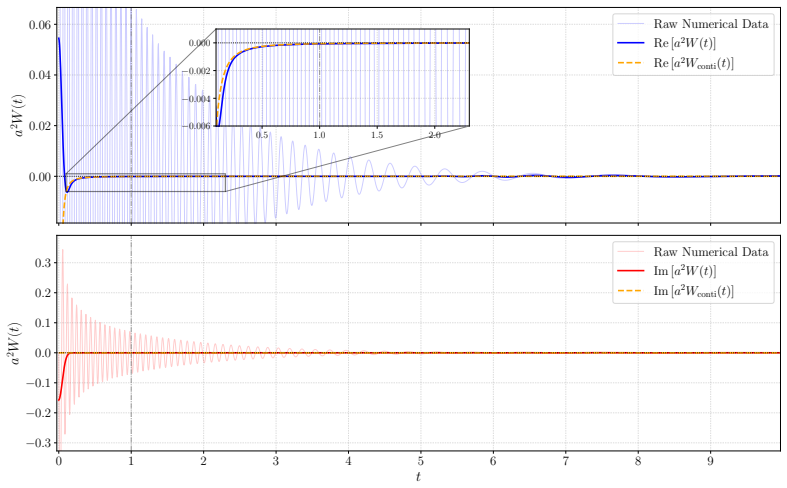
We investigate quantum field theory in Rindler space with a UV cutoff by considering a free scalar field on a lattice in Rindler coordinates. We find that the Minkowski vacuum is not exactly thermal with respect to the local lattice Rindler Hamiltonian. Nevertheless, for observables sufficiently far from the horizon, the Wightman function and the Unruh--DeWitt detector response reproduce the expected thermal behavior in the continuum limit. Thus, the Unruh effect survives operationally, even though exact thermality is lost at the state level. We also show that the Rindler vacuum energy density reproduces the standard continuum behavior away from the horizon, while the UV singularity at the horizon is replaced by a stretched-horizon contribution. Furthermore, the retarded Green function exhibits a component reflected at the stretched horizon, implying that an ingoing wave packet is reflected at a proper distance of order the cutoff. This provides an effective brick-wall picture in the UV-regulated theory. Our analysis suggests that, once a cutoff is introduced, the global Minkowski description and the wedge description based on a local Rindler Hamiltonian are no longer equivalent at the operator level.
Editorial analysis
A structured set of objections, weighed in public.
Referee Report
Summary. The manuscript studies a free scalar field quantized on a lattice in Rindler coordinates, thereby imposing a UV cutoff. It reports that the Minkowski vacuum is not exactly thermal with respect to the local lattice Rindler Hamiltonian. Nevertheless, the Wightman function and the response of an Unruh-DeWitt detector recover the standard thermal Unruh spectrum for points at fixed proper distance from the horizon once the continuum limit is taken. The Rindler vacuum energy density is shown to match the continuum result away from the horizon, with the UV divergence replaced by a finite stretched-horizon contribution; the retarded Green function acquires a reflected component, furnishing an explicit lattice realization of the brick-wall model. The authors conclude that the global Minkowski and local Rindler descriptions cease to be equivalent at the operator level once a cutoff is present.
Significance. If the continuum limit is under control, the work supplies a concrete, non-perturbative lattice realization of how a UV regulator modifies Rindler physics. It gives explicit evidence that operational thermality (Wightman functions and detector response) can survive even when exact thermality at the state level is lost, and it furnishes a microscopic picture of a stretched horizon together with brick-wall reflection. These results are directly relevant to ongoing discussions of black-hole thermodynamics in regulated theories and to the operational status of the Unruh effect.
major comments (2)
- [§3 (Wightman function and continuum limit)] The central claim that the Wightman function and Unruh-DeWitt response recover the exact thermal form for observables at fixed proper distance d ≫ a in the a → 0 limit rests on the assumption that the chosen Rindler-coordinate lattice discretization introduces no persistent artifacts. Because the proper spatial spacing is a/ρ (with ρ the Rindler radial coordinate), the local UV cutoff is position-dependent. The manuscript must demonstrate, either analytically or numerically, that the contribution of near-horizon lattice modes to the mode sum (or Bogoliubov coefficients) vanishes uniformly at fixed proper distance; without such a control, the operational recovery could be an artifact of the regulator.
- [§5 (Retarded Green function)] The statement that the retarded Green function exhibits reflection at a proper distance of order the cutoff (the brick-wall picture) is load-bearing for the claim of an effective stretched horizon. The precise location of the reflection point, its dependence on the lattice spacing a, and the coefficient of the reflected wave must be extracted explicitly from the lattice retarded propagator; a qualitative description is insufficient to establish that the reflection survives the continuum limit at fixed proper distance.
minor comments (2)
- The abstract and introduction introduce the term 'stretched horizon' without a brief definition or reference to the original brick-wall literature; a short clarifying sentence would aid readers.
- Notation for the lattice spacing, Rindler coordinate ρ, and proper distance should be introduced once and used consistently; occasional switches between coordinate and proper-distance language obscure the discussion of the position-dependent cutoff.
Simulated Author's Rebuttal
We thank the referee for the careful reading of our manuscript and for the constructive comments. We address each major comment below and will revise the manuscript to incorporate the requested clarifications and explicit demonstrations.
read point-by-point responses
-
Referee: [§3 (Wightman function and continuum limit)] The central claim that the Wightman function and Unruh-DeWitt response recover the exact thermal form for observables at fixed proper distance d ≫ a in the a → 0 limit rests on the assumption that the chosen Rindler-coordinate lattice discretization introduces no persistent artifacts. Because the proper spatial spacing is a/ρ (with ρ the Rindler radial coordinate), the local UV cutoff is position-dependent. The manuscript must demonstrate, either analytically or numerically, that the contribution of near-horizon lattice modes to the mode sum (or Bogoliubov coefficients) vanishes uniformly at fixed proper distance; without such a control, the operational recovery could be an artifact of the regulator.
Authors: We agree that an explicit demonstration is required to rule out persistent artifacts from the position-dependent cutoff. The discretization is uniform in the Rindler coordinate, so the proper spacing a/ρ becomes fine at any fixed d > 0 as a → 0. In the revised manuscript we will add both an analytical bound showing that the contribution of modes with ρ ≲ a to the Bogoliubov coefficients (and hence to the Wightman function) at fixed d decays at least as a power of a, and numerical evaluations of the mode sum and detector response for several decreasing values of a at fixed d, confirming uniform approach to the thermal result. revision: yes
-
Referee: [§5 (Retarded Green function)] The statement that the retarded Green function exhibits reflection at a proper distance of order the cutoff (the brick-wall picture) is load-bearing for the claim of an effective stretched horizon. The precise location of the reflection point, its dependence on the lattice spacing a, and the coefficient of the reflected wave must be extracted explicitly from the lattice retarded propagator; a qualitative description is insufficient to establish that the reflection survives the continuum limit at fixed proper distance.
Authors: We accept that a qualitative statement is insufficient. In the revised version we will compute the lattice retarded propagator explicitly and report the extracted reflection point (found to lie at proper distance of order a), its scaling with a, and the amplitude of the reflected component. These quantities will be presented for a sequence of lattice spacings, demonstrating that the reflection persists at fixed proper distance in the continuum limit and thereby furnishing a quantitative lattice realization of the brick-wall model. revision: yes
Circularity Check
No circularity: direct lattice construction yields independent results
full rationale
The paper performs an explicit lattice discretization of a free scalar field in Rindler coordinates, computes the Minkowski vacuum with respect to the local Rindler Hamiltonian, and takes the continuum limit for observables at fixed proper distance from the horizon. All reported behaviors (loss of exact thermality, recovery of thermal Wightman functions and detector response, stretched-horizon energy density, and reflected retarded propagator) are obtained by direct summation over lattice modes and Bogoliubov transformations without any parameter fitting, self-referential definitions, or load-bearing self-citations. The central operational-versus-state distinction follows immediately from the lattice operator algebra and does not reduce to any input quantity by construction.
Axiom & Free-Parameter Ledger
free parameters (1)
- lattice spacing a
axioms (1)
- domain assumption Free massless scalar field on a lattice in Rindler coordinates
invented entities (1)
-
stretched horizon
no independent evidence
Lean theorems connected to this paper
-
IndisputableMonolith/Foundation/AlexanderDuality.leanalexander_duality_circle_linking unclear?
unclearRelation between the paper passage and the cited Recognition theorem.
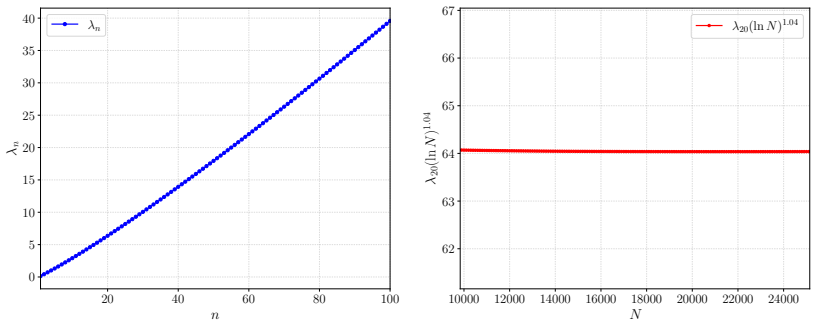
We discretize the X direction as X→Xn=(n−1/2)a ... the discretized Hamiltonian becomes H=∑[1/(2κa²(n−1/2))πn² + ...] (2.9); eigenvalues λn∼n/(ln N)γ
-
IndisputableMonolith/Cost/FunctionalEquation.leanwashburn_uniqueness_aczel unclear?
unclearRelation between the paper passage and the cited Recognition theorem.
the Minkowski vacuum is not exactly thermal with respect to the local lattice Rindler Hamiltonian. Nevertheless, for observables sufficiently far from the horizon, the Wightman function and the Unruh–DeWitt detector response reproduce the expected thermal behavior
What do these tags mean?
- matches
- The paper's claim is directly supported by a theorem in the formal canon.
- supports
- The theorem supports part of the paper's argument, but the paper may add assumptions or extra steps.
- extends
- The paper goes beyond the formal theorem; the theorem is a base layer rather than the whole result.
- uses
- The paper appears to rely on the theorem as machinery.
- contradicts
- The paper's claim conflicts with a theorem or certificate in the canon.
- unclear
- Pith found a possible connection, but the passage is too broad, indirect, or ambiguous to say the theorem truly supports the claim.
Reference graph
Works this paper leans on
-
[1]
Kruskal Space and the Uniformly Accelerated Frame,
W. Rindler, “Kruskal Space and the Uniformly Accelerated Frame,”Am. J. Phys.34 (1966) 1174
1966
-
[2]
Notes on black hole evaporation,
W. G. Unruh, “Notes on black hole evaporation,”Phys. Rev. D14(1976) 870
1976
-
[3]
Particle Creation by Black Holes,
S. W. Hawking, “Particle Creation by Black Holes,”Commun. Math. Phys.43(1975) 199–220. [Erratum: Commun.Math.Phys. 46, 206 (1976)]. 12If one discretizes the local BW ansatz [5]Kloc BW∝ ∫ x>0xT 00 dxusing the same midpoint prescription as in our paper, then one essentially reproduces our lattice Rindler Hamiltonian, with the kinetic term weighted byxn = (n...
1975
-
[4]
Thermo field dynamics of black holes,
W. Israel, “Thermo field dynamics of black holes,”Phys. Lett. A57(1976) 107–110
1976
-
[5]
On the Duality Condition for Quantum Fields,
J. J. Bisognano and E. H. Wichmann, “On the Duality Condition for Quantum Fields,”J. Math. Phys.17(1976) 303–321
1976
-
[6]
Lattice Unruh effect and world-line entanglement for the XXZ chain,
K. Okunishi and K. Seki, “Lattice Unruh effect and world-line entanglement for the XXZ chain,”J. Phys. Soc. Jap.88no. 11, (2019) 114002,arXiv:1906.10441 [cond-mat.quant-gas]
-
[7]
Spin systems as quantum simulators of quantum field theories in curved spacetimes,
S. Kinoshita, K. Murata, D. Yamamoto, and R. Yoshii, “Spin systems as quantum simulators of quantum field theories in curved spacetimes,”Phys. Rev. Res.7no. 2, (2025) 023197,arXiv:2410.07587 [hep-th]
-
[8]
Simulating quantum field theory in curved spacetime with quantum many-body systems,
R.-Q. Yang, H. Liu, S. Zhu, L. Luo, and R.-G. Cai, “Simulating quantum field theory in curved spacetime with quantum many-body systems,”Phys. Rev. Res.2no. 2, (2020) 023107,arXiv:1906.01927 [gr-qc]
-
[9]
Y.-H. Shiet al., “Quantum simulation of Hawking radiation and curved spacetime with a superconducting on-chip black hole,”Nature Commun.14no. 1, (2023) 3263, arXiv:2111.11092 [quant-ph]
-
[10]
Rindler bulk reconstruction and subregion duality in AdS/CFT,
S. Sugishita and S. Terashima, “Rindler bulk reconstruction and subregion duality in AdS/CFT,”JHEP11(2022) 041,arXiv:2207.06455 [hep-th]
-
[11]
Nonuniqueness of canonical field quantization in Riemannian space-time,
S. A. Fulling, “Nonuniqueness of canonical field quantization in Riemannian space-time,”Phys. Rev. D7(1973) 2850–2862
1973
-
[12]
Quantum Field Theory in Schwarzschild and Rindler Spaces,
D. G. Boulware, “Quantum Field Theory in Schwarzschild and Rindler Spaces,”Phys. Rev. D11(1975) 1404
1975
-
[13]
On the vacuum stress induced by uniform acceleration or supporting the ether,
P. Candelas and D. Deutsch, “On the vacuum stress induced by uniform acceleration or supporting the ether,”Proc. Roy.Soc. Lond. A354(1977) 79–99
1977
-
[14]
The Energy momentum tensor in Fulling-Rindler vacuum,
R. Parentani, “The Energy momentum tensor in Fulling-Rindler vacuum,”Class. Quant. Grav.10(1993) 1409–1416,arXiv:hep-th/9303062
-
[15]
Kawamoto and S
T. Kawamoto and S. Terashima to appear
-
[16]
The Large N Limit of Superconformal Field Theories and Supergravity
J. M. Maldacena, “The Large N limit of superconformal field theories and supergravity,”Adv. Theor. Math. Phys.2(1998) 231–252,arXiv:hep-th/9711200
work page internal anchor Pith review Pith/arXiv arXiv 1998
-
[17]
J. M. Maldacena, “Eternal black holes in anti-de Sitter,”JHEP04(2003) 021, arXiv:hep-th/0106112
work page Pith review arXiv 2003
-
[18]
On the Quantum Structure of a Black Hole,
G. ’t Hooft, “On the Quantum Structure of a Black Hole,”Nucl. Phys. B256(1985) 727–745. 26
1985
-
[19]
The Stretched Horizon and Black Hole Complementarity
L. Susskind, L. Thorlacius, and J. Uglum, “The Stretched horizon and black hole complementarity,”Phys. Rev. D48(1993) 3743–3761,arXiv:hep-th/9306069
work page Pith review arXiv 1993
-
[20]
The fuzzball proposal for black holes: an elementary review
S. D. Mathur, “The Fuzzball proposal for black holes: An Elementary review,” Fortsch.Phys.53(2005) 793–827,arXiv:hep-th/0502050
work page Pith review arXiv 2005
-
[21]
Black Holes: Complementarity or Firewalls?
A. Almheiri, D. Marolf, J. Polchinski, and J. Sully, “Black Holes: Complementarity or Firewalls?,”JHEP02(2013) 062,arXiv:1207.3123 [hep-th]
work page Pith review arXiv 2013
-
[22]
N. Iizuka and S. Terashima, “Brick Walls for Black Holes in AdS/CFT,”Nucl. Phys. B895(2015) 1–32,arXiv:1307.5933 [hep-th]
-
[23]
Simple bulk reconstruction in anti-de Sitter/conformal field theory correspondence,
S. Terashima, “Simple bulk reconstruction in anti-de Sitter/conformal field theory correspondence,”PTEP2023no. 5, (2023) 053B02,arXiv:2104.11743 [hep-th]
-
[24]
Subregion Complementarity in AdS/CFT
S. Sugishita and S. Terashima, “Subregion Complementarity in AdS/CFT,” arXiv:2309.04231 [hep-th]
work page internal anchor Pith review Pith/arXiv arXiv
-
[25]
Bulk reconstruction and gauge invariance,
S. Sugishita and S. Terashima, “Bulk reconstruction and gauge invariance,”Phys. Rev. D112no. 4, (2025) 046003,arXiv:2409.02534 [hep-th]
-
[26]
Holography at Finite N: Breakdown of Bulk Reconstruction for Subregions,
S. Terashima, “Holography at Finite N: Breakdown of Bulk Reconstruction for Subregions,”arXiv:2508.11592 [hep-th]
-
[27]
AdS/CFT Correspondence in Operator Formalism,
S. Terashima, “AdS/CFT Correspondence in Operator Formalism,”JHEP02(2018) 019,arXiv:1710.07298 [hep-th]
-
[28]
Classical Limit of Large N Gauge Theories with Conformal Symmetry,
S. Terashima, “Classical Limit of Large N Gauge Theories with Conformal Symmetry,”JHEP02(2020) 021,arXiv:1907.05419 [hep-th]
-
[29]
Bulk locality in the AdS/CFT correspondence,
S. Terashima, “Bulk locality in the AdS/CFT correspondence,”Phys. Rev. D104 no. 8, (2021) 086014,arXiv:2005.05962 [hep-th]
-
[30]
B. Czech, J. L. Karczmarek, F. Nogueira, and M. Van Raamsdonk, “Rindler Quantum Gravity,”Class. Quant. Grav.29(2012) 235025,arXiv:1206.1323 [hep-th]
-
[31]
Stretched horizon dissipation and the fate of echoes,
S. Terashima, “Stretched horizon dissipation and the fate of echoes,”JHEP10(2025) 147,arXiv:2506.20462 [hep-th]
-
[32]
Testing the nature of dark compact objects: a status report
V. Cardoso and P. Pani, “Testing the nature of dark compact objects: a status report,”Living Rev. Rel.22no. 1, (2019) 4,arXiv:1904.05363 [gr-qc]
work page internal anchor Pith review arXiv 2019
-
[33]
Quantum Black Holes in the Sky,
J. Abedi, N. Afshordi, N. Oshita, and Q. Wang, “Quantum Black Holes in the Sky,” Universe6no. 3, (2020) 43,arXiv:2001.09553 [gr-qc]. 27
-
[34]
Firewalls as artefacts of inconsistent truncations of quantum geometries,
C. Germani and D. Sarkar, “Firewalls as artefacts of inconsistent truncations of quantum geometries,”Fortsch.Phys.64(2016) 131–143,arXiv:1502.03129 [hep-th]
-
[35]
Scalar particle production in Schwarzschild and Rindler metrics,
P. C. W. Davies, “Scalar particle production in Schwarzschild and Rindler metrics,” J. Phys. A8(1975) 609–616
1975
-
[36]
Quantum Field Theory in Curved Space-Time,
B. S. DeWitt, “Quantum Field Theory in Curved Space-Time,”Phys. Rept.19 (1975) 295–357. 28
1975
discussion (0)
Sign in with ORCID, Apple, or X to comment. Anyone can read and Pith papers without signing in.