Recognition: 2 theorem links
· Lean TheoremAnalysis of Chaos and Bifurcation in Nonlinear two-delay differential equation
Pith reviewed 2026-05-10 18:05 UTC · model grok-4.3
The pith
A nonlinear equation with two time delays produces chaos and multi-scroll attractors that linear feedback can suppress and synchronize, including in fractional-order versions.
A machine-rendered reading of the paper's core claim, the machinery that carries it, and where it could break.
Core claim
The two-delay system exhibits chaotic motion and multi-scroll attractors for suitable choices of the parameters k, gamma, tau1 and tau2. These irregular behaviors are suppressed by the addition of a linear state-feedback term. A delay-independent criterion derived from the feedback law ensures that a slave system converges to a master system. The same chaotic attractors and feedback control remain effective when the integer derivative is replaced by a fractional derivative of order alpha less than or equal to one.
What carries the argument
The two-delay differential equation with sinusoidal nonlinearity, together with linear feedback control laws that stabilize the origin and enforce master-slave synchronization.
If this is right
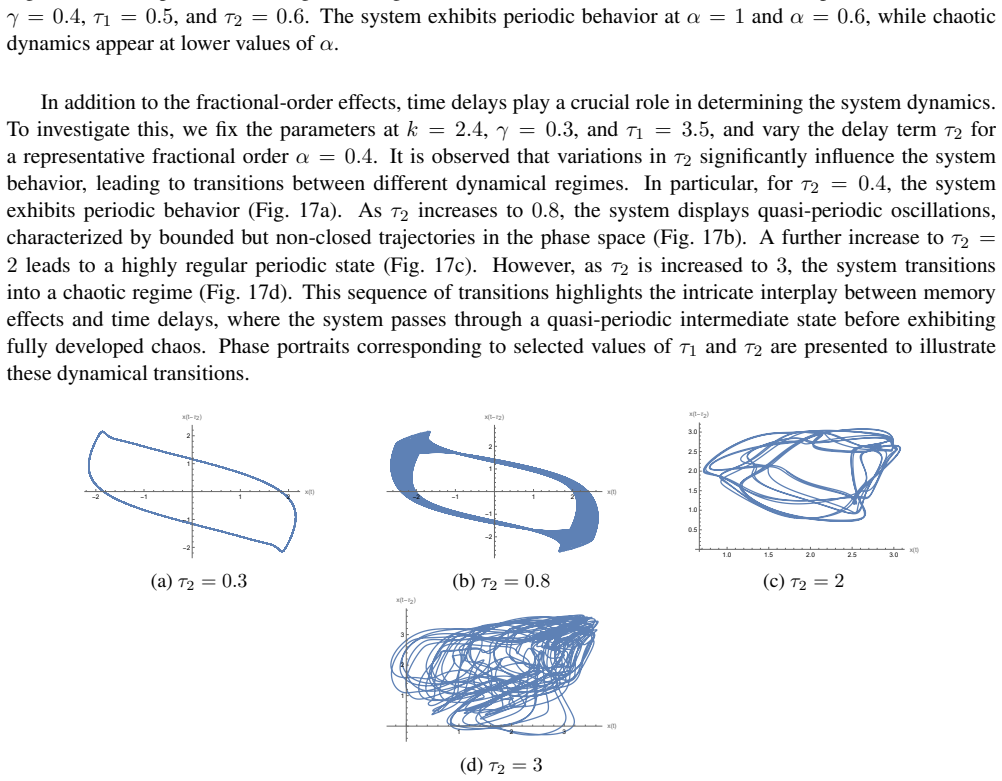
- Multi-scroll chaos appears for ranges of the sine gain k and the two delays.
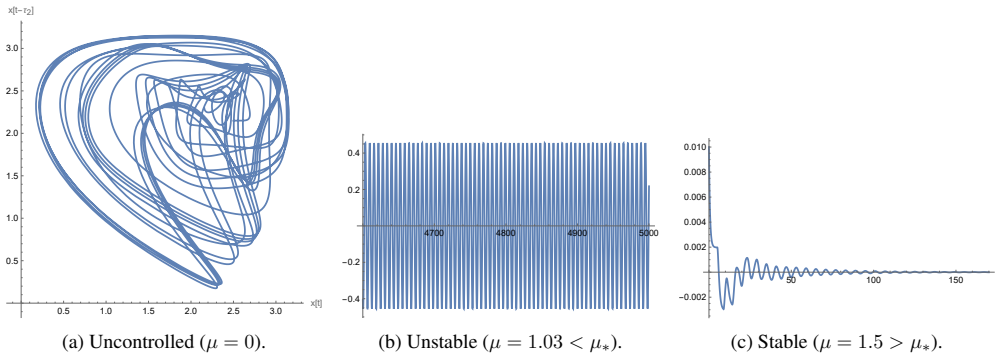
- A single linear feedback term suffices to eliminate the irregular oscillations.
- Synchronization occurs under a condition that does not depend on the size of either delay.
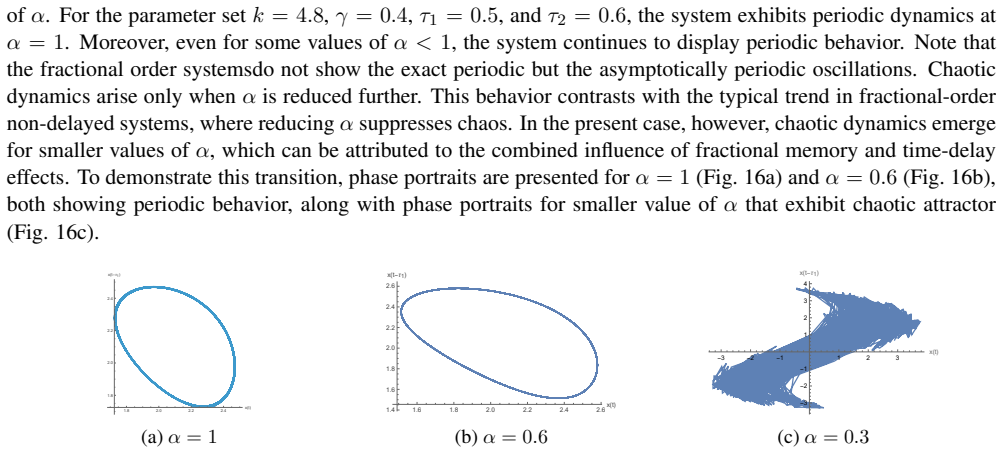
- Positive Lyapunov exponents and multi-scroll patterns persist when the system order is lowered to fractional values.
Where Pith is reading between the lines
- The delay-independent synchronization condition may allow controller design without precise knowledge of the delays.
- Similar linear feedback might stabilize other multi-delay systems whose nonlinearity is bounded.
- Fractional-order persistence of chaos suggests that memory effects alone do not destroy the irregular dynamics once they appear in the integer-order case.
Load-bearing premise
The chosen numerical parameter ranges, integration methods, and initial conditions are representative of the system's global dynamics and do not miss other attractors or instabilities.
What would settle it
Compute the largest Lyapunov exponent for a specific parameter tuple inside the reported chaotic region; if the exponent is negative while the phase portrait shows bounded irregular motion, or if synchronization fails for delays satisfying the reported inequality, the central claims are falsified.
Figures




read the original abstract
This paper studies how complicated and irregular behavior, known as chaos, can arise in a simple mathematical model that includes time delays. The model is a delay differential equation in which the present rate of change depends not only on the current state but also on past states at two different delay times. The system is described by \begin{equation} \dot{x}(t) = -\gamma x(t) + g\big(x(t - \tau_1)\big) - e^{-\gamma \tau_2}, g\big(x(t - \tau_1 - \tau_2)\big), \qquad 0 < \alpha \le 1, \end{equation} where $g(x)=k \sin{x}, k\in\mathbf{R}$. Here, the delays $\tau_1$ and $\tau_2$ represent memory effects in the system, while the sine terms introduce strong nonlinearity. Numerical simulations are used to study the system behavior for different parameter values. Chaotic motion is identified using Lyapunov exponents and phase portraits, which show irregular and unpredictable dynamics. For certain parameter ranges, the system exhibits multi-scroll chaotic attractors, in which the motion alternates among several complex patterns. Finally, chaos is controlled by adding a simple linear feedback term, which suppresses irregular oscillations and stabilizes the system. In addition, synchronization between master and slave systems is investigated using linear state feedback control, and a delay-independent sufficient condition for synchronization is derived and verified numerically. The results show that even complex delayed systems can be effectively controlled and synchronized using simple feedback techniques. The study is further extended to a fractional-order version of the system to examine the influence of memory effects, where it is observed that chaotic behavior can persist even for lower fractional orders.
Editorial analysis
A structured set of objections, weighed in public.
Referee Report
Summary. The manuscript presents a numerical study of chaos and bifurcations in a nonlinear two-delay differential equation (DDE) of the form dot x(t) = -γ x(t) + k sin(x(t-τ1)) - exp(-γ τ2) k sin(x(t-τ1-τ2)), extended to fractional orders 0 < α ≤ 1. Through phase portraits and Lyapunov exponent calculations, the authors identify chaotic regimes including multi-scroll attractors for various delay values and nonlinearity strengths k. They propose a linear feedback control to suppress chaos and derive a delay-independent sufficient condition for synchronization between master and slave systems, which is then verified through simulations. The fractional-order analysis suggests that chaotic behavior persists even at lower fractional orders.
Significance. If the numerical results prove robust, the work offers practical insights into controlling and synchronizing chaotic dynamics in delayed systems using straightforward linear feedback techniques. The derivation of a delay-independent synchronization condition, if rigorously established, would be a valuable contribution to the field of dynamical systems with memory effects. The observation of chaos in fractional-order versions adds to understanding how memory influences complex behavior. However, the significance is tempered by the purely numerical nature of the evidence without analytical proofs or exhaustive exploration of the infinite-dimensional state space.
major comments (3)
- The delay-independent sufficient condition for synchronization is stated as derived, but without the explicit steps of the derivation (e.g., the Lyapunov function or inequality used), it is difficult to assess its validity independently of the numerical verification. The numerical tests use limited initial conditions and parameter ranges, which may not confirm the delay-independence across all possible histories in the DDE state space.
- No information is provided on the specific numerical integrator used for the DDE (such as method of steps, Runge-Kutta with delay handling, or software like MATLAB's dde23), the step size, or error tolerances. This is particularly important for computing reliable Lyapunov exponents and identifying multi-scroll attractors, as numerical artifacts could mimic or obscure chaotic behavior.
- The fractional-order extension mentions persistence of chaos for lower α, but lacks specification of the fractional derivative type and the numerical scheme employed (e.g., Adams-Bashforth-Moulton or Grünwald-Letnikov). Given the sensitivity of fractional systems to discretization, this omission undermines confidence in the claim that chaos persists at low orders.
minor comments (3)
- The equation in the abstract has a comma before the final g term, which appears to be a typesetting error; it should read as multiplication by the exponential term.
- The parameter γ is introduced without explanation of its physical or mathematical significance in the model.
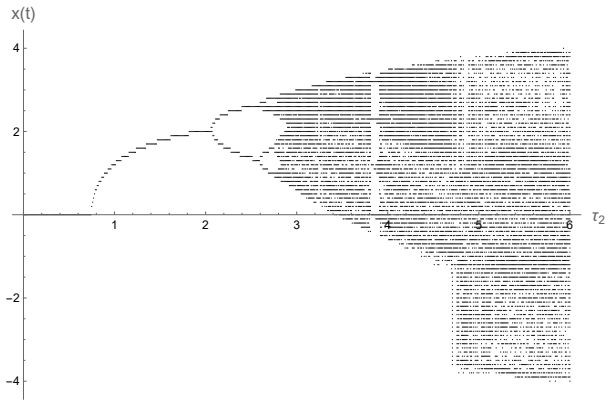
- Phase portraits and bifurcation diagrams would benefit from clearer labeling of parameter values used and axes scales for better reproducibility.
Simulated Author's Rebuttal
We thank the referee for the careful reading of our manuscript and the constructive comments, which will help strengthen the presentation of our results. We address each major comment below and will revise the manuscript accordingly.
read point-by-point responses
-
Referee: The delay-independent sufficient condition for synchronization is stated as derived, but without the explicit steps of the derivation (e.g., the Lyapunov function or inequality used), it is difficult to assess its validity independently of the numerical verification. The numerical tests use limited initial conditions and parameter ranges, which may not confirm the delay-independence across all possible histories in the DDE state space.
Authors: We thank the referee for this observation. In the revised manuscript we will include the complete, explicit derivation of the delay-independent synchronization condition, showing the Lyapunov function employed and the sequence of inequalities that establish the sufficient condition. While the state space of a DDE is infinite-dimensional, our numerical tests already employed several distinct initial history functions over intervals determined by the maximum delay together with a range of parameter values; we will augment this section with additional examples using further varied initial histories to better illustrate the robustness of the result. revision: yes
-
Referee: No information is provided on the specific numerical integrator used for the DDE (such as method of steps, Runge-Kutta with delay handling, or software like MATLAB's dde23), the step size, or error tolerances. This is particularly important for computing reliable Lyapunov exponents and identifying multi-scroll attractors, as numerical artifacts could mimic or obscure chaotic behavior.
Authors: We agree that the absence of these details limits reproducibility. We will add a dedicated paragraph in the revised manuscript that specifies the numerical integrator, software, step size, and error tolerances used for the integer-order DDE simulations, including the computation of Lyapunov exponents. This addition will allow readers to assess the reliability of the reported chaotic regimes and multi-scroll attractors. revision: yes
-
Referee: The fractional-order extension mentions persistence of chaos for lower α, but lacks specification of the fractional derivative type and the numerical scheme employed (e.g., Adams-Bashforth-Moulton or Grünwald-Letnikov). Given the sensitivity of fractional systems to discretization, this omission undermines confidence in the claim that chaos persists at low orders.
Authors: We appreciate the referee drawing attention to this omission. We will revise the fractional-order section to state explicitly the derivative definition employed and the numerical scheme together with its discretization parameters. These additions will provide the necessary information to evaluate the persistence of chaos at lower fractional orders. revision: yes
Circularity Check
No significant circularity; derivations are independent of target results
full rationale
The paper presents an analytical derivation of a delay-independent sufficient condition for master-slave synchronization via linear feedback, followed by separate numerical verification through direct simulation. Chaos and multi-scroll attractors are identified via explicit computation of Lyapunov exponents and phase portraits on the given two-delay DDE (and its fractional extension). No parameters are fitted to the synchronization error or chaos metrics, no self-definitional loops appear in the model equations or control laws, and no load-bearing self-citations are used to justify uniqueness or ansatzes. The numerical sweeps, while necessarily finite, do not retroactively force the analytical steps by construction.
Axiom & Free-Parameter Ledger
free parameters (3)
- delay values τ1 and τ2
- nonlinearity strength k
- fractional order α
axioms (2)
- standard math Solutions to the delay differential equation exist and are unique for the chosen parameters
- domain assumption Numerical computation of Lyapunov exponents reliably detects chaos
Lean theorems connected to this paper
-
IndisputableMonolith/Cost/FunctionalEquation.leanwashburn_uniqueness_aczel unclear?
unclearRelation between the paper passage and the cited Recognition theorem.
Theorem 5.1 (Delay-Independent Synchronization). If γ+δ>2|k| ...
What do these tags mean?
- matches
- The paper's claim is directly supported by a theorem in the formal canon.
- supports
- The theorem supports part of the paper's argument, but the paper may add assumptions or extra steps.
- extends
- The paper goes beyond the formal theorem; the theorem is a base layer rather than the whole result.
- uses
- The paper appears to rely on the theorem as machinery.
- contradicts
- The paper's claim conflicts with a theorem or certificate in the canon.
- unclear
- Pith found a possible connection, but the passage is too broad, indirect, or ambiguous to say the theorem truly supports the claim.
Reference graph
Works this paper leans on
-
[1]
Hale and Sjoerd M
Jack K. Hale and Sjoerd M. Verduyn Lunel.Introduction to Functional Differential Equations. Springer, 1993
1993
-
[2]
Odo Diekmann et al.Delay equations: functional-, complex-, and nonlinear analysis. V ol. 110. Springer Science & Business Media, 2012
2012
-
[3]
Springer Science & Business Media, 2011
Muthusamy Lakshmanan and Dharmapuri Vijayan Senthilkumar.Dynamics of nonlinear time-delay sys- tems. Springer Science & Business Media, 2011
2011
-
[4]
Oscillation and chaos in physiological control systems
Michael C Mackey and Leon Glass. “Oscillation and chaos in physiological control systems”. In:Science 197.4300 (1977), pp. 287–289
1977
-
[5]
Springer, 2009
Thomas Erneux.Applied delay differential equations. Springer, 2009
2009
-
[6]
Kondalsamy Gopalsamy.Stability and oscillations in delay differential equations of population dynamics. V ol. 74. Springer Science & Business Media, 2013
2013
-
[7]
Steven H Strogatz.Nonlinear dynamics and chaos: with applications to physics, biology, chemistry, and engineering (studies in nonlinearity). V ol. 1. Westview press, 2001
2001
-
[8]
Chaotic attractors of an infinite-dimensional dynamical system
J Doyne Farmer. “Chaotic attractors of an infinite-dimensional dynamical system”. In:Physica D: Nonlin- ear Phenomena4.3 (1982), pp. 366–393
1982
-
[9]
Dynamical analysis of fractional order Uc ¸ar prototype delayed system
Sachin Bhalekar. “Dynamical analysis of fractional order Uc ¸ar prototype delayed system”. In:Signal, Image and Video Processing6.3 (2012), pp. 513–519
2012
-
[10]
Generating multiscroll chaotic attractors: theories, methods and applica- tions
Jinhu L ¨u and Guanrong Chen. “Generating multiscroll chaotic attractors: theories, methods and applica- tions”. In:International Journal of Bifurcation and chaos16.04 (2006), pp. 775–858
2006
-
[11]
Analysis of a class of two-delay fractional differential equation
Sachin Bhalekar and Pragati Dutta. “Analysis of a class of two-delay fractional differential equation”. In: Chaos: An Interdisciplinary Journal of Nonlinear Science35.1 (2025)
2025
-
[12]
Continuous control of chaos by self-controlling feedback
Kestutis Pyragas. “Continuous control of chaos by self-controlling feedback”. In:Physics letters A170.6 (1992), pp. 421–428
1992
-
[13]
Control of chaos in delay differential equations, in a network of oscillators and in model cortex
Agnessa Babloyantz, C Lourenco, and JA Sepulchre. “Control of chaos in delay differential equations, in a network of oscillators and in model cortex”. In:Physica D: Nonlinear Phenomena86.1-2 (1995), pp. 274– 283. 15
1995
-
[14]
Chaos control in multistable delay-differential equations and their singular limit maps
Boualem Mensour and Andr ´e Longtin. “Chaos control in multistable delay-differential equations and their singular limit maps”. In:Physical Review E58.1 (1998), p. 410
1998
-
[15]
Springer, 2002
Silviu-Iulian Niculescu.Delay effects on stability: a robust control approach. Springer, 2002
2002
-
[16]
SIAM, 2007
Wim Michiels and Silviu-Iulian Niculescu.Stability and stabilization of time-delay systems: an eigenvalue- based approach. SIAM, 2007
2007
-
[17]
A new chaotic dynamical system and its synchronization
Sachin Bhalekar and Varsha Daftardar-Gejji. “A new chaotic dynamical system and its synchronization”. In:Proceedings of the international conference on mathematical sciences in honor of Prof. AM Mathai. 2011, pp. 3–5
2011
-
[18]
Synchronization of different fractional order chaotic systems using active control
Sachin Bhalekar and Varsha Daftardar-Gejji. “Synchronization of different fractional order chaotic systems using active control”. In:Communications in Nonlinear Science and Numerical Simulation15.11 (2010), pp. 3536–3546
2010
-
[19]
Synchronization of delay-differential equations with application to private communication
Boualem Mensour and Andr ´e Longtin. “Synchronization of delay-differential equations with application to private communication”. In:Physics Letters A244.1-3 (1998), pp. 59–70
1998
-
[20]
Synchronization of coupled time-delay systems: Analytical estimations
Kestutis Pyragas. “Synchronization of coupled time-delay systems: Analytical estimations”. In:Physical Review E58.3 (1998), p. 3067
1998
-
[21]
Synchronization of delay-coupled nonlinear oscillators: An approach based on the stability analysis of synchronized equilibria
Wim Michiels and Henk Nijmeijer. “Synchronization of delay-coupled nonlinear oscillators: An approach based on the stability analysis of synchronized equilibria”. In:Chaos: An interdisciplinary journal of non- linear science19.3 (2009)
2009
-
[22]
Stability analysis of an equation with two delays and application to the production of platelets
Lois Boullu, Laurent Pujo-Menjouet, and Jacques B ´elair. “Stability analysis of an equation with two delays and application to the production of platelets”. In:Discrete and Continuous Dynamical Systems-Series S 13.11 (2020), pp. 3005–3027
2020
-
[23]
Igor Podlubny.Fractional differential equations: An introduction to fractional derivatives, fractional dif- ferential equations, to methods of their solution and some of their applications. V ol. 198. elsevier, 1998
1998
-
[24]
The analysis of fractional differential equations
Kai Diethelm and NJ Ford. “The analysis of fractional differential equations”. In:Lecture notes in mathe- matics2004 (2010)
2010
-
[25]
Pragati Dutta and Sachin Bhalekar. “Some stability results for the fractional differential equations with two delays”. In:arXiv preprint arXiv:2509.21937(2025)
-
[26]
Detecting chaos from a time series
Stane Kodba, Matja ˇz Perc, and Marko Marhl. “Detecting chaos from a time series”. In:European journal of physics26.1 (2005), pp. 205–215
2005
-
[27]
Determining Lyapunov exponents from a time series
Alan Wolf et al. “Determining Lyapunov exponents from a time series”. In:Physica D: nonlinear phenom- ena16.3 (1985), pp. 285–317
1985
-
[28]
Synchronization in chaotic systems
Louis M Pecora and Thomas L Carroll. “Synchronization in chaotic systems”. In:Physical review letters 64.8 (1990), p. 821
1990
-
[29]
The synchronization of chaotic systems
Stefano Boccaletti et al. “The synchronization of chaotic systems”. In:Physics reports366.1-2 (2002), pp. 1–101
2002
-
[30]
Complete chaotic synchronization in mutually coupled time- delay systems
Alexandra S Landsman and Ira B Schwartz. “Complete chaotic synchronization in mutually coupled time- delay systems”. In:Physical Review E—Statistical, Nonlinear, and Soft Matter Physics75.2 (2007), p. 026201
2007
-
[31]
Generalized synchronization of chaos in directionally coupled chaotic systems
Nikolai F Rulkov et al. “Generalized synchronization of chaos in directionally coupled chaotic systems”. In:Physical Review E51.2 (1995), p. 980
1995
-
[32]
General approach for chaotic synchronization with applications to communication
Ljupco Kocarev and Ulrich Parlitz. “General approach for chaotic synchronization with applications to communication”. In:Physical review letters74.25 (1995), p. 5028
1995
-
[33]
Synchronization of neural networks by mutual learning and its application to cryptogra- phy
Einat Klein et al. “Synchronization of neural networks by mutual learning and its application to cryptogra- phy”. In:Advances in Neural Information Processing Systems17 (2004)
2004
-
[34]
Spontaneous synchrony in power-grid networks
Adilson E Motter et al. “Spontaneous synchrony in power-grid networks”. In:Nature Physics9.3 (2013), pp. 191–197
2013
-
[35]
San Diego: Academic Press, 1999
Igor Podlubny.Fractional Differential Equations. San Diego: Academic Press, 1999. 16
1999
-
[36]
Can a fractional order delay differential equation be chaotic whose integer-order counterpart is stable?
Sachin Bhalekar and Deepa Gupta. “Can a fractional order delay differential equation be chaotic whose integer-order counterpart is stable?” In:2023 International Conference on Fractional Differentiation and Its Applications (ICFDA). IEEE. 2023, pp. 1–6. 17
2023
discussion (0)
Sign in with ORCID, Apple, or X to comment. Anyone can read and Pith papers without signing in.