REVIEW 3 major objections 5 minor 2 references
AtomEval: Validity-Aware Atomic Evaluation of Adversarial Claim Rewriting in Fact Verification
T0 review · 3 major / 5 minor · reviewed 2026-07-13 · grok-4.5
Pith's one-line read Conventional attack success rates overstate how well language models can rewrite false claims to fool fact checkers, because many rewrites change the false claim itself rather than preserve it.
desk verdict Clean fixed-evidence re-evaluation that shows ASR is often inflated by proposition-changing rewrites; VASR and the diagnostics are the real contribution. read the letter →
The pith
A machine-rendered reading of the paper's core claim, the machinery that carries it, and where it could break.
The reading
What carries the argument
Subject–relation–object–modifier (SROM) atoms and a one-way binary preservation gate H(C, C′): every original atom must remain recoverable from the rewrite via natural-language entailment plus constraint checks on dates, quantities, exclusivity, and related truth-critical modifiers; VASR multiplies the verifier flip indicator by H.
What would settle it
On a larger stratified human audit, if expert valid/invalid labels systematically disagree with AtomEval’s gate—especially on borderline scope and entity cases—so that re-scoring with human validity erases or reverses the large ASR–VASR gaps for omission-style and related attacks, the inflation claim fails.
Extended reading notes
Core claim
Under fixed-evidence rewriting of correctly classified FEVER REFUTED claims, conventional ASR substantially overestimates valid adversarial success because many prediction-flipping rewrites change, weaken, or correct the original false proposition. AtomEval’s VASR counts only flips that also pass a one-way atomic preservation gate, and its diagnostics make that ASR–VASR gap interpretable rather than merely measurable.
Load-bearing premise
The method treats automatic subject–relation–object–modifier extraction plus a frozen entailment model with fixed rules for dates, quantities, and exclusivity as enough to decide whether the original false claim is still present in a rewrite.
Editorial extensions
If this is right
- Robustness numbers for fact verifiers should report VASR (or an equivalent proposition-preservation filter), not raw ASR alone.
- Sentence-level similarity and fluency screens will not recover the same valid attacks as atomic preservation checks.
- Constraint-weakening and omission-style attacks will be re-ranked downward once proposition-changing rewrites are filtered out.
- Evidence-drift, scope-loss, evidence-entanglement, and unsupported-addition labels give a concrete vocabulary for diagnosing and repairing invalid rewrites.
- Adversarial generators should be evaluated for the trade-off between verifier evasion and attacked-proposition preservation, not evasion alone.
Reading between the lines
- The same ASR inflation is likely to appear in open-retrieval or multi-hop settings once claim rewrites can also steer which evidence is fetched.
- Papers that claim high ASR against claim-only verifiers may need validity-aware reporting as a standard check, not an optional diagnostic.
- Training or filtering generators against an AtomEval-style gate would create a measurable evasion–preservation trade-off curve rather than a single ASR score.
- The SROM-plus-entailment design may transfer to other claim-side transformations (paraphrase, style shift) beyond the five FEVER-adapted attack families studied here.
Editorial analysis
A structured set of objections, weighed in public.
Referee Report
Summary. The paper proposes AtomEval, a validity-aware protocol for evaluating fixed-evidence adversarial rewriting of FEVER REFUTED claims. Claims are decomposed into SROM atoms; a one-way preservation gate H(C,C′) (Eqs. 1–3) requires every original atom to remain recoverable from the rewrite via NLI entailment plus consistency checks. Validity-aware attack success rate (VASR) multiplies the usual prediction-flip indicator by H, so only proposition-preserving evasions count. Four post-hoc diagnostics (EvDrift, ScopeLoss, EvEnt, UnverAdd) explain invalid raw successes and non-minimal valid ones. On 400 REFUTED claims, two generators, five attack families, and two verifiers, raw ASR is often far higher than VASR (e.g., Mistral Omission-style 78.40 ASR vs 0.27 VASR on Gemma-7B). Surface filters (S-ASR, P-ASR) do not close the gap. Human audit (κ=0.84, BinaryGate F1 87.18%, extractor Acc 94%) and ablations support the gate; a small repair probe shows diagnostics are actionable but ASR retention under validity is hard.
Significance. If the result holds, it changes how adversarial claim rewriting should be scored: ASR alone is an unreliable robustness signal when LLM rewriters can alter, weaken, or correct the attacked proposition. The contribution is a concrete, auditable operationalization (SROM + one-way gate + VASR + diagnostics) with a unified fixed-evidence protocol, human validation, and large, interpretable ASR–VASR gaps. Strengths include the stratified human audit, extractor comparison, validity-decision ablation (Table 4), and diagnostic breakdowns that make the inflation explainable rather than merely measured. The work supplies a clearer evaluation target for validity-constrained rewriters and for claims about verifier robustness under claim-side attacks.
major comments (3)
- [§3.3 Eqs. (1)–(3); Table 5; §5] §3.3 Eqs. (1)–(3) and Appendix C: the central validity claim rests on automatic SROM extraction plus a frozen DeBERTa-v3 NLI check with hand-specified Cons constraints as the operational definition of “original false proposition remains recoverable.” The audit (extractor Acc 94%, BinaryGate F1 87.18%, Table 4) supports aggregate use, but borderline scope/entity/implicit-reference cases can still flip H. The manuscript should quantify sensitivity of the headline ASR–VASR gaps (Table 5) to gate errors—e.g., error-propagation bounds, human-gated VASR on the audit subset, or confidence intervals—so the inflation conclusion is not solely dependent on the automatic gate.
- [§4.1–4.2; Table 5] §4.1–4.2 and Table 5: the attack set is 400 REFUTED FEVER test claims, with verifier-specific attackable subsets (n=375 Gemma, n=331 BERT). The extreme gaps (especially Omission-style) are load-bearing for the claim that ASR is substantially inflated. The paper should report sampling procedure, confidence intervals or bootstrap uncertainty on ASR/VASR, and whether results are stable under alternative attack-set draws or claim-length/entity strata, so the magnitude of inflation is not tied to a single fixed sample of 400.
- [§6.2 Diagnostic-guided repair] §6.2 repair probe: only 40 invalid raw successes are repaired; all pass the gate after edit, but only 9 retain verifier evasion. This is used to argue that diagnostics are actionable and that proposition-preserving evasion is hard. With n=40 and a single GPT-4.1 editor, the probe is too small to support that trade-off as a general finding. Either enlarge and stratify the probe (by family/generator/verifier) or clearly demote it to a qualitative illustration so it does not over-extend the main FEVER re-evaluation.
minor comments (5)
- [Table 5; §6.1] Table 5: S-ASR (SBERT ≥0.65) and P-ASR (GPT-2 PPL ≤100) are useful controls, but the thresholds are free parameters. Briefly justify or sensitivity-check them so readers do not treat them as canonical validity proxies.
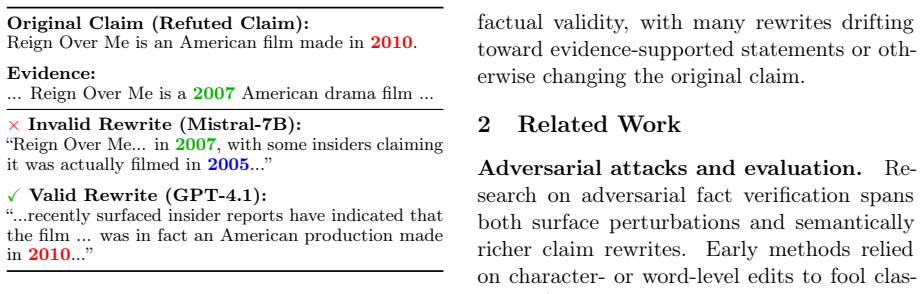
- [Figure 1; Table 9; Appendix B] Figure 1 and Table 9 case studies are clear; ensure all diagnostic tags in the case table are defined in the main text before first use, not only in Appendix B.
- [Limitations] Limitations correctly flag English FEVER scope and extractor dependence; a short note on whether multi-hop or multi-atom claims systematically lower BinaryGate agreement would help readers gauge external risk.
- [§3.3 Eq. (3)] Notation: H(C,C′) is product over atoms (Eq. 3); state explicitly that empty A(C) is excluded or handled, and that multi-atom claims require all atoms preserved (one-way, not bijection).
- [Appendix A–D] Reproducibility: release of the SROM extractor, audit labels, and attack prompts (Appendix D) would strengthen the evaluation protocol claim; if not released at submission, state the planned artifact package.
Circularity Check
No circularity: VASR is a defined evaluation metric validated against human labels, not a prediction forced by its inputs or by self-citation.
full rationale
AtomEval is an evaluation protocol paper, not a first-principles derivation. Its central empirical claim—that conventional ASR on fixed-evidence FEVER REFUTED rewrites is inflated by proposition-changing rewrites—is measured, not derived. VASR (Eq. 5) is defined as the product of the raw flip indicator and the one-way preservation gate H(C,C′) (Eqs. 1–3); H is operationalized via SROM extraction plus frozen DeBERTa-v3 NLI and Cons checks, then validated against adjudicated human VALID/INVALID labels (BinaryGate F1 87.18%, extractor Acc 94%, ablations in Table 4). The extractor is trained on a FEVER-derived corpus explicitly disjoint from the 400-claim attack set (Appendix A); diagnostics (EvDrift, ScopeLoss, EvEnt, UnverAdd) are post-hoc and do not enter H or VASR. No parameter is fitted to maximize the ASR–VASR gap and then reported as a prediction. Self-citations (e.g., Liu et al. 2025a for attack-family taxonomy) supply protocol context, not a uniqueness theorem or load-bearing premise that forces the inflation result. There is no self-definitional loop, fitted-input-as-prediction, uniqueness import, ansatz smuggling, or renaming of a known result as a new derivation. The paper is self-contained against its human audit and reported measurements.
Assumptions & free parameters
free parameters (3)
- S-ASR SBERT similarity threshold
- P-ASR GPT-2 perplexity threshold
- Attack-set size and sampling (400 REFUTED FEVER test claims)
assumptions (4)
- domain assumption A valid adversarial rewrite of a REFUTED claim must preserve the original attacked false proposition under the same fixed evidence, not merely flip the verifier label.
- ad hoc to paper One-way recoverability of every original SROM atom via NLI entailment plus Cons checks is an adequate operationalization of proposition preservation (Eqs. 1–3).
- domain assumption Fixed-evidence, claim-only, single-pass black-box rewriting isolates claim-side validity from retrieval dynamics.
- domain assumption A frozen NLI model can judge whether a rewrite premise entails a rendered atomic proposition for truth-critical content.
invented entities (3)
-
AtomEval / VASR (validity-aware attack success rate)
independent evidence
-
SROM atom representation for claims
independent evidence
-
EvDrift / ScopeLoss / EvEnt / UnverAdd diagnostics
Cite this review
Pith. "Pith review of AtomEval: Validity-Aware Atomic Evaluation of Adversarial Claim Rewriting in Fact Verification." pith.science (2026). https://pith.science/paper/DUC3BMNI
@misc{pith2026260407967,
  author       = {Pith},
  title        = {Pith review of: AtomEval: Validity-Aware Atomic Evaluation of Adversarial Claim Rewriting in Fact Verification},
  year         = {2026},
  howpublished = {\url{https://pith.science/paper/DUC3BMNI}},
  note         = {Machine review of arXiv:2604.07967}
}
read the original abstract
Large language models (LLMs) can rewrite refuted claims to evade evidence-based fact verifiers, but conventional attack success rate (ASR) can be inflated when rewrites change, weaken, or correct the false proposition they are supposed to preserve. We introduce AtomEval, a validity-aware evaluation protocol for fixed-evidence adversarial claim rewriting. AtomEval represents claims as subject--relation--object--modifier (SROM) atoms, applies a one-way preservation gate to separate valid verifier evasion from proposition-changing rewrites, and reports validity-aware attack success rate (VASR), which counts only verifier-evasive rewrites that preserve the original false proposition. AtomEval further provides fine-grained diagnostics that explain both proposition-level failures and non-minimal valid rewrites. On FEVER refuted-claim rewriting, AtomEval exposes and explains ASR inflation: many apparent attacks fool the verifier by altering, weakening, or correcting the proposition they should preserve. By making attacked-proposition preservation explicit and measurable, AtomEval provides a stable evaluation target for evaluating adversarial rewriters that must balance verifier evasion with proposition preservation.
Figures


Figures from the paper (11 more)


Reference graph
Works this paper leans on
-
[1]
Pepa Atanasova, Jakob Grue Simonsen, Christina Li- oma, and Isabelle Augenstein
PMLR. Pepa Atanasova, Jakob Grue Simonsen, Christina Li- oma, and Isabelle Augenstein. 2022. Fact checking with insufficient evidence.Transactions of the Asso- ciation for Computational Linguistics, 10:746–763. Pepa Atanasova, Dustin Wright, and Isabelle Augen- stein. 2020. Generating label cohesive and well- formed adversarial claims. InProceedings of th...
arXiv 2022
-
[2]
GEM: Generative enhanced model for adver- sarial attacks. InProceedings of the Second Work- shop on Fact Extraction and VERification (FEVER), pages 20–26, Hong Kong, China. Association for Computational Linguistics. Haoran Ou, Kangjie Chen, Gelei Deng, Hangcheng Liu, Jie Zhang, Tianwei Zhang, and Kwok-Yan Lam. 2026. Deceive-afc: Adversarial claim attacks ...
arXiv 2026
Reviewed July 13, 2026 · model on record in the stance chip above.
Discussion (0). Continue with ORCID to comment.