Recognition: 1 theorem link
· Lean TheoremBrain3D: EEG-to-3D Decoding of Visual Representations via Multimodal Reasoning
Pith reviewed 2026-05-10 17:44 UTC · model grok-4.3
The pith
A staged pipeline decodes EEG brain signals into 3D meshes by first generating 2D images then using language models for geometric descriptions.
A machine-rendered reading of the paper's core claim, the machinery that carries it, and where it could break.
Core claim
The Brain3D architecture decomposes EEG-to-3D reconstruction into progressive stages: EEG signals are first decoded into visually grounded 2D images, a multimodal large language model then extracts structured 3D-aware descriptions from those images, a diffusion-based generator produces outputs guided by the descriptions, and a single-image-to-3D model converts them into coherent meshes. Evaluations compare the final 3D outputs directly against the original visual stimuli using semantic and geometric metrics, reporting up to 85.4 percent 10-way Top-1 EEG decoding accuracy and 0.648 CLIPScore.
What carries the argument
Staged multimodal pipeline that converts EEG signals to 2D images, extracts 3D descriptions via LLM, generates diffusion outputs, and produces final meshes with a single-image-to-3D model.
If this is right
- The staged decomposition avoids the need for a single end-to-end EEG-to-3D mapping and supports scalable generation.
- Reconstructed outputs can be evaluated for both semantic alignment and geometric fidelity against the original stimuli.
- The approach enables brain-driven 3D generation that maintains coherence across the pipeline stages.
- Quantitative results such as 85.4 percent accuracy and 0.648 CLIPScore indicate feasibility for multimodal EEG-driven reconstruction.
Where Pith is reading between the lines
- The method could be extended by adding direct 3D supervision losses during the diffusion stage to reduce reliance on intermediate descriptions.
- Similar staged reasoning might apply to decoding other non-visual brain signals into structured 3D outputs such as object poses or scene layouts.
- If the LLM extraction step introduces bias, replacing it with task-specific 3D captioning models trained on EEG-image pairs could improve geometric accuracy.
Load-bearing premise
The intermediate 2D images and LLM-derived 3D descriptions are assumed to preserve the geometric information present in the original EEG signals.
What would settle it
Quantitative comparison of the generated 3D meshes against ground-truth 3D models of the original visual stimuli, measuring surface or volumetric geometric errors.
Figures

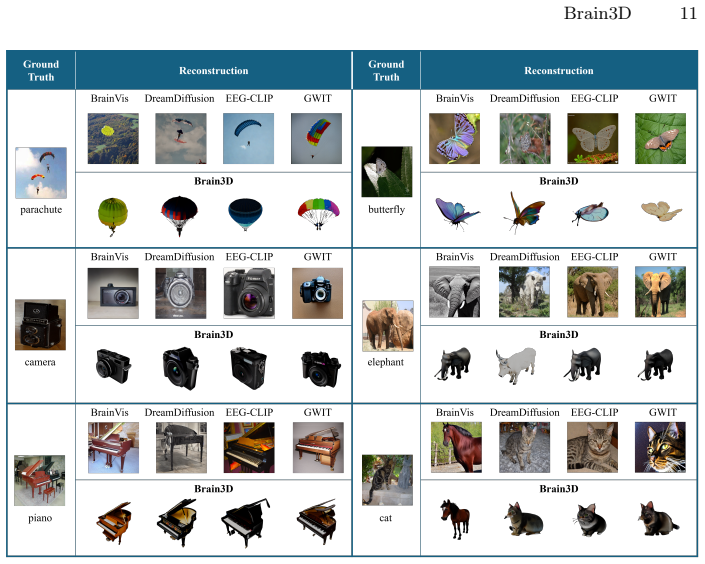
read the original abstract
Decoding visual information from electroencephalography (EEG) has recently achieved promising results, primarily focusing on reconstructing two-dimensional (2D) images from brain activity. However, the reconstruction of three-dimensional (3D) representations remains largely unexplored. This limits the geometric understanding and reduces the applicability of neural decoding in different contexts. To address this gap, we propose Brain3D, a multimodal architecture for EEG-to-3D reconstruction based on EEG-to-image decoding. It progressively transforms neural representations into the 3D domain using geometry-aware generative reasoning. Our pipeline first produces visually grounded images from EEG signals, then employs a multimodal large language model to extract structured 3D-aware descriptions, which guide a diffusion-based generation stage whose outputs are finally converted into coherent 3D meshes via a single-image-to-3D model. By decomposing the problem into structured stages, the proposed approach avoids direct EEG-to-3D mappings and enables scalable brain-driven 3D generation. We conduct a comprehensive evaluation comparing the reconstructed 3D outputs against the original visual stimuli, assessing both semantic alignment and geometric fidelity. Experimental results demonstrate strong performance of the proposed architecture, achieving up to 85.4% 10-way Top-1 EEG decoding accuracy and 0.648 CLIPScore, supporting the feasibility of multimodal EEG-driven 3D reconstruction.
Editorial analysis
A structured set of objections, weighed in public.
Referee Report
Summary. The paper proposes Brain3D, a staged multimodal pipeline for EEG-to-3D reconstruction that first decodes EEG signals to 2D images, extracts structured 3D-aware descriptions via a multimodal LLM, generates images with diffusion models, and converts them to 3D meshes using a single-image-to-3D model. It reports up to 85.4% 10-way Top-1 EEG decoding accuracy and 0.648 CLIPScore as evidence of semantic alignment and geometric fidelity between reconstructed outputs and original visual stimuli.
Significance. If the staged pipeline demonstrably transmits extractable 3D geometric structure from EEG without catastrophic loss, the work would meaningfully extend neural decoding from 2D image reconstruction to 3D representations, opening applications in brain-computer interfaces requiring spatial understanding. The current evaluation, however, relies exclusively on semantic proxies (CLIPScore, top-1 accuracy) rather than direct 3D geometric metrics, so the significance remains provisional pending stronger validation.
major comments (2)
- [Abstract] Abstract: the claim that the pipeline assesses 'geometric fidelity' is not supported by any quantitative 3D metrics (Chamfer distance, surface normal consistency, volumetric IoU, or mesh error against ground-truth 3D models). Only semantic measures are reported, and because the original stimuli are 2D images, no direct 3D ground truth exists; this makes the geometric-fidelity assertion an untested assumption rather than a measured result.
- [Abstract] Abstract (evaluation paragraph): no ablation studies, error-propagation analysis, or intermediate-stage metrics are described for the LLM 3D-description extraction or diffusion generation steps. Without these, it is impossible to determine how much geometric information is lost at each stage, undermining the central claim that the decomposed pipeline 'avoids direct EEG-to-3D mappings' while preserving 3D structure.
minor comments (1)
- [Abstract] The abstract states performance numbers but supplies no participant count, statistical tests, error bars, or baseline comparisons; these details should be added to the methods and results sections for reproducibility.
Simulated Author's Rebuttal
We thank the referee for the constructive comments on our manuscript. We address each major comment below and clarify the evaluation scope in a revised abstract.
read point-by-point responses
-
Referee: [Abstract] Abstract: the claim that the pipeline assesses 'geometric fidelity' is not supported by any quantitative 3D metrics (Chamfer distance, surface normal consistency, volumetric IoU, or mesh error against ground-truth 3D models). Only semantic measures are reported, and because the original stimuli are 2D images, no direct 3D ground truth exists; this makes the geometric-fidelity assertion an untested assumption rather than a measured result.
Authors: We agree that no quantitative 3D geometric metrics are provided, as the stimuli consist of 2D images without associated 3D ground-truth models. The term 'geometric fidelity' was used to describe the pipeline's output of coherent 3D meshes that preserve semantic content from the EEG-decoded images. We will revise the abstract to qualify this claim and emphasize that geometric aspects are supported indirectly through the multimodal reasoning and mesh generation stages, rather than direct metrics. revision: yes
-
Referee: [Abstract] Abstract (evaluation paragraph): no ablation studies, error-propagation analysis, or intermediate-stage metrics are described for the LLM 3D-description extraction or diffusion generation steps. Without these, it is impossible to determine how much geometric information is lost at each stage, undermining the central claim that the decomposed pipeline 'avoids direct EEG-to-3D mappings' while preserving 3D structure.
Authors: We recognize that including ablation studies and intermediate metrics would provide a more complete picture of information preservation across stages. In the revised version, we will add intermediate CLIPScore evaluations at key stages and a qualitative discussion of potential error propagation. A full quantitative error-propagation analysis is not included as it would require additional datasets and experiments; however, the end-to-end performance supports the viability of the staged approach. revision: partial
- The lack of 3D ground-truth models for the 2D visual stimuli precludes direct quantitative evaluation of 3D geometric fidelity using metrics like Chamfer distance or volumetric IoU.
Circularity Check
No circularity in derivation chain
full rationale
The paper describes an empirical staged pipeline (EEG-to-2D image decoding followed by LLM extraction, diffusion, and single-image-to-3D conversion) whose performance is measured by external metrics (10-way Top-1 accuracy, CLIPScore) against original stimuli. No equations, fitted parameters, or self-citations are presented that reduce any claimed result to its own inputs by construction. The architecture relies on off-the-shelf components and reports standard evaluation scores without self-referential definitions or load-bearing uniqueness theorems.
Axiom & Free-Parameter Ledger
Lean theorems connected to this paper
-
IndisputableMonolith/Foundation/AlexanderDuality.leanalexander_duality_circle_linking unclear?
unclearRelation between the paper passage and the cited Recognition theorem.
reconstruction of three-dimensional (3D) representations remains largely unexplored... progressively transforms neural representations into the 3D domain using geometry-aware generative reasoning
What do these tags mean?
- matches
- The paper's claim is directly supported by a theorem in the formal canon.
- supports
- The theorem supports part of the paper's argument, but the paper may add assumptions or extra steps.
- extends
- The paper goes beyond the formal theorem; the theorem is a base layer rather than the whole result.
- uses
- The paper appears to rely on the theorem as machinery.
- contradicts
- The paper's claim conflicts with a theorem or certificate in the canon.
- unclear
- Pith found a possible connection, but the passage is too broad, indirect, or ambiguous to say the theorem truly supports the claim.
Reference graph
Works this paper leans on
-
[1]
Biomed- ical Signal Processing and Control87, 105497 (2024) Brain3D 15
Ahmadieh, H., Gassemi, F., Moradi, M.H.: Visual image reconstruction based on eeg signals using a generative adversarial and deep fuzzy neural network. Biomed- ical Signal Processing and Control87, 105497 (2024) Brain3D 15
2024
-
[2]
In: European Conference on Computer Vision
Bai, Y., Wang, X., Cao, Y.P., Ge, Y., Yuan, C., Shan, Y.: Dreamdiffusion: High- quality eeg-to-image generation with temporal masked signal modeling and clip alignment. In: European Conference on Computer Vision. pp. 472–488. Springer (2024)
2024
-
[3]
PloS one6(6), e20674 (2011)
Bobrov, P., Frolov, A., Cantor, C., Fedulova, I., Bakhnyan, M., Zhavoronkov, A.: Brain-computer interface based on generation of visual images. PloS one6(6), e20674 (2011)
2011
-
[4]
Neural Networks p
Cao, X., Gong, P., Zhang, L., Zhang, D.: Eeg-clip: A transformer-based framework for eeg-guided image generation. Neural Networks p. 108167 (2025)
2025
-
[5]
In: Proceedings of the IEEE/CVF conference on computer vision and pattern recog- nition
Chen, Z., Qing, J., Xiang, T., Yue, W.L., Zhou, J.H.: Seeing beyond the brain: Conditional diffusion model with sparse masked modeling for vision decoding. In: Proceedings of the IEEE/CVF conference on computer vision and pattern recog- nition. pp. 22710–22720 (2023)
2023
-
[6]
In: 2009 IEEE conference on computer vision and pattern recognition
Deng, J., Dong, W., Socher, R., Li, L.J., Li, K., Fei-Fei, L.: Imagenet: A large- scale hierarchical image database. In: 2009 IEEE conference on computer vision and pattern recognition. pp. 248–255. Ieee (2009)
2009
-
[7]
arXiv preprint arXiv:2504.11936 (2025)
Deng, X., Chen, S., Zhou, J., Li, L.: Mind2matter: Creating 3d models from eeg signals. arXiv preprint arXiv:2504.11936 (2025)
-
[8]
In: ICASSP 2025-2025 IEEE International Conference on Acoustics, Speech and Signal Processing (ICASSP)
Fu, H., Wang, H., Chin, J.J., Shen, Z.: Brainvis: Exploring the bridge between brain and visual signals via image reconstruction. In: ICASSP 2025-2025 IEEE International Conference on Acoustics, Speech and Signal Processing (ICASSP). pp. 1–5. IEEE (2025)
2025
-
[9]
arXiv preprint arXiv:2510.13454 (2025)
Go, H., Narnhofer, D., Bhat, G., Truong, P., Tombari, F., Schindler, K.: Vist3a: Text-to-3d by stitching a multi-view reconstruction network to a video generator. arXiv preprint arXiv:2510.13454 (2025)
-
[10]
Grattafiori, A., Dubey, A., Jauhri, A., Pandey, A., Kadian, A., Al-Dahle, A., Let- man, A., Mathur, A., Schelten, A., Vaughan, A., et al.: The llama 3 herd of models. arXiv preprint arXiv:2407.21783 (2024)
work page internal anchor Pith review Pith/arXiv arXiv 2024
-
[11]
arXiv preprint arXiv:2502.16861 (2025)
Guo, W., Sun, G., He, J., Shao, T., Wang, S., Chen, Z., Hong, M., Sun, Y., Xiong, H.: A survey of fmri to image reconstruction. arXiv preprint arXiv:2502.16861 (2025)
-
[12]
In: Proceedings of the Computer Vision and Pattern Recognition Conference
Guo, Z., Wu, J., Song, Y., Bu, J., Mai, W., Zheng, Q., Ouyang, W., Song, C.: Neuro-3d: Towards 3d visual decoding from eeg signals. In: Proceedings of the Computer Vision and Pattern Recognition Conference. pp. 23870–23880 (2025)
2025
-
[13]
In: European Conference on Computer Vision
Huo, J., Wang, Y., Wang, Y., Qian, X., Li, C., Fu, Y., Feng, J.: Neuropictor: Refin- ing fmri-to-image reconstruction via multi-individual pretraining and multi-level modulation. In: European Conference on Computer Vision. pp. 56–73. Springer (2024)
2024
-
[14]
ArXiv pp
Kneeland, R., Ojeda, J., St-Yves, G., Naselaris, T.: Reconstructing seen images from human brain activity via guided stochastic search. ArXiv pp. arXiv–2305 (2023)
2023
-
[15]
In: Proceedings of the Computer Vision and Pattern Recognition Conference
Kneeland, R., Scotti, P.S., St-Yves, G., Breedlove, J., Kay, K., Naselaris, T.: Nsd- imagery: A benchmark dataset for extending fmri vision decoding methods to mental imagery. In: Proceedings of the Computer Vision and Pattern Recognition Conference. pp. 28852–28862 (2025)
2025
-
[16]
In: Proceed- ings of the Computer Vision and Pattern Recognition Conference
Li, Z., Gao, T., An, Y., Chen, T., Zhang, J., Wen, Y., Liu, M., Zhang, Q.: Brain- inspired spiking neural networks for energy-efficient object detection. In: Proceed- ings of the Computer Vision and Pattern Recognition Conference. pp. 3552–3562 (2025) 16 E. Balloni et al
2025
-
[17]
In: Proceedings of the IEEE/CVF conference on computer vision and pattern recognition
Liu, M., Shi, R., Chen, L., Zhang, Z., Xu, C., Wei, X., Chen, H., Zeng, C., Gu, J., Su, H.: One-2-3-45++: Fast single image to 3d objects with consistent multi- view generation and 3d diffusion. In: Proceedings of the IEEE/CVF conference on computer vision and pattern recognition. pp. 10072–10083 (2024)
2024
-
[18]
In: ICASSP 2025-2025 IEEE International Conference on Acoustics, Speech and Signal Processing (ICASSP)
Lopez, E., Sigillo, L., Colonnese, F., Panella, M., Comminiello, D.: Guess what i think: Streamlined eeg-to-image generation with latent diffusion models. In: ICASSP 2025-2025 IEEE International Conference on Acoustics, Speech and Signal Processing (ICASSP). pp. 1–5. IEEE (2025)
2025
-
[19]
bioRxiv (2025)
Lu, Z., Golomb, J.D.: Unfolding spatiotemporal representations of 3d visual per- ception in the human brain. bioRxiv (2025)
2025
-
[20]
In: NeurIPS 2025 Workshop on Symmetry and Geometry in Neural Representations (2025)
Masclef, N.L., Demcenko, T., Catanzaro, A., Kosmyna, N.: Dual-stream eeg de- coding for 3d visual perception. In: NeurIPS 2025 Workshop on Symmetry and Geometry in Neural Representations (2025)
2025
-
[21]
Current biology21(19), 1641–1646 (2011)
Nishimoto, S., Vu, A.T., Naselaris, T., Benjamini, Y., Yu, B., Gallant, J.L.: Recon- structing visual experiences from brain activity evoked by natural movies. Current biology21(19), 1641–1646 (2011)
2011
-
[22]
IEEE Transactions on Pattern Analysis and Machine Intelligence 43(11), 3833–3849 (2020)
Palazzo, S., Spampinato, C., Kavasidis, I., Giordano, D., Schmidt, J., Shah, M.: Decoding brain representations by multimodal learning of neural activity and vi- sual features. IEEE Transactions on Pattern Analysis and Machine Intelligence 43(11), 3833–3849 (2020)
2020
-
[23]
https://huggingface.co/blog/stable_diffusion(2022), hugging Face Blog
Patil, S., Cuenca, P., Lambert, N., von Platen, P.: Stable diffusion with diffusers. https://huggingface.co/blog/stable_diffusion(2022), hugging Face Blog
2022
-
[24]
DreamFusion: Text-to-3D using 2D Diffusion
Poole, B., Jain, A., Barron, J.T., Mildenhall, B.: Dreamfusion: Text-to-3d using 2d diffusion. arXiv preprint arXiv:2209.14988 (2022)
work page internal anchor Pith review arXiv 2022
-
[25]
arXiv preprint arXiv:2506.04906 (2025)
Schmors, L., Gonschorek, D., B¨ ohm, J.N., Qiu, Y., Zhou, N., Kobak, D., Tolias, A., Sinz, F., Reimer, J., Franke, K., et al.: Trace: Contrastive learning for multi-trial time-series data in neuroscience. arXiv preprint arXiv:2506.04906 (2025)
-
[26]
In: Proceedings of the IEEE/CVF Conference on Computer Vision and Pattern Recognition
Shah, U., Agus, M., Boges, D., Chiappini, V., Alzubaidi, M., Schneider, J., Had- wiger, M., Magistretti, P.J., Househ, M., Cal` ı, C.: Sam4em: Efficient memory-based two stage prompt-free segment anything model adapter for complex 3d neuro- science electron microscopy stacks. In: Proceedings of the IEEE/CVF Conference on Computer Vision and Pattern Recogn...
2025
-
[27]
PLoS computational biology15(1), e1006633 (2019)
Shen, G., Horikawa, T., Majima, K., Kamitani, Y.: Deep image reconstruction from human brain activity. PLoS computational biology15(1), e1006633 (2019)
2019
-
[28]
In: Proceedings of the IEEE/CVF Winter Conference on Applications of Computer Vision
Singh, P., Dalal, D., Vashishtha, G., Miyapuram, K., Raman, S.: Learning ro- bust deep visual representations from eeg brain recordings. In: Proceedings of the IEEE/CVF Winter Conference on Applications of Computer Vision. pp. 7553–7562 (2024)
2024
-
[29]
In: ICASSP 2023-2023 IEEE International Conference on Acoustics, Speech and Signal Processing (ICASSP)
Singh, P., Pandey, P., Miyapuram, K., Raman, S.: Eeg2image: image reconstruction from eeg brain signals. In: ICASSP 2023-2023 IEEE International Conference on Acoustics, Speech and Signal Processing (ICASSP). pp. 1–5. IEEE (2023)
2023
-
[30]
In: Proceedings of the IEEE conference on computer vision and pattern recognition
Spampinato, C., Palazzo, S., Kavasidis, I., Giordano, D., Souly, N., Shah, M.: Deep learning human mind for automated visual classification. In: Proceedings of the IEEE conference on computer vision and pattern recognition. pp. 6809–6817 (2017)
2017
-
[31]
In: Proceedings of the IEEE/CVF confer- ence on computer vision and pattern recognition
Takagi, Y., Nishimoto, S.: High-resolution image reconstruction with latent diffu- sion models from human brain activity. In: Proceedings of the IEEE/CVF confer- ence on computer vision and pattern recognition. pp. 14453–14463 (2023)
2023
-
[32]
Wang, H., Lu, J., Li, H., Li, X.: Zebra: Towards zero-shot cross-subject generaliza- tion for universal brain visual decoding. arXiv preprint arXiv:2510.27128 (2025) Brain3D 17
-
[33]
Annual review of vision science2(1), 345–376 (2016)
Welchman, A.E.: The human brain in depth: how we see in 3d. Annual review of vision science2(1), 345–376 (2016)
2016
-
[34]
In: Proceedings of the IEEE/CVF conference on computer vision and pattern recognition
Xiang, J., Lv, Z., Xu, S., Deng, Y., Wang, R., Zhang, B., Chen, D., Tong, X., Yang, J.: Structured 3d latents for scalable and versatile 3d generation. In: Proceedings of the IEEE/CVF conference on computer vision and pattern recognition. pp. 21469–21480 (2025)
2025
-
[35]
Engineering Applications of Artificial Intelligence156, 111180 (2025)
Xiang, X., Zhou, W., Dai, G.: Electroencephalography-driven three-dimensional object decoding with multi-view perception diffusion. Engineering Applications of Artificial Intelligence156, 111180 (2025)
2025
-
[36]
In: European Conference on Computer Vision
Xu, Y., Shi, Z., Yifan, W., Chen, H., Yang, C., Peng, S., Shen, Y., Wetzstein, G.: Grm: Large gaussian reconstruction model for efficient 3d reconstruction and gen- eration. In: European Conference on Computer Vision. pp. 1–20. Springer (2024)
2024
discussion (0)
Sign in with ORCID, Apple, or X to comment. Anyone can read and Pith papers without signing in.