Recognition: 2 theorem links
· Lean TheoremTime-dependent THz dielectric function of ZnTe under two-photon optical excitation at 800 nm wavelength
Pith reviewed 2026-05-10 17:50 UTC · model grok-4.3
The pith
The THz dielectric function of ZnTe changes substantially under typical 800 nm excitation for THz generation due to two-photon generated free carriers and activated phonon modes.
A machine-rendered reading of the paper's core claim, the machinery that carries it, and where it could break.
Core claim
Under 800 nm sub-bandgap excitation at fluences typical for THz generation, the THz dielectric function of ZnTe undergoes substantial transient modification arising from significant free-carrier generation via two-photon absorption of the pump, accompanied by the pump-driven activation of the THz-active phonon modes.
What carries the argument
Time-resolved optical pump-THz probe spectroscopy analyzed with the Drude-Lorentz model, which extracts the transient free-carrier density, momentum scattering time, and oscillator strength of the activated THz phonon modes.
If this is right
- THz generation efficiency and bandwidth in ZnTe become fluence- and time-dependent rather than fixed material properties.
- THz detection response also varies with the relative timing between the optical pump and the THz field.
- Carrier scattering time and phonon oscillator strength evolve continuously after the pump pulse arrives.
- Standard fixed-dielectric-function models will mispredict output power and spectral shape at higher fluences.
Where Pith is reading between the lines
- Device designs that assume a static dielectric function may underestimate or overestimate THz yield once pump intensity reaches two-photon thresholds.
- Adjusting pump fluence or introducing a controlled delay could be used to tune the THz spectrum in real time.
- Comparable transient effects are likely to appear in other common THz crystals such as GaP or GaAs when pumped at wavelengths that enable two-photon absorption.
Load-bearing premise
That the observed changes in the THz dielectric function are caused primarily by two-photon absorption generating free carriers and by activation of THz-active phonon modes, with the Drude-Lorentz model providing an accurate and complete description without significant contributions from other mechanisms.
What would settle it
A measurement of unchanged THz transmission or reflection spectra under identical 800 nm excitation conditions, or experimental data that cannot be reproduced by any reasonable set of Drude-Lorentz parameters.
Figures


read the original abstract
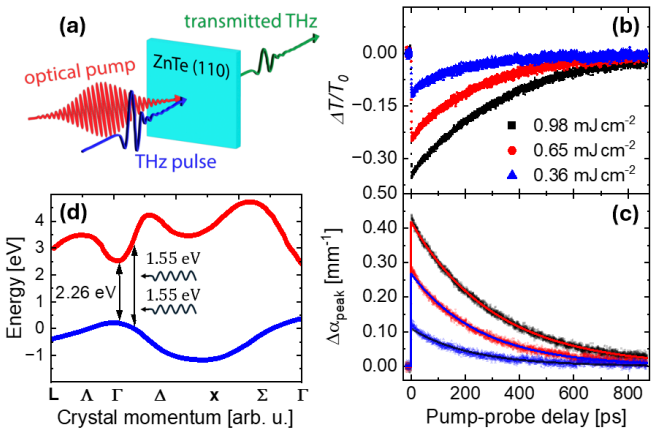
ZnTe is arguably the most widely used nonlinear crystal for the generation and detection of THz radiation, used in conjunction with sub-bandgap optical excitation by femtosecond lasers operating near 800 nm. The THz dielectric function of ZnTe is the key parameter defining the efficiency and bandwidth of THz generation and detection. Here, we demonstrate that the THz dielectric function of ZnTe undergoes substantial transient modification at 800 nm sub-bandgap excitation under conditions typical for THz generation. These modifications arise from significant free-carrier generation via two-photon absorption of the 800 nm pump, accompanied by the pump-driven activation of the THz-active phonon modes. Using optical pump-THz probe spectroscopy, we characterized the THz dielectric function of ZnTe under 800 nm excitation as a function of pump fluence and pump-probe delay. Analysis of the experimental data within the Drude-Lorentz model provided the generated free carrier density and momentum scattering time, and oscillator strength of the pump activated THz phonon modes, revealing their transient evolution in dependence on the excitation conditions.
Editorial analysis
A structured set of objections, weighed in public.
Referee Report
Summary. The manuscript investigates the transient THz dielectric response of ZnTe under sub-bandgap 800 nm excitation using optical pump-THz probe spectroscopy. The authors claim that the dielectric function undergoes substantial modification due to free-carrier generation by two-photon absorption and pump-induced activation of phonon modes. Data are collected as a function of pump fluence and delay, and fitted to a Drude-Lorentz model to extract carrier density, momentum scattering time, and phonon oscillator strength.
Significance. This result is significant for THz science because ZnTe is the most common crystal for THz generation and detection with Ti:sapphire lasers at 800 nm. Quantifying how the dielectric function changes under typical pump conditions can directly impact the interpretation and optimization of THz sources and detectors. The work provides experimental measurements and parameter extraction that could serve as a reference for the community. The inclusion of fluence-dependent measurements and time-resolved data adds empirical value.
major comments (1)
- [Results (fluence dependence analysis)] The paper presents the extracted free carrier density as a function of pump fluence but does not report a check for quadratic scaling n ∝ F². This verification is essential to substantiate that two-photon absorption is the primary mechanism, as deviations could point to other contributions like linear absorption or thermal effects, directly impacting the validity of the Drude-Lorentz interpretation of the dielectric changes.
minor comments (2)
- [Abstract] The abstract uses 'substantial' for the dielectric modification without quoting the observed magnitude of change in Re(ε) or Im(ε); adding a brief quantitative statement would improve precision.
- [Methods] The Drude-Lorentz fitting procedure and any constraints applied to the parameters (e.g., fixed phonon frequency) are not described in sufficient detail for independent reproduction.
Simulated Author's Rebuttal
We thank the referee for their positive evaluation of our manuscript and for the constructive feedback. We address the major comment in detail below and agree to revise the manuscript to incorporate the suggested verification.
read point-by-point responses
-
Referee: The paper presents the extracted free carrier density as a function of pump fluence but does not report a check for quadratic scaling n ∝ F². This verification is essential to substantiate that two-photon absorption is the primary mechanism, as deviations could point to other contributions like linear absorption or thermal effects, directly impacting the validity of the Drude-Lorentz interpretation of the dielectric changes.
Authors: We agree with the referee that explicitly verifying the quadratic fluence dependence is important to confirm the two-photon absorption mechanism. Upon re-examining our data, the extracted carrier densities indeed follow n ∝ F² over the range of fluences studied, consistent with two-photon absorption and with no evidence of significant linear absorption or thermal effects at these excitation levels. To address this, we will add a plot of carrier density versus fluence (on log-log scale) or include the scaling exponent in the revised manuscript, along with a brief discussion. This will strengthen the justification for our Drude-Lorentz model analysis. revision: yes
Circularity Check
Experimental pump-probe data fitted to standard Drude-Lorentz model; no derivation reduces to inputs
full rationale
The paper reports optical pump-THz probe measurements of ZnTe under 800 nm excitation, with spectra analyzed by fitting to the Drude-Lorentz model to extract time-dependent carrier density, scattering time, and phonon oscillator strength as functions of fluence and delay. No mathematical derivation, first-principles calculation, or predictive chain is presented that could reduce to its own fitted inputs by construction. Standard model fitting to measured data is used; no self-citation load-bearing step, uniqueness theorem, or ansatz smuggling is invoked to justify the central attribution. The analysis is self-contained against external benchmarks of THz spectroscopy and remains independent of any tautological reduction.
Axiom & Free-Parameter Ledger
axioms (1)
- domain assumption Drude-Lorentz model accurately describes the THz dielectric response of ZnTe under excitation
Lean theorems connected to this paper
-
IndisputableMonolith/Cost/FunctionalEquation.leanwashburn_uniqueness_aczel unclear?
unclearRelation between the paper passage and the cited Recognition theorem.
Analysis of the experimental data within the Drude-Lorentz model provided the generated free carrier density and momentum scattering time, and oscillator strength of the pump activated THz phonon modes
-
IndisputableMonolith/Foundation/AlphaCoordinateFixation.leanJ_uniquely_calibrated_via_higher_derivative unclear?
unclearRelation between the paper passage and the cited Recognition theorem.
We fit the measured frequency-dependent THz dielectric function of ZnTe using Eq. 1
What do these tags mean?
- matches
- The paper's claim is directly supported by a theorem in the formal canon.
- supports
- The theorem supports part of the paper's argument, but the paper may add assumptions or extra steps.
- extends
- The paper goes beyond the formal theorem; the theorem is a base layer rather than the whole result.
- uses
- The paper appears to rely on the theorem as machinery.
- contradicts
- The paper's claim conflicts with a theorem or certificate in the canon.
- unclear
- Pith found a possible connection, but the passage is too broad, indirect, or ambiguous to say the theorem truly supports the claim.
Reference graph
Works this paper leans on
-
[1]
Ha`ori, Y
T. Ha`ori, Y . Homma, A. Mitsuishi, and M. Tacke, Indices of refracQon of ZnS, ZnSe, ZnTe, CdS, and CdTe in the Far Infrared, Opt. Commun. 7, 229 (1973). [15] M. Schall, M. Walther, and P . Uhd Jepsen, Fundamental and second-order phonon processes in CdTe and ZnTe, Phys. Rev. B 64, 094301 (2001). [16] S. M. Harrel, R. L. Milot, J. M. Schleicher, and C. A....
1973
-
[2]
J. Liu, X. Chen, Z. Yao, X. Wu, M. Liu, A. V. Balakin, A. P . Shkurinov, G. You, and Y . Zhu, Ultrafast photoexcitaQon dynamics of ZnTe crystals by femtosecond opQcal pump-probe and terahertz emission spectroscopy, Microw. Opt. Technol. Le`. 62, 2656 (2020). [30] T. Shimada, N. Kamaraju, C. Frischkorn, M. Wolf, and T. Kampfrath, IndicaQon of Te segregaQon...
2020
discussion (0)
Sign in with ORCID, Apple, or X to comment. Anyone can read and Pith papers without signing in.