Recognition: no theorem link
AnOldBabylonian coefficient, its origin and impact on our understanding of measures on circles, including the radian measure
Pith reviewed 2026-05-10 17:45 UTC · model grok-4.3
The pith
The modern radian measure descends directly from an Old Babylonian coefficient for circle arcs.
A machine-rendered reading of the paper's core claim, the machinery that carries it, and where it could break.
Core claim
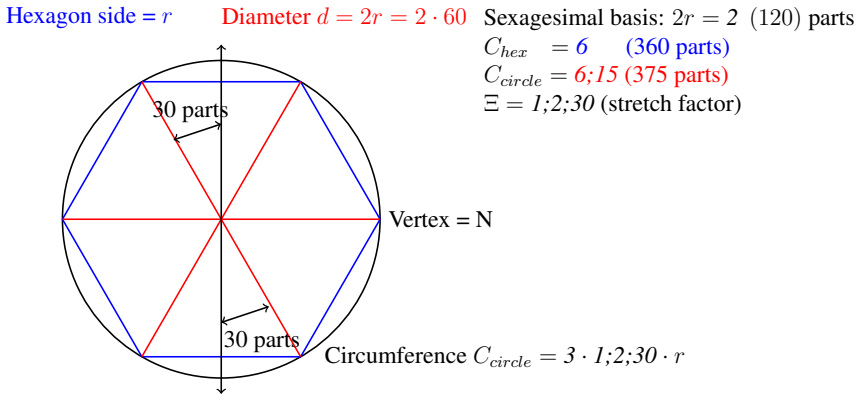
Ξ arises from the practical necessity of precise measurements on the sky or a circle, through the harmonization of length-measure systems. The analysis of the Nippur measure and the Gudea measure shows that Ξ = 375/360 represents the ratio of these established Old Babylonian measure systems. As a precision factor for circumference calculations, it remained in use until today. In Ptolemy's work, we find a slightly refined value of Ξ = 377/360. A further refinement of this coefficient led to our modern π, which still incorporates the two Old Babylonian components of a demonstrably two-stage calculation and refinement process. This investigation leads ultimately to the conclusion that the radia
What carries the argument
The coefficient Ξ = 375/360, the ratio of the Nippur and Gudea measure systems, which functions as a scaling factor for accurate arc-length calculations on circular segments through sexagesimal arithmetic.
If this is right
- The modern value of π retains the two Old Babylonian components from a two-stage calculation and refinement process.
- The radian measure is a direct descendant of the ancient coefficient Ξ.
- Relative sexagesimal notation enabled the universal application of Ξ and its reciprocal for highly accurate arc-length calculations.
- Accuracy increased by only 0.5 percent from the initial ratio to the modern value of π.
- The coefficient appears on multiple Old Babylonian tablets including those from Susa and demonstrates sexagesimal logic.
Where Pith is reading between the lines
- The 360-part division of the circle may trace to measure-system harmonization rather than solely to astronomical periods.
- Historians could search additional tablets for further instances of Ξ to map its geographic spread.
- Other ancient geometric constants might show similar origins in practical length-system adjustments.
Load-bearing premise
The assumption that Ξ = 375/360 represents the ratio of the Nippur and Gudea measure systems and that the refinement process directly connects to the modern radian without significant other influences or independent developments.
What would settle it
Discovery of cuneiform or later historical records showing that arc-to-radius measures developed independently of Babylonian measure ratios, or calculations demonstrating that the refinement from 375/360 does not preserve the claimed two-stage structure, would disprove the descent claim.
Figures
read the original abstract
This study reconstructs the origin of a constant, here called $\Xi$ (Xi), as a primary scaling factor in Old Babylonian mathematics and astronomy. $\Xi$ arises from the practical necessity of precise measurements on the sky or a circle, through the harmonization of length-measure systems. The analysis of the Nippur measure (with its famous cubit) and the Gudea measure shows that $\Xi = 375/360$ represents the ratio of these established Old Babylonian measure systems. As a precision factor for circumference calculations, it remained in use until today. In Ptolemy's work, we find a slightly refined value of $\Xi = 377/360$. A further refinement of this coefficient led to our modern $\pi$, which still incorporates the two Old Babylonian components of a demonstrably two-stage calculation and refinement process. The accuracy increased by only 0.5\% compared to the first ratio. This factor, attested on several Old Babylonian cuneiform tablets including those from Susa, demonstrates the profound understanding of sexagesimal logic. The relative sexagesimal notation (60 = 1 = 1/60) enabled the universal application of $\Xi$ and its reciprocal for highly accurate calculations of arc-length on circular segments. This investigation leads ultimately to a surprising consequence: the modern radian measure is a direct descendant of this Old Babylonian coefficient.
Editorial analysis
A structured set of objections, weighed in public.
Referee Report
Summary. The manuscript reconstructs an Old Babylonian coefficient Ξ = 375/360 as arising from the ratio of Nippur and Gudea length-measure systems, functioning as a precision scaling factor for circumference and arc-length calculations in sexagesimal notation. It traces a refinement to 377/360 in Ptolemy, a further step to modern π (with only 0.5% accuracy gain), and concludes that the radian measure is a direct conceptual descendant of this coefficient, citing cuneiform tablets including those from Susa.
Significance. If the interpretive links to primary sources hold, the work could offer a novel metrological perspective on the prehistory of circle constants and the radian, emphasizing continuity in Babylonian sexagesimal practices. It credits the relative notation (60 = 1 = 1/60) for enabling universal application and notes the two-stage refinement process. However, the significance is constrained by the absence of detailed tablet transcriptions, explicit derivations, or transmission evidence, making the central historical claim difficult to evaluate as more than conjecture at present.
major comments (3)
- [Abstract] Abstract and main argument on Ξ derivation: the claim that Ξ = 375/360 'represents the ratio of these established Old Babylonian measure systems' is load-bearing for the entire reconstruction, yet the manuscript provides no explicit calculation from the Nippur cubit and Gudea measures or direct tablet citations showing this fraction was computed or used as a circumference precision factor independent of later sources.
- [Ptolemy refinement discussion] Section tracing refinement to Ptolemy: the assertion of a 'slightly refined value of Ξ = 377/360' in Ptolemy requires a specific reference (e.g., to the Almagest) and demonstration that this value was obtained by refining the Babylonian ratio rather than arising independently; without this, the two-stage calculation narrative cannot be verified.
- [Conclusion] Conclusion on radian descent: the claim that 'the modern radian measure is a direct descendant of this Old Babylonian coefficient' is the paper's surprising consequence and rests on numerical similarity plus an unshown conceptual continuity; the manuscript must supply documented transmission or explicit alignment between the sexagesimal arc-scaling use of Ξ and the arc/radius definition, bypassing independent Hellenistic and modern developments.
minor comments (2)
- The paper would benefit from a table listing the successive values of Ξ (375/360, 377/360, π) with their decimal equivalents, relative errors, and primary-source references for each.
- Notation for sexagesimal fractions should be clarified on first use, as the relative notation (60 = 1 = 1/60) is central but may not be immediately transparent to all readers.
Simulated Author's Rebuttal
We thank the referee for the careful reading and constructive suggestions, which identify points where additional detail and explicit references will strengthen the presentation of our metrological reconstruction. We respond to each major comment below.
read point-by-point responses
-
Referee: [Abstract] Abstract and main argument on Ξ derivation: the claim that Ξ = 375/360 'represents the ratio of these established Old Babylonian measure systems' is load-bearing for the entire reconstruction, yet the manuscript provides no explicit calculation from the Nippur cubit and Gudea measures or direct tablet citations showing this fraction was computed or used as a circumference precision factor independent of later sources.
Authors: The ratio Ξ = 375/360 is derived in the manuscript from the comparative analysis of the Nippur and Gudea length systems, but we agree that the step-by-step metrological calculation and specific tablet references should be made fully explicit rather than summarized. We will add a dedicated subsection presenting the normalization of the cubit lengths in sexagesimal terms, together with citations to the primary Nippur and Gudea sources and the Susa tablets that attest the coefficient's application to circumference calculations. This will render the independence from later sources clear. revision: yes
-
Referee: [Ptolemy refinement discussion] Section tracing refinement to Ptolemy: the assertion of a 'slightly refined value of Ξ = 377/360' in Ptolemy requires a specific reference (e.g., to the Almagest) and demonstration that this value was obtained by refining the Babylonian ratio rather than arising independently; without this, the two-stage calculation narrative cannot be verified.
Authors: The manuscript identifies the refined value in Ptolemy's work but does not supply the precise location or comparative derivation. We will insert a direct reference to the relevant passage in the Almagest and include a short calculation contrasting 375/360 with 377/360 to illustrate the incremental refinement within the continuing sexagesimal framework. This addition will support the two-stage narrative without altering the historical interpretation. revision: yes
-
Referee: [Conclusion] Conclusion on radian descent: the claim that 'the modern radian measure is a direct descendant of this Old Babylonian coefficient' is the paper's surprising consequence and rests on numerical similarity plus an unshown conceptual continuity; the manuscript must supply documented transmission or explicit alignment between the sexagesimal arc-scaling use of Ξ and the arc/radius definition, bypassing independent Hellenistic and modern developments.
Authors: The conceptual continuity is grounded in the shared sexagesimal practice of employing a fixed scaling coefficient for arc-length computations, where Ξ normalizes circumference segments in a manner parallel to the radian (arc length equal to radius). The manuscript already notes the enabling role of relative notation (60 = 1 = 1/60). We will expand the conclusion with explicit examples of arc calculations from the tablets to make this alignment more visible, while acknowledging that the argument is interpretive rather than a claim of unbroken documented transmission. The core claim will be retained but presented with greater caution regarding independent developments. revision: partial
- Documented historical transmission of the specific coefficient Ξ from Old Babylonian sources through Hellenistic astronomy to the modern radian definition; the surviving record does not contain such explicit chains, so the descent argument necessarily rests on conceptual and numerical continuity.
Circularity Check
No circularity: historical reconstruction relies on external measure ratios and cited refinements
full rationale
The paper's chain starts from the independently attested ratio of Nippur and Gudea cubit systems to define Ξ = 375/360, then cites Ptolemy for the 377/360 refinement and notes the small accuracy gain to modern π. This is a narrative tracing of historical transmission rather than any mathematical step that reduces the output (radian descent) to the input by construction. No equations equate the modern radian definition to Ξ, no parameter is fitted to a subset and then relabeled a prediction, and no self-citation supplies a uniqueness theorem. The derivation remains self-contained against primary cuneiform and Hellenistic sources.
Axiom & Free-Parameter Ledger
axioms (1)
- domain assumption The relative sexagesimal notation (60 = 1 = 1/60) enabled the universal application of Ξ and its reciprocal for accurate calculations.
invented entities (1)
-
Ξ (Xi) coefficient
no independent evidence
Reference graph
Works this paper leans on
-
[1]
(1970).A History ofπ
Beckmann, P. (1970).A History ofπ
1970
-
[2]
The Cylinders of Gudea
Bewer, J. A. (1919). “The Cylinders of Gudea.”The American Journal of Semitic Lan- guages and Literatures, V ol. 35, No. 4, pp. 239–256
1919
-
[3]
Babylonische Mathematik,
Bibliotheca Orientalis 21 (1964). “Babylonische Mathematik," Nederlands Instituut voor het Nabije Oosten, pp. 45-52 by J.E. Hofmann
1964
-
[4]
M., & Rutten, M
Bruins, E. M., & Rutten, M. (1961).Textes mathématiques de Suse. Paris: Paul Geuthner
1961
-
[5]
Bruins, E.M. (1950). Aperçu sur les mathématiques babyloniennes.Revue d’histoire des sciences et de leurs applications, tome 3, no 4, pp. 301-314
1950
-
[6]
CDLI (2025). No. P232300 / P232301 (Gudea Cylinders A and B).https://cdli. earth/
2025
-
[7]
CDLI (2025). No. P254835.https://cdli.earth/P254835(TMS3 = MDP 34, 03 = SB13089)
2025
-
[8]
CDLI (2025). No. P254827.https://cdli.earth/P254827(TMS2 = MDP 34, 02 = SB13088)
2025
-
[9]
CDLI (2025). No. P254816.https://cdli.earth/P254816(TMS1 = MDP 34, 01 = SB13090)
2025
-
[10]
CDLI (2023). No. P255045.https://cdli.earth/P255045(YBC7243 = MCT136)
2023
-
[11]
CDLI (2023). No. P255026.https://cdli.earth/P255026(YBC5022 = MCT132)
2023
-
[12]
Edzard, D. O. (1997).Gudea and His Dynasty. Royal Inscriptions of Mesopotamia, Early Periods 3/1. Toronto: University of Toronto Press
1997
-
[13]
The building of Nin ˆgirsu’s temple (Gudea, cylinders A and B)
ETCSL (Electronic Text Corpus of Sumerian Literature). “The building of Nin ˆgirsu’s temple (Gudea, cylinders A and B)” – c.2.1.7. Oxford University.https://etcsl. orinst.ox.ac.uk/
-
[14]
(2005).Unexpected Links between Egyptian and Babylonian Mathematics
Friberg, J. (2005).Unexpected Links between Egyptian and Babylonian Mathematics. Sin- gapore: World Scientific
2005
-
[15]
(2002).Lengths, Widths, Surfaces: A Portrait of Old Babylonian Algebra and Its Kin
Höyrup, J. (2002).Lengths, Widths, Surfaces: A Portrait of Old Babylonian Algebra and Its Kin. New York: Springer
2002
- [16]
-
[17]
Kleb, J. (2022). Greek geometry theorems on Old Babylonian Cuneiform Tablets. Cuneiform Digital Library Initiative CDLP 25.0
2022
-
[18]
Kleb, J. (2023a). What isπ? On the emergence of the circle constant.Conference Pro- ceedings 2023.https://doi.org/10.6084/m9.figshare.24042636. 16
-
[19]
Kleb, J. (2023b). Himmelsbeobachtungen und deren Messung.Historia i ´Swiat, Tome 12, 209-236
-
[20]
Kleb, J. (2023c). The Reconstruction of the Hipparchan Dioptra,SSRN Digital Library: http://dx.doi.org/10.2139/ssrn.4636206
-
[21]
Sumerian Temple Building Ceremonies in Gudea Cylinders A and B
Liu Jian (2016). “Sumerian Temple Building Ceremonies in Gudea Cylinders A and B.” Journal of Ancient Civilizations, V ol. 31, pp. 1–27
2016
- [22]
-
[23]
(1945).Mathematical Cuneiform Texts
Neugebauer, O. (1945).Mathematical Cuneiform Texts. American Oriental Series V olume
1945
-
[24]
New Haven: American Oriental Society
-
[25]
Neugebauer, O. (1954). The exact Sciences in Antiquity [Review].Revue d’histoire des sciences, 7(3), 286–288
1954
-
[26]
(1969).The exact sciences in antiquity(2nd ed.)
Neugebauer, O. (1969).The exact sciences in antiquity(2nd ed.). New York: Dover Pub- lications
1969
-
[27]
(1962).The astronomical tables of Al-Khwarizmi
Neugebauer, O. (1962).The astronomical tables of Al-Khwarizmi. Kobenhavn
1962
-
[28]
Ptolemy, C. (ca. 150 CE).Almagest. Book I, chapters 10–11
-
[29]
Robson, E. (2014). The Digital Corpus of Cuneiform Mathematical Texts.http:// oracc.ub.uni-muenchen.de/dccmt/
2014
-
[30]
Gudea’s Temple Building and the Role of the Goddess Nisaba
Rey, S. (2020). “Gudea’s Temple Building and the Role of the Goddess Nisaba.” InPro- ceedings of the 65th Rencontre Assyriologique Internationale, Paris
2020
-
[31]
Römer, W. H. Ph. (2010).Die Zylinderinschriften von Gudea. Alter Orient und Altes Tes- tament 376. Münster: Ugarit-Verlag
2010
-
[32]
Rottländer, R. C. A. (1979).Vormetrische Längenmaße. Vienna: Verlag der Österreichis- chen Akademie der Wissenschaften
1979
-
[33]
Rottländer, R. C. A. (2010).www.vormetrische-laengeneinheiten.de
2010
-
[34]
J., & Schreiber, P
Scriba, C. J., & Schreiber, P. (2005).5000 Jahre Geometrie(2nd ed.). Berlin: Springer. [English translation:5000 Years of Geometry, Basel: Birkhäuser, 2015]
2005
-
[35]
I sogni di Gudea: oniromanzia e politica nella Mesopotamia del III millennio a.C
Verderame, L. (2020). “I sogni di Gudea: oniromanzia e politica nella Mesopotamia del III millennio a.C.”Studi Epigrafici e Linguistici, V ol. 35–36, pp. 123–138
2020
-
[36]
“Nisaba” –https://www.worldhistory
World History Encyclopedia (2021). “Nisaba” –https://www.worldhistory. org/Nisaba/. 17
2021
discussion (0)
Sign in with ORCID, Apple, or X to comment. Anyone can read and Pith papers without signing in.